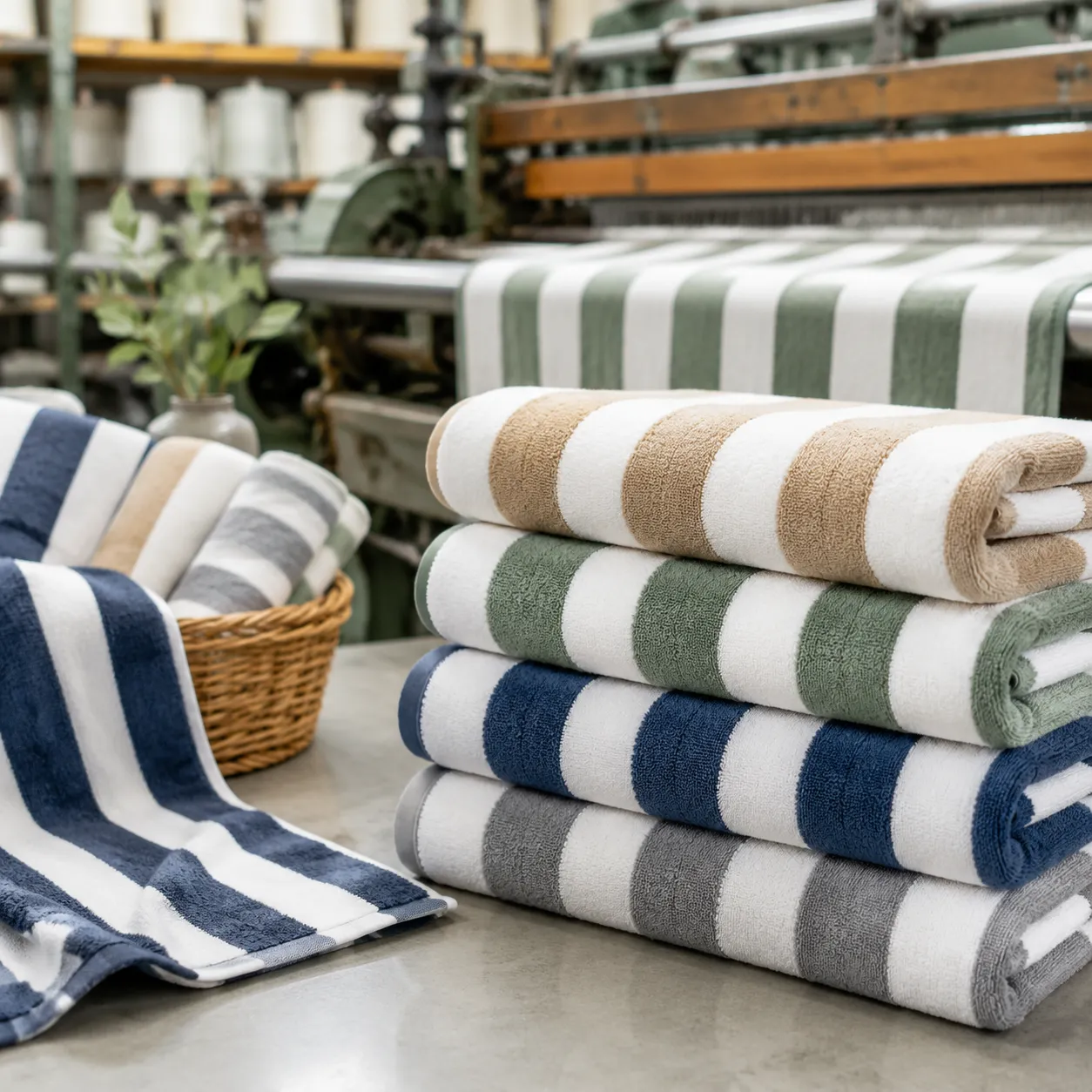
Why pool towels fail differently from room towels
Pool towels take a harsher route through the property than bath towels. They sit on wet loungers, pick up sunscreen oil, absorb chlorinated pool water, and are often collected in mesh carts while still damp. If the laundry team delays washing by 10-14 hours, residual chlorine and body oil keep reacting with the fiber. That is why we treat resort pool towels as a separate quality category, not as oversized bath towels in brighter colors.
In our mill, a typical hotel bath towel program may target 500-650 GSM with a softer terry feel. A resort pool towel usually needs 420-560 GSM depending on size and laundry capacity. The best spec is not always the heaviest one. A 650 GSM pool towel can overload dryers, trap sand, and increase mildew risk if the resort does not have enough circulation stock.
- Chlorine drag-in: guests bring pool water into the towel even before laundry chemicals touch it.
- Sunscreen residue: mineral sunscreen and tanning oil reduce absorbency and can leave yellow-grey patches after high-alkali washing.
- Outdoor UV exposure: cabanas and pool decks accelerate shade change, especially on turquoise, coral, black, and navy yarns.
- High handling rate: pool towels may be washed 160-240 times per year in a busy resort, compared with lower use in occasional guest-room rotation.
- Loss control pressure: missing towels push buyers toward lower-cost replacements, but very weak towels raise replacement frequency even faster.
A good durability program starts with the real use pattern. For a 280-room seaside resort with 760 loungers, we would normally calculate 3.5-4.2 pool towels per room equivalent, then test against the laundry formula that will actually be used on site. For broader linen planning, our beach club resort towel program and resort towel reorder playbook cover the inventory side.
Resort pool towel wash durability standard: our baseline
Our baseline resort pool towel wash durability standard is built around measurable change after repeated laundering, not a single pass/fail opinion. We check weight loss, dimensional change, border distortion, pile pull, color change, absorbency, and lint. For most resort buyers, we recommend a 25-cycle pre-bulk validation before the first PO and a 50-cycle control test for annual programs above 8,000 pieces.
| Test item | Factory baseline for pool towel programs | Why it matters |
|---|---|---|
| Wash cycles before approval | 25 cycles minimum; 50 cycles for repeat resort contracts | Catches early pile loss, border waviness, and shade movement |
| Dimensional change | Within -5% length and -4% width after 25 cycles | Controls shrinkage that makes folded stacks uneven |
| Weight loss | Under 7% after 25 cycles for cotton terry | Shows yarn integrity and lint risk |
| Color change | Grade 4 minimum on ISO 105-A02 grey scale after standard wash; grade 3-4 acceptable for very deep shades if approved | Protects resort branding and visible pool-deck presentation |
| Staining or cross staining | Grade 4 minimum on ISO 105-A03 for adjacent fabric | Important for striped and contrast-border towels |
| Absorbency after washing | Sink time under 8 seconds after 5 conditioning washes | Confirms softener, wax, or silicone finish is not blocking water uptake |
| Pile pull resistance | No loop ladders longer than 15 mm after tumble drying and manual inspection | Prevents snag growth on loungers, baskets, and deck furniture |
For lab reference we use methods aligned with ISO 6330 for domestic-style washing procedures, ISO 5077 for dimensional change, ISO 105-C06 for colorfastness to washing, and ISO 105-E03 when buyers want chlorinated water exposure evaluated separately. For commercial laundry simulation, we adjust the liquor ratio, alkali, peroxide, and drying heat to match the contracted laundry. This is one place where the purchase order must name the test condition, not only the towel size and GSM.
Our factory is OEKO-TEX Standard 100 Class I certified, BSCI audited, and ISO 9001 certified. These certifications do not replace wash testing. OEKO-TEX confirms restricted substance safety under its scope; ISO 9001 helps control process records; BSCI covers social compliance. Durability still depends on yarn, twist, dyeing, finishing, and the resort laundry formula.
The spec decisions that change wash life
The biggest mistake we see is treating GSM as the whole durability spec. GSM matters, but two towels at 500 GSM can perform very differently if one uses lower-twist open-end yarn and the other uses combed ring-spun yarn with a stable ground construction. For pool towels, the ground weave and border design often decide whether the towel stays square after repeated wash and tumble cycles.
| Spec line | Safer range for resort pool towels | Risk if pushed too far |
|---|---|---|
| GSM | 420-560 GSM for most pool-deck use; 580-620 GSM only where laundry capacity is strong | Too low feels thin; too high increases drying time and mildew risk |
| Yarn | 16s/1 or 21s/2 cotton terry; combed cotton for long-term resort contracts | Weak yarn sheds lint and produces flat pile after repeated alkali wash |
| Pile height | Medium pile, usually 4.5-6.5 mm before washing | Very tall loops snag on lounger hardware and wicker chairs |
| Border | Short dobby border or reinforced hem; avoid overly wide decorative borders | Wide borders shrink differently and create curling |
| Decoration | Yarn-dyed stripe, jacquard logo, or limited embroidery area | Large embroidery patches become stiff and may pucker after tumble drying |
| Color | White, sand, sky blue, mid blue, forest green, terracotta with tested dyes | Black, dark navy, and neon shades need tighter colorfastness control |
For a pool program, we usually push buyers toward 21s/2 ground yarn when the towel has a large size such as 90 × 170 cm or 100 × 180 cm. The two-ply yarn improves border stability. For smaller cabana towels around 80 × 160 cm, 16s/1 terry can still work if the ground is firm and the hem density is controlled.
- Use medium pile instead of plush pile when towels are dragged across textured pool decks.
- Keep jacquard logos below about 18-22% of towel surface unless the design is tested for absorbency loss.
- Avoid a very wide dobby border on oversized towels; it can bow after tumble heat.
- Ask the mill for pre-wash measurements at three points: left, center, and right, not only one corner-to-corner number.
- For striped towels, test the darkest yarn next to white pile for cross staining before approving bulk.
If your towel also serves as a beach towel, sand release becomes part of the decision. The construction guidance in beach towel GSM yarn spec sheet is useful, but pool towels often need tighter chlorine colorfastness than pure beach towels.
Laundry simulation: what we ask before quoting
We cannot build a reliable durability target without knowing the laundry process. Some resorts wash in-house with mild detergent at 60°C. Others send towels to an industrial laundry using high-alkali chemistry, peroxide, optical brightener, and extraction speeds that are harsher than the buyer expects. The same towel can pass 40 in-house cycles and fail in 18 outsourced cycles if the formula is too aggressive.
- Confirm whether towels are washed in-house or by a commercial laundry partner.
- Ask for the wash formula: temperature, detergent type, alkali, bleach, peroxide, souring step, and softener use.
- Confirm drying method and heat range; over-drying at high exhaust temperature causes brittle hems.
- Tell us the expected daily circulation: pieces issued, pieces washed, and pieces held in reserve.
- Send one used towel after 20-30 property washes if this is a replacement program; failure marks are better evidence than a written complaint.
For pool towel laundry testing, our sample room can run a controlled 25-cycle wash and tumble protocol in 9-12 days after yarn-dyed or piece-dyed samples are ready. If the buyer wants a third-party lab report, we usually add 5-8 working days depending on the test queue. SGS, Intertek, or BV reports are helpful when a hotel group has central procurement rules, but we still recommend keeping one washed sample set in the buyer's office for hand-feel comparison.
| Laundry condition | Typical resort setting | Factory recommendation |
|---|---|---|
| Mild in-house wash | 50-60°C, neutral detergent, low bleach | 430-500 GSM cotton terry can perform well if stock rotation is adequate |
| Standard commercial wash | 60-75°C, alkali detergent, oxygen bleach | 480-560 GSM, combed yarn preferred, 25-cycle validation required |
| Heavy stain program | 70-85°C, stronger alkali, periodic chlorine use | Avoid deep shades; specify white or pale yarn-dyed stripe and test ISO 105-E03 |
| Eco low-water system | Lower liquor ratio, concentrated chemistry | Check residue and absorbency after 5, 15, and 25 cycles |
| Fast-turn resort laundry | High extraction and hot tumble drying | Reinforce hem and avoid tall pile or wide decorative borders |
A wash durability standard also protects the laundry operator. If the towel is under-specified, the laundry team gets blamed for lint, curling, and shade loss. If the laundry process is too aggressive, the towel supplier gets blamed. Written test conditions reduce that argument before the first container ships.
Defects we reject before bulk shipment
Our QC team separates appearance defects from durability defects. A loose thread can be trimmed. A weak border cannot be trimmed into a strong one. During pre-shipment inspection, we pull samples from finished cartons and compare them against the approved sealed sample and the washed control sample. For larger orders, we use AQL inspection combined with targeted towel-specific checks.
- Border smile: the dobby border curves upward after washing, making stacks look uneven on pool shelves.
- Loop ladders: one pulled loop opens a line of pile because terry tension was unstable during weaving.
- Shade paneling: different dye lots appear acceptable under factory light but show bands in daylight on the pool deck.
- Harsh hand after drying: excessive resin or over-drying makes the towel feel crisp and lowers guest acceptance.
- Greying after test wash: oil and finishing residue are not fully removed, or the laundry formula is interacting with dye.
One construction quirk matters for striped pool towels: yarn-dyed stripes need balanced shrinkage between colored yarn and white pile. If the dyed yarn has a different twist level or finishing history, the stripe can tighten faster and create a ribbed surface after 15-20 washes. We catch this by measuring stripe width before washing and again after the 10th and 25th cycles.
Another pool-specific issue is hem edge abrasion. Towels that are repeatedly dragged from lounger clips or towel-return bins wear first at the folded hem corners. For resort towel quality control, we inspect hem density and seam bite after tumble drying, not only in greige or fresh-finished condition. Our export carton audit process is similar to the method described in beach towel carton packout freight audit, but pool towels get extra washed-sample review.
Cost impact of a real durability target
A proper durability standard adds cost, but the increase is usually smaller than the cost of early replacement. The main cost drivers are yarn grade, dye selection, GSM, size, wash testing, and whether the design requires yarn-dyed stripes or jacquard weaving. Our MOQ is 500 pieces per design per color, but resort pool programs usually become more efficient above 1,500 pieces because dyeing, weaving, and carton packing losses are spread across more units.
| Order volume | Typical FOB China price band | Common spec behind the band | Testing and sampling note |
|---|---|---|---|
| 500-999 pcs | USD 5.10-7.40 per pc | 80 × 160 cm, 430-500 GSM, solid color or simple stripe | Sample and 10-15 cycle internal check usually included; full 25-cycle test quoted separately |
| 1,000-2,999 pcs | USD 4.35-6.60 per pc | 80 × 160 or 90 × 170 cm, 460-540 GSM, yarn-dyed stripe or small jacquard logo | 25-cycle internal wash validation is practical before bulk |
| 3,000-7,999 pcs | USD 3.95-5.95 per pc | Standardized resort pool towel range with controlled GSM and carton packout | 50-cycle retention test recommended for annual reorder base |
| 8,000+ pcs | USD 3.55-5.40 per pc | Program order with repeat yarn, repeat dye lab dip, and scheduled shipment windows | Best level for third-party lab testing and sealed bulk standard sets |
Here is a realistic cost-per-use comparison from one recent pool-deck discussion. A buyer considered a 400 GSM towel at USD 3.85 and a 510 GSM combed-yarn towel at USD 5.05. Their laundry records showed about 175 washes per towel per year. If the cheaper towel starts failing at 55 washes, the textile cost is roughly 7.0 cents per use before freight and handling. If the stronger towel reaches 115 washes, the textile cost is about 4.4 cents per use. Even after adding around USD 0.18 per piece for extra validation and retained samples, the stronger towel is the lower operating cost.
We still push back when buyers request heavy, dark, oversized towels at the lowest possible price. A 100 × 180 cm black towel at 600 GSM with a large jacquard logo is a high-risk commercial laundry item. If the resort needs dramatic deck presentation, we would rather engineer a mid-tone yarn-dyed design at 520 GSM and prove it through 25-cycle washing.
Sample approval workflow for durability
A towel can look correct at pre-production sample stage and still fail once bulk fabric runs at speed. Our approval workflow keeps the buyer, mill, and laundry target aligned. We seal both an unwashed sample and a washed control. The unwashed sample protects color, size, label, and decoration approval. The washed sample protects real-life performance expectations.
- Build the tech pack with size, GSM tolerance, yarn, color reference, logo method, label, carton packout, and required wash test.
- Make lab dip or yarn-dyed strike-off first, especially for stripes, navy, teal, terracotta, or black.
- Produce pre-production samples and record weight, size, pile height, and border width before washing.
- Run the agreed wash cycle count and record dimensional change, shade change, lint, absorbency, and defects.
- Seal one unwashed and one washed sample for the buyer; keep matching retain samples at the mill.
- Start bulk only after written approval, then compare first bulk output against both retained standards.
For first-time resort programs, timing is usually 7-10 days for tech-pack confirmation and costing, 10-18 days for lab dip or yarn approval, 12-20 days for sample weaving and finishing, and 9-12 days for a 25-cycle internal wash check. Bulk production normally takes 30-45 days after deposit and final sample approval. If a third-party lab report is required, add 5-8 working days. Sea freight and customs timing depend on destination; for planning, see container vs air freight towel orders.
If your team is still building the PO document, build towel tech pack that mills can quote is the best starting point. For decoration choices that can affect durability, compare embroidery vs sublimation vs jacquard before locking the artwork.
How we set pass-fail rules on the PO
A purchase order should not say only “durable for hotel laundry.” That wording is too loose. We prefer line items that name the wash method, cycle count, tolerance, and inspection stage. The resort pool towel wash durability standard should sit inside the PO or technical data sheet so the production team and QC inspector have the same target.
- Size tolerance after wash: for example, final size within agreed range and shrinkage not exceeding the approved limit.
- GSM tolerance: commonly ±5% on finished bulk, measured after conditioning.
- Colorfastness: ISO 105-C06 grade 4 minimum for standard shades, with special agreement for dark colors.
- Chlorinated water exposure: ISO 105-E03 requested when the towel will be used directly around treated pools.
- Retained sample rule: bulk must match approved unwashed and washed standards under D65 light source.
- Carton marking: PO number, SKU, color, size, quantity, gross weight, net weight, and country of origin.
We also recommend defining what happens if bulk fails. For example, if dimensional change exceeds the approved limit but the towel is otherwise usable, the buyer may accept with a discount only if carton labeling is corrected and future production is adjusted. If color bleeding or major pile loss appears, we do not treat that as a discount issue; it is a structural failure that should be stopped before shipment.
For buyers comparing certifications, how to read OEKO-TEX certificate explains what the certificate does and does not cover. For GSM decisions outside the pool category, towel GSM decision framework gives a broader reference.
A practical standard for annual resort buying
For an annual resort contract, we suggest treating the first PO as the engineering order. Approve the construction, run the wash validation, record laundry feedback after 30-45 property days, then lock the spec for repeat orders. This is more disciplined than changing towel weight or yarn every season to chase a small FOB reduction.
Our operating baseline at LUMA & CO. TEXTILE is MOQ 500 pieces per design per color, with better pricing at 1,500 pieces and above. We produce about 2.4 million towels annually with a 220-person team, supplying brand and hospitality clients across 47 countries. For pool programs, we usually recommend ordering enough stock for opening inventory plus 8-12 weeks of loss and damage cover, then scheduling replenishment before peak occupancy.
Related reads: for pool-deck assortment planning, see pool deck towels bulk OEM spec and chair towels lounger pool deck guide. For broader resort towel sourcing, compare hotel towels wholesale supplier guide and beach towels in bulk buyers guide.
If you already have a towel failing in laundry, send us the used sample, the original spec if available, and the laundry formula. We can usually identify whether the problem is yarn, dye, finishing, hem construction, or chemical exposure after reviewing wash marks and testing a replacement construction.
Build a pool towel spec that survives laundry
Send your size, GSM target, color plan, laundry process, and annual quantity to [email protected] or WhatsApp +86 13205717266. We will quote with MOQ, sample timing, wash-test options, and FOB China price bands.
Request a durability quote →