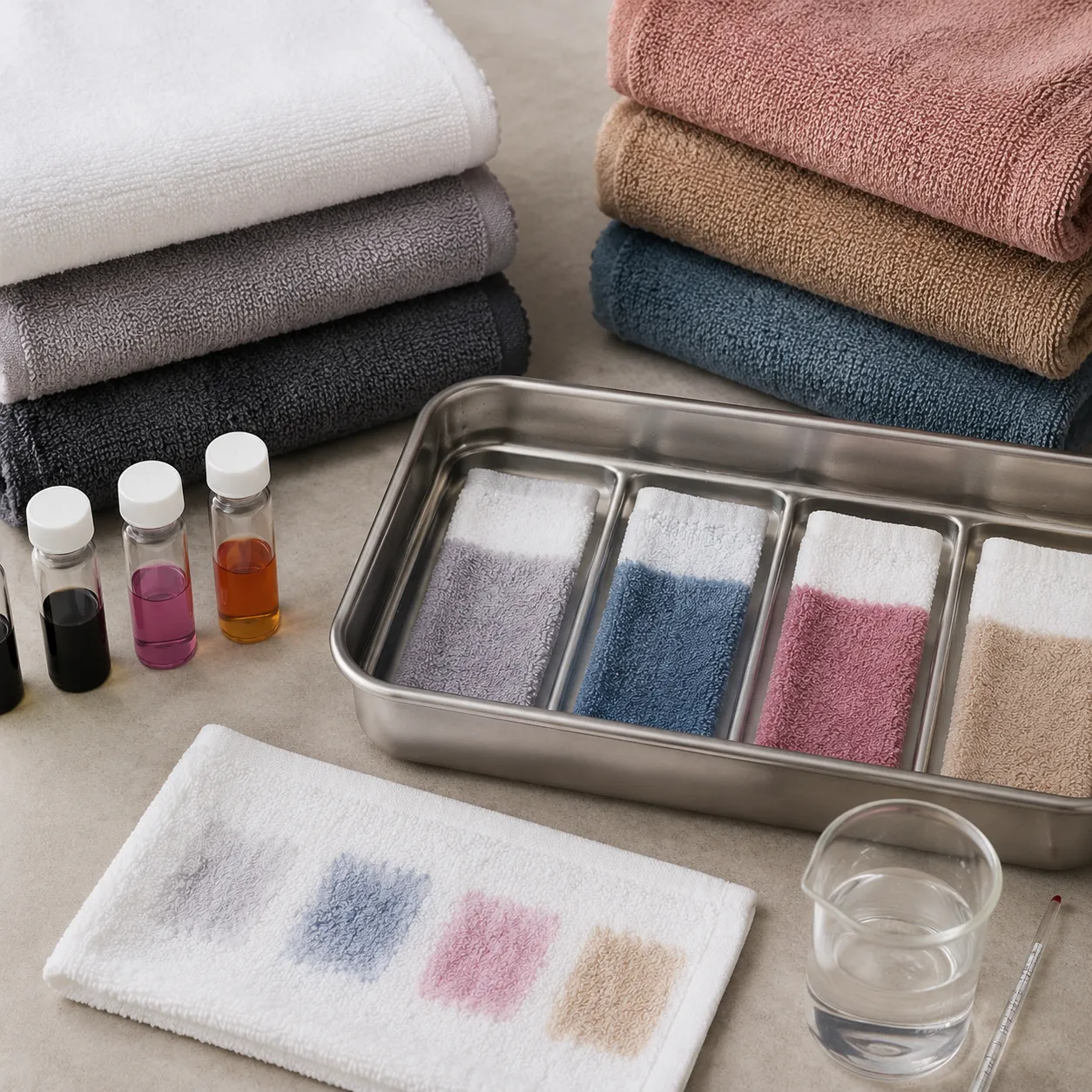
Where towel sets usually fail first
The weak point is rarely the logo. It is usually the body dye, the border yarn, or the sewing thread behaving differently under wet abrasion. On a four-piece set, one item can pass while the hand towel bleeds onto a pillowcase or bath mat, so we test the set as a system, not as a single SKU.
For a private label towel set colorfastness test protocol, we look at three failure modes early: shade loss after alkaline wash, dye transfer during wet rubbing, and edge darkening where dobby or hem threads are packed tighter than the pile field. That is why a tidy appearance at inspection is not enough.
- Loose reactive dye on cotton pile can show up as blue rinse water in the first two washes.
- Deep colors in 2/20 ring-spun yarn often hide migration until the fabric is folded wet.
- Decorative borders fail differently from the pile because the weave density is higher and detergent builds differently in the edge.
| Failure mode | Where we see it | What we test first |
|---|---|---|
| Shade loss | Body pile or border | AATCC 61 accelerated laundering |
| Rubbing transfer | Dark towels and heather shades | ISO 105-X12 dry and wet crocking |
| Wet bleed | Unfixed dye in seams and borders | ISO 105-C06 wash fastness with multi-fiber cloth |
| UV fade | Outdoor or spa display sets | ISO 105-B02 light exposure |
Build the protocol around use, not just lab labels
A hotel set, a spa set, and a retail gift set do not age in the same way. The test plan should mirror the buyer’s actual handling: institutional wash temperatures, tumble drying, stacked storage, and occasional exposure to sunlight near a pool or retail shelf.
For the private label towel set colorfastness test protocol, we usually separate the risk by component. The bath towel takes the most washing cycles, the hand towel sees the most skin contact, and the washcloth or face towel often shows first signs of crocking because it is rubbed hardest during daily use. If the set includes a jacquard border, that part gets its own visual grading line.
| Set component | Typical stress | Preferred check |
|---|---|---|
| Bath towel | Hot wash, tumble dry, fold storage | ISO 105-C06 and AATCC 61 |
| Hand towel | Wet hand transfer, daily rubbing | ISO 105-X12 wet crocking |
| Washcloth | Frequent detergent contact, body oils | Repeated wash cycles plus grayscale rating |
| Border/trim | Edge abrasion, shade contrast | Post-wash visual review under D65 light |
- Test the lightest shade and the darkest shade in the same lot; mixed color sets can fail asymmetrically.
- Keep one prewash control sample sealed so you can judge fade against the original shade.
- If the set has embroidery, check the thread after wash because polyester thread can stay bright while the cotton body dulls.
The lab sequence we ask mills to run
We do not treat all color tests as equal. First we want to know whether dye can leave the towel, then whether it can move onto another fabric, and only then whether the color still looks acceptable to a brand buyer under controlled light. That order saves time because a towel that bleeds badly does not need a longer aesthetic discussion.
- Cut swatches from the bulk lot and mark face, pile, border, and seam areas.
- Run wash fastness using ISO 105-C06 or AATCC 61, depending on customer standard and market.
- Check crocking with ISO 105-X12 on both dry and wet states.
- Grade staining on multi-fiber cloth and compare it to the grey scale.
- Inspect the washed specimen under D65 light against the approved shade standard.
For buyer-facing approval, we usually ask for a compact report with raw grades, not a vague pass/fail note. A report should show the test method, number of cycles, water temperature, detergent type, and the grading result on both the specimen and the adjacent multifiber strip. If the lab omits those details, we ask for a rerun.
| Test item | Common method | What we need on the report |
|---|---|---|
| Wash fastness | ISO 105-C06 / AATCC 61 | Cycles, temperature, detergent, grey scale grade |
| Crocking | ISO 105-X12 | Dry and wet results, staining grade, specimen photo |
| Light fastness | ISO 105-B02 | Hours, lamp type, blue wool reference |
| pH / residual chemistry | Internal or SGS-style check | pH range, after-wash rinse status |
A towel can look clean in a showroom and still be wrong in a laundry room. We trust the wash report more than the sample photo.
How we set acceptance grades without overpromising
Buyers often ask for a simple universal threshold. The issue is that a pale hotel white, a navy spa set, and a printed promo towel do not carry the same risk. We set acceptance by color depth, end use, and wash count, then tie it to a written approval sample.
A practical setup is to allow a slightly stricter grade for dark body colors and a lower-risk band for light neutrals. For example, a light beige set can sometimes live with a higher visual score after wash than a saturated charcoal set, because the charcoal will show shade lift and border contrast sooner. We do not push a one-size-fits-all number if the fabric construction is different.
| Color type | Wash fastness target | Wet crocking target | Buyer note |
|---|---|---|---|
| White / ivory | Grade 4 minimum | Grade 4 minimum | Focus on stain removal and optical brightness |
| Mid-tone colors | Grade 3.5 to 4 | Grade 3.5 minimum | Good for retail and mixed-use sets |
| Dark colors | Grade 3 minimum | Grade 3 minimum | Best checked with an approved wash trial |
| Two-tone sets | Each panel graded separately | Each panel graded separately | Border can fail before the pile |
If the buyer is running institutional laundry, we often specify a tougher internal target on the first lot because chlorine carryover, high-alkali detergent, and overdrying can punish the dye system. In that case, the supplier should quote a yarn-dyed or vat-dyed option, or the complaint rate usually arrives after the first turn of replenishment.
What the test costs at real order sizes
Testing is not the expensive part; fixing a bad color lot is. A lab screen for a set order typically sits inside the sampling budget, but the cost changes when we need extra wash cycles, lightfastness hours, or a second round after recipe correction. The numbers below reflect a realistic factory-to-lab workflow, not retail markups.
| Order size | Testing + sample cost | Indicative FOB range per set | Notes |
|---|---|---|---|
| 500 sets | USD 120-220 total | USD 7.80-11.40 | Higher setup pressure, fewer shade revisions |
| 1,500 sets | USD 160-280 total | USD 6.10-9.20 | Most common private label starting lot |
| 5,000 sets | USD 220-360 total | USD 5.20-7.80 | Better dye-house control and lower unit absorbency risk |
| 10,000+ sets | USD 300-450 total | USD 4.60-6.90 | Best leverage for fixed lab program and repeat shades |
These FOB bands assume a cotton terry set with normal embroidery or woven label finishing, not complex packaging or gift box work. A darker set may add a small dye-control premium, especially if the buyer wants a tighter shade band across bath, hand, and face pieces. That premium is usually cheaper than a chargeback or a warehouse return.
- For low-MOQ runs, expect more variation because the dye lot is small and recipe tuning is less efficient.
- For repeat orders, ask for the previous lab report and the retained swatch before approving production.
- If the supplier quotes a colorfastness test as free, confirm whether that includes reruns or only the first submission.
The production quirks that lab grades do not catch
Some issues only show up after bulk finishing. A towel can pass the standard wash test and still shadow through because the pile is packed too tightly at the shearing stage, leaving dye residue trapped in the base structure. Likewise, over-heat setting can shift the hand feel and make a dyed towel look flatter than the approved sample.
We also watch for three factory-side quirks that do not fit neatly into a lab summary. First, fixation quality can vary between machine heads if the dyer loads too much fabric at once. Second, sewing thread can wick dye from the body if the thread cone is stored in a damp room. Third, folded carton pressure can rub dark corners against each other during long transit, especially on high-GSM pieces.
- Retain a post-finishing swatch from each dye lot before the goods move to packing.
- Check pH after neutralization; excess alkali can keep bleeding alive during the first consumer wash.
- Watch border contrast after shearing because a sharper surface often exposes color shift more clearly.
What we request in the tech pack
A useful order file should tell the dye house exactly what to hold, not leave color performance to interpretation. If the buyer sends only Pantone references, the factory can still quote, but the approval loop gets longer. For a set, we need body color, border color, thread color, packaging color, and the intended wash environment.
This is where a tight tech pack protects margin. A navy hotel set that needs a 4.0 wet crocking result and repeated laundry at 60°C is not the same as a retail spa gift set that will be washed lightly at home. If those uses are mixed in one brief, the price will be wrong and the sample round will drag.
| Spec line | What to state | Why it matters |
|---|---|---|
| Color target | Pantone or approved lab dip code | Prevents shade drift between lots |
| Fabric content | Cotton, blend, or ring-spun construction | Different fibers hold dye differently |
| Wash condition | Temperature, detergent, cycle count | Defines the real fastness requirement |
| Decoration | Embroidery, woven label, jacquard border | Decoration can change color behavior |
| Acceptance record | Lab grade and visual standard | Stops disputes at bulk approval |
If you need help building that file, we already cover the structure in build-towel-tech-pack-that-mills-can-quote.html and the shade control side in pantone-color-matching-custom-towels.html.
Related reads
For buyers comparing materials and finishes, these guides are the next useful step: how-to-read-oeko-tex-certificate.html, towel-gsm-decision-framework.html, combed-vs-zero-twist-cotton-explained.html, custom-beach-towel-colorfastness-test-protocol.html, and salon-towels-wholesale-bleach-proof.html.
If the order also includes embroidery or a woven border, embroidery-vs-sublimation-vs-jacquard.html helps separate decoration risk from dye risk.
Production timing and approval flow
A clean schedule for a private label towel set usually runs faster than a repair cycle. Once colors are confirmed, lab dip approval takes about 3-5 days, weave or knit sampling needs 5-7 days, and the first testing round can be returned in another 2-4 days if the lab is local. Bulk production then depends on yarn booking and dye-house queue, but a normal order stays inside 28-40 days after sample sign-off.
If the first test fails, the timeline expands quickly because a corrected color needs a new dip, a second wash run, and sometimes a repeat at a different detergent concentration. We prefer to fix that at sample stage instead of discovering it after the packing line has already started.
- Approve color standards and retained swatches.
- Run lab dips and compare under D65 light.
- Test wash, crocking, and, when needed, lightfastness.
- Lock the bulk recipe and sign the pre-production record.
- Start bulk with retained control samples at the line and at packing.
For certification-sensitive programs, ask for OEKO-TEX STANDARD 100 Class I coverage if the towels will be used by infants, or Class II for general consumer and hospitality programs. That certificate does not replace colorfastness testing, but it reduces the chance that the dye recipe carries unexpected restricted substances.
Our mill is OEKO-TEX 100 Class I, BSCI, and ISO 9001 certified, with MOQ 500 pcs per design or per color. Typical private label towel set FOB pricing moves with construction and finish, but the range above is the correct starting point for realistic sourcing discussions, not a bait price. For larger repeat programs, we can hold shade and test records across reorders more consistently than on one-off runs.
Send your towel set spec for a color review
We can check the dye risk, suggest the right lab methods, and quote bulk with the testing steps included.
Request Quote →