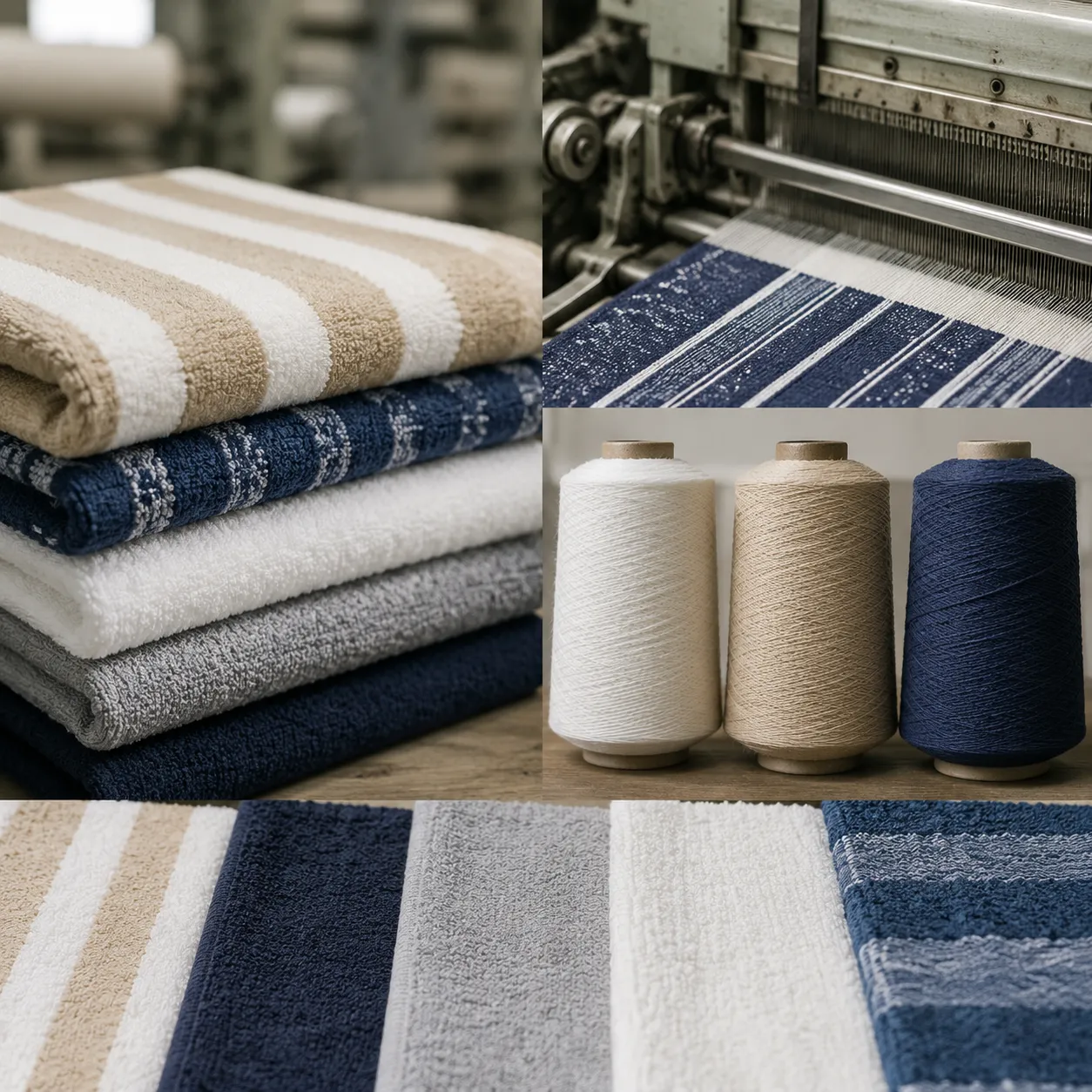
Start With the Use Case, Not the Scale Weight
Beach towels fail in different ways depending on where they are used. A retail towel that is folded on a shelf needs visual body and a clean face. A resort pool towel needs laundry survival and controlled shrinkage. A beach club towel may need a bolder jacquard logo, which changes the yarn requirement before we even discuss GSM.
In our mill, we treat beach towel GSM as one line in the specification, not the full specification. A 500 GSM towel made with loose open-end yarn can feel bulky in the carton but collapse after repeated drying. A 430 GSM towel made with 21s/2 ring spun cotton in a tighter terry setting can keep its shape better, even though the initial hand feel is not as fluffy.
| Buyer program | Typical size | Practical GSM range | Yarn direction we normally quote | Why it works |
|---|---|---|---|---|
| Retail beach towel | 76 × 152 cm | 380–480 GSM | 21s/1 or 21s/2 ring spun cotton | Good shelf fold, manageable freight weight, clear printed or jacquard face |
| Resort pool and beach issue | 80 × 160 cm | 450–560 GSM | 21s/2 ring spun or combed cotton loop | Handles daily wash cycles without becoming boardy too quickly |
| Luxury beach club towel | 90 × 170 cm | 520–650 GSM | 16s/1 or 21s/2 combed cotton loop | Heavier hand, stronger logo definition, higher perceived value |
| Promotional beach towel | 70 × 140 cm | 300–380 GSM | 32s/2 cotton-poly or 21s/1 cotton | Lower unit cost, short campaign life, lower carton cube |
| Turkish-style flat beach towel | 90 × 180 cm | 240–360 GSM | 20s–30s cotton warp/weft, low or no terry loop | Fast dry, compact packing, lower laundry load weight |
For a buyer building a towel program across multiple locations, we ask for the laundry method before yarn selection. A tunnel washer with high extraction, alkaline detergent, and tumble drying is harder on loop yarn than home laundering. If the towel is washed in commercial conditions three to five times per week, we usually move away from very soft single-ply yarns unless the buyer accepts higher replacement rates.
How We Build a Custom Beach Towel GSM and Yarn Spec Guide
A custom beach towel gsm and yarn spec guide should connect four numbers: size, GSM, yarn count, and construction density. If one number changes, the others move. Increasing GSM without adjusting pick density can create long loops that snag. Changing from 21s/2 to 16s/1 can improve bulk but may reduce surface smoothness for detailed printing.
The first factory calculation is simple: finished size multiplied by GSM gives the approximate finished towel weight. A 90 × 160 cm towel at 520 GSM has a fabric area of 1.44 square meters, so the finished towel weight is about 749 g before packaging. If the buyer orders 6,000 pieces, that spec creates roughly 4.49 metric tons of towel weight before cartons, polybags, moisture allowance, and palletization.
- Finished size: measure after washing tolerance, not just loom greige width.
- GSM: define finished GSM after pre-shrink and finishing, with tolerance such as ±5%.
- Ground yarn: controls body, dimensional stability, and whether the towel twists after washing.
- Pile yarn: controls softness, absorbency, loop height, and logo clarity.
- Weft density: affects edge stability and how cleanly the towel folds after tumble drying.
This is why buyers who only write “500 GSM cotton beach towel” in an RFQ receive prices that look inconsistent. One supplier may quote 21s/1 open-end cotton, another may quote 21s/2 ring spun cotton, and a third may include combed cotton pile. The GSM looks the same on paper, but the wash result and cost are not the same.
Yarn Count Decisions We Actually See in Production
Cotton yarn count is often misunderstood because a higher cotton count number means a finer yarn. A 32s yarn is finer than a 21s yarn. For beach towels, the useful range is usually 16s to 32s, depending on whether the buyer wants bulk, compact drying, or a smooth surface for decoration.
For terry towels, we look at both pile yarn and ground yarn. The pile yarn forms the loops that touch the skin. The ground yarn locks the structure. If the pile is soft but the ground is weak, the towel may skew or develop edge waves after laundering. If the ground is too tight, the towel can feel stiff even at a high GSM.
| Yarn option | Where we use it | Advantages | Watch-outs |
|---|---|---|---|
| 16s/1 cotton pile | Heavy beach club or pool towel | Bulkier hand and visible loop body | Can feel less refined; slower drying at high GSM |
| 21s/1 ring spun pile | Mid-weight retail towel | Balanced cost, softness, and absorbency | Less durable than 21s/2 for harsh laundry |
| 21s/2 ring spun pile | Resort towel and custom woven beach towels | Better loop strength and lower linting than single ply | Higher yarn cost and slightly firmer hand |
| 32s/2 cotton ground | Stable ground structure | Cleaner surface, better dimensional control | Not usually used alone for plush pile |
| Combed 21s/2 cotton pile | Higher-end resort beach towel specs | Lower short fiber content and smoother touch | Adds cost; needs realistic wash-care labeling |
Combing removes short fibers and neps before spinning. This improves smoothness and can reduce lint release, but it is not a magic fix for poor construction. We still run absorbency and lint checks because a combed cotton towel with excessive softener can absorb more slowly than a ring spun towel with a cleaner finish.
- For retail shelf feel, we often test 21s/1 ring spun cotton at 420–480 GSM.
- For commercial laundry, we prefer 21s/2 ring spun cotton at 470–560 GSM.
- For luxury beach club programs, we sample 16s/1 or combed 21s/2 cotton at 540–650 GSM.
- For fast-dry travel towels, we move toward flat weave or microfiber rather than forcing terry below 320 GSM.
The Construction Quirk: Loop Height Versus Lock-In
Two towels can have the same size, same GSM, and same yarn count, yet perform differently because of terry loop construction. Loop height is the visible pile length. Lock-in is how firmly that loop is held by the ground weave. If loop height is pushed too high to create a fluffy first touch, the towel may snag on deck chairs, bracelets, laundry cage edges, or embroidery backing.
On dobby and jacquard looms, we control this through pile-to-ground ratio, reed density, pick density, and finishing tension. A beach towel with large jacquard artwork may need slightly firmer pile lock than a plain dyed towel because the weave already shifts between high and low pile zones. If the pile is too loose, the logo area can show raised fuzz after five to eight washes.
One defect we reject during inline inspection is terry pull concentration. A single pulled loop is not unusual in bulk terry, but repeated pulls along the same stripe or logo boundary usually point to poor yarn tension or pile lock. For resort towels, we set an internal alert when more than 3 pieces in a 50-piece inspection stack show repeated loop pulls in the same construction zone.
| Construction choice | Best use | Typical GSM | Factory risk if overused |
|---|---|---|---|
| Low loop, tight ground | Promotional and compact beach towel | 300–400 GSM | Can feel flat and less absorbent |
| Medium loop, balanced ground | Retail and resort crossover towel | 420–540 GSM | Needs careful finishing to avoid stiffness |
| High loop, firm ground | Luxury resort or club towel | 540–650 GSM | Higher drying time and higher carton weight |
| Jacquard high-low pile | Logo or patterned beach towel | 450–620 GSM | Logo edges may fuzz if yarn tension is weak |
| Velour sheared face with terry back | Printed retail beach towel | 380–520 GSM | Shearing can expose weak yarn and increase lint if yarn quality is poor |
For velour beach towels, shearing removes the loop tips on one face to create a printable surface. The shearing blade setting matters. If the cut is too aggressive, we see pin-line streaks and fiber shedding. If the pile is too low before shearing, the print face looks thin after washing. This is a decoration-specific issue, so we coordinate yarn count with artwork before confirming the bulk fabric.
GSM Ranges That Make Sense by Buyer Type
The safest GSM range depends on who pays the laundry bill and who pays the freight bill. Buyers often ask us to quote a heavier towel because it feels better in the hand. We push back when the towel is going into high-volume laundering or air shipment, because each extra 60 GSM can add hundreds of kilograms across one order.
For example, moving an 80 × 160 cm towel from 460 GSM to 540 GSM adds about 102 g per piece. On 8,000 pieces, that is about 816 kg of additional towel weight before carton material. If the buyer ships by sea, the cost may be acceptable. If 1,200 pieces must be flown for a pre-opening hotel deadline, that weight increase can make the emergency freight more expensive than the yarn upgrade itself.
- Set the towel’s daily use pattern: retail occasional use, resort guest issue, club rental, or event giveaway.
- Calculate finished piece weight from size and GSM before comparing supplier prices.
- Choose pile yarn based on wash pressure, not just softness on the sample table.
- Confirm decoration method before fixing loop height or velour shearing.
- Run wash testing on the signed-off construction, not on a similar towel from stock.
A practical custom beach towel gsm and yarn spec guide should also state tolerances. We normally quote finished GSM tolerance at ±5%, size tolerance after washing at ±3%, and weight tolerance per piece at ±5% unless the design requires tighter control. Tighter tolerance is possible, but it increases sorting work and waste.
Testing: What We Check Before Bulk Approval
Beach towel testing is not complicated, but the test method must match the buyer’s risk. For absorbency, we use a drop test and can align to AATCC TM79 for absorbency of textiles when the buyer needs a named method. For dimensional change, we use ISO 6330 washing and drying procedures, then measure shrinkage after three to five cycles depending on the purchase order requirement.
For colorfastness, we commonly reference ISO 105-C06 for domestic and commercial laundering and ISO 105-X12 for rubbing. For beach towels with bright reactive dyes, we also discuss chlorine exposure, sunscreen staining, and saltwater rinse behavior. OEKO-TEX Standard 100 Class I is available for skin-contact safety, and we maintain BSCI and ISO 9001 systems for factory-level compliance and process control.
- Absorbency: target initial wet-out under 5 seconds for cotton terry unless a special finish is requested.
- Shrinkage: keep length and width change within 3–5% after ISO 6330 wash cycles for most resort programs.
- Colorfastness to washing: target grade 4 or better under ISO 105-C06 for solid dyed towels.
- Rubbing fastness: test dry and wet crocking under ISO 105-X12, especially for dark navy, red, and black.
- Lint observation: inspect dryer screen and towel surface after repeated tumble cycles, not only after the first wash.
We do not recommend approving bulk production from an unwashed hand sample. Finishing chemicals can make a sample feel smooth for one meeting, then wash out quickly. A buyer should approve the towel after a small laundry trial, especially when the program uses combed cotton, velour shearing, jacquard patterns, or dark reactive dye.
Pricing Bands and MOQ for Realistic RFQs
Our standard MOQ is 500 pieces per design per color. For yarn-dyed stripe or jacquard beach towels, MOQ can effectively rise because dyed yarn preparation and loom setup are less efficient at very small quantities. We will still discuss 500 pieces, but color splits such as 180 pieces navy, 160 pieces coral, and 160 pieces sage usually create avoidable cost.
The price bands below are realistic FOB China ranges for custom beach towel programs we would quote in 2026. They assume OEM production, normal export cartons, and buyer-supplied artwork or Pantone references. Final pricing changes with cotton market movement, yarn construction, dye method, decoration, packaging, and inspection level.
| Spec example | 500–999 pcs | 1,000–2,999 pcs | 3,000–7,999 pcs | 8,000+ pcs |
|---|---|---|---|---|
| 76 × 152 cm, 420 GSM, 21s/1 ring spun, reactive dyed | USD 4.15–5.10 | USD 3.62–4.38 | USD 3.28–3.96 | USD 3.02–3.70 |
| 80 × 160 cm, 500 GSM, 21s/2 ring spun, dobby border | USD 5.80–6.95 | USD 5.05–6.12 | USD 4.62–5.48 | USD 4.25–5.08 |
| 90 × 170 cm, 580 GSM, combed cotton, jacquard logo | USD 8.40–10.20 | USD 7.35–8.85 | USD 6.72–8.05 | USD 6.18–7.48 |
| 76 × 152 cm, 460 GSM, velour print face, terry back | USD 5.25–6.45 | USD 4.55–5.52 | USD 4.12–5.05 | USD 3.82–4.68 |
A cheaper towel can still be the correct towel if the use case is short. For a three-day surf event, a 340 GSM towel at USD 2.85–3.35 may be better than a 520 GSM towel at USD 5.10–6.00 because guests take it home and the brand values coverage over laundry life. For a beach resort washing each towel 90–130 times per year, the heavier and stronger yarn spec often wins on cost per guest stay.
As a rough operating example, suppose a resort buys a 470 GSM 80 × 160 cm towel at USD 4.55 and replaces it after 65 wash cycles. The towel cost is about 7.0 cents per wash before freight. If a 540 GSM 21s/2 towel costs USD 5.35 but lasts 105 wash cycles, the towel cost drops to about 5.1 cents per wash. That calculation is more useful than comparing first unit price only.
Sampling and Bulk Timeline We Recommend
For new development, we need a tech pack or a clear reference sample. If the buyer has no physical sample, we can still develop from size, GSM, yarn preference, decoration method, Pantone color, edge finish, label position, and packaging request. The more precise the yarn and GSM brief, the faster we can avoid unnecessary counter-samples.
- Day 1–2: confirm RFQ details, target GSM, yarn direction, size, artwork, and intended wash environment.
- Day 3–7: source yarn, lab dip solid colors, and prepare weave or jacquard setup plan.
- Day 8–14: make first sample or strike-off, including border and label position where applicable.
- Day 15–19: run internal wash, shrinkage, absorbency, and visual checks before sending samples.
- Day 20–28: buyer review, courier transit, comments, and any revised sample direction.
- Day 29–55: bulk weaving, dyeing, finishing, inspection, packing, and export documentation after deposit and approvals.
For repeat orders with no construction change, bulk production can often run in 25–38 days after deposit and material confirmation. For new jacquard artwork, yarn-dyed stripes, or velour print programs, 42–60 days is more realistic. Sea freight timing depends on destination port, but buyers should usually add 18–35 days for ocean transit and local clearance planning.
If you are building a broader beach or pool program, related reads that help the specification process include Beach Towels in Bulk: Buyer’s Guide, Beach Club Resort Towel Program, and Towel GSM Decision Framework. For size planning, we also recommend Towel Sizes and Dimensions Complete Guide.
RFQ Lines That Prevent Misquotes
The fastest way to receive comparable quotes is to specify the towel in lines, not paragraphs. A mill can price accurately when the RFQ separates yarn, GSM, construction, decoration, testing, packaging, and quantity. If any line is unknown, say “factory recommendation requested” rather than leaving it blank.
- Product: beach towel, finished size 80 × 160 cm, finished GSM 500 ±5%.
- Pile yarn: 21s/2 ring spun cotton; ground yarn: factory standard cotton ground unless otherwise proposed.
- Construction: terry both sides, medium loop height, dobby border 4 cm at both short ends.
- Color: reactive dyed Pantone reference, colorfastness to washing ISO 105-C06 grade 4 minimum.
- Testing: ISO 6330 shrinkage after five cycles, absorbency check, rubbing fastness ISO 105-X12.
- Packaging: one piece folded with belly band, 24 pieces per export carton, carton marks required.
- Quantity: 2,400 pieces in one color, MOQ acknowledged at 500 pieces per design per color.
For decoration-specific choices, buyers can compare Embroidery vs Sublimation vs Jacquard and Pantone Color Matching for Custom Towels. If the buying team is still building the document, Build a Towel Tech Pack That Mills Can Quote will save several rounds of clarification.
A custom beach towel gsm and yarn spec guide is useful only if it becomes part of the purchase order. The final PO should repeat the approved sample reference number, finished GSM, yarn construction, size tolerance, wash test standard, label artwork, packaging, carton quantity, and inspection level. Otherwise, a nice sample can become a loose instruction rather than a production control document.
Our Practical Recommendation for Most Buyers
For a first custom resort or retail beach towel program, we usually recommend starting with 80 × 160 cm at 460–520 GSM using 21s/2 ring spun cotton pile, reactive dyeing, and a controlled dobby or jacquard border. It gives enough hand feel for guests, stays within reasonable carton weight, and gives the laundry team a better chance than a soft but weak single-ply construction.
For buyers targeting a more elevated beach club towel, we sample 90 × 170 cm at 560–620 GSM with combed cotton or a carefully selected 16s/1 pile. We also ask whether the towel will be sold, rented, or issued with a deposit. That answer affects whether we prioritize softness, logo visibility, dry time, or replacement economics.
LUMA & CO. TEXTILE has operated since 2007 with a 220-person team, about 2.4 million towels annual output, and 80+ brand clients across 47 countries. We manufacture under OEKO-TEX Standard 100 Class I, BSCI, and ISO 9001 systems. For a quote, send size, GSM target, yarn preference, quantity, Pantone colors, and artwork to [email protected] or WhatsApp +86 13205717266.
Build a Beach Towel Spec We Can Quote
Send us your target size, GSM, yarn idea, artwork, and wash environment. We will return a practical OEM spec with MOQ, pricing band, and sampling timeline.
Request a Beach Towel Quote →