What breaks first around the pool
The weak point is rarely the base cotton itself. We see failures in the dyed border, the printed logo, and any yarn-dyed pattern that was not stabilized before finishing. Sun, chlorine splash, sunscreen, and frequent laundering act together, so a towel that passes a basic wash check can still lose tone at the deck stage.
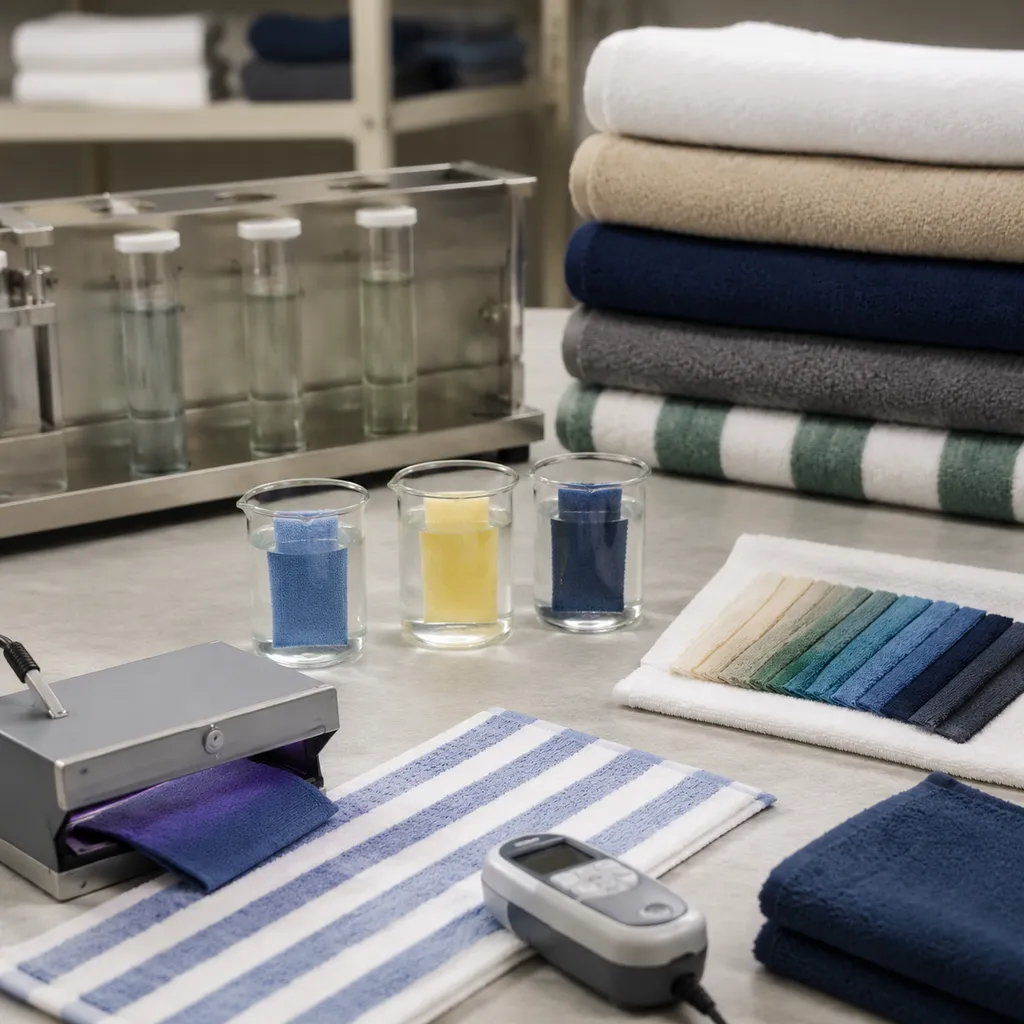
For resort programs, we treat the resort pool towel colorfastness test protocol as three separate checks: wet chlorine exposure, UV/light exposure, and repeated wash plus tumble cycles. If one of those is skipped, the buyer gets a lab report that looks good but does not reflect real use.
| Failure mode | How it shows up on property | Usually caused by |
|---|---|---|
| Border shade drop | Towels look washed out after a few pool cycles | Under-fixed reactive dye, poor after-wash rinse |
| Logo bleed | Color transfers onto white body or adjacent towel | Incorrect ink system, weak curing, poor print penetration |
| Edge mismatch | One side fades faster than the other | Uneven dyeing, heat-set variation, hem yarn inconsistency |
| Patchy fade | Random pale spots after washing | Oiling, scouring residue, unstable dye lot |
The core resort pool towel colorfastness test protocol
We do not run one test and call it done. For pool towels, the protocol should combine ISO 105-C06 for washing, ISO 105-X12 for crocking, and a light exposure method such as ISO 105-B02 or an equivalent xenon-arc test for UV fade. If the towel has a logo, we also check the decoration layer separately, because a stable body cloth can still hide a weak print or embroidery backing.
| Test item | Method | Pass target we use for resort orders |
|---|---|---|
| Wash fastness | ISO 105-C06 | Grade 4 or better on adjacent multifiber staining |
| Wet crocking | ISO 105-X12 | Grade 4 or better |
| Dry crocking | ISO 105-X12 | Grade 4 or better |
| Light fastness | ISO 105-B02 or xenon equivalent | At least Grade 4 for exposed colors |
| Chlorine splash simulation | Internal pool-chemical soak + rinse | No visible bleed, no shade jump over benchmark swatch |
That last line matters. Chlorine exposure is not captured well by a generic laundry test, so we build an internal soak using a controlled sodium hypochlorite dilution, then rinse and dry the towel before comparing it with the sealed reference swatch. We record the result under daylight and under D65 lighting, because some shades look acceptable in the lab and fail once they reach a bright pool deck.
- Test the towel body, border, and logo as separate components.
- Keep a sealed master swatch from the approved color lot.
- Compare wet, fully dried, and rewashed states before sign-off.
- Reject any sample that shows edge migration or haloing around decoration.
How we stage the lab sequence
Sequence matters. If you expose a towel to the wrong order, you can mask a defect. We usually start with incoming yarn or greige fabric checks, then run the dyed sample through wash fastness, crocking, and light exposure. Only after those pass do we push the sample into chlorine simulation, because a towel that already fails a standard wash has no reason to consume extra lab time.
- Confirm the color recipe, dye class, and finishing temperature on the lab dip.
- Wash the sample once to remove surface residue before any comparison.
- Run crocking on both face and pile side, dry and wet.
- Expose to light or xenon and compare against the control swatch.
- Apply the pool-chemical soak, rinse, dry, and inspect for shade shift or bleed.
For jacquard or border-heavy designs, we also check tension distortion after wetting. A tight border can pull differently from the pile ground, and that creates the illusion of color drift even when the dye is stable. That is why we photograph the sample flat, after wash, and after a 24-hour rest period.
| Stage | What we inspect | Why it matters |
|---|---|---|
| Incoming shade control | Lab dip vs sealed master | Prevents quote-stage color drift |
| Post-wash | Staining, shrinkage, edge distortion | Catches unstable dye or poor scouring |
| Post-light | Fade index under controlled illumination | Simulates sun exposure near pool decks |
| Post-chlorine | Bleed, halo, residue, tone loss | Replicates the real resort environment |
Lab thresholds that make sense for resorts
Not every buyer needs the same cutoff. A day-use club towel with a dark border can tolerate a slightly different target from a white towel with a bright accent stripe. For most resort programs, we recommend setting the spec at the order level rather than using a generic mill blanket standard.
| Program type | Typical towel spec | Colorfastness target |
|---|---|---|
| High-turn resort pool | 450-520 GSM ring-spun cotton | Grade 4 minimum on wash and crocking |
| Private beach club | 420-500 GSM with dark border | Grade 4-5 preferred on wash, Grade 4 wet crocking |
| Luxury cabana set | 500-560 GSM combed cotton | Grade 4-5 on all visible components |
| Promotion-heavy rollout | 380-450 GSM economy towel | Grade 4 minimum, limited color palette |
When buyers push for a brighter shade at a lower cost, the dye chemistry often becomes the hidden trade-off. A reactive dye system with tighter fixation and a better after-wash rinse costs more than a low-cost shade recipe, but the low-cost option is usually what prints or bleeds after the first laundry cycle. On a 1,200-piece resort order, the difference is often about USD 0.28 to 0.55 per towel depending on color depth and whether both border and logo are customized.
That extra spend is easier to justify when you measure replacement cost. If a towel is replaced after six turns instead of eighteen, the real cost per use rises faster than the purchase price suggests. The property pays for sorting, re-laundering, guest complaints, and emergency top-up freight, not just for fabric.
Specs we ask buyers to lock before bulk
The biggest QC mistake is approving color in the sample room without freezing the production recipe. Once bulk dyeing starts, changes to shade depth, softener type, or heat-set temperature can move the result. For resort programs, we ask buyers to lock the following items before the PO is released.
- Pantone or physical standard swatch for each visible color.
- Border width, logo size, and stitch or print method.
- Dye class and acceptable shade tolerance across the lot.
- Required test method and pass grade for each visible panel.
- Lot separation rules for body, border, and decoration yarns.
If your design uses embroidery, check the backing and thread separately. If it uses sublimation, the fabric base and ink cure profile matter more than the towel face. For jacquard, the weave pattern can hold color differently in the raised and recessed areas, so we compare the high-loop and low-loop zones under the same light source.
Related reads: resort pool towel factory audit checklist, beach towel colorfastness test protocol, how to read oeko-tex certificate, hotel bath towel colorfastness test protocol.
Buyer sign-off: sample, bulk, and retained control
We keep one approved sample for the buyer, one for production, and one retained in the lab. That retained sample is important because color disputes often happen after the first wash lot or after the resort changes detergent. Without a retained control, everyone argues from memory.
- Approve one signed lab dip and one sewn sample with the exact trim.
- Seal both with date, batch number, and the exact shade code.
- Require the first bulk lot to match the retained control under D65 lighting.
- Recheck the first 200-300 pieces before carton closing.
- Keep a wash record for at least the first three laundry cycles on property.
We also ask buyers to specify whether they want the main body, border, and logo released together or as separate acceptance gates. Separate gates are stricter, but they catch more problems. If the border passes and the print fails, you can still correct the decoration line without scrapping the whole towel lot.
| Approval point | Who signs | What gets archived |
|---|---|---|
| Lab dip | Buyer + mill merchandiser | Shade chip and recipe code |
| Pre-production sample | Buyer + QC | Photo set, dimensions, decoration position |
| First bulk lot | Buyer or agent | Retained towel and test report |
| Shipment release | QC manager | Final inspection and carton seal record |
MOQ, pricing, and lead time by volume
Colorfastness control affects cost, but it should not surprise the buyer late in the cycle. The extra lab work usually adds only a small amount to the towel, while the true cost driver is the dye stability required for the shade family. Dark navy, red, and saturated teal are the most expensive to hold stable on pool programs.
| Order size | Typical FOB China range per towel | Notes |
|---|---|---|
| 500-999 pcs | USD 4.60-6.20 | Higher setup cost, tighter shade sorting |
| 1,000-2,999 pcs | USD 3.70-5.10 | Best balance for custom resort programs |
| 3,000-9,999 pcs | USD 3.15-4.40 | Lower unit cost, more efficient dye lot control |
| 10,000+ pcs | USD 2.75-3.85 | Best for chain-wide seasonal rollout |
Our MOQ is 500 pcs per design per color. For multi-color pool programs, we usually quote by shade family rather than by towel shape, because that is how dye lots are actually managed on the floor. A plain white towel with a colored border is simpler than a full-color jacquard body, and the lead time reflects that.
| Stage | Typical days |
|---|---|
| Lab dip and shade approval | 5-7 days |
| Yarn or fabric dyeing | 7-12 days |
| Cut, sew, finish | 8-14 days |
| Colorfastness recheck and packing | 3-5 days |
| Total from PO to ship | 23-38 days |
If you are matching a fixed brand color, add a few days for correction rounds. If the order needs OEKO-TEX 100 Class I documentation, BSCI factory records, and ISO 9001 traceability on the same shipment, we prepare the paperwork in parallel so it does not extend the sewing window. Our mill has been operating since 2007, we run about 2.4M towels a year, and we supply 80+ brand clients across 47 countries, so the scheduling piece is usually about queue management rather than capability.
What certificates help, and what they do not prove
Certification is useful, but it is not a substitute for a pool-specific test. OEKO-TEX 100 Class I tells you the material inputs are controlled against harmful substances; it does not guarantee the towel will survive chlorine splash and repeated laundering at the resort. BSCI helps on social compliance, and ISO 9001 supports process control, but colorfastness still needs its own approval loop.
- Use OEKO-TEX for chemical safety and skin-contact confidence.
- Use ISO 9001 records to verify process traceability and corrective action.
- Use BSCI if the brand requires social compliance at factory level.
- Use a pool-specific color test for the actual use environment.
A certificate can tell you what the towel is made from. It will not tell you how it behaves after a week beside a chlorinated pool.
If a supplier promises that certification alone covers the whole risk, we push back. The better approach is to pair the certificate file with a real exposure protocol. That gives the buyer a clean paper trail and a practical QC decision, especially when procurement, housekeeping, and brand merchandising all need to sign off.
Common defects and how we block them
Three defects show up again and again in resort pool work. The first is border bleed from insufficient fixation. The second is light fade on one side of the towel when the finishing flow is uneven. The third is a print that looks clean at delivery but cracks or halos after the first hot wash.
- Border bleed: increase fixation time and rinse-out control.
- Uneven fade: check heat-setting and drying tunnel tension.
- Print halo: verify ink cure and keep the first wash gentle.
- Shade drift between lots: maintain a sealed master and a lot log.
One practical detail many buyers miss is seam adjacency. If the hem thread and border yarn are dyed in separate runs, the towel can look mismatched after washing even when each component is technically within tolerance. That is why we photograph the hem corner, not just the towel face.
Related reads: beach towels in bulk buyers guide, hotel towel sourcing guide 2026, towel gsm decision framework, building hotel towels brand specs, evaluate hotel towel manufacturers oem.
What we need from a buyer to quote correctly
If you send us a clear color brief, we can tell you quickly whether the towel should stay in cotton, move to a darker border, or switch decoration method. The best RFQ includes the cloth spec, decoration method, target use area, and the test standard you want us to apply before shipment.
- Target size and GSM.
- Body color, border color, and Pantone reference.
- Logo method: embroidery, print, jacquard, or none.
- Expected wash count and laundry chemistry if known.
- Requested test standard and acceptance grade.
When the brief is complete, we usually quote faster and with fewer shade revisions. When it is incomplete, the hidden risk is not the sewing line; it is the post-approval color argument that appears after the first laundry cycle. That is the argument this protocol is meant to prevent.
Request a pool towel test quote
Send your target shade, size, and volume. We will map the colorfastness checks, lead time, and bulk price before sampling starts. WhatsApp +86 13205717266 or email [email protected].
Get a Quote →