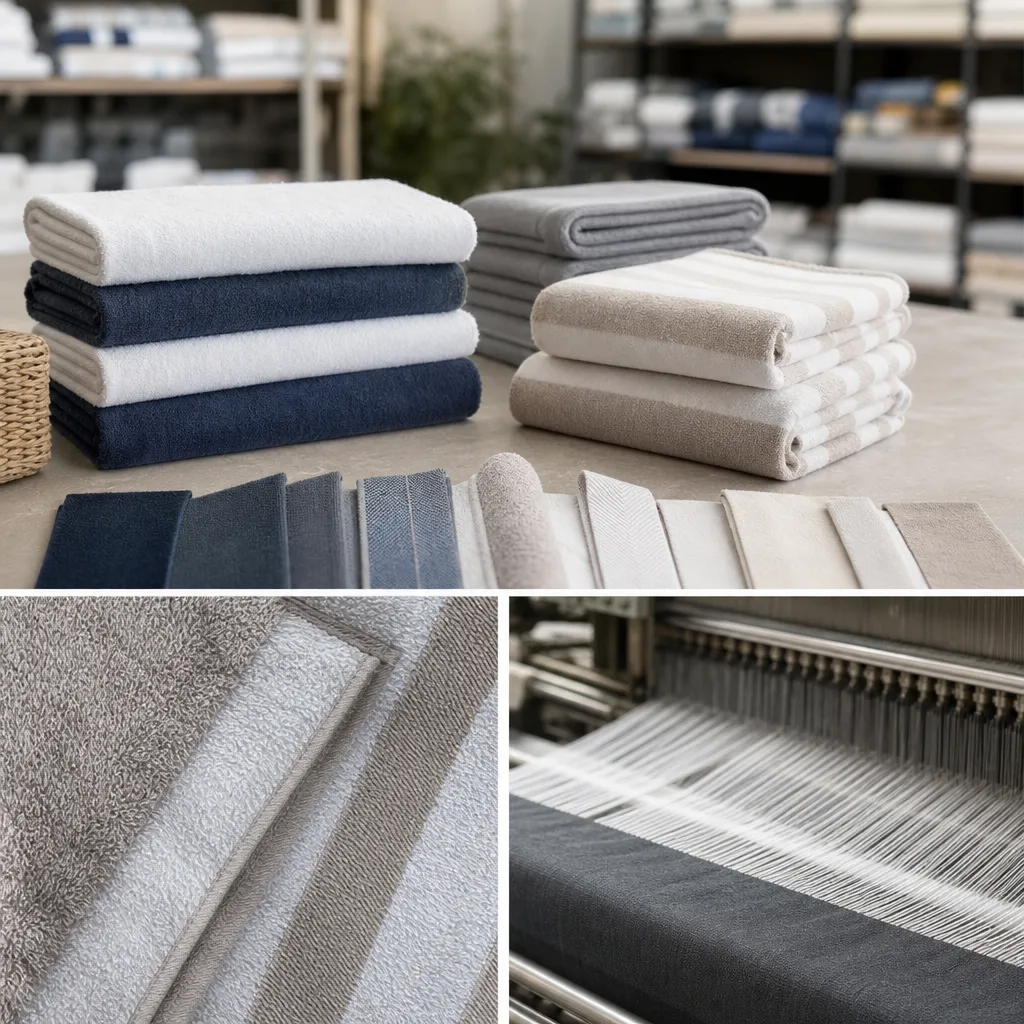
Why second-order towels fail in resorts
The first carton usually looks fine because everyone is looking at the same sample, in the same room, before service starts. The second carton is where the gaps appear: the sand color reads greener under lobby lighting, the border shrinks more than the body after washing, or the pool towels start snagging on lounger edges because the pile finish changed. That is why resort towel restock planning is more about repeat control than about finding a cheaper mill.
| What slips | How it shows up | Why it happens | Fix |
|---|---|---|---|
| Shade drift | The second shipment looks greener, duller, or warmer than the first | Different dyelot, altered softener, or a rinse change after approval | Retain a physical shade swatch and approve under D65 and warm lobby light |
| Handfeel change | Guests say it feels lighter, rougher, or less absorbent | GSM moved outside tolerance or yarn twist changed | Lock yarn count, pile height, and GSM before the repeat |
| Border distortion | Dobby border waves, logo shifts, or hem curls after wash | Border density and finishing heat were not repeated | Wash the first approved sample three times before final lock |
| Loop pulls | Snags from carts, loungers, or rough handling at the pool deck | Loose pile, weak sewing, or over-soft finishing | Tighten shearing and inspect under close light before packing |
A reorder is not a new product launch. It is a repeat of the same construction, finish, and pack-out, with fewer surprises. If the first buy did not leave behind a clear reference file, the next purchase becomes a guess, and guesswork is expensive in hospitality.
Low MOQ Towels Resort Reorder Plan
The practical floor is still 500 pcs per design/color, but the real discipline is deciding what gets frozen after the first approval. Once those points are locked, low moq towels resort reorder plan work stops being a sourcing exercise and becomes inventory control.
- Keep one sealed master sample for every SKU and color.
- Record yarn count, pile height, finished GSM, hem width, and border spec.
- Save the approved shade swatch and the final lab dip code.
- Hold the carton artwork, barcode, and destination label version used on the first run.
- Reorder before cover falls below the peak-week forecast, not after the storeroom looks thin.
For resorts, the best reorder plan treats pool, spa, and villa towels as separate inventory streams. Pool towel replacement is usually the fastest because stain load and guest turnover are high. Spa and guest-room towels move slower, but shade continuity matters more because they sit closer to the guest's face and hands.
Build the reorder point from usage, not hope
The cleanest way to set the trigger is to work backward from actual use. A 160-key property at 68% occupancy does not consume towels evenly across the month; it burns harder on weekends, event dates, and check-in waves. If the reorder point is based on annual average only, the property can look comfortable on paper and short on the busiest three days of the week.
| Towel group | Safe cover | Trigger to reorder | Why it matters |
|---|---|---|---|
| Bath towels | 8-10 weeks | When on-hand falls below 10-12 weeks of forecast use | Bulky, but easier to keep consistent if ordered before peak |
| Pool towels | 5-6 weeks | When cover slips under 7 weeks | Loss and stain rates rise fast in high season |
| Spa hand towels | 6-8 weeks | When cover slips under 9 weeks | Color match matters more than absolute weight |
| Cabana or lounger towels | 4-5 weeks | When cover slips under 6 weeks | Seasonal spikes and guest movement can empty bins fast |
If the resort is running a mixed program, the reorder point should also reflect the towel's job. A 500 GSM spa hand towel and a 600 GSM bath towel may look similar in a photo, but they do not behave the same in laundry, folding, or freight. The ordering rhythm should match the piece that turns fastest, not the piece that looks most expensive.
Keep shade and handfeel stable across reorders
This is where repeat business succeeds or fails. The second lot must match the first lot under real resort lighting, not just in a sample room. For that reason, we keep the shade standard, the finish recipe, and the wash test record together. OEKO-TEX 100 Class I, BSCI, and ISO 9001 are useful filters, but they do not replace repeat control; they only make traceability easier when a lot needs to be explained.
A reorder is not a new purchase. It is a promise to make the next carton look like the first one.
| Control point | What to check | Useful method | Why it catches problems early |
|---|---|---|---|
| Color | Match against the retained swatch in daylight and warm indoor light | D65 viewing and approved lab dip reference | Shows shade drift before the shipment reaches the resort |
| Shrinkage | Finished size after wash and dry | ISO 6330 wash cycle with measured before-and-after dimensions | Prevents border wave and pack-count surprises |
| Colorfastness | Pool towels exposed to repeated laundering and sanitizer residue | AATCC 61 and a rinse check after the fifth wash | Catches weak dye fixation before guest use |
| Surface quality | Loose loops, sheared pile, and hem density | Close-light visual check and hand-rub inspection | Finds snag risk and finish inconsistency |
Two defect modes come up again and again on resort reorders. One is barre, where faint stripes appear after dyeing because yarn lots were mixed too aggressively. The other is hem pucker, usually caused by finishing heat or thread tension that changed between runs. Neither problem is glamorous, but both are easy to prevent if the repeat file keeps the yarn lot, dye lot, and hem spec visible.
What low MOQ changes in pricing
Low minimums help a resort test a new color or open a new season without tying up cash. They do not erase setup cost. The cleanest pricing comes when the same color repeat is reissued inside the same dye family, because the mill can reuse more of the previous setup. If the shade changes, or the border gets wider, the quote moves quickly.
| Order size | Spec example | FOB China / unit | What changes the price |
|---|---|---|---|
| 500 pcs | 500 GSM ring-spun cotton pool towel, one-color border, standard hem | $4.85-$6.20 | Lab dip setup, shorter runs, tighter color control |
| 1000 pcs | 550 GSM combed cotton bath towel, dobby border, woven label | $4.15-$5.45 | Better loom efficiency and lower setup cost per piece |
| 3000 pcs | 600 GSM combed cotton bath towel, same color repeat, embroidered logo | $3.55-$4.70 | Repeat lots usually save on setup and finishing |
As a cost-per-use check, a 550 GSM towel that lands at $5.10 and stays in service for 110 wash cycles costs about 4.6 cents per use. A cheaper towel at $4.30 that looks fine for 70 cycles costs about 6.1 cents per use. That gap is not theory; it shows up in laundry, replacement, and guest perception.
If the resort wants the next reorder to stay inside budget, the safest lever is color continuity, not chasing the lowest FOB number. A stable repeat with the same yarn count and finish is usually cheaper over a season than a bargain lot that forces early replacement.
Timeline from approved sample to packed cartons
A low moq towels resort reorder plan works only when the calendar is honest. If the PO lands late, the factory cannot compress every step without risking shade drift or weak finishing. For a simple repeat order, the usual path is tight but manageable.
- Day 1-2: confirm PO, retained shade swatch, carton copy, and delivery window.
- Day 3-5: lab dip approval, greige check, and loom slot reservation.
- Day 6-14: weaving, dyeing, shearing, hemming, and finishing.
- Day 15-19: final wash test, metal detection, packing, and carton count.
- Day 20-24: export documents and handoff to the forwarder.
If the reorder adds new embroidery, a different border width, or a fresh color, budget 28-36 days instead of 20-24. Air freight can rescue the last few days, but it cannot rescue a late approval or a missing shade swatch. The more stable the repeat file, the less the schedule depends on heroics.
The reorder file should travel with every PO
The smallest file often prevents the biggest delay. When a resort sends a repeat order without a clear record, the mill has to guess which version was actually approved. The better habit is to attach the same file every time, even if the order is small.
- One sealed master sample labeled with date, lot, and wash count.
- A daylight photo and a warm-light photo of the approved color.
- Finished size, GSM, and hem width after wash.
- Shade swatch or lab dip code tied to the production lot.
- Carton marks, pack count, and destination label copy.
- A short issue log for any prior snagging, shrinkage, or border shift.
That file also supports traceability under ISO 9001 and makes OEKO-TEX paperwork easier to match to the correct lot. For buyers who need a second opinion on certificate reading, the lot number on the towel should always match the lot number on the test file, not just the shipment paperwork.
Related reads: Setting up a hotel linen program in 90 days, How to read an OEKO-TEX certificate, and Container vs air freight towel orders.
For SKU control and negotiation context, see How to build a towel tech pack mills can quote, Negotiate towel MOQ without killing margin, and Hotel towel sourcing guide 2026.
Send the repeat file for a quote
If the next resort reorder needs matching shade, timing, and pack labels, send the current specs by WhatsApp +86 13384590853 or email [email protected] and we will quote the repeat run from the same reference.
Request a Quote →