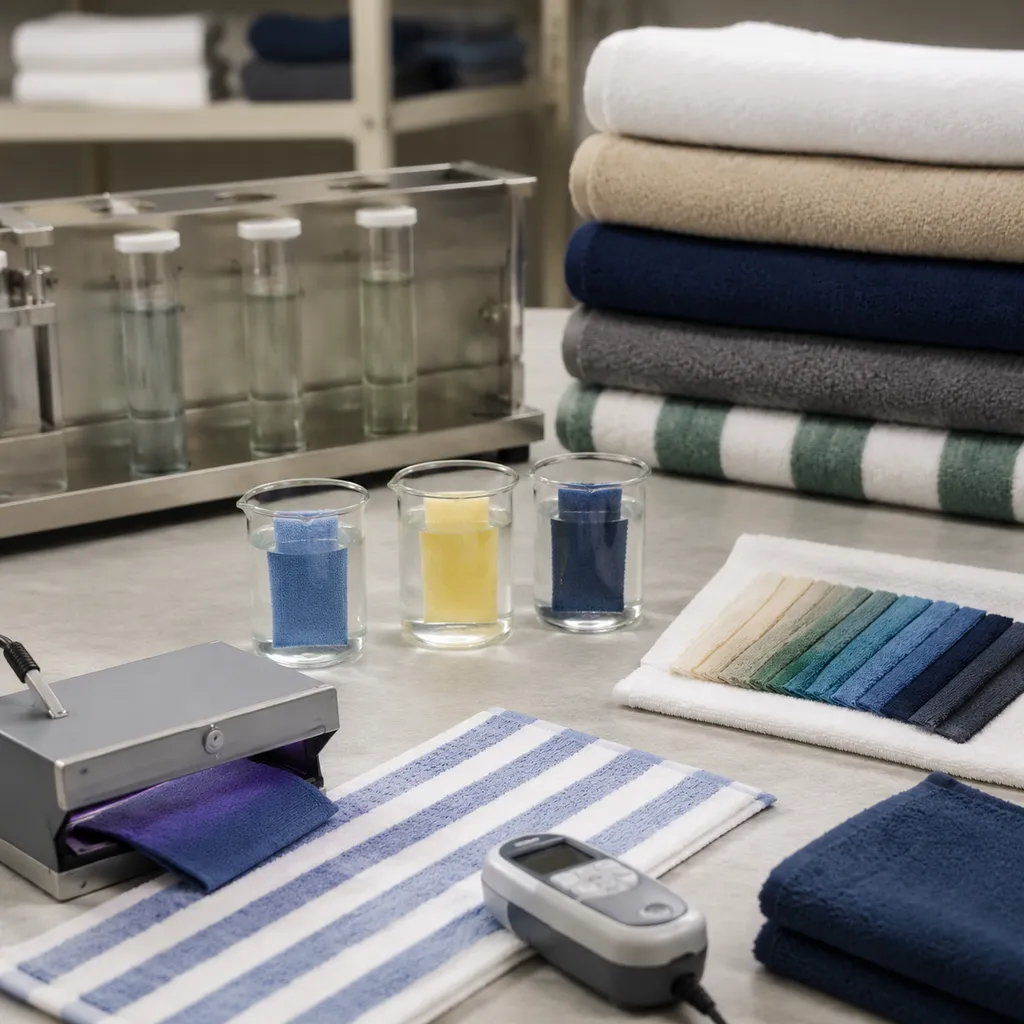
Start with the failure modes that matter on travel towels
For this product, the most expensive complaints usually do not come from catastrophic defects. They come from small inconsistencies that show up only after the customer unpacks the towel on a trip: uneven shape after first wash, low absorbency on the first use because finishing oil was not fully cleared, logo print offset by 6-8 mm, or a storage pouch that fits one fold method but not another. A bath towel inspection plan misses these points. A travel towel is lighter, usually microfiber or microfiber-blend, often 200-320 GSM, and commonly packed with elastic straps, snap loops, or mesh bags that create extra inspection gates.
- Appearance defects: streaky dyeing, print ghosting, needle lines on hems, loose overlock tails
- Functional defects: weak water uptake, slow release from cutting finish, poor loop or snap attachment strength
- Dimensional defects: undersized cut panels, bowing after heat setting, pouch mismatch to finished fold size
- Packout defects: wrong barcode sticker, mixed pouch color, carton quantity variance, silica gel missing where required by buyer spec
Our default recommendation is an inline check during sewing plus a final random inspection at 80% packed quantity. If you wait until the full lot is sealed, rework becomes slower because every correction requires carton reopen, recount, and repack.
What we inspect first in quick dry travel towel qc inspection before shipment
We start with construction confirmation against the approved sample and tech pack. Travel towels are often quoted too loosely as "microfiber suede" or "waffle microfiber," but inspection must verify the exact build. A 230 GSM warp-knit suede towel behaves very differently from a 280 GSM waffle with border binding. The inspection table should include the sealed approval sample, Pantone signoff if printed, pouch artwork, barcode sheet, carton marks, and packing method photo.
| Inspection point | What we verify | Typical tolerance |
|---|---|---|
| Finished size | Length and width after normal conditioning | ±3% or buyer-specific |
| Fabric weight | GSM from conditioned swatch | ±5% |
| Logo placement | Distance from edge or corner | ±4 mm |
| Hem or binding width | Consistency around perimeter | ±2 mm |
| Pouch fit | Towel fits approved fold method | No force packing |
| Carton count | Units per export carton | 0 shortage allowed |
On microfiber travel towels, one topic-specific checkpoint we insist on is nap direction consistency. On brushed suede styles, shade can look darker or lighter depending on pile lay. If inspection happens under weak warehouse light, inspectors sometimes miss side-to-side tone difference that becomes obvious in retail photos. We also check laser-cut or hot-knife edge sealing on ultralight styles because incomplete sealing can create edge fuzz after only a few uses.
Sampling plan, AQL level, and lot staging
For most export orders, we use ANSI/ASQ Z1.4 single sampling, normal inspection, with AQL 2.5 for major defects and 4.0 for minor defects unless the buyer gives a stricter protocol. Travel towel orders often run 3,000 to 18,000 pieces per design, so the sample size is manageable, but staging matters. Do not pull all samples from the top three cartons near the packing line. Pull across early, middle, and late production cartons because GSM drift and print registration issues often cluster by time block.
- Confirm lot quantity packed and segregated by PO, color, and size.
- Select cartons across at least three pallet positions and more than one production hour.
- Open samples from both the top and middle of cartons to catch compression marks and folding variation.
- Record defect count by defect code, not just pass or fail, so rework teams know what to target.
| Lot size | Common inspection level | Sample size code | Units checked |
|---|---|---|---|
| 1,201-3,200 | General II | K | 125 |
| 3,201-10,000 | General II | L | 200 |
| 10,001-35,000 | General II | M | 315 |
If the order includes a bundled bottle clip, carabiner, or printed pouch insert, we usually treat those as integrated components, not accessories outside scope. Otherwise a visually acceptable towel lot can still fail at retail due to missing bundled parts.
Fabric and performance checks that catch hidden problems
A proper pre shipment towel inspection for travel styles needs at least a few quick functional checks on top of visual grading. We are not doing a full lab certification round at this stage, but we can still screen for bulk risk. The biggest hidden issue is residual finish. Some quick-dry towels receive a softening or handfeel treatment that improves first impression yet suppresses absorbency if overdosed.
- GSM check: cut a measured swatch after conditioning and compare to approved construction.
- Absorbency screen: simple timed water drop or short immersion release comparison against the sealed sample.
- Drying behavior comparison: hang two units in the same room after controlled wetting and compare time band, not exact scientific dry point.
- Color rub check: quick crocking screen on dark colors, especially navy, black, teal, and saturated red prints.
For lab-backed methods, we commonly reference AATCC 79 for absorbency and ISO 105-X12 for color fastness to rubbing when a buyer asks us to align screening to a known standard. Another travel-towel-specific checkpoint is sandwich-layer delamination on double-layer printed microfiber. If the towel uses a printed face laminated or joined to a backing layer, inspect corner peel and edge stability after light tension. This does not belong in a cotton bath towel checklist, but it matters here.
| Test or screen | Why it matters | Typical release rule |
|---|---|---|
| GSM verification | Confirms fabric weight consistency | Within agreed tolerance |
| Absorbency screen | Flags excess finish or yarn issue | Comparable to approval sample |
| Dry-rub check | Protects adjacent apparel in travel use | No heavy transfer |
| Seam strength pull | Prevents pouch or loop failure | No seam burst in hand pull screen |
Visual defects that should be classified as major
Some buyers classify too many issues as minor, then wonder why returns climb. On quick-dry microfiber, a defect that affects fold appearance or travel function should usually be treated as major. For example, a corner that rolls because binding tension is uneven may still pass a loose aesthetic review, but it photographs badly and frustrates users trying to repack into the pouch.
- Wrong size beyond tolerance or obvious shape distortion
- Logo missing, upside down, mirrored, or offset beyond placement tolerance
- Visible stain, oil mark, or heat shine in main presentation area
- Broken stitch line, skipped stitches, open seam, detached hang loop, or loose snap
- Pouch unable to accept folded towel per approved packing method
- Barcode, care label, or country-of-origin labeling incorrect for market requirement
A common micro-defect on travel towels is tracking marks from tenter clips or finishing tension, especially on very light shades. These can look like faint vertical lanes. If visible at normal viewing distance, we count them as major because the end user reads them as dirty or used fabric.
Measurements, sewing quality, and accessory attachment
This is where many lots drift. Travel towel panels are lightweight, so cutting stack height and heat-setting stability matter more than buyers expect. A panel cut slightly narrow before edge finishing can end up 2.5 cm short after binding draw-in. That is enough to trigger fit problems in a branded pouch program.
| Spec item | Commercial range we often see | Inspection note |
|---|---|---|
| Finished GSM | 200-320 GSM | Below 220 GSM needs tighter skew control |
| Size | 40x80 cm to 80x160 cm | Measure laid flat without stretching |
| Edge finish | Overlock, turned hem, or binding | Check tension and waviness |
| Accessory | Elastic band, snap loop, mesh pouch | Match color and attachment security |
On sewing quality, we look for seam slippage at pouch side seams, needle heating marks on synthetic-rich fabric, and untrimmed thread tails longer than 5 mm in presentation zones. If a mesh carry pouch is included, we test drawcord lock movement and make sure the towel can be inserted without excessive compression. For travel retail, that unboxing moment matters as much as the towel itself.
Related reads: if you are still locking the product spec, start with build-towel-tech-pack-that-mills-can-quote, compare material behavior in microfiber-vs-cotton-towel-comparison, and review decoration trade-offs in embroidery-vs-sublimation-vs-jacquard.
Packaging checks are part of the inspection, not an afterthought
A large share of shipment disputes on travel towels comes from packaging, especially on ecommerce-ready packs. The fabric may be fine, but if the barcode label is placed over the logo window, the fold method is inconsistent, or the pouch artwork is mixed by language version, the lot still creates downstream cost.
- Verify unit folding method against approved pack photo.
- Check polybag gauge or pouch material if specified in the PO.
- Confirm insert card language, barcode, and SKU mapping by colorway.
- Count inner packs and master cartons physically, not by carton stamp only.
- Review carton drop condition, tape seal quality, and shipping marks.
For export cartons we usually target gross carton weight that handlers can manage consistently, often under 16 kg for smaller travel towel programs and up to around 19 kg for larger packed units. Carton dimensions also affect freight efficiency. A loosely packed 5,000-piece order can add noticeable cubic volume cost even when the FOB unit price looks attractive.
Related reads: for freight planning, see container-vs-air-freight-towel-orders and for MOQ structure on custom programs, negotiate-towel-moq-without-killing-margin. If your program sits close to the outdoor or beach crossover segment, quick-dry-microfiber-beach-towel-sourcing is also useful.
Lead times, inspection timing, and realistic price bands
Inspection quality is partly a scheduling problem. If the inspector arrives before 80% of goods are packed, the sample does not represent the lot. If the inspector arrives after the forwarder booking cutoff, everyone becomes tempted to waive defects. For most custom travel towel orders, we plan the critical path backward from ETD.
| Order type | MOQ | FOB China price band | Typical production time |
|---|---|---|---|
| Solid dyed microfiber suede towel | 500 pcs per design per color | USD 1.18-1.72 | 18-24 days |
| Printed towel with mesh pouch | 1,000 pcs per design | USD 1.86-2.68 | 22-30 days |
| Large-format travel towel with elastic strap | 1,000 pcs per design | USD 2.35-3.40 | 26-34 days |
Those bands assume standard export packing, OEKO-TEX compliant raw materials, and no unusual retail fixture packaging. A third-party final inspection in China is a small cost relative to chargebacks. On a 6,000-piece lot priced at USD 2.14 each, even a 4% repacking issue can burn more money than the inspection fee once relabeling, storage, and customer service time are counted.
- Lab dip or print strike-off approval: 3-5 days
- Bulk fabric knitting, dyeing, or printing: 9-14 days
- Cutting, sewing, and pouch assembly: 5-9 days
- Final packing and carton readiness: 2-4 days
- Pre-shipment inspection window: 1 day on site, plus rework if needed
Certifications and documents buyers should ask for
The inspection report is only one part of release. Buyers should also match the lot to the compliance file and purchase documents. We operate with OEKO-TEX Standard 100 Class I, BSCI, and ISO 9001 controls, but the release packet still needs to line up with the exact product shipped.
- Approved pre-production sample or sealed counter sample
- Final inspection report with defect photos and carton selection record
- Packing list, commercial invoice, and carton mark file
- OEKO-TEX certificate reference for applicable materials
- Care label artwork and legal labeling confirmation for destination market
If the order includes recycled polyester content claims, ask for the claim support separately and do not assume a generic mill certificate covers that exact SKU. For certificate reading basics, how-to-read-oeko-tex-certificate remains a useful checkpoint.
A buyer checklist we use before release
If you need a simple release framework for quick dry travel towel qc inspection before shipment, this is the sequence we recommend to brand teams and import managers.
- Match inspected SKU, color, and packaging version to the PO and approved sample.
- Review major defect count first, then check whether minor defects cluster around one production block.
- Verify at least one functional screen result for absorbency or seam security.
- Confirm carton count, barcode mapping, and shipping marks before booking release.
- Approve shipment only after rework photos or reinspection if any major issue was found.
The best inspection reports do not just say pass or fail. They tell you whether the lot will survive unpacking, first wash, and the retailer's returns desk.
Used well, a pre-shipment towel inspection is not a policing exercise. It is a decision gate that protects margin on small and medium custom programs where one weak lot can distort the next forecast.
Need a travel towel inspection plan before bulk ships?
Send us your spec sheet or approved sample details. We can review construction, likely defect points, MOQ fit, and the right final inspection timing for your order. MOQ is 500 pcs per design per color. Contact us at [email protected] or WhatsApp +86 13205717266.
Request a QC review →