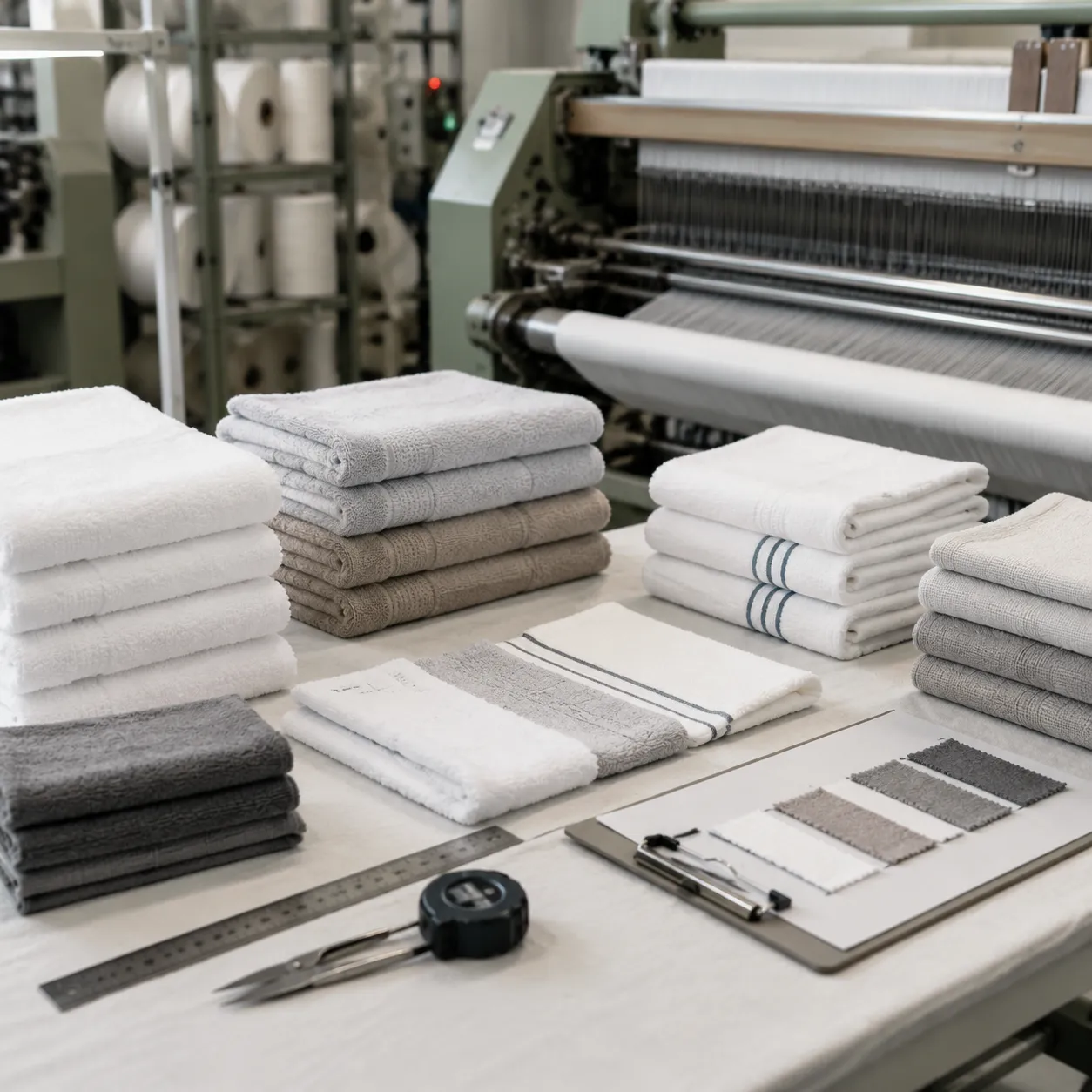
Why Luxury Towel QC Starts Before Inspection Day
For luxury bath programs, final inspection is only the last gate. The useful work starts when the buyer confirms the technical data sheet: size tolerance, GSM range, yarn, pile height, border construction, dye standard, wash test, carton packout and AQL level. If those lines are vague, an inspector can only judge appearance. That is not enough for hotel laundry, spa use or retail returns.
In our mill, most high-end cotton bath towels sit between 550 and 750 GSM. A 650 GSM towel can feel rich if the pile is balanced and the base is stable. The same 650 GSM can fail quickly if the ground yarn is weak, the dobby border is too tight, or the softener level masks poor absorbency. We check the towel as a textile product, not as a showroom sample.
| QC control point | Typical luxury bath towel range | Why it matters |
|---|---|---|
| GSM | 550-750 GSM for hotel and retail bath towels | Controls hand feel, drying time, carton weight and laundry cost |
| Size tolerance | +/-3% after finishing, tighter if agreed in TDS | Prevents shelf mismatch and room set inconsistency |
| Shrinkage after wash | Usually within 5% length and 5% width after 3 cycles | Catches unstable borders and loose finishing |
| Colorfastness to washing | ISO 105-C06, target grade 4 or above for most shades | Reduces shade loss in commercial laundry |
| Rubbing fastness | ISO 105-X12, dry 4, wet 3-4 or better | Important for dark navy, charcoal and deep spa colors |
| AQL level | ISO 2859-1, commonly General II | Defines the sampling plan and rejection threshold |
Best Luxury Bath Towels QC Inspection Guide: AQL Setup
The best luxury bath towels QC inspection guide should state the sampling level before the inspector arrives. We normally use ISO 2859-1, General Inspection Level II for visual and measurement checks. For safety or compliance issues, we treat them as critical defects with zero acceptance. For luxury towel programs, many buyers choose AQL 1.5 for major defects and AQL 4.0 for minor defects. Some five-star hotel groups push major defects to AQL 1.0 when the order is for a new opening and all rooms need the same hand feel.
AQL is not a decoration. It decides how many cartons are opened, how many pieces are checked, and whether a lot passes. For a 6,000-piece shipment, code letter L under General II means 200 pieces inspected. At AQL 1.5, 7 major defects may pass and 8 fail. If the buyer expected every visible issue to be checked one by one, the purchase order should say 100% inspection or a tighter special inspection plan. That cost is different.
| Order quantity | Suggested sample size | Major defect AQL | Minor defect AQL | Common use |
|---|---|---|---|---|
| 500-1,200 pcs | 80 pcs | 1.5 | 4.0 | Boutique hotel launch or retail trial |
| 1,201-3,200 pcs | 125 pcs | 1.5 | 4.0 | Resort room replenishment |
| 3,201-10,000 pcs | 200 pcs | 1.0-1.5 | 2.5-4.0 | New hotel opening or chain program |
| 10,001-35,000 pcs | 315 pcs | 1.0 | 2.5 | Multi-property annual contract |
- Critical defect: wrong fiber claim, missing OEKO-TEX documentation, needle contamination, mildew odor, incorrect care label, or severe dye bleeding.
- Major defect: size outside tolerance, wrong GSM, open seam, heavy shade variation, skewed border, broken ground yarn, visible oil mark, or logo position outside approved limit.
- Minor defect: light loose thread, small pile variation, slight carton scuff, minor label wrinkle, or one isolated terry pull within the agreed allowance.
Defects We Classify Before Counting Them
Cotton terry defects are easy to undercount if the inspector only writes "poor workmanship." We separate defect types because the root cause is different. A terry pull may come from handling after sewing. A tight border usually comes from weaving tension or dobby design. Shade bands often come from dye circulation or uneven loading. If we know the defect family, we can decide whether to repair, sort, rewash or reject.
One construction quirk matters on luxury towels: the decorative border and the terry body do not shrink at the same rate. A wide dobby border with dense picks can pull the towel edge inward after washing. We test this by measuring before wash, after tumble drying, and after the towel rests for at least 4 hours. If the border torque shows only after cooling, a rushed inspection may miss it.
| Defect mode | Factory-side cause | Inspection method | Usual decision |
|---|---|---|---|
| Terry pull over 20 mm | Snagging during sewing, packing or transport | Visual check under normal light; measure pull length | Trim if isolated, reject if repeated |
| Border cupping | Dobby tension too high or finishing overheat | Wash and flat measurement after rest period | Reject or revise border construction |
| Low absorbency | Excess silicone softener or waxy residue | Drop test or sink test after prewash | Rewash trial or formula correction |
| Shade band across width | Dye flow or bath loading issue | Compare under D65 light box and daylight | Sort by shade or reject affected rolls |
| Open hem corner | Weak needle setting or wrong stitch density | Pull check and seam visual inspection | Repair only if finish remains clean |
| Excess lint | Loose fibers, poor singeing or insufficient washing | Dark cloth rub check and wash lint screen review | Additional wash or lot downgrade |
Measurement, GSM and Weight Checks That Matter
A bath towel can pass appearance inspection and still fail the commercial promise if GSM and size drift. We cut GSM samples only from approved test pieces or retained lab samples, because cutting random saleable towels during a pre-shipment inspection can create shortage disputes. For bulk checks, we combine piece weight, finished dimensions and lab-confirmed GSM. That gives a practical control without damaging too many units.
For example, a 76 x 152 cm towel at 680 GSM should weigh around 785 g before label and packing tolerance. If random pieces come in at 735 g, the issue is not a few grams. It may indicate low pile height, excessive shrinkage compensation error, or yarn substitution. We do not approve that lot until the production record and retained fabric samples match the purchase order.
- Measure length and width on a flat table without stretching the towel.
- Weigh the same piece on a calibrated scale with 1 g resolution.
- Check pile height and density by hand against the approved seal sample.
- Compare border width on both ends; more than 5 mm difference is a warning sign.
- Record carton number for every failed piece so defects can be traced to loom, sewing line or packing shift.
Buyers can reduce disputes by putting the target and tolerance into the PO: "76 x 152 cm, 680 GSM, piece weight 770-810 g after finishing, shrinkage max 5% after 3 washes." That sentence is stronger than only writing "luxury hotel bath towel." For broader GSM choices, we usually point buyers to towel GSM decision framework and towel sizes dimensions complete guide before sampling.
Wash Testing Is Where Weak Luxury Towels Show Up
A towel that looks excellent at packing can become rough, twisted or dull after the first industrial laundry. That is why our QC file includes wash testing, not only finished inspection. For hotel and spa programs, we usually run 3 to 5 internal wash cycles before bulk approval. For chain hotels with strict laundry contracts, buyers sometimes require 10 or 15 cycles on the pre-production sample.
We use ISO 6330 as the reference structure for domestic wash simulation when a buyer does not supply a laundry protocol, then adjust temperature and drying to match the actual use. For commercial hotel laundering, 60 C wash and tumble drying is more realistic than a gentle household wash. White towels may be tested with oxygen bleach conditions if the buyer's laundry uses it. Chlorine bleach must be declared clearly because it changes dye and fiber-life decisions.
- After 1 wash: check size change, lint release, absorbency and obvious twisting.
- After 3 washes: compare hand feel against the approved sample and inspect border cupping.
- After 5 washes: check pile loss, hem puckering and shade movement for dyed towels.
- After 10+ washes: use when the towel is for luxury hotel rooms, spa suites or retail claims about long service life.
A realistic service-life view also affects cost. A 620 GSM combed cotton bath towel at 5,000 pieces may cost USD 5.40-6.20 FOB China depending on yarn and packaging. A lighter 500 GSM version may save about USD 0.85 per piece, but if it loses guest-room hand feel after 45 laundry cycles instead of 90, the operating cost per use is worse. For a property using 3,600 bath towels, that difference can turn a USD 3,060 purchase saving into a USD 8,000-10,000 earlier replacement exposure.
Color, White Shade and Chemical Compliance
Luxury towel QC has two different color problems: dyed shade movement and white shade inconsistency. Dark colors need rubbing and washing fastness checks. White towels need shade band control because one optic white can look blue next to a warmer white, especially under LED bathroom lighting. We approve white shade by standard light source, not by warehouse lighting only.
For OEKO-TEX bath towels, we keep certificate scope, product class and mill name aligned. Our mill works with OEKO-TEX Standard 100 Class I when required, plus BSCI social compliance and ISO 9001 quality management. Buyers should check whether the certificate covers the actual fiber, dyeing and finishing route. A certificate from a trading company is not the same as a certificate covering the manufacturing process used for the order.
- Ask for OEKO-TEX Standard 100 certificate number and product class before deposit.
- Confirm whether labels, embroidery thread, sewing thread and packaging ink are included or separately declared.
- Use ISO 105-C06 for wash fastness and ISO 105-X12 for rubbing fastness on dyed towels.
- For white towels, approve one physical shade standard and keep one sealed sample at the mill and one with the buyer.
- Require care label wording before bulk label printing, especially for bleach and tumble drying instructions.
Related reads: buyers who need compliance documentation can compare this inspection approach with how to read OEKO-TEX certificate, hotel towel sourcing guide 2026, and building hotel towels brand specs.
Price Bands, MOQ and What QC Adds to Cost
Our standard MOQ is 500 pieces per design per color. At that quantity, a buyer can make a real custom towel, but the fixed costs are still heavy: yarn setup, dye lab dip, machine cleaning, label printing, carton mark setup and inspection time. QC does not add value if it is treated as a last-minute add-on. It should be built into the quoted spec from the start.
| Volume per color/design | Typical FOB China price band | QC and setup notes |
|---|---|---|
| 500-999 pcs | USD 7.10-9.40 per pc | Higher unit cost due to dyeing, labels and small-lot handling |
| 1,000-2,999 pcs | USD 6.25-8.10 per pc | Good range for boutique hotels and retail capsules |
| 3,000-7,999 pcs | USD 5.55-7.20 per pc | More stable dye lot and better carton efficiency |
| 8,000-20,000 pcs | USD 4.95-6.60 per pc | Best fit for hotel groups and annual replenishment |
| 20,000+ pcs | USD 4.55-6.15 per pc | Yarn booking and production line planning reduce waste |
These bands assume 600-720 GSM cotton terry bath towels with normal woven label or care label, standard export carton and no complex embroidery. Long-staple cotton, zero-twist yarn, combed ring-spun yarn, special dobby borders, individual belly bands, RFID labels and gift boxes all move the price. For decoration cost logic, monogrammed bath towels luxury brand guide and embroidery vs sublimation vs jacquard are useful companions.
A third-party pre-shipment inspection in China often costs USD 230-380 per man-day depending on location and scope. In-mill QC is already part of our production control, but buyer-appointed inspection may still be useful for first orders, chain hotel openings or retail programs with strict chargebacks. The important point is timing: book inspection after 100% production and at least 80% packing, with enough days left to repair or remake if the lot fails.
Production Timing and QC Gates
For custom luxury bath towels, a normal order does not move from PO to vessel in one week. The towel has to pass lab dip, yarn booking, weaving, dyeing or bleaching, washing, finishing, sewing, inspection and packing. If embroidery or monogramming is added, the decoration sample and stitch density approval sit on the critical path.
- Tech pack review and quotation: 1-3 days if GSM, size, yarn and packout are clear.
- Lab dip or white shade approval: 5-9 days, longer for difficult dark shades.
- Proto or pre-production sample: 7-14 days depending on yarn and border design.
- Bulk weaving and dyeing: 18-28 days for most 1,000-10,000 piece orders.
- Finishing, sewing, labeling and packing: 6-10 days.
- Final inspection and corrective action window: 2-5 days.
- Export booking and China port handling: 5-9 days before vessel departure.
For a repeat white hotel towel with no decoration, we can sometimes ship in 30-38 days after deposit. For a new luxury dyed towel with custom border, woven label, carton marks and buyer inspection, 45-60 days is more realistic. Air freight can solve a delivery emergency, but bath towels are heavy. A 680 GSM bath towel program can quickly exceed 6-7 metric tons, so sea freight planning matters. For logistics planning, see container vs air freight towel orders and setting up hotel linen program 90 day roadmap.
Inspection Checklist Buyers Can Put in the PO
A good PO does not need to be long, but it needs to be measurable. We prefer buyer documents that define the pass line before production. That protects both sides. If a hotel buyer says "soft and plush," the factory has to interpret. If the PO says "650 GSM, combed cotton, piece weight range, ISO 105-C06 grade 4, shrinkage max 5%, AQL 1.5/4.0," the inspection team has a real standard.
- Finished size, GSM, piece weight tolerance and shrinkage limit.
- Fiber content, yarn type and whether combed, carded, zero-twist or ring-spun yarn is required.
- Approved shade standard, lab dip number and light source for evaluation.
- AQL level under ISO 2859-1 and defect classification list.
- Wash test method, number of cycles, temperature and drying method.
- Label, care instruction, carton quantity, carton dimensions and gross weight limit.
- Required certificates: OEKO-TEX Standard 100, BSCI, ISO 9001 or buyer-specific compliance files.
- Photo record requirements for failed pieces, carton marks and packed pallet condition.
This is also where buyers should push back on unclear low-price offers. If a supplier quotes far below the market but will not state yarn count, GSM tolerance, wash shrinkage or AQL level, the price is not comparable. The missing controls usually reappear later as lint complaints, size claims, color mismatch or short service life.
What We Need to Quote and Inspect Correctly
For our factory team, the fastest route is a complete spec and one approved reference towel. We can quote from photos, but photos do not show pile density, yarn quality or absorbency. A physical benchmark lets us test weight, construction and finishing. If the buyer wants the same hand feel at a lower price, we can explain which changes are realistic and which ones will damage use life.
Send us target size, GSM, color, quantity by color, decoration method, label needs, packaging, destination port and the inspection standard you want. We will confirm whether the spec fits our MOQ of 500 pieces per design per color and give a practical FOB China range with sample timing. Our mill has 220 employees, has operated since 2007, supplies 80+ brand clients across 47 countries, and produces about 2.4 million towels annually. Certifications include OEKO-TEX 100 Class I, BSCI and ISO 9001.
Related reads: for adjacent procurement decisions, review hotel towels wholesale supplier guide, combed vs zero twist cotton explained, and bath towel wholesale program specs. A best luxury bath towels QC inspection guide works best when it is tied to those sourcing decisions before deposit.
Build a QC-Ready Bath Towel Spec
Send your towel benchmark, GSM target, quantity, color standard and inspection requirement. We will return a practical quote with MOQ, timing, QC gates and FOB China price range.
Request a quote →