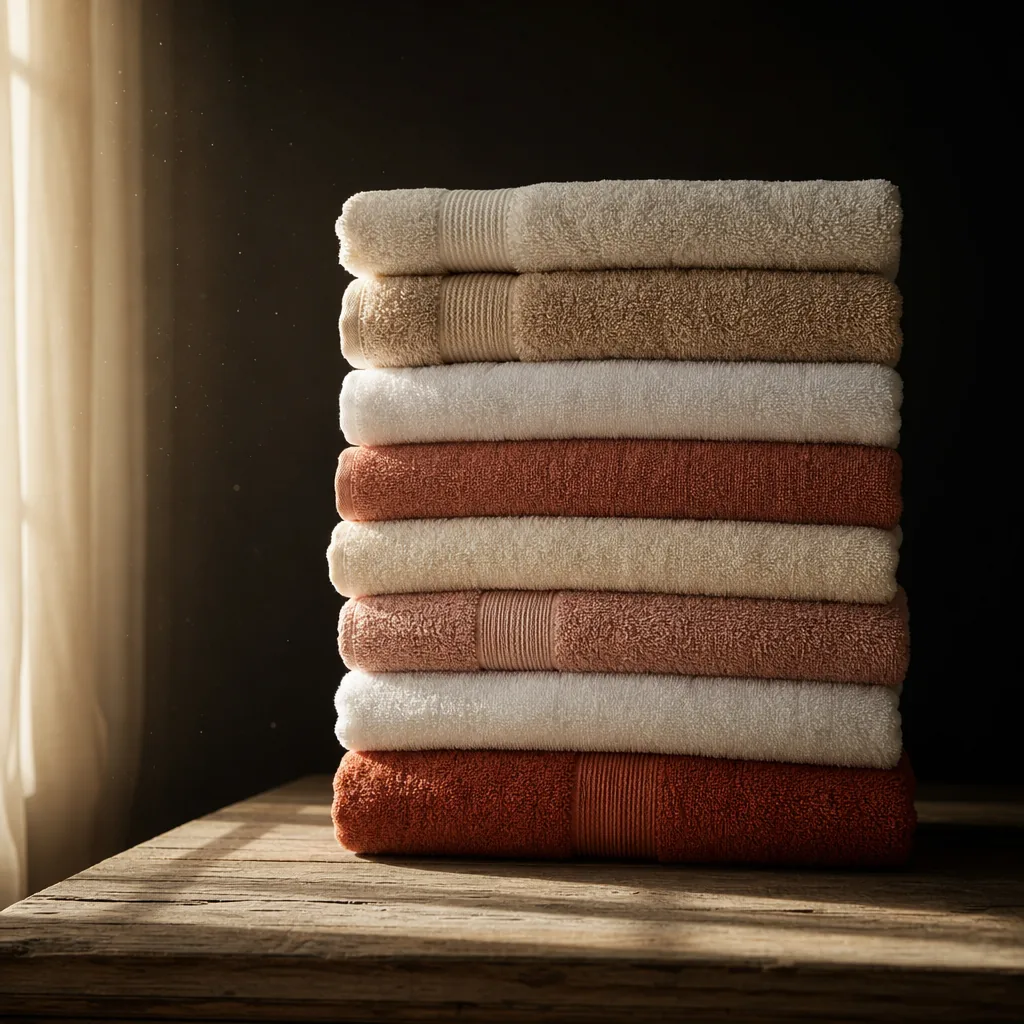
If you have ever opened a five-star hotel towel and an economy-airline-amenity-kit towel side by side, you have already felt the difference. They might both say 100% cotton on the label. They might even have similar GSM ratings. But one feels alive in your hand and the other feels like cardboard. The difference is yarn engineering, and it is the spec most buyers fail to specify clearly.
What yarn actually is
Raw cotton starts as a boll, a small puffy package of cotton fibers wrapped around a seed. After harvesting and ginning (separating fibers from seeds), the fibers are short, tangled and full of impurities. Yarn is the process of turning that mess into a continuous thread strong enough to weave with. How that thread is made determines almost everything about how a towel feels and how long it lasts.
The four yarn categories you need to know
1. Open-end (OE) yarn
Made on rotor-spinning machines that swirl fibers into a yarn shape using centrifugal force. It is fast, cheap, and the dominant yarn in commodity textile manufacturing. The yarn is structurally weak, with more loose fiber ends and lower tensile strength than ring-spun yarn.
For towels: avoid OE yarn for any hotel, gym or spa program. By wash 50 you will see fiber breakdown, loft loss and absorbency decline. OE is acceptable only for genuinely disposable applications like single-use event towels.
2. Ring-spun yarn
The traditional spinning method, where fibers are pulled, twisted and wound onto a ring frame. It produces a stronger, smoother, more uniform yarn than OE. Costs about 15-25% more than OE per kilogram.
For towels: this is your minimum-acceptable specification for any commercial program. Ring-spun cotton towels survive 150-200+ wash cycles before showing significant wear.
3. Combed ring-spun yarn
Same ring-spinning process, but with an extra combing step before spinning that removes short fibers (those under about 13mm). What is left is a more uniform set of longer fibers, which produces a stronger, smoother, noticeably softer yarn. Combing typically removes 15-25% of the cotton by weight as waste (which is why combed yarn costs more).
For towels: this is what you want for any 4-star and above hotel program, premium retail and gift markets, and any application where hand-feel is part of the brand experience.
4. Long-staple cotton (Xinjiang, Egyptian Giza, Pima)
Not a spinning method, but a fiber-length category. Most upland cotton has fibers around 22-28mm long. Long-staple varieties have fibers 32mm or longer. Because longer fibers mean fewer fiber ends per inch of yarn, the resulting yarn is stronger, smoother and softer than upland-cotton yarn of the same count.
Xinjiang cotton (from northwestern China) has fibers around 32-36mm and is one of the highest-volume long-staple cottons in the world. Egyptian Giza 86, 87 and 88 are premium long-staple varieties with fibers around 35-40mm. Pima cotton (grown in the US Southwest and Peru) is another long-staple option, typically 35mm+.
Zero-twist cotton: a special case
Zero-twist cotton is a finishing technique, not a yarn type. Normal yarn is held together by twist. Zero-twist cotton uses a soluble support yarn (typically water-soluble PVA) wound around the cotton fibers; after weaving, the support yarn is dissolved away in finishing, leaving untwisted cotton loops on the towel surface.
The result: each loop has more surface area exposed to water, so the towel absorbs water faster and holds more. Hand-feel is also markedly softer because the loops are not twisted tight. The trade-off: zero-twist is less abrasion-resistant than twisted-yarn towels and adds about 25-40% to unit cost.
Use zero-twist for: premium spa, bath sheets, luxury retail. Don't use zero-twist for: gym, golf, or any high-friction-wear application.
The yarn count question
Once you've picked a cotton type, the next variable is yarn count, expressed as Ne or Nm. Higher yarn count means finer yarn. For towels:
- Ne 16/1 (single, count 16): coarse, heavy yarn. Used for low-cost industrial towels.
- Ne 21/1: standard for most commercial terry.
- Ne 32/1 and 32/2: finer yarn, denser pile possible. Premium hospitality.
- Ne 40/2: very fine, used for luxury smooth-surface towels.
If you specify only GSM in your tech-pack, the mill picks the cheapest yarn that hits the weight. Two 600gsm towels can vary in lifespan by 3x depending on whether the mill uses Ne 16/1 open-end or Ne 32/2 combed long-staple. Write both into your spec.
How to write the right yarn spec
Here is a real-world hotel bath towel specification we like to see in a tech-pack:
| Variable | Specification |
|---|---|
| Fiber composition | 100% cotton, no recycled or regenerated content |
| Fiber length | Long-staple, minimum 32mm average |
| Origin | Xinjiang or Egyptian Giza (specify preference) |
| Spinning method | Combed ring-spun |
| Yarn count | Ne 32/2 ground warp, Ne 16/1 pile |
| Twist | Standard Z-twist (or zero-twist for spa pile) |
| Certification | OEKO-TEX Standard 100 Class I (mandatory) |
A spec like the above gives a mill no room to substitute downward. If you receive a quote that says we accept this spec without questions on a price 25% under market, that is a strong sign the supplier doesn't actually plan to honor the spec. A serious mill will sometimes push back on a couple of items or propose alternatives. That is what dialogue with a real partner looks like.
Want a yarn audit of your current supplier?
Send us a sample of your current production towel and we will lab-test the fiber length, twist and yarn count, then send a write-up of what you are actually buying versus what you specified.
Request a yarn audit →