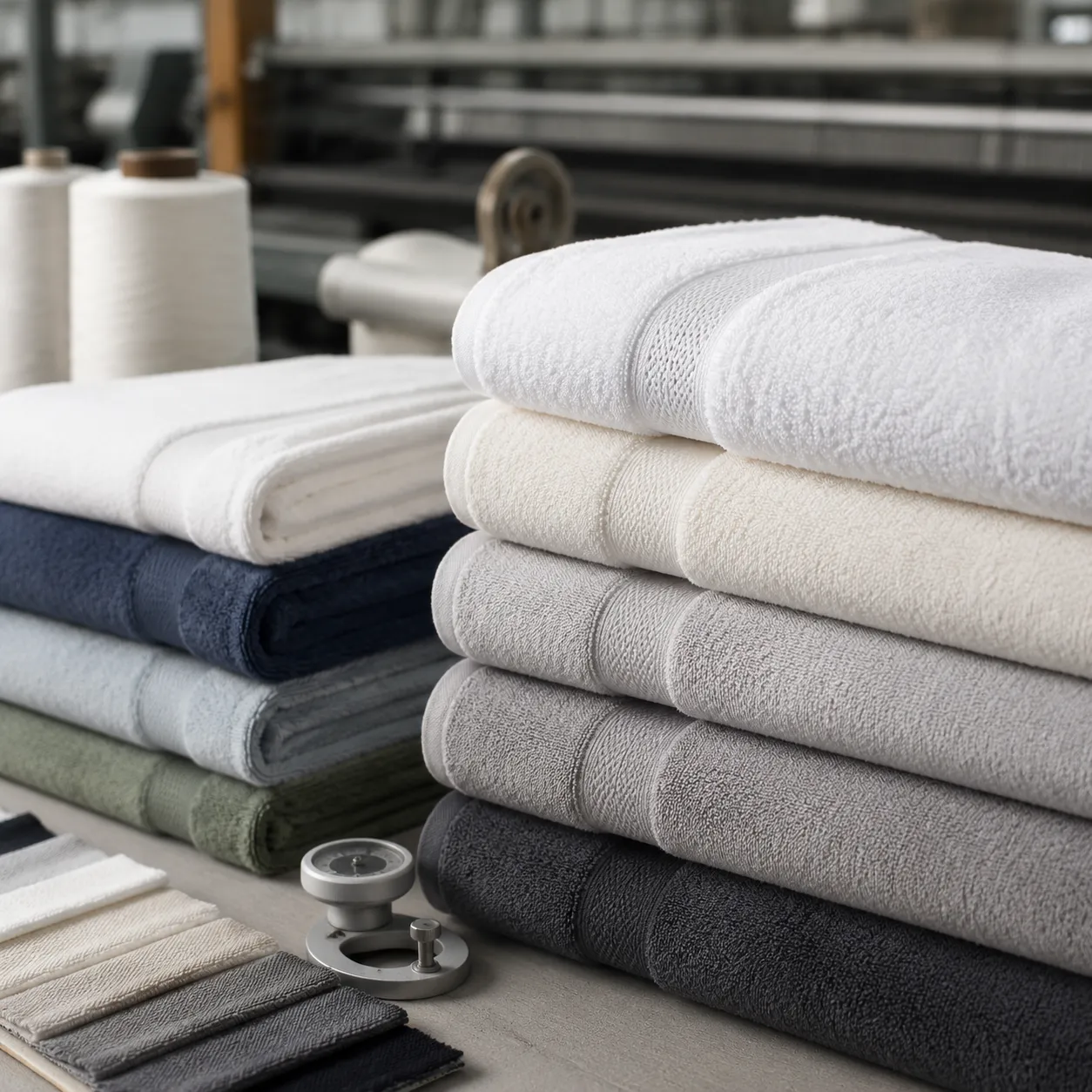
Start With Use Case, Not Just GSM
We make bath towels for hotels, spas, gyms, retail packs, apartment operators, and private label home brands. They all ask for softness and absorbency, but they do not need the same towel. A hotel towel may run through tunnel washing three times per week. A retail towel may sit folded on a shelf and be judged by hand feel in five seconds. A spa towel may need lower lint because oil residue and tumble drying make loose fiber more visible.
For wholesale bath towels, GSM is only one control point. A 520 GSM towel with compact terry loops and strong hems can outlast a loose 620 GSM towel that looks bulky in the carton. We normally build the first quotation around expected wash frequency, target shelf weight, decoration needs, and whether the buyer prioritizes drying speed or plush hand feel.
| Use case | Common size | Working GSM | Construction note |
|---|---|---|---|
| Hotel standard room | 70 x 140 cm or 27 x 54 in | 500-600 GSM | Ring-spun or combed cotton with medium loop height for faster drying |
| Resort or spa | 76 x 152 cm or 30 x 60 in | 600-700 GSM | Longer terry loop, softer hand, slower dry time |
| Gym shower towel | 65 x 130 cm or 25.5 x 51 in | 420-520 GSM | Lower weight reduces laundry cost and locker bulk |
| Retail 2-pack | 70 x 140 cm | 450-580 GSM | Shelf feel and color consistency matter more than extreme durability |
| Apartment or rental | 68 x 137 cm | 480-560 GSM | Balanced cost-per-use with reinforced hems |
One practical weight check: a 68 x 137 cm towel at 540 GSM should land near 503 g before normal production tolerance. If the delivered carton averages 455 g, the towel is not behaving like the quoted spec, even if the label still says 540 GSM.
Wholesale Bath Towels: Spec Decisions That Change Cost
The largest cost drivers are cotton grade, yarn count, finished weight, dye method, and packaging. Decoration can add cost too, but for plain bath towel programs the base fabric usually decides 70-85% of the FOB price. Buyers sometimes focus on saving USD 0.08 on a header card while leaving USD 0.35 hidden in unnecessary towel weight.
- Cotton type: carded cotton is cheaper but sheds more lint; combed cotton removes shorter fibers and improves hand feel after repeated washing.
- Yarn count: 16s is common for heavier hotel towels, while 21s gives a smoother face for retail or spa towels.
- Loop design: taller loops feel plush but snag more easily in commercial laundry if twist and density are not controlled.
- Hem construction: a 3-needle lockstitch hem with 10-12 stitches per inch holds better than a light 2-needle hem on high-wash programs.
- Dye class: reactive dyeing is our normal route for cotton bath towels because it gives better wash fastness than direct dyeing.
A small construction quirk matters here: bath towel selvage tension must be balanced during weaving. If edge tension is too tight, the towel cups after washing. If it is too loose, the side seam waves and the towel looks twisted when folded. We check this during pre-production by washing trial pieces under ISO 6330-style domestic cycles and, for hospitality orders, by adding higher-temperature internal wash checks.
Cotton, Yarn, And Loop Height
For cotton bath towels wholesale buyers usually choose between carded cotton, ring-spun cotton, combed cotton, and cotton-bamboo blends. We are careful with bamboo blends because many buyers expect a softer hand, but the blend can reduce wet strength if the yarn is not specified correctly. For hotel and spa towels, our default recommendation is 100% cotton, ring-spun or combed depending on budget.
| Material route | Typical GSM | Best fit | Factory caution |
|---|---|---|---|
| Carded cotton | 420-520 GSM | Budget rental, short-cycle promo retail | Higher lint in first 5-8 washes |
| Ring-spun cotton | 480-620 GSM | Hotels, apartments, gyms | Good balance if loop density is controlled |
| Combed cotton | 520-700 GSM | Spa, resort, retail private label | Higher yarn cost but cleaner surface |
| Cotton-bamboo blend | 450-600 GSM | Soft hand retail or wellness programs | Needs shrinkage and strength testing before bulk |
| Zero-twist cotton | 550-700 GSM | Luxury retail, low-abuse use | Very soft, but less suitable for rough commercial laundry |
Loop height should match the laundry environment. A 4.0-4.5 mm terry loop can feel rich on a showroom sample, but in a hotel laundry with extractor pressure and hot tumble drying, that loop may flatten faster than a 3.2-3.6 mm loop with tighter ground weave. We also watch pile pull resistance. If a loop catches and pulls 25-35 mm with light finger tension, the towel will not survive housekeeping carts, rings, and mixed laundry loads well.
For lint control, the first two washes tell us a lot. In our QC room, we compare dryer screen fiber release by batch and run a dark cloth rub check after tumble drying. High lint is not only a guest complaint; it also clogs dryers and increases housekeeping time. That is why a USD 2.95 towel that loses shape by wash 18 can be worse than a USD 3.62 towel still serviceable at wash 55.
Sizing And Weight Tolerance Buyers Should Lock
Bath towel size is often copied from an old purchase order without checking the shelf, laundry basket, or guest expectation. We prefer to lock three values in the tech pack: finished size after wash, GSM tolerance, and piece weight tolerance. If only size is written, the mill and buyer may both think the towel is correct while the delivered weight is too light.
| Spec item | Recommended tolerance | Why it matters |
|---|---|---|
| Finished size | ±3% after approved wash test | Cotton terry shrinks in both warp and weft |
| Finished GSM | ±5% bulk average | Prevents weight drift between dye lots |
| Piece weight | ±5% against approved sample | Easy carton-level audit for incoming QC |
| Color shade | Grey scale 4 or better after ISO 105-C06 | Reduces guest-visible lot variation |
| Hem width | Within ±2 mm | Protects fold appearance and seam strength |
We tell buyers to approve a washed sample, not only a fresh sample. Fresh towels are fuller because loops have not been compacted by laundering. After washing, the towel should still fold squarely, the header band should stay flat, and the side hems should not torque. The defect mode we reject most often at this stage is diagonal skew: the towel looks rectangular before washing but becomes a parallelogram after drying.
- Confirm intended market: hotel, spa, gym, retail, rental, or promotional set.
- Choose size and target washed weight before decoration discussions.
- Approve lab dip or yarn-dyed color under D65 and TL84 lighting.
- Wash the pre-production sample before signing the bulk approval.
- Keep one sealed approval sample at the buyer office and one at our mill QC desk.
Price Bands By Volume And Construction
Prices move with cotton, exchange rate, dye depth, and freight terms, but buyers still need a realistic planning range. The bands below are FOB China estimates for plain dyed cotton bath towels, using common 68 x 137 cm to 76 x 152 cm sizes. Very dark colors, jacquard borders, special cartons, or low-MOQ private label packaging can push prices higher.
| Order volume per color | 420-500 GSM budget | 520-600 GSM commercial | 620-700 GSM spa/resort |
|---|---|---|---|
| 500-999 pcs | USD 2.45-3.35 | USD 3.10-4.25 | USD 4.35-6.10 |
| 1,000-2,999 pcs | USD 2.18-3.05 | USD 2.82-3.88 | USD 3.95-5.55 |
| 3,000-7,999 pcs | USD 1.96-2.78 | USD 2.55-3.52 | USD 3.62-5.05 |
| 8,000+ pcs | USD 1.82-2.60 | USD 2.38-3.30 | USD 3.40-4.82 |
Our MOQ is 500 pcs per design per color. Below that, dyeing, cone setup, packaging setup, and inspection time do not spread efficiently. If a buyer needs four colors at 300 pcs each, we usually suggest reducing to two colors at 600 pcs each or using a stock color route for the first replenishment test.
Cost-per-use is a better conversation than lowest FOB. For example, a 500 GSM rental towel at USD 2.72 that survives 32 acceptable washes costs about USD 0.085 per use before laundry. A 560 GSM combed cotton towel at USD 3.46 that survives 58 washes costs about USD 0.060 per use. The heavier towel also reduces replacement sorting, which matters when labor is the expensive part of the linen room.
Testing, Certifications, And Compliance Paperwork
We operate under ISO 9001 quality management, BSCI social compliance, and OEKO-TEX Standard 100 Class I certification for approved materials and processes. Class I is the strictest OEKO-TEX product class, originally set for baby articles, so it is a strong baseline for bath towels that touch skin repeatedly. Buyers should still match the certificate scope to the product and factory, not just ask whether a supplier has a logo.
- Colorfastness to washing: ISO 105-C06, commonly target grade 4 or above for shade change and staining.
- Dimensional change: ISO 6330 wash procedure adapted to the buyer's care label and laundry setting.
- Absorbency: AATCC 79 drop test or internal sink-rate comparison for terry performance.
- pH value: usually controlled around 6.0-8.0 for skin-contact cotton goods.
- Needle detection: required when towels include sewn labels, hang loops, or packed retail sets.
For bulk bath towels, we inspect weaving defects before dyeing and again after finishing. A broken end in the ground weave can hide under terry loops until the towel is stretched. Oil spots from loom maintenance can become permanent after dyeing. We mark and cut out these areas before hemming, because repairing after sewing wastes more labor and can still leave a visible shade mark.
Related reads: for standards paperwork, see how to read an OEKO-TEX certificate. For fiber decisions, compare combed vs zero-twist cotton and our microfiber vs cotton towel comparison.
Decoration And Private Label Choices
Plain bath towels are often not truly plain by the time they reach the guest or retail shelf. Buyers add woven labels, embroidery, jacquard dobby borders, belly bands, barcode stickers, care labels, or gift boxes. Each item affects production flow. A sewn label is simple, but it still needs needle detection and pull-strength checks. Embroidery looks clean on a bath towel, but dense stitching can create a hard patch that feels uncomfortable if placed too low.
- For hotel branding, keep embroidery under 8,000-10,000 stitches on bath towels unless the logo is decorative and the buyer accepts a firmer hand.
- For retail, woven labels should be pre-shrunk or tested with the towel so label curling does not distort the folded edge.
- For dobby borders, avoid very thin contrast lines on dark towels because dye migration and terry shadow can make them uneven.
- For private label sets, confirm barcode position before carton artwork so warehouse scanning does not require repacking.
If artwork is important, send vector files and Pantone references early. Cotton terry cannot hold tiny detail like paper printing. A 1 mm line in a logo may disappear into pile, while a 3-4 mm line usually reads cleanly. For color planning, our article on Pantone color matching custom towels explains why lab dips should be approved under more than one light source.
Production Timeline From Sample To Shipment
A realistic timeline prevents rushed approvals. For a new bath towel supplier program, sample and lab dip work should begin 45-60 days before the goods are needed at port. Repeat orders are faster, but only if yarn, dye recipe, label inventory, and packaging artwork remain unchanged.
- Tech pack review and quotation: 2-4 working days when size, GSM, color, and packaging are clear.
- Lab dip or strike-off: 5-8 days for reactive dyed cotton colors.
- Sample weaving, dyeing, sewing, and finishing: 10-16 days depending on yarn and decoration.
- Bulk production after deposit and approvals: 25-38 days for most 1,000-10,000 pc orders.
- Final inspection, packing, and export documents: 3-6 days before vessel closing.
Peak season adds pressure. Before summer retail programs and Q4 hotel replenishment, dyeing capacity fills quickly. Dark navy, charcoal, forest green, and deep burgundy also need more careful rinsing, so we do not compress the dyeing calendar unless the buyer accepts a higher shade-variation risk. For freight planning, compare carton volume and lead time in container vs air freight towel orders.
What To Put In The Purchase Brief
A good purchase brief saves more money than aggressive negotiation. It lets us quote the right towel on the first round instead of protecting against unknowns. We do not need a 20-page document, but we do need enough detail to avoid guessing.
- Target market and wash environment, including home laundry, hotel laundry, or commercial rental service.
- Finished size, GSM, piece weight, and acceptable tolerance after washing.
- Fiber route: carded, ring-spun, combed, zero-twist, or blend.
- Color standard, dye depth, and whether lot-to-lot shade continuity is required.
- Decoration files, label layout, care label language, carton marks, and retail packaging needs.
- Testing requirements, certification documents, AQL level, and third-party inspection plan if required.
If you are building the brief from scratch, use our towel tech pack guide. Buyers working on hotel rooms can also compare the hotel towel sourcing guide and towel GSM decision framework before locking the spec.
How We Quote A Stable Program
As a vertically integrated OEM towel manufacturer in Gaoyang, Zhejiang, we quote from the production route, not from a catalog guess. Our mill has 220 employees, has operated since 2007, and supplies more than 80 brand clients across 47 countries. Annual towel output is about 2.4 million pieces, which is large enough for stable dyeing and inspection routines but still practical for 500 pc per design per color MOQ programs.
For wholesale bath towels, we prefer to confirm the washed sample, then lock the yarn, loom setting, dye formula, hem thread, label, carton, and QC checklist. That is how repeat orders stay consistent. A towel is not stable because the first sample felt good; it is stable when the third shipment folds, weighs, absorbs, and launders like the first.
Our practical rule: approve the towel after washing, weigh the towel after finishing, and inspect the towel after packing. Skipping one of those three checks is where most bath towel disputes begin.
For a new bulk bath towels program, send the target size, GSM, quantity by color, destination port, decoration plan, and any compliance requirements. We can usually return a quote range in 2-4 working days, then move into lab dips or sampling once the construction is agreed.
Build A Bath Towel Quote
Share your target GSM, size, quantity, wash environment, and packaging needs. We will quote the workable construction, MOQ, timing, and FOB price band. WhatsApp: +86 13384590853. Email: [email protected].
Request a Quote →