What We Can Benchmark — And What We Will Not Copy
Liquid8r is a retail product name associated with its trademark owner. We are not the owner of that mark, and we do not reproduce another company’s labels, hangtags, printed claims, color blocking, packaging layout, or any proprietary presentation. For an OEM project, the correct approach is to define a private-label towel by performance: water pickup, drying speed, lint level, edge softness, wash stability, and carton economics.
For this article, our benchmark basis is measured retail sample data, not factory assumptions. In May 2026 we purchased three publicly available high-pile car drying towels sold in the same performance category, including one retail Liquid8r drying towel sample. We measured size, finished weight, pile structure, binding construction, water absorption, and post-wash dimensional change in our sample room. The numbers below are useful for specification planning, but they are not a claim about every production batch sold by any retail brand.
- Allowed target: “Make a private-label twisted loop drying towel at 920-1,050 GSM with absorption above 650% by weight.”
- Not allowed: “Copy this brand’s exact look, label artwork, hangtag wording, or commercial name.”
- Allowed target: “Match a measured handling profile: soft edge, low lint, strong water pickup, no hard corner.”
- Not allowed: “Use another company’s product image or retail claims on your listing.”
This distinction protects the buyer as much as the mill. Amazon, Shopify, and distributor catalogues can remove listings if product positioning looks like imitation. A cleaner brief gives us room to engineer a towel that performs well and carries your own brand language.
Liquid8r Drying Towel Benchmark: Measured Sample Notes
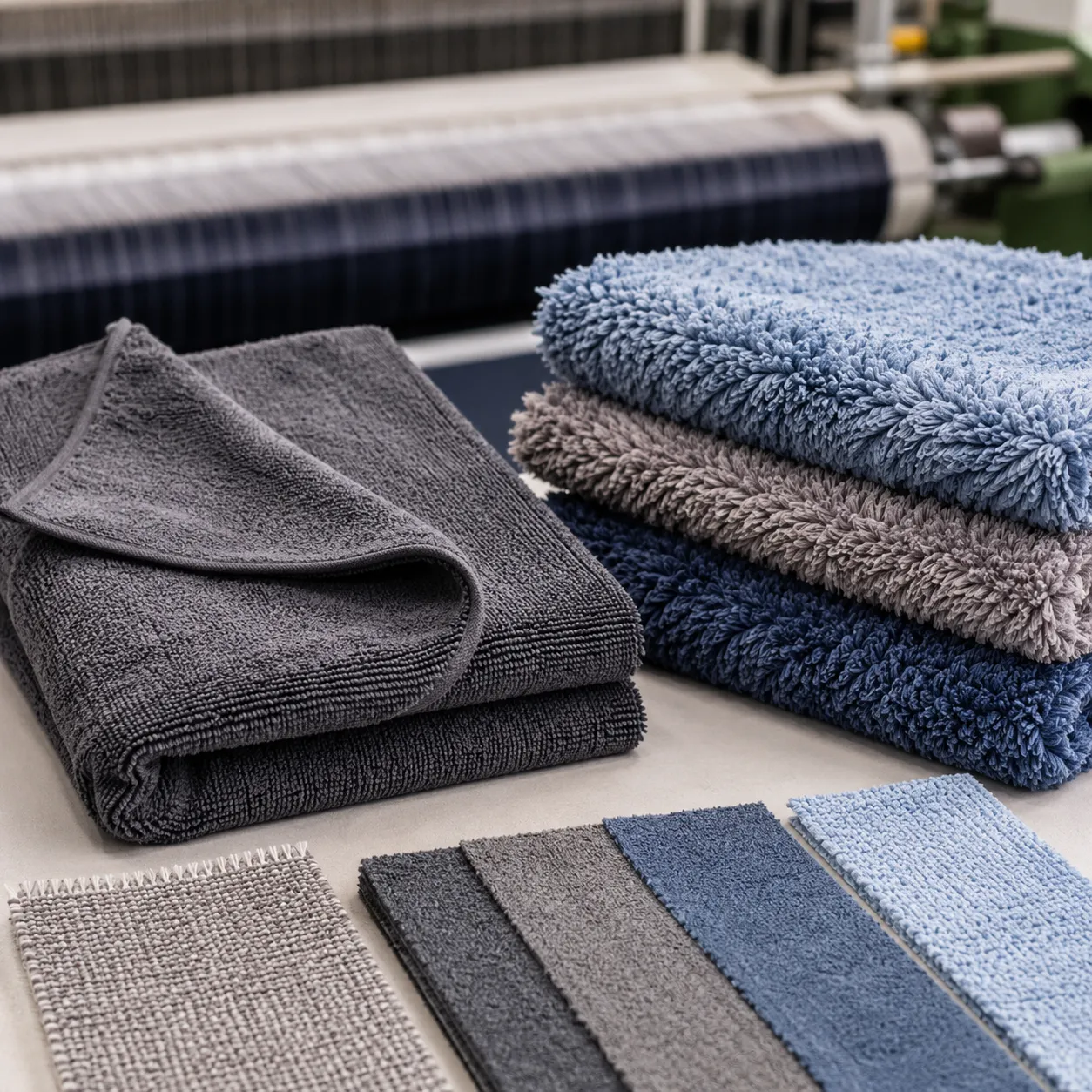
The Liquid8r drying towel category is popular because the customer feels the result quickly: fewer passes over a wet panel and less wringing during a full vehicle dry. The construction behind that feel is usually a dense microfiber base with long twisted loops. Those loops create channels that hold water away from the paint surface instead of flattening immediately like a short terry pile.
In our retail sample check, we did not rely on advertised GSM. We cut small internal test swatches after weighing the full towel, then calculated GSM from finished size and confirmed by lab scale. Finished retail towels can vary because hemming, labels, and cutting tolerance affect weight. That is why our OEM quotations specify both fabric GSM and finished towel weight tolerance.
| Measured item | Retail sample range observed | OEM spec range we usually quote | Why it matters |
|---|---|---|---|
| Finished GSM | Approx. 880-1,080 GSM across samples | 900-1,100 GSM | Higher GSM improves water capacity but raises drying time and freight weight. |
| Pile type | Twisted loop or hybrid long loop | Twisted loop microfiber, 70/30 or 80/20 blend | Loop geometry affects glide, pickup, and lint release. |
| Finished size | Medium to large panel-drying formats | 50×70 cm, 60×90 cm, 70×90 cm, or buyer spec | Large towels dry faster but can drag on the floor for mobile detailers. |
| Edge construction | Soft cloth binding or microfiber edge | Microfiber binding, suede border, or edgeless ultrasonic cut | Hard edge tape is a common cause of swirl complaints. |
| Post-wash shrinkage | Typically under 5% after first hot wash in our sample check | ≤4% length/width after 5 wash cycles | Unstable fabric curls and becomes harder to fold for retail kits. |
For private-label work, we prefer a performance window rather than a single copied number. A 965 GSM towel with the right yarn, loop height, and binding can outperform a heavier towel that has poor pile opening after dyeing.
Construction Choices That Change Drying Behavior
A high GSM microfiber towel is not automatically a good car drying towel. We see failed samples where the towel is heavy on the scale but slow on the panel because the pile has been over-calendered or the split microfiber was not opened properly during finishing. In our line, the finishing bath, tumble opening, and heat setting are as important as the knitting specification.
The main construction decision is between twisted loop, plush terry, and waffle. For a towel intended to sit near the performance of a retail Liquid8r drying towel, twisted loop is normally the closest functional category. Waffle is excellent for glass and compact kits, but it does not hold the same volume of water on a full SUV. Plush terry feels soft, yet it can push water around if the pile collapses.
| Construction | Typical GSM | Best use | Risk to control |
|---|---|---|---|
| Twisted loop microfiber | 850-1,100 GSM | Final drying of panels, hoods, roofs, doors | Loop snagging if yarn twist and brushing are not stable. |
| Plush terry microfiber | 500-800 GSM | General detailing, buffing, interior wiping | Can leave lint if pile is too loose or cut poorly. |
| Waffle microfiber | 350-520 GSM | Glass, mirrors, low-bulk drying kits | Lower total water holding capacity for large vehicles. |
| Dual-pile hybrid | 650-900 GSM | Retail kits needing drying plus buffing function | Different faces may shrink unevenly after repeated washing. |
Blend also matters. A 70/30 polyester-polyamide microfiber usually absorbs faster than an 80/20 blend, but it costs more and can feel heavier when wet. For car wash chains that launder towels daily, 80/20 may be acceptable if the pile height and split quality are controlled. For DTC detailing brands selling one hero towel, we usually recommend 70/30 because customers judge performance in the first use.
- 70/30 blend: better absorbency and softer handfeel; usually adds USD 0.18-0.42 per towel depending on size and GSM.
- 80/20 blend: lower cost and stable supply; suitable for car wash programs where replacement cycles are planned.
- Twisted loop height: we normally keep loop exposure controlled rather than chasing maximum height, because tall loose loops snag on badges and trim.
- Binding width: 8-12 mm microfiber binding is common; wider binding looks neat but adds a firmer edge if the tape is dense.
Scratch-Safe Edge and Lint Control
Most complaints on car drying towels are not from the center fabric. They come from the edge, corner bartack, label, or contamination during packing. A towel can pass a handfeel test on the face and still create risk if the binding seam has exposed monofilament or a raised corner lump.
For scratch-sensitive programs, we run an internal edge audit before bulk approval. We check seam height, corner hardness, loose thread length, and label position. If the towel is for paint contact, we usually recommend a removable paper belly band or outer polybag sticker instead of a sewn woven label on the wiping face. If a label is necessary, it should sit in a corner on the binding and use a soft satin base.
- We rub the finished edge across a black acrylic test panel under consistent hand pressure and inspect under angled LED light.
- We shake and vacuum-test five towels from each pilot lot to check loose fiber release after cutting.
- We wash samples for 5 cycles at 40°C using neutral detergent, then recheck edge curl and lint on glass.
- We reject cartons if loose thread ends above the agreed limit are found during final AQL inspection.
Named lab standards can also be written into the purchase order. We commonly use ISO 105-C06 for washing colorfastness, ISO 105-X12 for rubbing colorfastness, and AATCC TM79 as a reference method for absorbency behavior. For dimensional change, we can record results after ISO 6330 domestic washing conditions. These tests are not decoration; they are how we prevent a good prototype from becoming an unstable reorder.
Size, GSM, and Finished Weight Planning
Size is where online brands often over-spec. A very large towel looks strong in a product photo, but it can become awkward when saturated. Mobile detailers also dislike towels that touch the ground while drying lower door panels. For retail, the best size is often one that feels substantial but still folds neatly into a printed sleeve or zipper pouch.
| OEM size | Suggested GSM | Approx. finished towel weight | Recommended channel |
|---|---|---|---|
| 50×70 cm | 850-950 GSM | 298-333 g plus edge allowance | Starter detailing kits, compact cars, add-on SKU |
| 60×90 cm | 900-1,000 GSM | 486-540 g plus edge allowance | DTC hero drying towel, car wash retail shelf |
| 70×90 cm | 950-1,050 GSM | 599-662 g plus edge allowance | SUV and truck users, higher-ticket retail item |
| 40×60 cm two-pack | 700-850 GSM | 168-204 g each plus edge allowance | Glass-plus-panel bundle, promotional detailing kit |
The finished weight shown above is calculated from area and GSM before adding binding, label, and normal moisture regain. In real production, we set tolerance by finished unit weight, usually ±5% for microfiber drying towels. If a buyer asks us to reduce cost, we do not only reduce GSM. We first check whether the same perceived value can be kept with a smarter size or simpler packaging.
For example, one recent quotation changed from a 70×90 cm towel at 1,000 GSM to a 60×90 cm towel at 960 GSM. Finished unit weight dropped by roughly 129 g before packaging. On 5,000 pcs, that saved about 645 kg of product weight, which reduced both fabric cost and carton freight. The towel still felt substantial because the pile and edge remained correct.
Decoration and Branding Without Hurting Performance
Decoration for a twisted loop microfiber towel should be restrained. The pile is the working surface; heavy embroidery or a large heat-transfer patch can create a stiff zone that does not absorb water and may drag across paint. If the towel is positioned for serious detailers, the cleanest branding is often on packaging, hangtag, belly band, or a small soft label outside the main wiping path.
Embroidery can work on a corner, but we recommend a low stitch count and soft backing that is trimmed cleanly. A 35×20 mm logo with 1,200-1,800 stitches is safer than a dense 80×45 mm mark. For retail shelf impact, printed cardboard sleeves and color-coded woven tabs usually deliver better brand visibility without compromising the towel face.
- Best for performance: no face decoration; printed sleeve, belly band, or pouch carries the artwork.
- Acceptable: small corner woven label on binding, tested for edge softness.
- Use carefully: embroidery on one corner only, with backing trimmed and wash-tested.
- Avoid: PVC patches, thick heat transfers, metallic thread, or large sewn labels on the wiping surface.
For artwork control, we request Pantone references for labels and packaging, not just RGB screen colors. If the towel body is dyed, dark graphite, navy, and deep red need extra testing because rubbing colorfastness matters on paint, glass, and hands. Our normal target for microfiber car towels is ISO 105-X12 dry rubbing grade 4 or above and wet rubbing grade 3-4 or above, depending on shade.
Related reads: if your team is still comparing fabric categories, start with microfiber vs cotton towel comparison. For private-label detailing assortments, see our auto detailing microfiber towel program and custom microfiber towels wholesale guide.
Testing Plan for a Private-Label Drying Towel
A prototype can look excellent in the first sample photo and still fail after the first wash. We therefore separate approval into two stages: appearance approval and performance approval. Appearance covers size, shade, label, folding, and packaging. Performance covers absorbency, lint, edge safety, shrinkage, and colorfastness.
| Test item | Method or basis | Typical acceptance target | Sample quantity |
|---|---|---|---|
| Absorbency | AATCC TM79 reference plus internal water pickup by weight | Initial sink time under agreed limit; pickup above 600% for 900 GSM+ towel | 3 pcs after conditioning |
| Washing colorfastness | ISO 105-C06 | Grade 4 or above for most shades | 1 lab set per color |
| Rubbing colorfastness | ISO 105-X12 | Dry 4+, wet 3-4+ depending on shade | 1 lab set per color |
| Dimensional change | ISO 6330 wash condition reference | Length and width change within 4% after repeated wash check | 3 pcs |
| Final inspection | ISO 2859-1 AQL sampling | Critical 0, major 2.5, minor 4.0 unless buyer specifies otherwise | By shipment lot |
For OEKO-TEX 100 Class I orders, we control approved dyes and auxiliaries from the beginning. LUMA & CO. TEXTILE operates under ISO 9001 quality management, BSCI social compliance, and OEKO-TEX Standard 100 Class I certification. If your retailer requires documentation, ask for the certificate number and scope before deposit, not after goods are packed.
One process detail that matters for microfiber is post-dye rinsing. Residual finishing oil can make a towel feel slick and slow down first-use absorption. We run a rinse and tumble-opening step so the pile opens before inspection. If a buyer requests very low pricing and asks us to shorten finishing time, we push back because the saving is small compared with the return risk.
Pricing Bands, MOQ, and Cost-Per-Use
Our MOQ is 500 pcs per design per color. For a twisted loop car drying towel, real pricing depends on size, GSM, blend, dye shade, edge, packaging, and whether lab testing is included. The ranges below are FOB China estimates for typical private-label programs in 2026. They are not a quote for any branded retail product.
| Order volume | 50×70 cm, 900 GSM | 60×90 cm, 960 GSM | 70×90 cm, 1,000 GSM | Typical inclusion |
|---|---|---|---|---|
| 500-999 pcs | USD 2.65-3.25 | USD 4.15-5.10 | USD 5.35-6.55 | Custom color, soft edge, simple polybag |
| 1,000-2,999 pcs | USD 2.28-2.85 | USD 3.62-4.45 | USD 4.82-5.85 | Better fabric yield, printed belly band possible |
| 3,000-7,999 pcs | USD 1.98-2.48 | USD 3.18-3.95 | USD 4.28-5.18 | Retail sleeve, carton mark, stable dye lot |
| 8,000+ pcs | USD 1.78-2.25 | USD 2.86-3.58 | USD 3.92-4.75 | Optimized cutting, packaging line setup amortized |
Cheap alternatives usually remove value from the wrong place. Suppose a 60×90 cm drying towel at 960 GSM costs USD 3.74 at 3,000 pcs and lasts 110 consumer wash cycles with acceptable absorbency. The towel cost is about USD 0.034 per wash cycle. If the buyer reduces to a 720 GSM fabric at USD 2.64 but complaints begin around 55 wash cycles, the cost becomes USD 0.048 per useful cycle, before returns and review damage. That is not a saving for a detailing brand.
For car wash operators, the calculation changes because towels may be used many times per day and laundered in bulk. In that case, we may suggest a slightly lower GSM with tighter lint control and stronger edge sewing. The best towel for a subscription wash tunnel is not always the same as the best towel for a DTC retail box.
Production Timeline and Packing Decisions
Microfiber drying towel lead time is usually shorter than jacquard cotton towel lead time, but the testing calendar still needs respect. If the buyer wants a new dyed shade, new packaging, and a shipment inspection report, a realistic schedule is 31-48 days after deposit and artwork approval. Air samples can move faster; bulk goods should not be rushed through finishing.
- Tech pack review and quotation: 1-3 working days after receiving size, GSM, blend, color, edge, and packaging brief.
- Lab dip or stock color confirmation: 3-7 days depending on shade and whether Pantone matching is required.
- Prototype sampling: 6-10 days for available yarn and standard edge; longer for custom packaging.
- Bulk knitting, dyeing, finishing, cutting, and sewing: 18-28 days for most 500-8,000 pc orders.
- Inspection, packing, and export paperwork: 3-5 days after bulk approval.
Carton planning is not minor on high GSM towels. A 60×90 cm towel near 960 GSM can pack 20-30 pcs per export carton depending on fold and sleeve thickness. If each towel goes into a zipper pouch, carton volume rises and sea freight efficiency drops. For Amazon FBA or distributor cartons, we can add barcode labels, suffocation warning text, master carton marks, and carton drop-test planning.
Related reads: for freight decisions, review container vs air freight towel orders. If your team has not built a formal mill brief yet, use build towel tech pack that mills can quote. For gym or sport crossover SKUs, sweat towels for gym spec guide explains why lower GSM towels need different testing.
Spec Sheet We Recommend Sending to the Mill
If you want a private-label towel that competes in the same high-absorption category as the Liquid8r drying towel, do not send only a product link. Send a measurable spec. A link can explain market positioning, but the purchase order must define what will be inspected.
- Size and tolerance: for example, 60×90 cm, finished tolerance ±2 cm.
- Fabric: twisted loop microfiber, 70/30 polyester-polyamide, 940-1,000 GSM.
- Color: Pantone target or approved stock shade, with ISO 105-C06 and ISO 105-X12 requirements.
- Edge: soft microfiber binding or ultrasonic edgeless construction, no hard label on wiping face.
- Performance: absorbency target, lint check, shrinkage after repeated wash, and inspection AQL.
- Packaging: polybag, belly band, printed sleeve, pouch, barcode, carton quantity, and destination requirements.
LUMA & CO. TEXTILE has 220 employees and has operated since 2007. We produce about 2.4M towels annually for 80+ brand clients across 47 countries. For microfiber car drying towels, our role is not to imitate retail brands. Our role is to translate a market reference into a manufacturable OEM specification that your brand can own, reorder, test, and defend.
Build a Private-Label Drying Towel Spec
Send your target size, GSM, blend, edge type, packaging plan, and benchmark notes. MOQ is 500 pcs per design per color. Contact us by WhatsApp at +86 13384590853 or email [email protected].
Request OEM pricing →