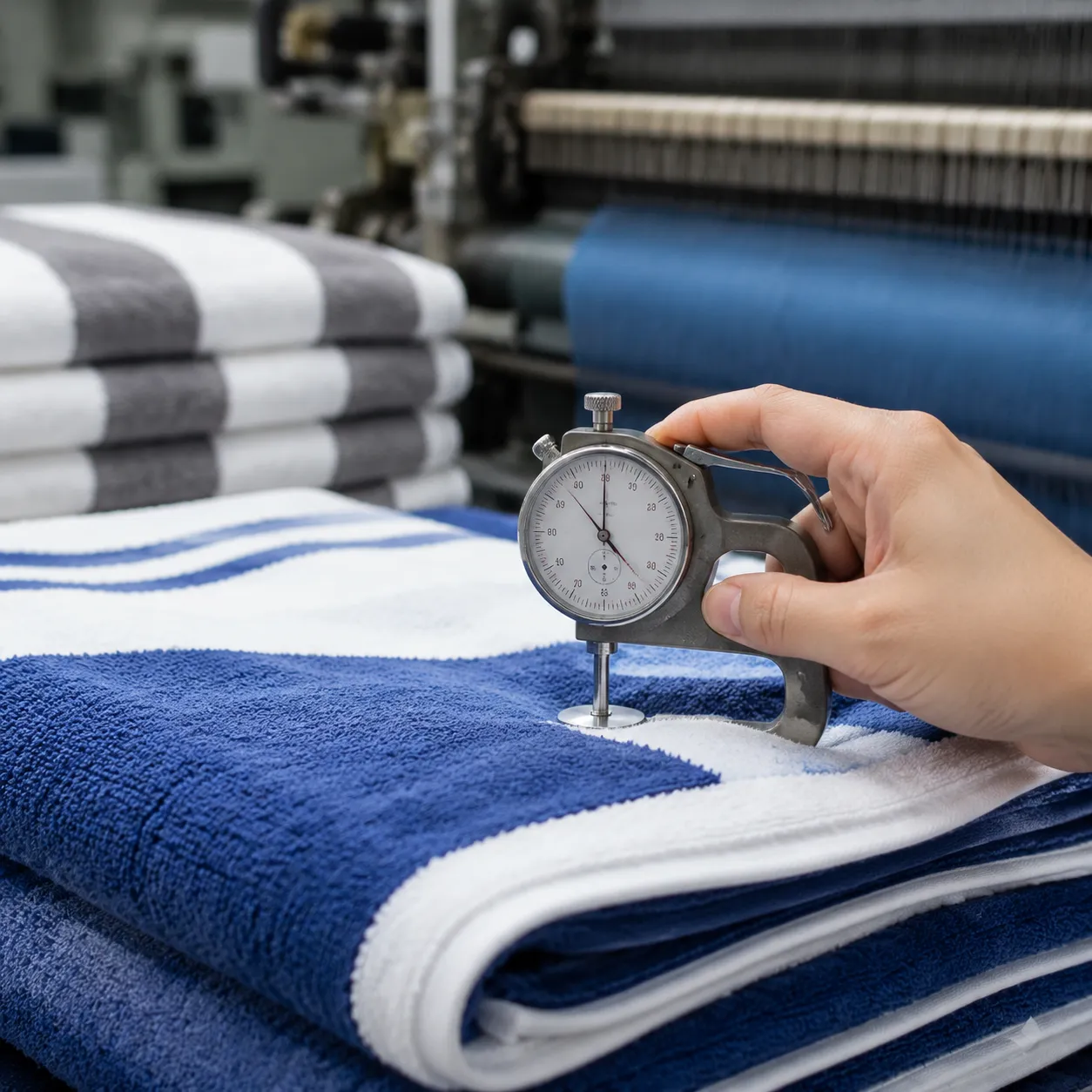
Why Final Inspection Cannot Be a Photo Review
Beach towels are deceptively hard to inspect at the end of production. A bath towel in white or ivory mainly fails on weight, size, sewing, and absorbency. A beach towel adds big-area color, border alignment, velour shearing, logo placement, sand exposure, and export packout. If the inspection is reduced to ten smartphone photos, the buyer sees the nicest pieces on the packing table, not the order risk.
For our OEM beach programs, we treat final inspection as a release gate. Bulk goods must be at least 80 percent packed, the remaining towels must be in finished condition, and the inspection lot must be randomly pulled across carton numbers, colorways, and production shifts. For a 500-piece MOQ order, that often means checking 50 to 80 pieces. For a 12,000-piece resort program, the sample size can rise above 200 pieces depending on the buyer’s AQL level.
We use ISO 2859-1 sampling logic for visual inspection, then add towel-specific checks that the standard does not explain: GSM by cut-and-weigh, pile loss after hand rubbing, terry loop pull, side-hem puckering after steam relaxation, shade continuity across panels, and carton compression after 24 hours. These details matter because a beach towel is handled in bulk by guests, laundry staff, beach attendants, and retail customers before anyone gives feedback to procurement.
| Inspection layer | What we check | Why it matters before shipment |
|---|---|---|
| Visual AQL | Stains, holes, loose loops, logo defects, shade bands | Stops obvious rejects from entering mixed cartons |
| Measurement audit | Size, GSM, weight, hem width, border position | Confirms the goods match the signed sample and PO |
| Functional tests | Absorbency, rubbing fastness, lint, seam strength | Finds failures that appear after first guest use |
| Packout audit | Carton count, polybag, barcode, carton mark, gross weight | Prevents short-shipments and receiving disputes |
| Documentation | Inspection report, test photos, carton list, retained samples | Creates traceability if a claim happens later |
Custom Beach Towel QC Inspection Before Shipment: Our Release Gate
A proper custom beach towel qc inspection before shipment starts before the inspector opens the first carton. We compare the production order, approved sample, lab dip or strike-off, packing instruction, and carton label file. If the documents do not match, the inspection is paused. We would rather lose half a day than inspect against the wrong version of a logo or size spec.
Our release gate is normally set after sewing, trimming, washing if required, final drying, metal detection where applicable, folding, and carton packing. For reactive printed velour towels, we do not release goods until the post-print wash and softening steps are complete. For jacquard beach towels, we inspect after the final shearing and air blowing because loose pile can hide float yarns and small weaving bars.
- Lot identity: PO number, design name, color code, size, GSM, packing method, and carton range must match the buyer’s tech pack.
- Inspection timing: Goods should be 80-100 percent packed, with unpacked balance available for spot checks if the inspector requests it.
- Random pull: Cartons are selected from front, middle, back, top, and bottom pallet positions, not only from easy-access stacks.
- Retained evidence: We keep one sealed control towel per color/design for 12 months when the order uses custom dyeing or logo decoration.
- Hold authority: If critical defects are found, our QC manager can block loading even if the vessel cutoff is near. Shipping defective goods is more expensive than missing a sailing.
This is also where we push back on rushed inspections. If a buyer wants 9,000 printed beach towels loaded the same afternoon as carton sealing, there is no time to open cartons, refold towels, rebuild pallets, and recheck labels. We ask for 2-3 working days between final packout and cargo handover for normal orders, and 4-5 days when third-party inspection is required.
Defects We Classify as Critical, Major, and Minor
AQL only works if everyone agrees on defect severity. A tiny loose thread on one corner is not the same as a dye stain across the logo. We classify defects by use risk, brand risk, and whether the issue can spread during washing. Beach towels have a few defect modes that do not show up in ordinary hotel towel checklists, especially for oversized printed velour and two-color jacquard constructions.
| Defect class | Beach towel examples | Typical action |
|---|---|---|
| Critical | Needle fragment, mildew odor, incorrect fiber content label, unsafe packaging staple | Stop shipment, isolate lot, 100 percent check affected process |
| Major | Wrong size over tolerance, severe shade band, logo off placement by more than approved limit, open seam, hole, heavy oil mark | Reject lot or rework affected cartons before reinspection |
| Minor | Single loose thread under 3 cm, slight fold mark, small pile variation outside logo zone | Accept only if within AQL limit and not clustered |
| Documentation defect | Wrong carton mark, missing barcode, mixed PO labels, carton count mismatch | Correct labels and repeat carton audit before loading |
For most beach towel programs we recommend AQL 0 for critical, 2.5 for major, and 4.0 for minor defects under ISO 2859-1 general inspection level II. Some retail buyers ask for major AQL 1.5 on high-visibility logo orders. That is workable, but the inspection cost and rework allowance should be planned in the PO. A tighter AQL after goods are already packed does not improve manufacturing; it only increases the chance of a late hold.
One beach-specific failure we watch closely is side-hem torque. On wide 90 × 170 cm towels, an unbalanced side hem can pull the towel into a banana shape after tumble drying. The piece may pass a flat-table size check before shipment, but after one laundry cycle it twists on a lounger. We check this by steaming or lightly misting suspect samples, relaxing them for 20 minutes, then re-measuring diagonal skew.
Measurement Checks: GSM, Size, Weight, and Shrinkage Risk
Beach towel buyers often approve samples by hand feel, then forget to lock the measurable values. At final inspection we need tolerances written down. A 420 GSM hammam-style beach towel and a 650 GSM resort pool towel can both be correct if they were specified that way. They cannot be judged by the same weight expectation.
Common beach towel GSM ranges we manufacture are 360-430 GSM for lightweight travel or promotional programs, 450-520 GSM for mid-weight retail and club towels, 540-620 GSM for resort pool-deck use, and 650-750 GSM for heavyweight cabana or luxury beach towels. For velour face towels, the shearing process removes pile height from one side, so finished weight can run lower than an unsheared terry construction at the same loom setting.
| Check point | Normal tolerance we use | Inspection method |
|---|---|---|
| Finished size | ±3 percent after relaxation, unless buyer sets tighter | Steel tape on flat table, three pieces per size/color minimum |
| Finished weight | ±5 percent against approved production sample | Digital scale, calibrated daily, piece weight recorded |
| GSM verification | ±5 percent for solid terry, ±6 percent for printed velour | Cut-and-weigh swatch or calculated from size and weight |
| Hem width | ±3 mm on side and end hems | Ruler check at three locations |
| Logo placement | ±5 mm for woven/printed placement, ±3 mm for embroidery on small marks | Template or transparent placement guide |
| Diagonal skew | Under 2.5 percent for resort-grade towels | Corner-to-corner measurement after relaxation |
For shrinkage risk, we do not rely on a promise from yarn suppliers. We run wash checks against the buyer’s use case. A resort laundry may wash at 60°C with tumble drying, while a DTC beach brand may expect home washing at 40°C. For cotton beach towels, our usual pre-shipment warning limit is over 6 percent length shrinkage or over 4 percent width shrinkage after one accelerated wash. If the towel uses fringe, we also check fringe tangling and knot loss.
A real example from a recent order: a 75 × 150 cm, 500 GSM printed velour towel should finish around 563 g before packing if the GSM is stable. During inspection we found one color averaging 531 g. The surface looked acceptable, but the cut-and-weigh test confirmed a low pile density in one weaving shift. We held 1,240 pieces, separated the shift cartons, and shipped only the conforming balance after buyer approval.
Color, Print, and Logo Checks Buyers Should Not Skip
Beach towels carry more visible color than most towel categories. Large panels make small dye variation obvious, and sunlight makes metamerism worse. For solid dyed cotton, we compare bulk to the approved lab dip under D65 light and TL84 store light. For printed velour, we compare against the signed strike-off and inspect both dry and slightly rubbed surfaces.
For colorfastness, the buyer should decide the test level based on use. We commonly use ISO 105-C06 for washing colorfastness, ISO 105-X12 for dry and wet rubbing, and ISO 105-E03 when chlorinated pool exposure is relevant. Dark navy, coral, emerald, and black grounds need more care than pale sand or ivory because wet crocking can transfer to white pool furniture or swimwear.
- Reactive print blur: Edges of fine logos soften when paste viscosity or steaming time is not controlled.
- Pigment hand-feel patchiness: Heavy pigment areas can feel stiff on velour and crack after tumble drying.
- Jacquard float pulls: Long float yarns at color changes snag on rings, deck chairs, and laundry equipment.
- Embroidery backing shadow: Dense stitching on light towels can show a backing outline after the first wash.
- Border misregistration: Stripes near the towel end can drift if cutting follows the wrong repeat mark.
Logo inspection should use a physical placement template, not a ruler held casually over folded towels. On a 100 × 180 cm oversized beach towel, a logo that is 18 mm low may still look acceptable on the table, but it can sit under the fold line in retail packaging. For beach clubs using stacked towel service, logo position also affects how staff identify property towels versus guest-owned towels.
Related reads: for decoration trade-offs, see embroidery vs sublimation vs jacquard and printed towel artwork and fabric OEM guide. For color approval before bulk, our Pantone color matching custom towels article explains why lab dips and strike-offs should not be merged into one approval step.
Carton Audit: The Part That Saves Receiving Claims
A beach towel pre shipment inspection is not complete until cartons are opened and counted. The carton audit looks dull compared with fabric inspection, but it prevents the claims that are hardest to solve after arrival: mixed designs, wrong inner packs, weak cartons, missing hangtags, and carton marks that do not match the booking.
Our standard export pack for beach towels is usually 12-24 pieces per master carton depending on GSM and size. A 450 GSM 80 × 160 cm towel may pack 20 pieces per carton, while a 650 GSM 100 × 180 cm towel may need 8-10 pieces to keep gross weight manageable. We try to keep cartons under 22 kg gross weight for manual handling and under 0.09 CBM each where possible, but oversized plush towels often exceed that.
- Match carton marks against PO, SKU, color, design, carton number, and destination.
- Open selected cartons and count pieces, inner polybags, belly bands, hangtags, and care labels.
- Check folding direction so the logo faces the agreed retail or resort presentation side.
- Weigh cartons and compare against the packing list; investigate any carton more than 0.8 kg off expected weight.
- Perform a drop check on packed carton corners when the buyer requests courier or LCL shipment.
- Photograph pallet layout, carton seal, desiccant placement if used, and container loading sequence.
Moisture control is part of the packout decision. Cotton towels packed too warm after drying can trap vapor inside polybags. We check fabric moisture with a handheld meter and normally want cotton beach towels below 8 percent before final sealing. In humid months, especially for sea freight routes longer than 30 days, we add carton desiccants and avoid sealing wet-weather cartons directly after transfer from the finishing floor.
Pricing Impact of QC Level and Rework Allowance
Inspection has a cost, but poor inspection usually costs more. The buyer pays for replacement freight, claim handling, lost retail windows, or resort complaints. We price QC into the order in a practical way: normal in-line checks are part of production, while special third-party inspection, 100 percent logo sorting, or repacking after buyer-side label changes must be costed separately.
| Order size | Typical FOB price band | QC and inspection allowance |
|---|---|---|
| 500-999 pcs | USD 5.60-9.40 per pc for 450-620 GSM cotton beach towels | Standard mill QC, final random inspection, MOQ applies per design/color |
| 1,000-2,999 pcs | USD 4.85-8.20 per pc | Better yarn and dye lot efficiency, optional AQL report included |
| 3,000-9,999 pcs | USD 4.25-7.35 per pc | In-line shade control, carton audit, retained samples per color |
| 10,000-25,000 pcs | USD 3.70-6.60 per pc | Dedicated QC plan, pre-loading check, rework buffer planned |
| 25,000+ pcs | Quoted by construction and shipping window | Possible split production lots with separate inspection reports |
A cheap towel can look attractive until rejects are counted. Suppose a 4,000-piece beach club order uses a low-density 390 GSM towel at USD 3.45 instead of a 520 GSM construction at USD 4.95. If the lighter towel loses 11 percent of pieces within one season from seam failures and guest complaints, the club replaces 440 towels at rush freight cost. At USD 6.80 landed replacement cost, the failure consumes USD 2,992, not counting staff time. The stronger towel costs USD 6,000 more upfront, but may last two seasons instead of one. The right decision depends on use intensity, not unit price alone.
Third-party inspection in China commonly adds USD 250-380 per man-day, depending on city, report format, and whether lab sampling is included. For our factory in Gaoyang, we advise booking the inspector after packing reaches 80 percent, not before. Failed inspection followed by reinspection can add 2-5 days and another inspection fee.
Timeline: Where Inspection Fits in the Order Calendar
Final QC cannot rescue a calendar that was impossible from the start. For custom beach towels, realistic production timing depends on yarn, dyeing, weaving, printing or decoration, washing, packing, and vessel schedule. Our MOQ remains 500 pieces per design per color, but low MOQ orders still need the same approval sequence.
For a normal cotton beach towel order, sampling takes 7-12 days for solid dyed or jacquard constructions and 10-16 days for printed velour with custom artwork. Bulk production usually takes 28-42 days after sample approval and deposit. Complex border jacquard, fringe, or multi-color reactive print can push bulk to 45-55 days, especially before peak summer shipment months.
- Day 0-3: Confirm tech pack, artwork, Pantone references, packing method, and certification needs.
- Day 7-16: Review sample, lab dip, strike-off, or woven trial depending on construction.
- Day 18-35: Yarn preparation, dyeing, weaving, printing or embroidery, and in-line QC checks.
- Day 36-48: Washing, drying, trimming, final sewing correction, folding, and carton packing.
- Day 46-53: Final inspection, rework if needed, inspection report approval, booking confirmation, and loading.
If the buyer needs OEKO-TEX Standard 100 Class I documentation, BSCI audit information, or ISO 9001 process records included in the shipment file, we gather those before final inspection. The certificate name, scope, and validity date should be checked early. A towel can be physically correct but still blocked by a compliance team if the document pack is incomplete.
Related reads: our custom beach towel quality specs bulk guide is useful before writing the PO, and beach towels in bulk buyers guide covers construction choices. For freight timing after inspection, see container vs air freight towel orders and beach towel carton packout freight audit.
Inspection Documents We Send With Shipment Approval
For shipment approval, the buyer should not receive only a pass or fail sentence. We send a file that shows what was inspected, what was found, and what was corrected. The report becomes the reference if the warehouse later claims shortage, color mix, or wrong label.
- Final inspection report with PO, SKU, color, sample size, AQL level, defect count, and conclusion.
- Measurement sheet showing size, weight, GSM, hem width, and logo placement readings.
- Defect photo sheet with carton number, defect class, corrective action, and recheck result.
- Packing list matched to carton marks, gross weight, net weight, CBM, and piece count.
- Certificate pack when required: OEKO-TEX 100 Class I, BSCI status, ISO 9001 certificate, and care label confirmation.
We also keep internal records that buyers do not always request but should value: loom batch traceability, dye lot number, sewing-line assignment, needle control log, and metal detector check sheet for orders with sewn labels or embroidery. These records allow us to isolate the source of a problem instead of blaming the whole lot.
Our factory has 220 employees, has operated since 2007, and supplies more than 80 brand clients across 47 countries. Annual towel output is about 2.4 million pieces. Those numbers do not remove the need for inspection; they make a disciplined inspection system more important because one missed defect mode can repeat across thousands of towels quickly.
Buyer Checklist Before You Approve Loading
Before giving loading approval, procurement should review the inspection report against the original PO, not only against the sample photos. A custom beach towel qc inspection before shipment should answer three questions: are the towels correct, are the cartons correct, and is the shipment file complete enough for customs, warehouse receiving, and brand compliance?
- Confirm final sample, bulk photos, and measurement sheet match the signed tech pack.
- Check AQL result and make sure critical defects are zero, not averaged into the lot.
- Review any rework photos and ask whether corrected pieces were reinspected after repacking.
- Compare packing list totals to PO quantity, color split, carton sequence, and booking volume.
- Verify care label, fiber content, country of origin, barcode, and carton mark files.
- Hold shipment if mildew odor, wet cartons, needle risk, severe shade bands, or wrong logo placement appears in the report.
For beach towels, do not approve loading while color, packout, or moisture issues are still described as “under checking.” That phrase usually means the factory needs more time. A 24-hour delay for clear evidence is better than a 40-day ocean transit carrying a defect you already suspected.
We can support buyer-side inspectors, your nominated third-party agency, or our own final QC report. What we will not recommend is shipping first and inspecting at destination unless the order is urgent enough to accept full replacement risk. For most resort, beach club, retail, and promotional programs, the lower-risk path is simple: define the defect limits early, inspect before loading, and keep the evidence file complete.
Plan a Beach Towel QC File
Send your towel size, GSM, artwork, packing method, and target ship date. We will return a practical inspection plan with MOQ, timing, and FOB price band. WhatsApp: +86 13205717266 or email [email protected].
Request QC Plan →