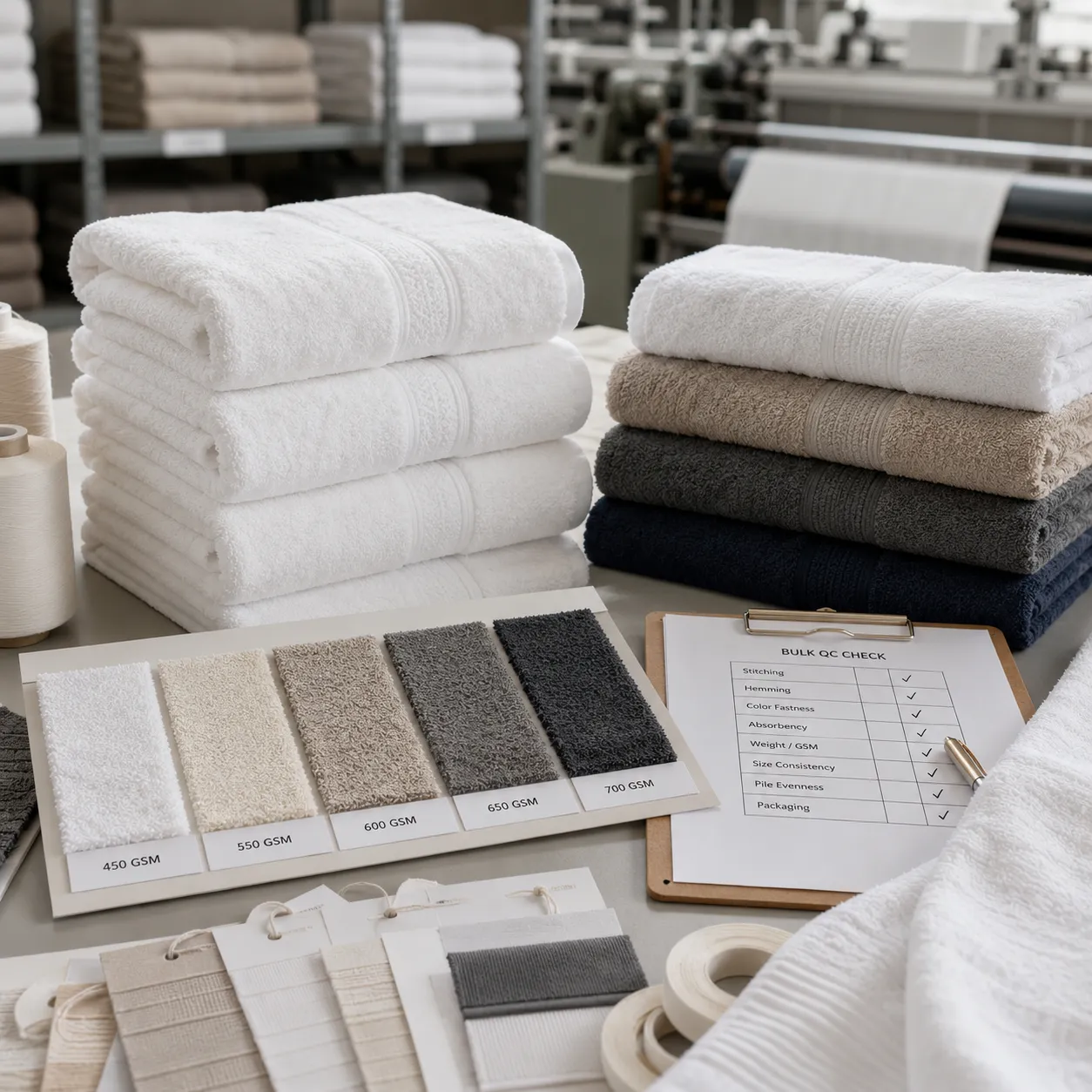
What a Hotel Towels Brand Really Controls
For buyers, a hotel towels brand is not just a woven label or a logo embroidery. It is a controlled specification system: fiber, yarn count, pile height, weight tolerance, shade standard, border design, carton packing, and replenishment rule. If those decisions are not fixed, the same hotel group can receive noticeably different towels across two orders even when the invoice description says “100% cotton white bath towel.”
At our mill, we treat brand control as a production file, not a brochure. LUMA & CO. TEXTILE operates with 220 employees in Gaoyang, Zhejiang, China, and we have supplied 80+ brand clients across 47 countries since 2007. Annual towel output is about 2.4 million pieces. Our MOQ is 500 pcs per design per color, which matters when a hotel wants bath, hand, face, pool, and spa towels under one hospitality towels program.
The most common sourcing mistake is approving a beautiful pre-production sample without defining what is allowed to change in repeat orders. Cotton lot, bleaching curve, pile density, dobby border tension, and softener level all influence the final towel. A good brand spec sets measurable limits so the second container is not a surprise.
| Brand-control item | Factory spec to define | Practical tolerance we use |
|---|---|---|
| Bath towel weight | GSM plus finished piece weight | ±5% after conditioning |
| White shade | Lab dip or approved bulk standard | Delta E usually ≤1.2 against master |
| Size | Cut size and washed finished size | ±2 cm length, ±1.5 cm width |
| Absorbency | AATCC 79 sink time or internal drop test | Target under 10 seconds for hotel cotton |
| Shrinkage | ISO 6330 wash/dry method | Normally ≤5% length and width |
| Logo placement | Embroidery or woven label coordinates | ±5 mm from approved position |
Start With Laundry Reality, Not Shelf Weight
Hotel towels are washed harder than retail bath towels. A city business hotel may launder a bath towel 130-180 times per year. A beach resort can hit 220+ wash cycles on pool towels because guests exchange them more frequently. If the towel is designed only for first-touch softness, the guest experience drops quickly after alkaline detergent, chlorine oxygen bleach, tumble drying, and mechanical extraction.
For a hotel towel supplier, the key question in development meetings is how the towel behaves after 20 and 50 industrial-style washes. We check lint release, pile flattening, border waviness, side-seam twisting, and color cast. One defect that shows up only after repeated laundering is dobby grin-through: the decorative border tightens more than the terry field, creating a puckered line that looks like a pressing defect but actually comes from unbalanced weaving tension.
- Urban business hotel: 500-600 GSM bath towels, compact size range, strong side hems for outsourced laundry handling.
- Luxury resort: 600-700 GSM bath towels and 420-520 GSM pool towels, with separate pool color coding to reduce room-stock loss.
- Budget chain: 430-520 GSM towels, lower pile height, tighter cost-per-use target, but still OEKO-TEX 100 Class I compliant.
- Spa or wellness floor: 550-650 GSM for bath and body service towels, lower lint target because oils and creams trap loose fiber.
- Serviced apartment: 480-580 GSM with retail-like hand feel, often packed by room set for opening shipments.
We push back when a buyer asks for a 380 GSM bath towel for a four-star room because the math usually fails. For example, a 68 × 137 cm towel at 450 GSM weighs about 419 g before finishing loss. If it costs USD 2.72 at 8,000 pcs and survives 70 useful guest cycles, the towel cost is about USD 0.039 per use. A 560 GSM version may cost USD 3.44 but hold 115 cycles, bringing towel cost to roughly USD 0.030 per use before laundry energy. The heavier towel is not automatically better, but the cheapest piece price is often the more expensive operating decision.
Core Specifications Buyers Should Lock Before Sampling
Sampling should not begin with “send your best hotel towel.” It should begin with a short technical brief. We need room category, laundry process, target market, label requirement, annual forecast, and whether the towel must match an existing hotel linen program. Without those details, the sample room can make something pleasant but not necessarily repeatable.
Below are the specification ranges we most often quote for wholesale hotel towels. These are not fixed rules. They are a starting point for comparing piece cost, drying time, and guest feel.
| Towel type | Common hotel size | Usual GSM range | OEM notes |
|---|---|---|---|
| Washcloth | 30 × 30 cm or 33 × 33 cm | 420-550 GSM | Avoid oversized labels; guests feel them on face use |
| Hand towel | 40 × 70 cm or 41 × 76 cm | 450-600 GSM | Dobby border must stay flat after tumble drying |
| Bath towel | 68 × 137 cm or 70 × 140 cm | 500-700 GSM | Use finished weight target, not GSM alone |
| Bath sheet | 80 × 160 cm or 90 × 170 cm | 520-680 GSM | Check shelf depth and laundry folding standard |
| Pool towel | 76 × 152 cm or 86 × 170 cm | 380-520 GSM | Color yarn or border stripe helps inventory control |
| Bath mat | 50 × 80 cm | 650-900 GSM | Use stronger ground weave to reduce edge curling |
- Confirm the room grade and expected wash cycles before choosing GSM.
- Define finished size after wash, not just loom cut size.
- Approve cotton type, yarn count, and pile construction in writing.
- Set a shade master for white, ivory, charcoal, or brand color.
- Decide whether logo belongs on embroidery, dobby border, woven label, or packaging.
- Lock carton quantity and polybag rules before the shipping quote.
For cotton construction, combed cotton is the safest mainstream hotel choice because shorter fibers are removed before spinning. Ring-spun carded cotton can work for economy programs but releases more lint in early washes. Zero-twist cotton gives a fuller hand feel, yet we only recommend it where laundry temperatures and tumble time are controlled because the pile can abrade faster under harsh commercial handling. For more on fiber behavior, see combed vs zero-twist cotton explained and our towel GSM decision framework.
Branding Options That Survive Hotel Use
A hotel towel can carry brand identity quietly. The wrong decoration can also create hard hand feel, pulled loops, or laundry complaints. For private label hotel towels, we usually compare four options: woven label, dobby border text, tone-on-tone embroidery, and jacquard weaving. Each has a different MOQ pressure and different risk profile.
Embroidery is flexible at 500 pcs per design per color, but stitch density must be controlled. A 9 cm wide logo filled with 18,000 stitches may look sharp on a sample and feel stiff on a hand towel. For hotel bath towels bulk orders, we often reduce fill areas, use satin outlines, or move the logo to the lower border where skin contact is less sensitive. We also test for loop snagging around embroidery backing after wash.
| Branding method | Best use | Typical added cost at 2,000 pcs | Main factory warning |
|---|---|---|---|
| Woven label | Room towels, spa sets, private label cartons | USD 0.04-0.09/pc | Label edge must not scratch face or hand use |
| Embroidery | Suite towels, membership clubs, boutique hotels | USD 0.16-0.48/pc | Dense fill causes stiffness and longer drying |
| Jacquard logo | Pool towels, resort bath sheets, brand programs | USD 0.22-0.65/pc | Requires loom planning and higher setup discipline |
| Dobby border text | Classic hotel identity, chain consistency | USD 0.10-0.28/pc | Text clarity drops if border height is too narrow |
- Keep embroidery on bath towels under roughly 70 × 45 mm unless the design is mostly outline.
- Avoid metallic thread in commercial laundry; it breaks faster and feels harsh.
- Use water-soluble topping during embroidery on high pile so stitches do not sink unevenly.
- For jacquard logos, simplify curves and small lettering before loom card making.
- Approve logo position after one full wash because border shrinkage can shift the visual balance.
Decoration decisions should be made with the same seriousness as cotton selection. Buyers comparing logo options can review embroidery vs sublimation vs jacquard, while teams building monogram standards may find monogrammed bath towels luxury brand guide useful.
Pricing Bands and MOQ for Wholesale Orders
Price depends on cotton market, exchange rate, dyeing load, yarn count, packing, and decoration. Still, buyers need planning numbers. The table below reflects realistic FOB China bands we would use for 2026 quoting on white or light-color 100% cotton hotel towels, before unusual packaging or complex logo work.
| Item and spec | 500-999 pcs | 2,000-4,999 pcs | 10,000+ pcs |
|---|---|---|---|
| Washcloth 33 × 33 cm, 500 GSM | USD 0.38-0.56 | USD 0.31-0.44 | USD 0.27-0.39 |
| Hand towel 40 × 70 cm, 520 GSM | USD 0.92-1.28 | USD 0.78-1.08 | USD 0.69-0.96 |
| Bath towel 70 × 140 cm, 580 GSM | USD 3.36-4.25 | USD 2.96-3.72 | USD 2.68-3.38 |
| Bath sheet 90 × 170 cm, 620 GSM | USD 6.45-8.10 | USD 5.82-7.28 | USD 5.35-6.70 |
| Pool towel 86 × 170 cm, 450 GSM yarn-dyed stripe | USD 4.75-6.15 | USD 4.22-5.40 | USD 3.88-4.95 |
Our MOQ is 500 pcs per design per color. For a hotel towels brand with five towel types, buyers sometimes assume 500 total pieces is enough. In practice, five types means five production lines in planning, and each size has its own cutting, hemming, weight check, packing, and barcode requirement. We can combine colors and sizes intelligently, but the quote must respect real setup time.
A chain rollout usually gets better economics by standardizing two or three base constructions and changing only label or packaging. For example, one 580 GSM bath towel can serve standard rooms and suites, while the suite upgrade comes from a bath sheet and robe rather than a completely different bath towel spec. That reduces yarn fragmentation and helps repeat orders stay closer in shade.
Certifications and Test Methods We Put in the File
Certifications are not decoration for a supplier profile. They decide whether your compliance team can approve the mill before deposit. LUMA & CO. TEXTILE works under OEKO-TEX Standard 100 Class I, BSCI, and ISO 9001. OEKO-TEX Class I is stricter because it covers baby-contact textile limits; many hotel buyers accept Class II, but Class I gives brand groups an easier internal approval path.
For a hotel towel program, we normally attach certification copies, fiber content declaration, care label wording, and test expectations to the technical pack. If the towel is going into a regulated market, buyers should confirm labeling language early. A last-week care-label change can delay packing even when towel production is finished.
- ISO 6330: domestic washing and drying procedure used to evaluate dimensional change and appearance after laundering.
- ISO 105-C06: color fastness to domestic and commercial laundering, useful for grey, beige, navy, and pool towel shades.
- AATCC 79: absorbency evaluation; slow sink time often means too much softener or hydrophobic finish.
- ISO 12945-2: pilling tendency check for some cotton blends and microfiber programs.
- Needle detection record: required by some hotel groups and Japanese buyers after embroidery or sewing.
White towels need their own discipline. Optical brightener level can make one batch look blue-white and another look cream-white under LED corridor lighting. We keep an approved white master and compare bulk under D65 and TL84 light sources. For colored hospitality towels, we recommend lab dip approval and bulk cuttings retained from each dye lot.
Related reads: certification teams often start with how to read OEKO-TEX certificate. Procurement teams building their first technical file should also use build a towel tech pack that mills can quote before asking factories for final price.
Factory Timeline From Brief to Replenishment
A realistic timeline protects both sides. Rushing hotel towels usually creates mistakes in border, packing, or shade. For a new branded program, we prefer 42-65 days from approved spec to FOB shipment for cotton terry towels, depending on dyeing capacity, decoration, and testing requirements. Repeat orders can shorten to 28-45 days if yarn and labels are already reserved.
- Technical review and quote: 2-4 days after full spec file arrives.
- Lab dip or white standard confirmation: 4-7 days for dyed shades, shorter for standard white.
- Sample weaving and finishing: 7-12 days for plain terry, 12-18 days for jacquard or dobby text.
- Buyer approval and corrections: usually 3-10 days depending on courier time and decision chain.
- Bulk weaving, dyeing, finishing, and sewing: 22-35 days for normal volumes.
- Inspection, packing, and export documents: 3-6 days before vessel cut-off.
The slowest part is not always weaving. It can be label approval, carton mark revision, or waiting for one stakeholder to confirm whether the pool towel border should be navy or cobalt. We advise hotel groups to approve a master towel set and keep it stored at head office. Every repeat order should be checked against that physical reference, not just a PDF.
For opening orders, freight planning should be discussed before production ends. Towels are bulky. A 40HQ container may hold roughly 52,000-68,000 medium bath towels depending on GSM, compression, and carton size, while bath sheets reduce that count quickly. Air freight can rescue a delayed opening but often adds USD 0.55-1.20 per bath towel equivalent, which is usually higher than any savings from pushing the mill for a cheaper construction. Freight teams can compare scenarios in container vs air freight towel orders.
Quality Control Points That Prevent Brand Drift
Brand drift happens slowly. One order has a slightly softer finish. The next uses a different side-hem thread. A third has a bath towel 2 cm shorter after wash. None of these failures may trigger a claim alone, but together they make a hotel group look inconsistent across properties.
Our QC team checks incoming yarn, loom output, dyeing or bleaching result, sewing, embroidery if used, final piece weight, metal detection when required, and packing. For hotel programs, we also recommend retaining counter samples from each bulk shipment for at least 18 months. That makes repeat-order disputes easier to solve with evidence instead of memory.
- Measure finished size after conditioning, not immediately after high-heat tumble drying.
- Weigh 10 randomly selected pieces per size and compare average plus individual outliers.
- Check side hems for skipped stitches, loose lockstitch tails, and hard seam ridges.
- Inspect dobby borders for waviness, tight draw-in, and broken picks near the selvedge.
- Wash-test logo embroidery to confirm backing does not curl or scratch.
- Verify carton assortment against property-level packing lists before sealing export cartons.
One topic-specific defect we watch closely is pile barré, visible horizontal striping caused by uneven yarn tension or mixed yarn lots. It may be subtle on a single white towel, but on a shelf stack under hotel lighting the stripes become obvious. Another is edge rope twist, where repeated tunnel finishing and tumble drying make one long edge curl inward. Both defects are preventable when loom tension, yarn lot control, and finishing temperature are documented.
Related reads: hotel groups comparing supplier structures can use hotel towels wholesale supplier guide and hotel towel sourcing guide 2026. If your opening schedule is tight, setting up hotel linen program 90-day roadmap gives a practical order sequence.
How to Brief Us for a Stable Program
The best RFQs are short but specific. If you send only “need hotel towels brand quote,” every supplier will fill the gaps differently, and the lowest quote may simply be the thinnest towel, the smallest finished size, or the weakest packing. A usable brief lets us quote the same target you intend to buy.
We need property type, room count, annual replacement forecast, towel sizes, target GSM or target finished piece weight, color, logo method, certification requirement, packing method, delivery country, and first delivery deadline. If you already have a towel to match, send a physical sample. Photos cannot show pile density, softener load, or border tension accurately.
For most hotel buyers, we recommend starting with one base bath towel, one hand towel, one washcloth, and a separate pool or spa towel only if the operation truly needs it. Keep the first program disciplined. You can add suite-level upgrades after laundry feedback from the first 60-90 operating days.
Build a Hotel Towel Spec That Repeats
Send your target sizes, GSM, logo plan, and delivery country. We will review feasibility, MOQ, price bands, and production timing for your hotel towel program. WhatsApp: +86 13384590853. Email: [email protected].
Request a Quote →