What has to be approved first
For spa treatment towels, the fastest way to waste time is to review a pretty sample without locking the functional spec. We ask buyers to approve in this order: fiber and yarn, GSM and size, weave and hem construction, then color and decoration. That sequence matters because a 480 GSM towel and a 560 GSM towel may both look soft, but they behave very differently on a warm cabana table, in a facial room, or after a towel warmer cycle.
| Sample item | What we verify | Common failure if skipped |
|---|---|---|
| Fiber and yarn | Cotton content, ring-spun or combed yarn, yarn count | Hand feel changes after the first wash |
| GSM and size | Net weight and cut size tolerance | Towel looks right on paper but dries too slowly |
| Construction | Border width, dobby line, hem stitch density | Edges wave, curl, or fray after laundry |
| Color and finish | Shade band, softness, lint level | Shade drift across replenishment orders |
| Decoration | Embroidery density, backing, placement | Logo puckers or shows on the reverse side |
Build the sample stack, not one sample
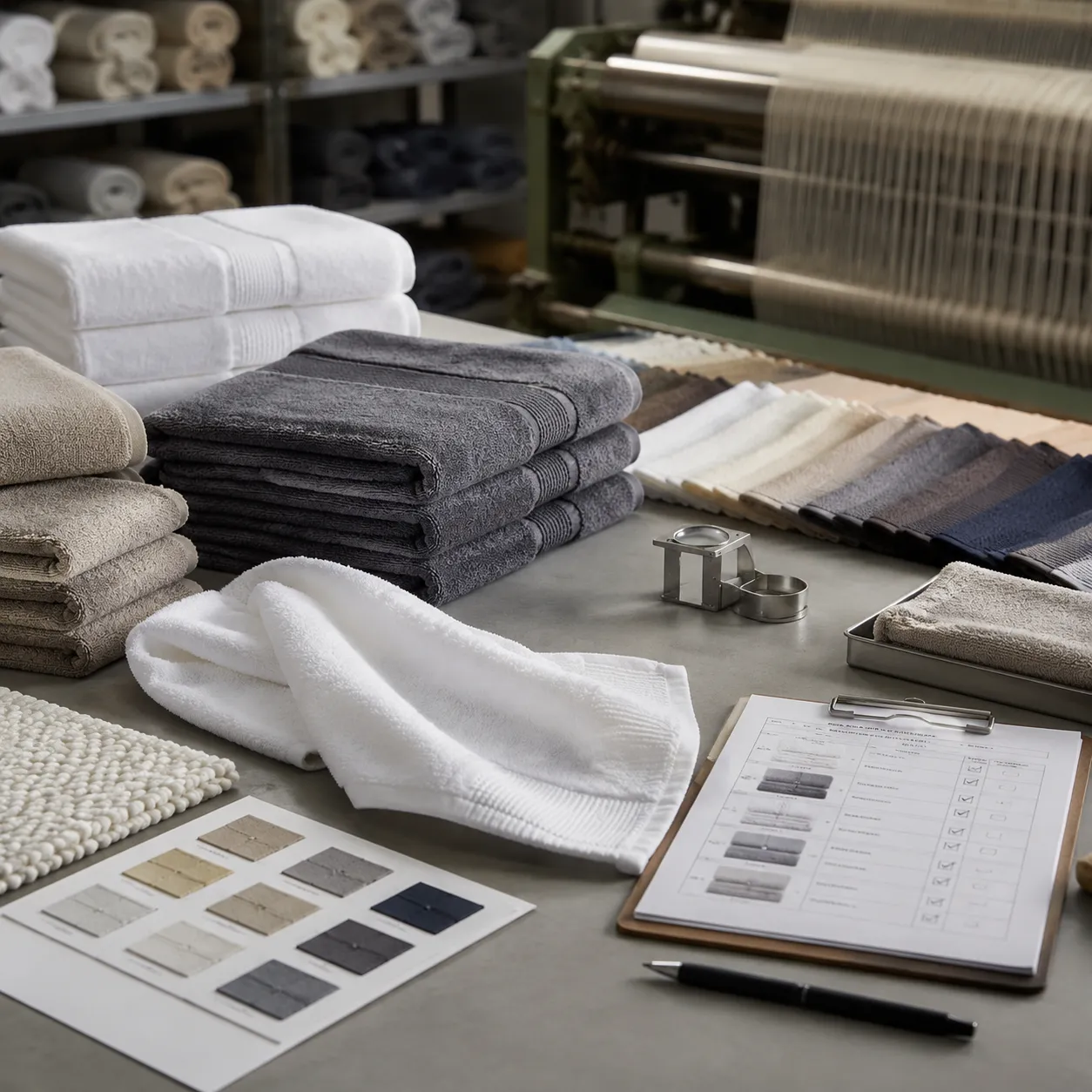
A single showroom sample is not enough for a spa program. We prefer a sample stack made of a base towel, a color swatch, a decoration strike-off, and a wash-tested reference piece. That gives the buyer a realistic view of the final result and lets us catch issues like border distortion, shade variation, or a thread contrast that disappears on terry loops.
- Base towel sample: full size, unwashed, with the intended GSM and hem spec
- Shade submission: lab-dip or dyed swatch for each approved color
- Decoration sample: embroidery strike-off or woven label proof
- Reference wash piece: one towel washed and dried once in factory conditions
- Packing mock-up: folded presentation, banding, and carton count
If the spa uses towel warmers, facial-room trays, or folded retail display, we also stage the sample in the same fold pattern the end user will use. A towel that photographs well open flat can still fail when folded into thirds because the hem edge twists or the logo lands on the fold line.
spa treatment towel sample approval workflow at the mill
This is the workflow we use when a buyer wants a clean approval trail without dragging sampling for weeks. It is simple enough for procurement teams to track, but strict enough to protect bulk production.
- Confirm the tech pack: size, GSM, yarn type, color code, logo method, and pack format.
- Review the first blank sample: check hand feel, loop uniformity, border stability, and stitched hem tension.
- Approve color on a lab-dip or dyed swatch before decorating full towels.
- Run decoration strike-off on the actual towel fabric, not on a separate cloth.
- Wash-test the sample in one controlled cycle and compare shrinkage, shade change, and loop pull.
- Issue written sign-off with photos, dates, and the exact sample code tied to the PO.
| Approval gate | Target window | What gets signed off |
|---|---|---|
| Tech pack check | Day 1-2 | Sizes, GSM, color, logo method |
| Blank sample | Day 5-8 | Hand feel, loop quality, stitching |
| Color swatch | Day 5-10 | Pantone or matched shade range |
| Decoration proof | Day 8-12 | Placement, density, reverse-side clean-up |
| Wash reference | Day 10-14 | Shrinkage, lint, color stability |
For most spa programs, the approval cycle takes 10-14 days if the buyer answers quickly. If the design needs a custom yarn shade or a complex border pattern, we usually budget 15-21 days because the first round may need a second strike-off.
The sample details that actually catch risk
The most useful details are the ones that sound small but control bulk consistency. We look at loop height, hem density, and edge behavior because they influence both appearance and laundry life. For treatment-room towels, a tighter hem and a stable border usually perform better than a loose decorative edge that looks soft in photos but waves after repeated drying.
- Loop pull risk: loose loops snag on warmer racks and manicure tools
- Border twist: uneven stitching makes the towel sit crooked after folding
- Shade banding: visible difference between center panel and border
- Lint release: excess lint can bother treatment rooms and dark uniforms
- Logo ghosting: embroidery backing or thread shows through on lighter towels
If the towel passes one beauty shot but fails the second wash, it is not approved. Spa buyers live with the second wash, not the first photo.
We also flag shrinkage in a practical way. A 70 x 140 cm towel that loses 4% in length may still be usable, but a matching set will no longer fold the same way across treatment beds. That becomes a merchandising problem, not just a QC issue.
Set the wash test before you sign
The sample is not approved until it survives the same wash logic the spa will use. We do not rely on a generic laundry claim. We define the method, the temperature, the detergent type, and the drying condition in writing so the sample result means something.
| Test item | Typical lab setting | Pass condition |
|---|---|---|
| Wash cycle | 40°C with standard detergent | No visible seam damage or shade breakout |
| Drying | Tumble dry medium or line dry per buyer use | No severe curling or hardening |
| Shrinkage | Measured length and width before/after | Within agreed tolerance band |
| Color transfer | White cloth rub after wash | No obvious staining |
| Loop integrity | Visual and finger pull check | No concentrated snagging or pull-out |
A useful spa wash test usually includes at least one cycle with a dark cosmetic towel or cape nearby, because treatment rooms often mix textiles during laundering. If the border bleeds or the pigment crocking is weak, the issue shows up there first. For light colors, we also check whether lotion residue changes the surface tone after drying, which is common on plush cotton programs.
Decoration approval: keep it quiet and durable
Most spa treatment towels need restrained decoration, not heavy retail embellishment. Buyers usually want a small monogram, a tone-on-tone logo, or a woven label placed away from the main contact zone. In sampling, we check whether the decoration interferes with fold lines, massage-table drape, or towel warmer stacking.
- Embroidery: best for stable logos, but density must stay low enough to avoid stiffness
- Sublimation: usually not the right fit for absorbent cotton towels
- Jacquard border: useful when the brand mark must be woven into the structure
- Woven label: good for minimalist branding with low skin contact
- Heat transfer: rarely our first choice for treatment towels because laundering is harsher
If the buyer wants a logo near the edge, we test how it looks after folding. On spa towels, a mark placed 6-8 cm from the hem often reads better in use than a centered mark that disappears under the fold. We also check reverse-side clean-up, because embroidery backing that feels stiff can annoy therapists and guests when the towel is used as a face cradle cover.
Price changes between sample and bulk
Sampling is cheap only when the spec is stable. Once buyers revise GSM, color, size, and decoration after the first round, the cost rises quickly because each change may require fresh yarn reservation, a new dye lot, or another strike-off. For spa treatment towels, we usually quote sample development separately from bulk, then offset part of the sample cost once the order confirms.
| Order stage | Typical FOB China range | Notes |
|---|---|---|
| Sampling only | USD 18-45 per design set | Depends on color count and decoration method |
| 500-1,000 pcs | USD 4.20-6.80 per towel | MOQ-level pricing with limited color splits |
| 3,000-5,000 pcs | USD 3.15-4.70 per towel | Better spread across dyeing and setup |
| 10,000+ pcs | USD 2.55-3.85 per towel | Usually for chain spas or multi-site rollouts |
Those numbers move with cotton grade, towel size, and decoration density. A combed cotton towel with a small embroidery mark costs less to qualify than a thick jacquard-border towel with custom shade matching. If the buyer asks for a lower price without simplifying the spec, the workflow usually slows down because the mill has to protect margin by tightening tolerances elsewhere.
What we need from the buyer
A clean approval workflow depends on complete buyer inputs. Missing details are the biggest reason spa sampling stalls. We can move quickly when the buyer gives us clear targets and one decision-maker for sign-off.
- Target GSM and size range
- Color reference: Pantone, physical swatch, or previous purchase sample
- Decoration method and logo artwork in vector format
- Expected wash standard and laundering frequency
- Packing format, fold style, and carton count
- Required certifications such as OEKO-TEX 100 Class I, BSCI, or ISO 9001 alignment
For most spa chains, the right question is not whether the towel feels soft in the hand. The question is whether the towel still looks composed after twenty or thirty washes, because that is where treatment-room programs either hold up or start to look tired. We design the sample process around that point of failure.
Typical sampling timeline and MOQ context
Even when sampling is the main topic, buyers still need production context. Our minimum order quantity is 500 pcs per design per color, and that matters because a spa with three towel colors and two logo placements is already creating multiple production lines. The more variables in the sample stage, the more important it is to commit the exact final mix before bulk reservation.
| Milestone | Days | Buyer action |
|---|---|---|
| Spec confirmation | 1-2 | Approve measurements and artwork |
| Blank sample | 5-8 | Check fabric, hem, and weight |
| Color and decoration | 8-12 | Sign off swatch and strike-off |
| Wash reference | 10-14 | Confirm laundry result |
| Bulk reservation | After sign-off | Release PO and color allocation |
For recurring replenishment, we keep a master sample on file and compare every repeat order against it. That prevents drift across seasons, which is especially important for spa brands that split orders across multiple sites or stagger replenishment by quarter.
Related reads: spa towel program treatment room specs, spa towel wrap OEM fit guide, towel GSM decision framework, how to read OEKO-TEX certificate, pantone color matching custom towels, spa towels need different cotton than hotel.
Related reads: spa towel cotton hotel buying checklist, spa cotton towel sample approval workflow, building hotel towels brand specs.
Request a spa treatment towel sample approval workflow review
Send your spec sheet, artwork, and target wash standard. We will confirm sample scope, timing, and bulk pricing before production starts.
Get a Quote →