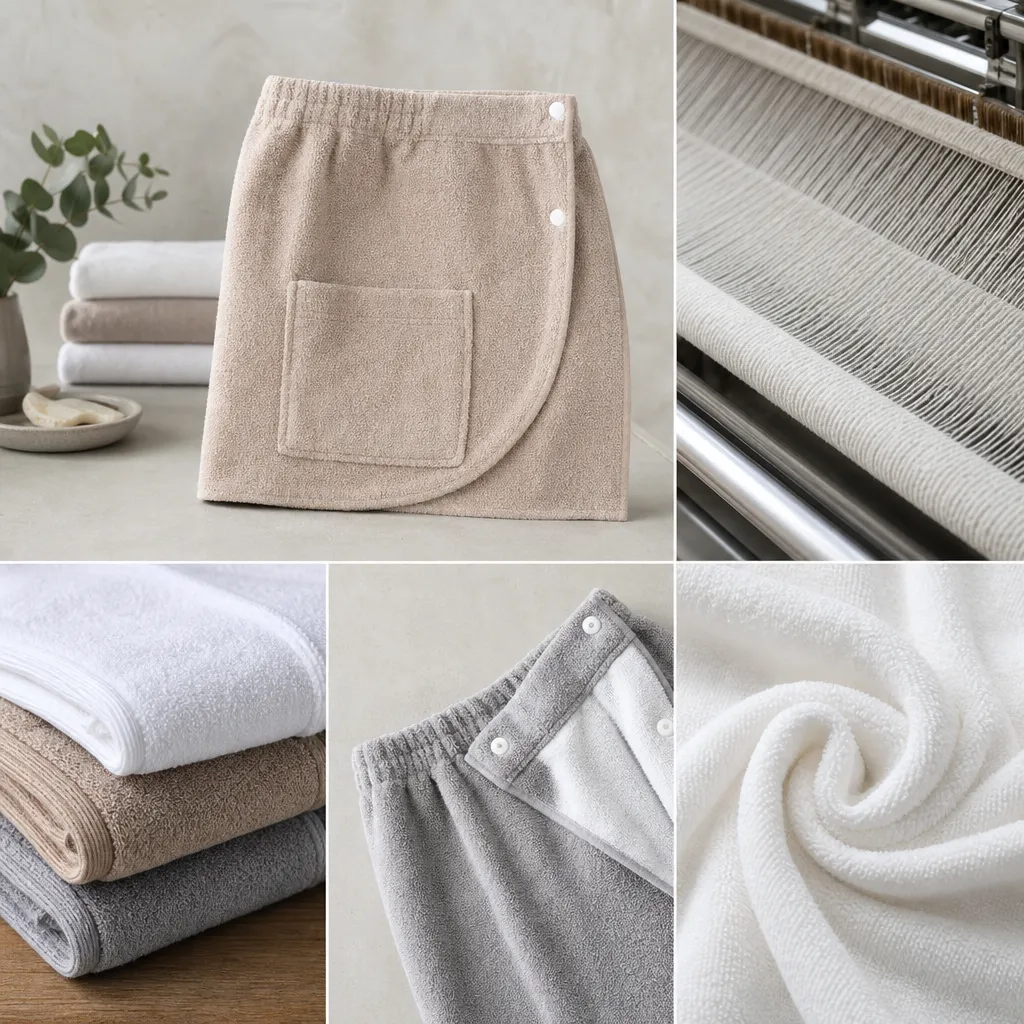
Why a Spa Towel Wrap Fails Differently Than a Bath Towel
A bath towel is a flat absorbent panel. A wrap is a garment-like towel, so the weak points are not only GSM or yarn quality. We check the top band, elastic recovery, hook-and-loop position, side seam balance, and whether the body fabric shrinks at a different rate than the trim. If those details are not specified, the wrap can become narrow, curl at the upper edge, or lose grip after laundering.
For hotel spas, wellness clubs, salons, and treatment rooms, the wrap usually replaces a robe during massage, facial, sauna, waxing, or body treatment service. The product touches skin for longer than a standard towel and is washed more aggressively because oils, clay masks, and body products transfer into the pile. That is why our quote sheet treats a terry body wrap as a sewn textile product, not just a towel with an added fastener.
| Failure point | What we check at sampling | Typical factory tolerance |
|---|---|---|
| Top band distortion | Band width after wash and steam pressing | Within +/- 4 mm across the full width |
| Elastic recovery | Stretch and return after 30 manual pulls | Minimum 85 percent recovery |
| Hook-and-loop hold | Peel resistance after wash testing | No opening under normal body tension |
| Body shrinkage | ISO 6330 domestic wash cycle review | Usually 3-6 percent depending on fabric |
| Side seam twist | Panel grain alignment before cutting | No visible spiral after 5 washes |
Fit Comes Before Decoration
The biggest sourcing mistake is approving a beautiful embroidered sample without putting it on different body sizes. A spa towel wrap has to close securely without forcing the wearer to pull the fabric so hard that the pile compresses. For most adult spa programs, we start with two unisex ranges or separate women's and men's blocks. One-size can work for low-risk promotional use, but it is rarely the best fit for hotel spa operations.
For women's wraps, common finished body lengths are 78-88 cm from top edge to hem. Chest wrap width is often 135-150 cm before closure overlap. For men's wraps, we normally extend the width to 150-165 cm and keep the length around 55-70 cm when the garment is worn from waist level. Some resort programs request a longer men's sauna wrap, but that adds weight and slows drying.
- Women's spa wrap: 80 cm length, 145 cm width, 8-10 cm elasticized back panel, front hook-and-loop closure.
- Men's waist wrap: 62 cm length, 155 cm width, reinforced front closure, no bust shaping needed.
- Plus-size option: 90 cm length, 165-175 cm width, longer closure strip so the wearer can adjust without strain.
- Children's or teen spa use: smaller blocks need separate safety review, especially if snaps or hard trim are used.
We recommend fitting samples on at least three live bodies or mannequins before bulk approval. A paper measurement chart is useful, but it will not show whether the top band digs into the skin or whether the closure lands in an awkward place when the wearer sits.
Fabric Weight: Soft Enough, But Not Slow to Dry
For a spa towel wrap, our usual cotton terry range is 360-480 GSM. Below 340 GSM, the wrap may feel thin after repeated tunnel drying. Above 520 GSM, it can feel plush on day one but becomes heavy when damp and takes longer to process in commercial laundry. Spa operators with high room turnover often choose 380-420 GSM because drying speed matters more than showroom thickness.
We use ring-spun cotton for most OEM spa wraps. Combed cotton is cleaner and smoother, but for a wrap the sewing construction is just as important as the fiber. If the buyer wants a softer hand, we can adjust loop height, yarn count, and finishing. We avoid over-softening when the item will be washed with massage oil residue because too much softener can reduce absorbency and make the closure area feel slippery.
| Use case | Recommended GSM | Construction note | Drying behavior |
|---|---|---|---|
| Treatment room daily use | 360-400 GSM | Short loop terry with stable top band | Fastest for frequent laundry |
| Hotel spa retail or suite amenity | 420-480 GSM | Combed cotton option, cleaner face for embroidery | Moderate drying time |
| Sauna or poolside wrap | 380-450 GSM | Slightly tighter pile to reduce snagging | Good balance |
| Luxury body treatment wrap | 480-520 GSM | Heavier hand, reinforced closure required | Slower, higher laundry cost |
A quick cost-per-use check helps here. One buyer compared a 330 GSM wrap at USD 4.35 with a 430 GSM version at USD 5.85 for 2,000 pieces. In their spa laundry, the lighter version started edge curling around 32 wash cycles and had to be retired near 45 cycles. The stronger version held shape past 85 cycles. Even before counting guest complaints, the cheaper unit cost about USD 0.097 per use, while the better one landed near USD 0.069 per use.
Closure Choices: Velcro, Snaps, Elastic, or Buttons
Most spa wrap towels wholesale orders use hook-and-loop tape because it is familiar, adjustable, and easy for guests. The closure needs careful placement. If the scratch side faces outward too close to the pile, it can catch loops during washing. We normally use a low-profile tape, bar-tack both ends, and set the strip away from the edge so it does not curl.
Snaps look cleaner, but they reduce adjustability. We use nickel-free metal or coated plastic snaps when requested, and we test them after wash and drying because high heat can weaken poor snap tape. Buttons are less common for hotel use because they slow changing and can press into the body during treatment. Elastic at the back is helpful, but the channel must be sewn with enough allowance so the terry and elastic do not fight each other after shrinkage.
- Hook-and-loop tape: best for adjustable spa towel wrap programs; specify width, color, soft-side orientation, and stitch box size.
- Snaps: cleaner appearance for retail or boutique spa use; less forgiving across body sizes.
- Elastic back panel: useful for comfort, but must be tested after ISO 6330 washing and tumble drying.
- Button closure: acceptable for retail gifting, less efficient for treatment-room turnover.
- Internal modesty tab: small added cost, useful when guests sit or move between rooms.
One construction quirk we watch closely is pile crush under the top-band seam. If the folder pressure is too high, the upper 2-3 cm of terry becomes shiny and stiff. It does not always show in a flat photo, but guests feel it against the chest or waist. During sampling, we ask the sewing line to adjust presser-foot pressure and stitch density before we approve the pre-production sample.
Decoration That Survives Spa Laundry
Decoration should sit where it will not rub during treatment or interfere with closure. For a women's body wrap, we usually place embroidery on the lower front panel or above the hem. Chest embroidery can look good on a hanger, but it may shift with different body sizes. For men's waist wraps, a small logo near the lower right front is safer.
Embroidery works well on 380-480 GSM cotton terry when the logo has enough open space. Very thin serif letters below 5 mm height can sink into the pile. For a cleaner result, we use water-soluble topping during stitching and specify backing weight according to the logo. Jacquard is possible, but minimums and setup are higher because the design is woven into the towel body. Printing is less common on cotton spa wraps, though sublimation works for microfiber versions.
| Decoration method | Best for | Technical risk | Typical setup cost |
|---|---|---|---|
| Embroidery | Spa logo, initials, room category marks | Thread snagging if placed near closure | USD 35-80 per logo file |
| Woven label | Size, care, discreet brand mark | Label irritation if placed at top edge | USD 25-60 depending on label type |
| Jacquard border | Repeated brand pattern or stripe | Longer loom setup and higher MOQ pressure | USD 90-180 artwork and sampling |
| Heat transfer | Polyester or microfiber wrap | Peeling under high-heat laundry if film is poor | USD 40-100 per artwork |
For more detail on choosing decoration methods, our comparison of embroidery vs sublimation vs jacquard is useful. If the project includes monograms for VIP suites, the notes in monogrammed bath towels for luxury brands also apply to wrap placement and thread color selection.
QC Tests We Put Into the Spec
A sample wrap should be washed before the buyer signs off. We use internal pre-wash checks and can align with recognized methods when the client requires formal reporting. For dimensional stability, ISO 6330 is a practical reference for domestic-style washing procedures. For colorfastness to washing, ISO 105-C06 is commonly requested. If the wrap is used in spa programs with bleaching or peroxide stain treatment, we test that separately because standard colorfastness does not cover every laundry chemical.
OEKO-TEX Standard 100 Class I is important because the wrap has direct skin contact. Class I is the strictest product class and is often used for baby articles, so it gives conservative assurance for spa and wellness buyers. Our mill also operates under BSCI social compliance and ISO 9001 quality management, which helps when a hotel group needs supplier documentation before onboarding.
- Measure finished width, length, top band, closure strip, and elastic stretch before wash.
- Wash according to the agreed cycle, usually 40 C or 60 C depending on the buyer's laundry reality.
- Tumble dry to the specified condition, then rest the sample flat before re-measurement.
- Check closure peel, elastic recovery, edge curling, side seam twist, and logo distortion.
- Record defects with photos so the bulk production line can match the approved correction.
We also run a simple lint and snag review. Hook-and-loop tape can collect loose fiber during the first wash, so we inspect both tape faces. If the tape clogs too quickly, guests may think the closure is worn out even when the terry body is still good. That is a small component choice with a large service-life effect.
MOQ, Pricing, and What Changes the Quote
Our standard MOQ is 500 pcs per design per color. For a spa towel wrap, that MOQ is more important than for flat towels because cutting and sewing setup take extra line time. If a buyer wants three sizes, two colors, and embroidered department names, each combination needs to be counted. We can sometimes group fabric dyeing across sizes, but decoration and sewing still create separate work tickets.
Pricing depends on GSM, cotton grade, size, closure type, embroidery stitch count, packing, and testing requirements. The bands below are realistic FOB China ranges for cotton terry wraps with standard hook-and-loop closure. They are not fixed quotes because a 12,000-stitch logo and a plain woven label do not cost the same.
| Order volume | Basic 380-400 GSM wrap | 420-460 GSM embroidered wrap | 480-520 GSM heavy wrap |
|---|---|---|---|
| 500-999 pcs | USD 5.10-6.40 | USD 6.30-7.80 | USD 7.60-9.20 |
| 1,000-2,999 pcs | USD 4.55-5.85 | USD 5.70-7.10 | USD 6.95-8.45 |
| 3,000-7,999 pcs | USD 4.15-5.25 | USD 5.20-6.55 | USD 6.35-7.85 |
| 8,000+ pcs | USD 3.85-4.90 | USD 4.85-6.20 | USD 5.95-7.40 |
- Add USD 0.18-0.45 for wider or higher-grade hook-and-loop tape, depending on length and supplier.
- Add USD 0.25-0.90 for embroidery, mainly driven by stitch count and thread changes.
- Add USD 0.12-0.35 for individual polybag, barcode sticker, or size label customization.
- Add lab testing cost if the buyer needs third-party reports rather than factory QC records.
- Reduce unit cost by keeping one fabric color across sizes and changing only the size label.
Cheap closures are where low quotes often hide. Saving USD 0.22 on tape can shorten useful life by 20-30 wash cycles if the hook face clogs or the stitching pulls out. In a spa using each wrap three times per week, that is not a saving. It becomes replacement stock, guest complaints, and laundry sorting time.
Sampling and Production Timeline
A normal OEM timeline is 7-10 days for fabric and closure sourcing if the material is standard, 5-7 days for pattern adjustment and first sample sewing, then 3-5 days for embroidery approval. If lab dips are needed for a custom towel color, add 5-8 days. Once the pre-production sample is approved, bulk production is usually 25-35 days for 500-5,000 pcs and 35-50 days for larger hotel-group rollouts.
Shipping time depends on destination and freight mode. Air freight can move urgent replenishment in 5-9 days after export documents are ready, but the cost per kilogram is high because wraps are bulky. Sea freight is usually better for planned programs. A 430 GSM women's wrap at 80 x 145 cm with closure and packing may weigh around 520-610 g, so carton planning matters.
- Buyer sends size block, GSM target, closure preference, logo file, and expected wash process.
- We confirm fabric construction, component options, MOQ, price band, and sample cost.
- Lab dip or stock color is approved before cutting the fit sample.
- Fit sample is washed, measured, corrected, and photographed.
- Pre-production sample is signed off, then bulk cutting and sewing begin.
- Final inspection checks AQL level, carton marks, size ratio, and packing list before shipment.
For spa openings, we prefer to start 70-90 days before the linen is needed on site. That gives time for sampling, wash testing, production, sea freight, customs clearance, and a small buffer for receiving inspection. The same planning logic in our 90-day hotel linen roadmap works well for spa wrap launches.
Buying for a Full Spa Linen Program
A wrap is usually one item inside a larger linen program. The useful specification depends on what else the guest touches. A resort may pair wraps with treatment towels, hair towels, bath sheets, slippers, and pool towels. A city spa may only need treatment-room towels and wraps, but laundering intensity can be higher because turnover is faster.
If the wrap is cotton terry, we normally keep the hand feel close to the treatment towel so the guest experience is consistent. That does not mean every item should use the same GSM. A treatment towel might sit at 450-550 GSM, while the wrap stays at 400-450 GSM for faster drying and better drape. For waffle spa textiles, the weight and shrinkage behave differently, so they need their own test path.
- Use one white or warm-neutral body color if laundry sorting is limited.
- Choose darker embroidery only after checking thread colorfastness against spa oils and peroxide spotting.
- Keep size labels simple: S/M, L/XL, or Women's and Men's are easier for attendants than numeric sizing.
- Specify carton labels by treatment room, outlet, or property when shipping to multi-site hotel groups.
- Hold 8-12 percent opening reserve stock for new spa launches, then adjust replenishment after 60 days of use.
Related reads: for towels used beside treatment beds, see our spa towel program treatment room specs. For waffle options, compare construction notes in waffle weave towels for spa buyers.
Related reads: if your program includes pool or beach service, beach club resort towel program and chair towels for lounger pool decks cover sizing, loss control, and outdoor laundering issues. For certification paperwork, keep how to read an OEKO-TEX certificate beside your vendor file checklist.
What to Send Us for a Clean Quote
We can quote from a rough brief, but a clean spec prevents expensive revision loops. The minimum package is size, GSM target, color, closure type, logo file, expected order quantity, destination country, and whether the wrap will be retail-packed or bulk-packed for laundry. Photos of current wraps are useful, especially if the buyer wants to fix a real problem like curling, weak closure, or shrinkage.
LUMA & CO. TEXTILE is a 220-employee towel mill operating since 2007 in Gaoyang, Zhejiang, China. We produce about 2.4 million towels annually for more than 80 brand clients across 47 countries. Our standard MOQ is 500 pcs per design per color, and we support OEKO-TEX Standard 100 Class I, BSCI, and ISO 9001 documentation for qualified orders.
Build a Spa Wrap Spec That Holds Up
Send size targets, GSM range, closure preference, logo artwork, order quantity, and destination. We will return a practical OEM quote with sampling timing and wash-test notes. WhatsApp: +86 13384590853. Email: [email protected].
Request a Quote →