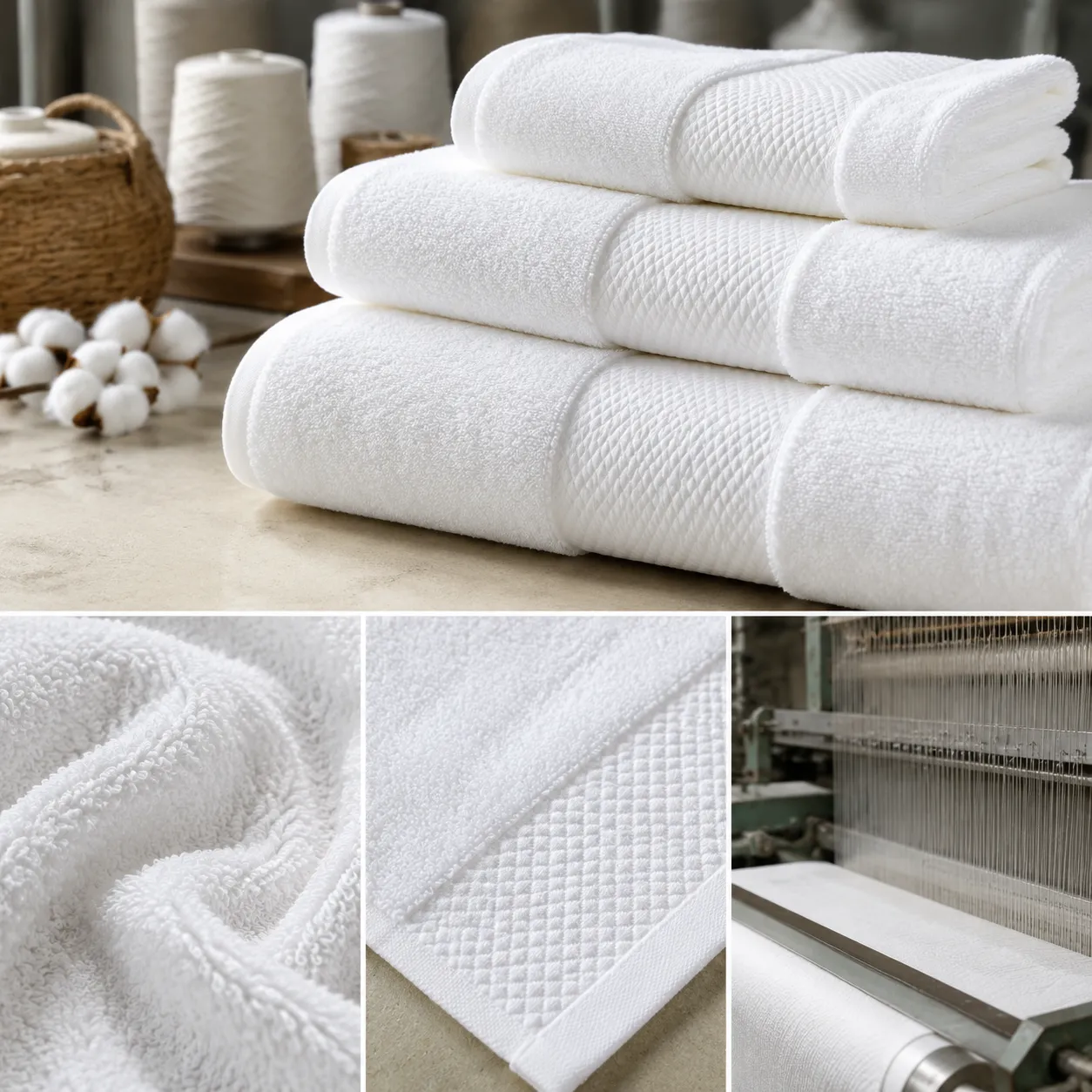
Spa towel cotton hotel procurement checklist
We start this spec by separating the towel program into actual use zones: treatment rooms, locker rooms, pool transfer, and guest-facing vanity areas. A spa towel cotton hotel procurement checklist fails when every towel gets the same GSM and the same hem, because the laundry load, dry time, and hand feel are not the same in each zone. A 60 x 120 cm bath towel at 580 GSM comes in around 418 g before shrinkage, while a 40 x 70 cm hand towel at 500 GSM stays much lighter for faster drying and lower replacement cost.
| Use zone | Suggested size | Target GSM | Why it works |
|---|---|---|---|
| Treatment room face/hand | 30 x 30 cm / 35 x 35 cm | 420-480 | Soft enough for skin contact, dries fast in a hot laundry cycle |
| Locker room hand towel | 40 x 70 cm | 480-520 | Good grip, moderate bulk, lower dryer time than a heavy bath towel |
| Guest bath towel | 60 x 120 cm | 550-620 | Balanced absorbency and fold volume for a spa-linen shelf |
| Pool or sauna transition | 70 x 140 cm | 600-680 | Higher body coverage, but only if your dryers can handle the mass |
If you are standardizing a broader hospitality program, our hotel-towel-sourcing-guide-2026.html and spa-towels-need-different-cotton-than-hotel.html explain where spa towels should diverge from room towels. For a rollout that touches housekeeping, laundry, and front desk inventory, setting-up-hotel-linen-program-90-day-roadmap.html is the cleaner operating sequence.
Cotton construction matters more than brochure language
Buyers often ask for '100% cotton' and stop there, but the cotton construction drives the result. For spa towels, we usually quote ring-spun combed cotton first, because it gives a cleaner yarn surface, less lint in the first wash, and more stable loop formation. Zero-twist can feel plush, but it is more sensitive to snagging and border distortion if the laundry is aggressive. Carded cotton is cheaper, yet it usually brings more fiber fly and a rougher first-hand feel after repeated washing.
| Construction | Hand feel | Laundry behavior | Typical use |
|---|---|---|---|
| Ring-spun combed cotton | Clean, soft, controlled | Lower lint, better loop stability | Spa guest towels and treatment rooms |
| Zero-twist cotton | Very plush at first touch | More snag-prone in heavy commercial laundry | High-touch premium programs with careful handling |
| Carded cotton | Simpler and less refined | More lint and faster surface fatigue | Budget-led or short-life programs |
| Long-staple terry blend | Smooth and absorbent | Can improve durability if yarn quality is controlled | Luxury-facing spa and hotel crossover sets |
Two details tell us whether the mill understands spa use or only retail language. First, the loop height on the body must be even, or the towel starts to stripe after washing. Second, the dobby border should be firm without over-tensioning the edge, because a border that is too tight will cup after hot tumble drying. These are the defects that show up in laundry, not in a glossy sample photo.
Set GSM around the washroom, not the brochure
GSM is still the fastest way to align feel, dry time, and replacement cost. For a spa towel cotton hotel procurement checklist, the best number is not the heaviest number. A thicker towel can feel better in the hand, but if your dryers are already overloaded, you pay for that plushness in extra cycles and slower linen turns. In practice, we see 480-520 GSM for hand and face towels, 550-620 GSM for guest bath towels, and 650 GSM plus only where the laundry team has the capacity to keep up.
| GSM band | Dry time impact | Perceived feel | Our view |
|---|---|---|---|
| 420-500 | Fast | Lean and practical | Best for face, hand, and treatment-room rotation |
| 520-600 | Moderate | Balanced and familiar | The safest zone for most spa bath towels |
| 620-700 | Slow | Dense and premium | Use only when dryers, shelf space, and budget support it |
The technical point is simple: the wrong GSM forces the laundry to work against the spec. If a spa wants the towel to feel luxurious and still turn quickly, we usually tighten the loop density before we just add weight. That gives better absorbency without making the towel unnecessarily thick.
Ask for the right tests before first PO
We do not release a spa order on marketing claims. We release it on measurable checks: OEKO-TEX Standard 100 Class I for skin-contact safety, BSCI for social compliance, and ISO 9001 for process control. On the fabric side, AATCC 135 for dimensional change, AATCC 61 for laundering colorfastness, and ISO 6330 for the wash procedure are the minimum useful references. If the buyer only asks for 'soft and absorbent,' the factory has too much room to interpret the spec.
- Confirm OEKO-TEX Standard 100 Class I on the towel body, not just on one yarn lot.
- Request AATCC 135 shrinkage results after the planned wash temperature, not a home-laundry guess.
- Ask for AATCC 61 colorfastness if the spa uses dyed towels or colored borders.
- Check the ISO 6330 washing method used for the test, since cycle severity changes the result.
- Keep the mill's ISO 9001 and BSCI documentation in the supplier file before deposit.
A good sample is not the one that feels nicest in the first minute. It is the one that still meets size, edge, and color limits after hot laundering and commercial drying.
Construction details that decide pass or reject
This is where spa towels either stay calm in production or turn into a claims file. The most common problems are not dramatic; they are small edge failures that get worse in laundry. A loose hem can tunnel, the side seam can twist, and a border can show wave distortion after washing. If the buyer wants white towels for a humid spa, we also watch for stray cotton seeds, yarn contamination, and uneven whiteness between body and border.
- Check the hem stitch density and make sure both ends are locked evenly.
- Measure width and length after the first wash and again after the third wash.
- Inspect loop pull resistance around the border transition, not only on the center panel.
- Confirm the shade is consistent across cartons so housekeeping does not sort by eye.
- Open random polybags to confirm no moisture smell or packing dust is trapped inside.
| Defect mode | What causes it | How to prevent it |
|---|---|---|
| Border cupping | Over-tight dobby or uneven tension in finishing | Relax the border weave and test after tumble drying |
| Side twist | Yarn imbalance or poor cutting alignment | Use balanced cutting and inspect the selvage before sewing |
| Lint shedding | Weak yarn twist or poor first wash control | Specify ring-spun yarn and ask for pre-shrink wash checks |
| Pill spots | Short fibers and surface abrasion | Upgrade cotton quality and reduce aggressive finishing |
We prefer to review the finished towel under real handling: fold, shake, wash, dry, and stack. If it only looks right on a flat table, it is not ready for spa operations. That is why we build the approval around use, not around a single photo.
Pricing, MOQ, and lead time
For a standard spa towel cotton hotel procurement checklist, our MOQ is 500 pcs per design per color. At that size, the mill is still absorbing setup cost, so price discipline matters. Once buyers move into repeat orders and cleaner artwork, the unit rate improves quickly. For plain white ring-spun combed cotton towels with a dobby border, these are realistic factory-side bands when the order is stable and the spec is clear.
| Order size | Typical spec | Unit price band (USD) | Lead time |
|---|---|---|---|
| 500 pcs | 580 GSM bath towel, plain white, standard dobby | 2.85-3.75 | 10-14 days sample, 30-38 days bulk |
| 1,500 pcs | Same body spec, tighter packing control | 2.35-3.10 | 28-35 days bulk |
| 5,000 pcs | Repeat program with confirmed yarn and color | 1.88-2.55 | 28-32 days bulk |
| 10,000 pcs+ | Annual spa program with steady repeats | 1.72-2.30 | 26-30 days bulk |
Logo embroidery, woven labels, or special border colors usually add cost, but the delta should stay controlled if the artwork is simple. We generally see small embroidery add USD 0.18-0.42 per piece depending on stitch count and thread coverage. If the buyer wants a dyed body color plus a matching border, the real cost driver is not the dye itself; it is the risk of shade mismatch and the extra approval loop.
Build the PO so the factory cannot guess
The fastest way to keep a spa program stable is to write the purchase order like a production document. That means the mill should not need to infer size tolerance, folding method, carton ratio, or whether the towel is for treatment rooms or guest baths. If you need the tech-pack structure, build-towel-tech-pack-that-mills-can-quote.html is the format we use before quoting. It cuts down the back-and-forth that usually burns a week.
- State the exact finished size with shrinkage tolerance, not just the cut size.
- Call out GSM, cotton type, border style, and hem construction in one line.
- Specify whether the towel must survive commercial laundering or only guest-room use.
- Confirm carton quantity, inner packing, and pallet requirement before mass production.
- Add the approved Pantone or white shade reference if the program is not pure white.
If the hotel also wants a decorative treatment-room textile or a coordinated wellness set, the decoration language needs a separate review. Our waffle-weave-towels-spa-buyer-specs.html notes where construction changes the hand feel, and how-to-read-oeko-tex-certificate.html shows what to check before you accept a certificate scan.
What we would push back on
We push back when the buyer wants luxury softness, hotel-grade durability, and the lowest possible price in the same line item. Those goals are not equal. A cheaper towel can work for a short-cycle promotional program, but a spa program is different because it gets repeated laundering, higher staff handling, and more guest touchpoints. The cost-per-use gap widens once the lower-grade towel loses shape and has to be replaced earlier than planned.
- If the request is under 450 GSM for a premium spa bath towel, the turnover will be fast but the shelf look will be thin.
- If the buyer wants heavy pile without changing dryer settings, the laundry bill usually rises.
- If the spec skips colorfastness, any dyed border can become a recurring complaint.
- If the program ignores shrinkage tolerance, housekeeping ends up sorting by size after a few wash cycles.
For buyers comparing hospitality towel systems more broadly, our hotel-towel-sourcing-guide-2026.html explains the bigger category tradeoffs, while setting-up-hotel-linen-program-90-day-roadmap.html is useful when spa towels sit inside a full opening plan.
Related reads
Related reads: spa-towels-need-different-cotton-than-hotel.html, waffle-weave-towels-spa-buyer-specs.html, hotel-towel-sourcing-guide-2026.html.
Also useful: build-towel-tech-pack-that-mills-can-quote.html, how-to-read-oeko-tex-certificate.html, setting-up-hotel-linen-program-90-day-roadmap.html.
If you want us to check a spa spec before you send the PO, reach us on WhatsApp +86 13205717266 or email [email protected]. We can review GSM, cotton construction, test language, and packing details before you lock the order.
Send Your Spa Towel Quote Review
Share the spec, target price, and opening date. We will check the towel construction, wash-life risk, and packing details before production.
Request a Quote →