Why hotel towel manufacturers are not interchangeable
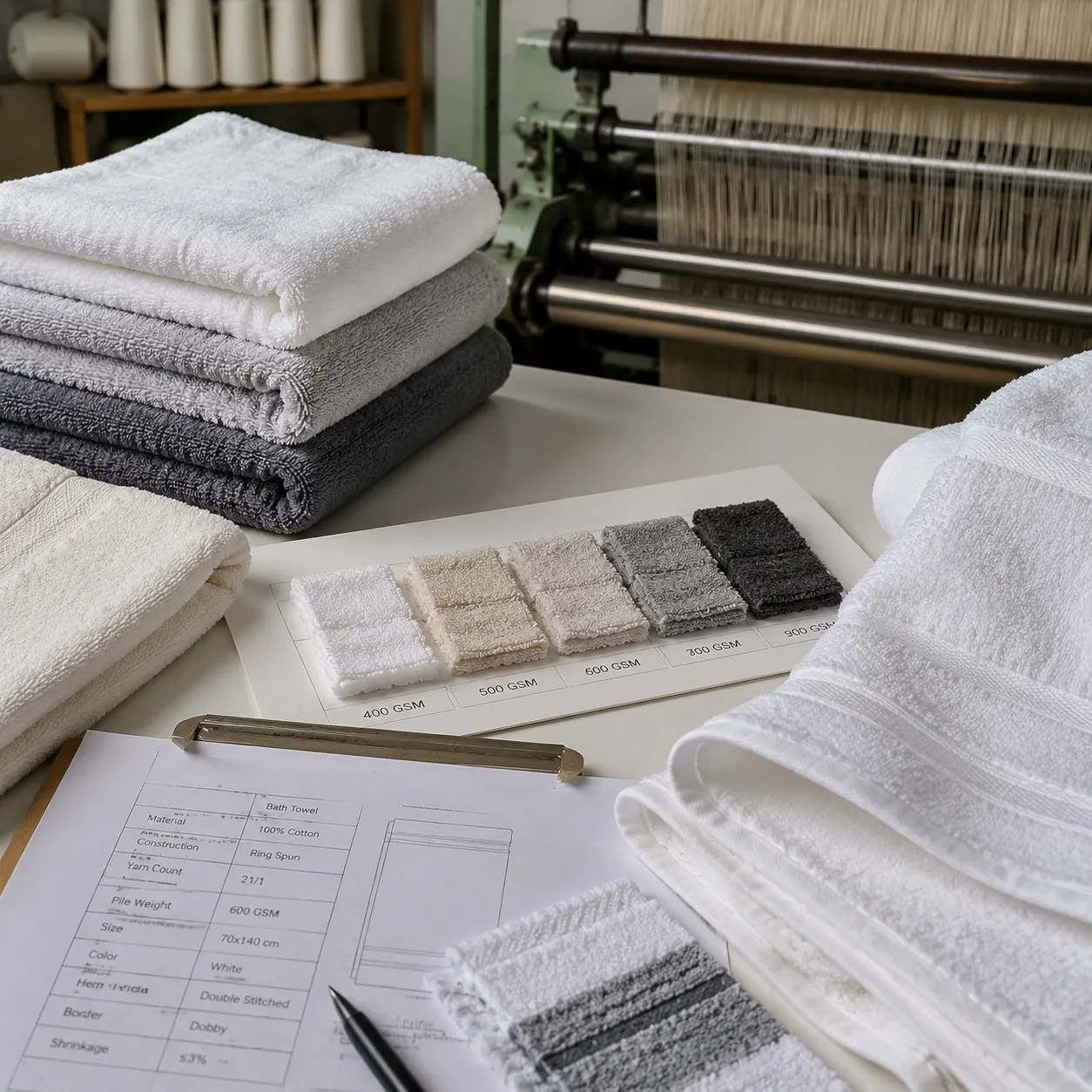
A hotel towel is a laundry asset, not a decorative textile. The buyer sees a unit price, but the hotel operator pays for wash cycles, drying time, replacement stock, guest complaints, and shrinkage control. Two factories can quote the same 70 x 140 cm bath towel at 550 GSM, yet the finished towels may behave very differently because of yarn count, pile height, twist, dyeing route, hem density, and finishing tension.
Inside our mill, we separate hotel programs from retail bath towel programs because the failure modes are different. Retail towels are judged heavily on shelf softness. Hotel towels must survive tunnel washers, alkaline detergent, chlorine-free oxygen bleach, tumble drying, folding pressure, and cart handling. For a 180-room hotel running 3.2 par stock, one weak specification can become 1,700 replacement towels within a year.
We operate as a vertically integrated OEM towel manufacturer with 220 employees, annual output around 2.4 million towels, and MOQ of 500 pcs per design per color. Our normal hotel towel range is 450-750 GSM for terry bath items, 320-450 GSM for pool or gym towels, and 380-520 GSM for lighter guest-room hand towels. For buyers comparing hotel towel manufacturers, the useful question is whether the factory can explain why those ranges exist.
| Hotel towel item | Common size | Practical GSM range | Main risk if underspecified |
|---|---|---|---|
| Washcloth | 30 x 30 cm or 33 x 33 cm | 420-550 GSM | Edges curl and corners deform after hot wash |
| Hand towel | 40 x 70 cm or 50 x 80 cm | 430-600 GSM | Low absorbency at guest-room vanity |
| Bath towel | 70 x 140 cm or 76 x 152 cm | 500-700 GSM | Short laundry life and thin hand feel |
| Bath sheet | 90 x 150 cm or 100 x 180 cm | 550-750 GSM | High drying cost if weight is not controlled |
| Pool towel | 75 x 150 cm or 80 x 160 cm | 360-520 GSM | Sand retention, slow drying, and deck loss |
Start with laundry conditions, not softness
The first technical question we ask a hotel buyer is not the target hand feel. We ask about laundry. Is washing done in-house or by an outside industrial laundry? What is the drying temperature? Is optical brightener used? Are towels sorted by department, or do spa, pool, and room towels move through the same wash flow?
A soft showroom sample can be created by aggressive silicone finishing. That finish may disappear after 5-8 washes, leaving a weak base fabric. A better hotel construction uses suitable cotton, controlled pile ratio, and enough ground stability so the towel still feels acceptable after finishing chemistry is gone. For most full-service hotels, we prefer combed cotton ring-spun yarn in the pile, with a stronger ground yarn to stabilize the fabric.
- In-house laundry at 60-75°C: choose stronger hems, moderate pile height, and avoid overly low-twist yarns that shed early.
- Outsourced industrial laundry: specify shrinkage limits and require wash-test reports before bulk cutting.
- Resort pool operation: prioritize drying speed and inventory control; a 480 GSM pool towel often performs better than a 650 GSM towel on a busy deck.
- Spa or wellness rooms: separate the spa towel specification from bath linen if oil exposure or warmer cabinets are used.
- White-only hotel program: confirm whiteness tolerance and rewash method because optical brightener differences are visible on mixed batches.
For hotel operators building a new room program, our related 90-day planning article is useful: setting up a hotel linen program. If the issue is mainly towel weight, see our GSM decision framework before locking the tech pack.
Construction details that reveal a real factory
A serious hotel towel factory should be able to discuss construction without hiding behind vague words like luxury or premium. We look at pile-to-ground ratio, loop density, selvedge stability, border depth, hem stitch count, and finishing route. These are not decorative details. They decide whether the towel distorts after repeated extraction and tumble drying.
One construction quirk we watch closely is the border transition. Decorative dobby borders can become a weak line if the float length is too long or the pile change is too abrupt. In hotel laundries, this creates a horizontal crease that never fully relaxes after pressing. For bath towels above 600 GSM, we usually keep the dobby border compact, around 4-6 cm, unless the buyer accepts longer drying time and higher edge stress.
Another defect mode is hem tunneling. This happens when the sewn hem shrinks at a different rate from the terry body, creating a raised tube along the towel end. It is often caused by poor sewing tension, unstable ground weave, or insufficient relaxation after dyeing. A buyer may not see it on a new sample, but after 20 washes it becomes obvious during folding.
| Construction point | Factory check | Our usual hotel setting |
|---|---|---|
| Pile yarn | Ask for cotton type and yarn count, not only GSM | Combed cotton pile, often 16s/1 or 21s/2 depending on towel |
| Ground yarn | Check stability after 5 wash cycles | Stronger cotton or cotton/poly ground where permitted by spec |
| Hem | Inspect stitch density and after-wash puckering | Double-needle lockstitch, typically 8-11 stitches per inch |
| Dobby border | Check float length and crease behavior | Compact hotel border unless a custom brand pattern is required |
| Finishing | Ask whether softness is mechanical, chemical, or both | Controlled softener with absorbency check after finishing |
Testing: what we ask QC to measure
Buyers often ask for a pre-production sample, but a sample without test data is only half useful. In our QC room, we measure GSM, dimensions before and after washing, color fastness, absorbency, lint behavior, and seam appearance. For white hotel towels, whiteness consistency across lots is also checked because mixed replacement orders can sit in the same bathroom.
For dimensional stability, we use ISO 6330 washing procedures as a reference point and record shrinkage after multiple wash cycles. For color fastness, especially on beige, charcoal, spa green, or pool stripe towels, ISO 105-C06 and ISO 105-X12 are relevant references for washing and rubbing. Absorbency can be checked by a drop test and by timed sink testing; the important part is consistency between lab sample and bulk.
A topic-specific test we recommend for hotel towels is the lint screen check after tumble drying. We weigh lint collected after controlled wash and dry cycles, then compare it with towel weight loss. High first-wash lint may be acceptable on some terry, but continuing lint after the fifth wash suggests weak fibers, poor singeing, or unstable pile yarn. That towel will fill dryer filters and age quickly.
| QC item | Reference or method | Typical acceptance target |
|---|---|---|
| Dimensional change | ISO 6330 wash reference | Within -5% length and -5% width for most hotel terry |
| Color fastness to washing | ISO 105-C06 | Grade 4 or better for dyed hotel colors |
| Rubbing fastness | ISO 105-X12 | Dry grade 4, wet grade 3-4 or better |
| Absorbency | Internal drop and sink timing | Water drop absorbed within 5 seconds after prewash |
| Lint and weight loss | Controlled wash/dry comparison | Stable after early wash cycles; no continuous heavy shedding |
Certification matters, but it should not replace product testing. Our mill holds OEKO-TEX Standard 100 Class I, BSCI, and ISO 9001 certification. OEKO-TEX helps confirm chemical safety. BSCI is about social compliance. ISO 9001 supports process control. None of these certificates automatically proves that a 620 GSM towel will survive your laundry flow, so we still recommend wash testing the exact construction.
Pricing bands by volume and specification
Hotel towel pricing changes with cotton market, exchange rate, dyeing route, packaging, and towel weight. Still, buyers need a working range before they build a budget. Below are realistic FOB China reference bands we use when discussing wholesale hotel towels with procurement teams. They are not final quotations, but they show where cost usually sits.
| Item and specification | 500-999 pcs | 1,000-4,999 pcs | 5,000+ pcs |
|---|---|---|---|
| 70 x 140 cm bath towel, 520 GSM, white combed cotton | USD 3.35-4.10 | USD 2.95-3.65 | USD 2.70-3.30 |
| 76 x 152 cm bath towel, 600 GSM, white combed cotton | USD 5.10-6.20 | USD 4.55-5.45 | USD 4.20-5.05 |
| 50 x 80 cm hand towel, 500 GSM, dyed color | USD 1.55-2.05 | USD 1.35-1.80 | USD 1.20-1.60 |
| 30 x 30 cm washcloth, 450 GSM, white | USD 0.38-0.62 | USD 0.32-0.52 | USD 0.28-0.45 |
| 80 x 160 cm pool towel, 420 GSM, yarn-dyed stripe | USD 4.40-5.60 | USD 3.95-5.05 | USD 3.60-4.65 |
A simple cost-per-use check prevents false savings. Suppose a 76 x 152 cm bath towel at 580 GSM costs USD 4.70 and lasts 92 hotel wash cycles before demotion to back-of-house use. The textile cost is about USD 0.051 per use. A lighter version quoted at USD 3.85 may look attractive, but if it loses body and is removed after 54 cycles, the cost becomes USD 0.071 per use. On a 240-room property using 4.5 towel turns per room per day, that difference is large enough to affect annual linen budgeting.
This is why we sometimes push back when buyers ask for very low GSM bath towels for full-service rooms. A 430 GSM bath towel can make sense for a hostel, airline amenity, or compact gym shower program. It is usually a poor fit for a four-star hotel room where the guest compares towel weight directly with the room rate.
Custom hotel towels: logo, border, and color
Custom hotel towels can be made with embroidery, jacquard weaving, dobby border text, yarn-dyed stripe, or woven label. Each method has a different minimum, cost, and laundry behavior. Embroidery is flexible for boutique hotels because it works at our standard MOQ of 500 pcs per design per color. Jacquard is stronger for repeated identity across a larger program, but it needs more planning because the design is built into the weave.
- Embroidery: best for bathrobes, bath sheets, and selected guest towels; keep stitch density moderate so the logo does not create a hard patch.
- Jacquard logo: useful for pool towels and branded bath towels; artwork must be simplified to the terry grid.
- Dobby border wording: clean for hotel names, but letters under 8-10 mm high often lose sharpness.
- Yarn-dyed stripe: strong for resort and pool programs; test stripe bleeding with ISO 105-C06 before approval.
- Woven label: low cost and easy to reorder, but check label edges because rough labels irritate guests.
For logo decisions, compare methods in embroidery vs sublimation vs jacquard. If your team is preparing artwork for woven patterns, our guide on designing for jacquard explains why fine lines and gradients need to be redrawn for towel production.
MOQ, sampling, and production timing
Our standard MOQ is 500 pcs per design per color. For hotel programs, the practical ordering unit is often higher because par stock must cover rooms, laundry circulation, storage, and replacement. A 120-room hotel with 3 par bath towels per room should not place a first production order of only 500 bath towels unless it is a pilot.
- Tech pack review and quotation: 1-3 working days if size, GSM, yarn, color, logo, and packing are clear.
- Lab dip or strike-off for dyed towels: 5-8 days after Pantone or physical color standard is confirmed.
- Prototype or pre-production sample: 7-14 days for plain terry, 15-22 days for jacquard or special border work.
- Bulk weaving, dyeing, sewing, inspection, and packing: usually 25-38 days after sample approval and deposit.
- Export booking and vessel departure: commonly 5-12 days depending on port space and destination schedule.
A normal repeat order for white hotel towels is faster than a new custom program. For a new hotel opening, however, we advise locking towel specifications at least 75-90 days before the required warehouse date. This leaves time for sample correction, lab testing, carton mark approval, and freight buffer. Buyers using sea freight should also compare the timing and cost implications in container vs air freight towel orders.
How to audit a hotel towel supplier
A supplier audit does not need to be complicated, but it must be specific. A trading company may send attractive photos and still have no control over yarn purchase, weaving tension, dyeing correction, or final inspection. A real hotel towel supplier should be able to show production records, inspection standards, and defect classification.
- Ask whether weaving, dyeing coordination, sewing, inspection, and packing are controlled directly or outsourced without traceability.
- Request a test report for the exact towel construction, not a generic certificate from another product line.
- Check whether the factory can hold lot-to-lot whiteness and color within agreed tolerance for repeat orders.
- Confirm carton weight, compression method, and bale handling because over-compressed towels arrive with deep creases.
- Ask how seconds are separated; mixed-grade shipment is a common reason hotel towels look inconsistent after unpacking.
- Review BSCI, ISO 9001, and OEKO-TEX certificates for validity, product scope, and issuing body.
For chemical safety documents, we recommend reading our guide on how to read an OEKO-TEX certificate. For buyers still building the first specification sheet, build a towel tech pack that mills can quote will reduce back-and-forth and prevent unclear quotes.
Common sourcing mistakes we see
The most expensive hotel towel mistakes usually begin with incomplete specifications. A buyer asks three hotel towel manufacturers for a 600 GSM bath towel, then chooses the lowest price. Later, the hotel receives towels with loose hems, narrow finished size, unstable whiteness, or excessive lint. The quote was not comparable because the underlying construction was not controlled.
- Approving an unwashed sample: always compare new sample and washed sample side by side.
- Ignoring finished size tolerance: a towel woven to size and a towel finished to size are not the same thing.
- Using retail softness as the main target: hotel towels must be soft enough, but laundry durability comes first.
- Mixing pool and room inventory: chlorine exposure, sunscreen oil, and deck loss distort room linen planning.
- Ordering too close to opening date: rushed air freight can erase the savings of careful OEM sourcing.
One practical correction is to define demotion rules before ordering. For example, a guest-room bath towel may move to spa, pool, housekeeping, or rag use after stains, edge wear, or weight loss cross a defined threshold. This makes procurement decisions easier because the towel is judged across its full service path.
If your hotel also operates a beach club or pool deck, the specification should not simply copy the room bath towel. See our beach club resort towel program and chair towels for lounger pool decks for deck-specific sizing, loss control, and drying considerations.
What to send us for an accurate quote
The fastest way to compare OEM hotel towel pricing is to send a complete but simple brief. We do not need a 20-page document. We need the details that affect yarn, weaving, dyeing, sewing, testing, packing, and freight. If those are clear, we can usually return a practical quotation within 1-3 working days.
- Towel item list with finished size, target GSM, and quantity per item.
- Color requirement: white, Pantone reference, physical standard, or yarn-dyed stripe layout.
- Logo method if needed: embroidery file, jacquard artwork, dobby wording, or woven label dimensions.
- Laundry conditions: in-house or outsourced, wash temperature, bleach policy, drying method, and expected wash life.
- Certification requirement: OEKO-TEX Standard 100 Class I, BSCI, ISO 9001, or buyer-specific compliance documents.
- Packing method: carton pack, inner polybag policy, barcode label, carton mark, pallet requirement, and destination port.
For standard white hospitality towels, our workable production path is straightforward: confirm spec, make sample, wash test, approve bulk, weave, dye or bleach, finish, sew, inspect, pack, and ship. For custom color or logo work, add lab dip and decoration approval. MOQ remains 500 pcs per design per color, but the economic price level improves noticeably at 1,000 pcs and again above 5,000 pcs.
LUMA & CO. TEXTILE has supplied towel programs for brand clients in 47 countries since 2007. We are not a resale catalog; we make OEM towels and control the specification from yarn planning through final inspection. For hotel buyers, that control is what protects consistency across first order, replacement order, and expansion order.
Send a hotel towel spec for review
For OEM hotel towel quotations, contact us on WhatsApp at +86 13384590853 or email [email protected] with size, GSM, quantity, color, logo method, and laundry conditions.
Request a quote →