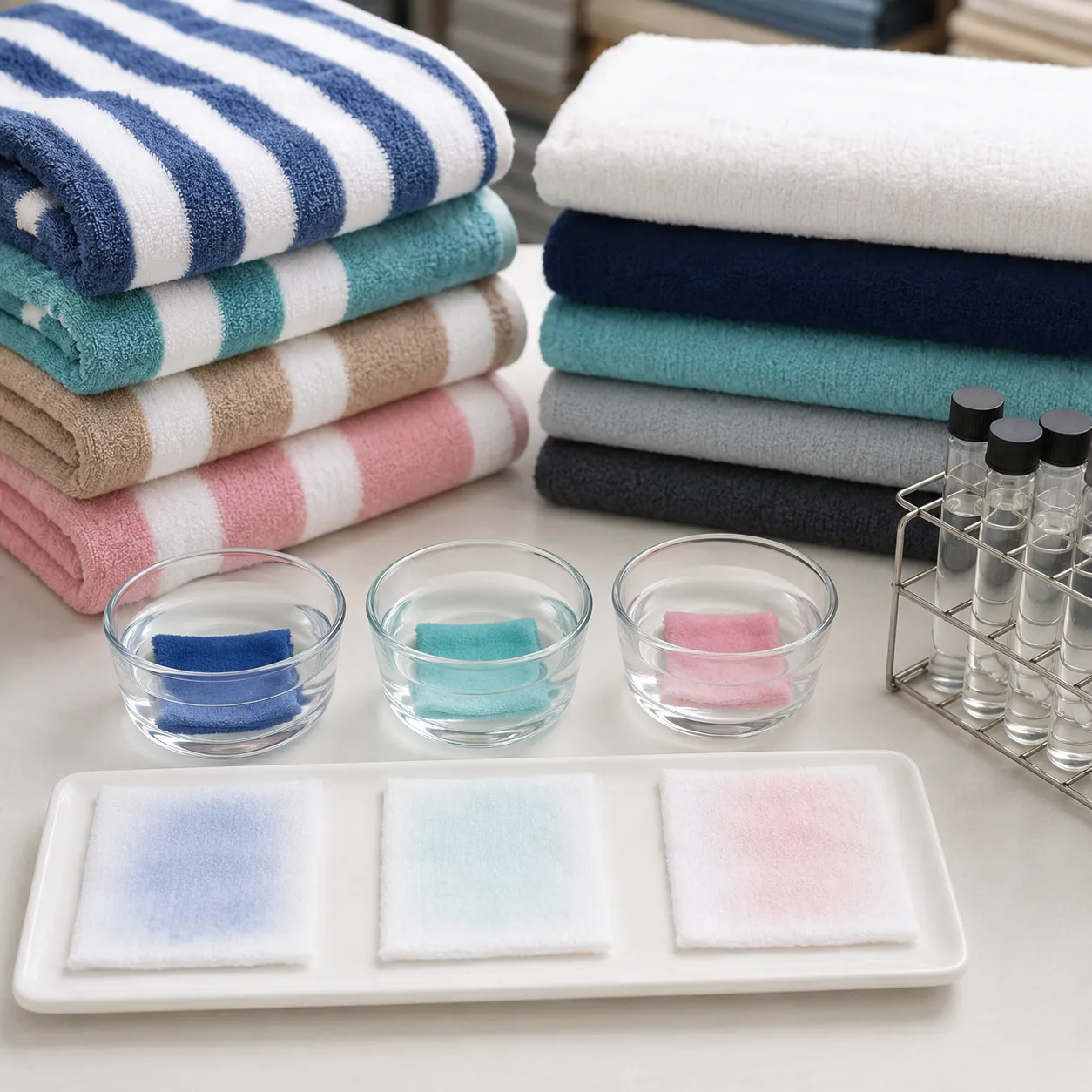
Why Colorfastness Fails on Beach Towels
Beach towels are harder to control than indoor bath towels because the color is stressed in more ways. A hotel bath towel mostly sees detergent, tumble drying, and guest use. A beach towel sits under UV, touches chlorinated pool water, absorbs sweat and sunscreen, and is often packed wet into a tote bag or laundry cart. If the dye recipe, washing-off process, or decoration layer is weak, the towel may pass a simple visual inspection and still fail in service.
At our Gaoyang mill we treat colorfastness as a production gate, not as a complaint-response activity. For cotton terry beach towels, most solid colors use reactive dyeing with salt and soda ash fixation. The risk is unfixed hydrolyzed dye left in the pile or border. For printed microfiber or velour-face beach towels, the risk shifts to transfer print penetration, binder stability, and shade migration at the cut edge. Jacquard beach towels add a different problem: dark and light yarns sit in the same fabric, so staining of the pale yarn becomes visible after wet storage.
Our default MOQ is 500 pcs per design / per color. That sounds small, but it is still enough product for a brand to damage a resort launch if the wrong turquoise, navy, red, or black fails. For this reason, we ask buyers to approve both shade and performance before bulk dyeing starts.
- Dark reactive shades such as navy, black, bottle green, and burgundy need stronger soaping and neutralization control than pale beige or ivory.
- High-contrast jacquard layouts need staining checks because loose dye from dark yarn can mark white pile.
- Velour sheared faces can look even in the showroom but release lint and surface dye during rubbing tests if the shearing and washing-off steps are rushed.
- Sublimated microfiber towels usually resist washing well, but poor heat transfer settings can cause dull shade and edge migration.
- Resort pool programs need chlorine and wet-stacking checks because guest behavior is less controlled than retail home use.
Custom Beach Towel Colorfastness Test Protocol
A custom beach towel colorfastness test protocol should be written before lab dips are ordered. If the buyer waits until the pre-shipment inspection, the mill has fewer ways to correct the issue without re-dyeing, re-washing, or downgrading the lot. We recommend treating the protocol as part of the tech pack, beside GSM, size, yarn, decoration, packaging, and carton packout.
For most OEM beach towel orders we combine ISO methods with buyer-specific service simulations. ISO gives a repeatable baseline; service tests catch the situations that happen on pool decks and beach clubs. For example, ISO 105-C06 gives wash fastness data, but it does not tell us what happens when a damp navy towel is rolled against a white embroidered label for eight hours in a housekeeping cart. That is why our protocol includes both laboratory tests and practical mill-floor checks.
| Test item | Recommended method | Typical pass level | Why it matters |
|---|---|---|---|
| Wash fastness | ISO 105-C06 A1S or A2S | Grade 4 color change, grade 4 staining | Checks loose dye after laundering |
| Rubbing / crocking | ISO 105-X12, dry and wet | Dry grade 4, wet grade 3-4 | Prevents transfer to loungers, bags, uniforms |
| Chlorinated water | ISO 105-E03 | Grade 3-4 or higher | Screens pool-water shade loss |
| Perspiration | ISO 105-E04 acidic and alkaline | Grade 4 staining target | Useful for beach, gym, and cruise use |
| Grey scale rating | ISO 105-A02 and ISO 105-A03 | Used for all visual grading | Keeps supplier and buyer using one language |
| Wet stacking | Mill simulation, 8-12 hours at 38-42°C | No visible transfer to white cotton | Catches damp-cart staining not covered by basic inspection |
For retail beach towels, we usually add a one-home-laundry simulation after sample approval. For hotel, beach club, and cruise buyers, we increase the wash count and include chlorine exposure. If the towel will be sold as a coordinated set with white robes, canvas bags, or pale chair covers, wet rubbing and wet stacking become non-negotiable.
Failure Mode 1: The Lab Dip Matches, Then Bulk Bleeds
The most common sourcing mistake is approving the lab dip only under a lightbox. A lab dip is usually made from a small fabric swatch under controlled conditions. Bulk dyeing runs in larger liquor ratios and the fabric mass is heavier. If the dye bath, salt dosing, alkali ramp, or soaping stage is not scaled correctly, the color can match the Pantone target and still release dye in the first wash.
In reactive dyeing, fixation is not 100%. The remaining hydrolyzed dye must be washed off. On a 450-520 GSM cotton beach towel, the pile holds more liquor than a flat woven fabric, so insufficient rinsing leaves residue deep in the loops. We check the final rinse conductivity and pH before softening. Our internal target after neutralization is usually pH 6.0-7.5 on extracted liquor for cotton terry. If the towel is softened while still alkaline, the hand feel may be acceptable but the wash fastness can drift.
| Bulk symptom | Likely production cause | Spec control to add |
|---|---|---|
| First wash water turns dark | Insufficient soaping after reactive dyeing | Require ISO 105-C06 plus rinse-water check before finishing |
| White border stains blue or red | Dark yarn migration during wet storage | Add wet stacking test with adjacent white cotton fabric |
| Shade looks patchy after chlorine contact | Dye class not suitable for pool exposure | Add ISO 105-E03 at lab dip stage |
| Color rubs onto packaging insert | Surface dye or print binder not cured | Add ISO 105-X12 wet crocking before packing |
| Bulk shade is redder than approved sample | Dye bath scaling or drying temperature shift | Approve bulk cutting from first lot before full finishing |
For dark navy, emerald, rust, and black beach towels, we normally advise buyers not to compress the post-dye washing time to save a few cents. A rushed wash-off can reduce FOB cost by roughly USD 0.06-0.11 per piece on a 5,000 pc order, but one replacement shipment by air can add USD 0.85-1.35 per towel depending on destination and carton volume. The cheaper route is not cheaper if the towel transfers color onto a guest's white cover-up.
Failure Mode 2: Pool Chlorine Changes the Shade
Pool towels are exposed to more chemistry than buyers often specify. Chlorinated water, cleaning spray residue on loungers, and high-pH commercial laundering can all attack color. The issue is not only fading; some shades shift hue. A turquoise can turn dull green, a warm red can move toward orange, and a charcoal can look brown after repeated exposure.
For resort beach towels we suggest testing chlorine fastness during the strike-off stage, especially when the color palette includes blues, greens, corals, and deep greys. ISO 105-E03 is a useful base method. For stricter resort programs, we also run a practical soak: towel cutting in 20-30 ppm available chlorine solution for 30 minutes, rinse, dry, and compare under D65 light. This is not a replacement for ISO testing, but it helps the buyer visualize pool-deck risk.
- Ask whether towels will be used at pools, beaches, spas, yachts, or retail homes; the chemical exposure is different.
- State whether chlorine fastness is required on the lab dip, pre-production sample, bulk fabric, or all three.
- Define the acceptable grey scale grade instead of writing vague wording such as "no fading".
- Check embroidery thread separately because polyester thread can hold color while the cotton ground fades.
- Keep a sealed control sample from the approved lot for reorder comparison.
A buyer sourcing for a beach club should not use the same acceptance standard as a one-season retail giveaway. For a 380 GSM promotional towel, grade 3-4 after chlorine exposure may be commercially acceptable. For a 560 GSM resort towel expected to run two summers, we normally push for stronger dye selection and a documented wash/chlorine trial before bulk approval.
Failure Mode 3: Wet Crocking Marks Loungers and Bags
Wet crocking is one of the most important tests for beach towels because guests do not use towels dry. They sit on them after swimming, carry them in canvas bags, and roll them against swimwear. ISO 105-X12 uses a crockmeter to rub a white test cloth against the towel surface under controlled pressure. We grade staining using ISO 105-A03.
Velour beach towels need special attention. The sheared face looks clean and prints well, but the cut fiber ends can hold surface dye and softener. If the towel is dark and heavily softened, wet crocking can drop below grade 3 even when wash fastness is acceptable. In production we check both the terry back and velour face because the two surfaces behave differently.
This is also where decoration choices matter. A large plastisol transfer, a rubber patch, or a dense embroidery can trap moisture. If the towel is packed before full conditioning, the area around the logo may become a staining point. For buyers comparing logo methods, our related article embroidery vs sublimation vs jacquard explains how each technique behaves on towel surfaces.
| Towel construction | GSM range we usually see | Colorfastness risk | Recommended added check |
|---|---|---|---|
| Cotton terry solid dyed | 420-600 GSM | Loose reactive dye in pile | Wash fastness and wet crocking |
| Cotton velour printed or dyed | 360-520 GSM | Surface rubbing on sheared face | Wet crocking on velour side |
| Jacquard yarn-dyed beach towel | 450-650 GSM | Dark yarn staining light yarn | Wet stacking against white cotton |
| Turkish flat weave / hammam | 240-380 GSM | Stripe bleeding along warp/weft | Wash fastness with multifiber adjacent fabric |
| Microfiber sublimation towel | 200-320 GSM | Print migration or edge dullness | Rubbing plus heat-transfer cure check |
Build the Test into Sampling, Not Inspection
The cleanest workflow is to test in stages. A pre-shipment inspection can confirm the final goods, but it should not be the first time colorfastness is measured. If a bulk lot fails after cutting and hemming, the corrective options are slow and expensive. Re-washing may improve loose dye, but it can change hand feel, shrinkage, and shade. Re-dyeing finished towels is usually not acceptable for branded goods.
- Confirm end use and exposure: pool, beach, spa, cruise, retail, or promotional event.
- Set GSM, size, yarn, dye class, decoration, and packaging in the tech pack before lab dips.
- Run lab dip shade approval with D65/TL84/A light source review and colorfastness tests for risky shades.
- Make a pre-production sample from production fabric, not only a small hand-dyed swatch.
- Test bulk fabric before full cutting when dark colors or white contrast areas are involved.
- Keep approved sample, bulk cutting, test report, and carton label photos in the order file.
For a standard beach towel program, lab dips usually take 5-7 days after Pantone or physical sample confirmation. Pre-production samples take 7-12 days if the yarn and base fabric are available. Bulk production normally runs 25-38 days after sample approval and deposit, depending on order size, jacquard loom time, printing queue, and packaging requirements. Third-party lab testing can add 4-8 days, so it should be planned before the ship window is tight.
Related reads: For buyers still defining construction, start with beach towels in bulk buyers guide and towel GSM decision framework. If you need a quote package that mills can evaluate without guessing, use build towel tech pack that mills can quote.
Acceptance Grades by Buyer Segment
Not every order needs the same test level. A 1,000 pc launch for a boutique surf brand and a 40,000 pc resort replenishment program carry different risks. The protocol should match the cost of failure. For high-volume hospitality programs we usually recommend higher pass grades and bulk-lot retention samples. For short promotional use, the buyer may accept a lower chlorine result if the towel is clearly not intended for repeated pool laundering.
| Buyer segment | Common spec | Suggested minimum testing | Typical FOB band |
|---|---|---|---|
| Beach club / resort | 500-620 GSM cotton terry or velour, 80x160 cm to 90x180 cm | ISO 105-C06, X12, E03, wet stacking | USD 5.10-8.90 at 3,000-8,000 pcs |
| Retail DTC brand | 380-520 GSM printed or jacquard, custom label | Wash fastness, rubbing, lab dip shade report | USD 3.40-6.70 at 1,500-5,000 pcs |
| Promotional event | 300-430 GSM cotton or microfiber, simple logo | Wash fastness and dry/wet rubbing | USD 1.95-4.20 at 2,000-10,000 pcs |
| Cruise or yacht program | 450-580 GSM compact cotton, controlled shade | Wash, chlorine, perspiration, wet stacking | USD 4.80-8.40 at 2,500-12,000 pcs |
| Pool chair cover towel | 420-550 GSM, fitted or long lounger size | Wet rubbing against white fabric and chlorine check | USD 6.30-11.60 at 1,000-4,000 pcs |
These bands assume normal OEM export packing and vary with cotton price, yarn count, size, color depth, decoration, and carton configuration. A very dark oversized jacquard towel costs more than a pale solid terry towel of similar GSM because yarn dyeing, loom speed, and inspection time are different. If a buyer asks us to remove colorfastness testing to save cost, we normally push back on dark resort shades. The test cost is small compared with replacing stained furniture covers or issuing guest compensation.
- MOQ: 500 pcs per design / per color for OEM beach towels, with better unit economics from 2,000 pcs upward.
- Certifications: OEKO-TEX Standard 100 Class I, BSCI, and ISO 9001 are available for qualified production routes.
- Inspection standard: We can align with AQL 2.5 for major defects and AQL 4.0 for minor defects unless the buyer specifies stricter levels.
- Documentation: Test reports, approved shade cards, production sample photos, and carton marks should stay linked to the PO number.
- Reorder control: Keep the same dye house route and approved master sample when seasonal replenishment requires shade continuity.
What We Need in the RFQ
A good RFQ lets us quote the right testing scope instead of hiding risk in assumptions. If a buyer sends only size, GSM, and logo file, we can estimate price, but we cannot know whether chlorine fastness or wet stacking is necessary. The clearer the service environment, the fewer surprises during sample approval.
For color, a Pantone TCX or TPX reference is useful, but a physical standard is better for terry towels because pile direction changes the visual shade. We evaluate under D65 daylight, TL84 store light, and A incandescent light when needed. For striped or jacquard towels, we also need to know which yarns touch each other in the construction. A navy pile next to an ivory border needs more staining control than a monochrome sand-color towel.
- Target size, GSM, construction, and whether the face is terry, velour, flat weave, or microfiber.
- Pantone reference or physical color standard, with tolerance if your brand has one.
- End-use conditions, including pool chlorine, salt water, commercial laundry, wet storage, and sunscreen exposure.
- Decoration method and logo position, especially for embroidery, woven labels, heat transfers, or large printed panels.
- Required standards such as ISO 105-C06, ISO 105-X12, ISO 105-E03, OEKO-TEX Standard 100 Class I, or buyer-specific protocols.
- Target delivery date, destination port, order quantity per design / per color, and packaging format.
Related reads: If your color risk is tied to decoration, compare options in custom logo towels OEM decoration guide and pantone color matching custom towels. For pool and resort replenishment planning, beach club resort towel program is a useful companion.
How We Handle Failed Results
A failed colorfastness result does not always mean the order is unusable, but it must be classified quickly. If the issue is loose surface dye, additional washing-off and neutralization may improve performance. If the dye class is wrong for chlorine exposure, re-washing will not solve the root cause. If a printed towel fails rubbing because binder cure was low, temperature and dwell time must be corrected before bulk transfer continues.
Our internal response is to hold the lot, identify whether the failure is shade change or staining, then cut comparison swatches from retained lab dip, pre-production sample, and bulk fabric. We retest after corrective processing only if the correction is technically meaningful. We do not recommend shipping a failed dark shade on the promise that it will "wash out" at the resort laundry. That transfers factory risk to the buyer.
- Separate shade-change failures from staining failures; the corrective route is different.
- Check whether failure appears on the pile, border, label area, decoration area, or cut edge.
- Review dye bath record, pH record, soaping temperature, softener dosage, and drying temperature.
- Run a small corrective wash trial before treating the full lot.
- Retest using the same ISO method and grey scale before releasing goods.
- Update the buyer's spec sheet if the original standard was too weak for the actual service environment.
LUMA & CO. TEXTILE has produced towels since 2007 with a 220-person team, about 2.4M towels annually, and 80+ brand clients across 47 countries. Our job is not to make the cheapest towel pass a showroom touch test; it is to make the towel survive the way your guests or customers actually use it. For a custom beach towel colorfastness test protocol, that means testing before the problem reaches the pool deck.
Send Us Your Beach Towel Test Brief
Share your size, GSM, Pantone colors, construction, end-use environment, and required ISO tests. We will review the risk points and quote sampling, bulk production, and colorfastness checks. WhatsApp: +86 13205717266. Email: [email protected].
Request a Quote →