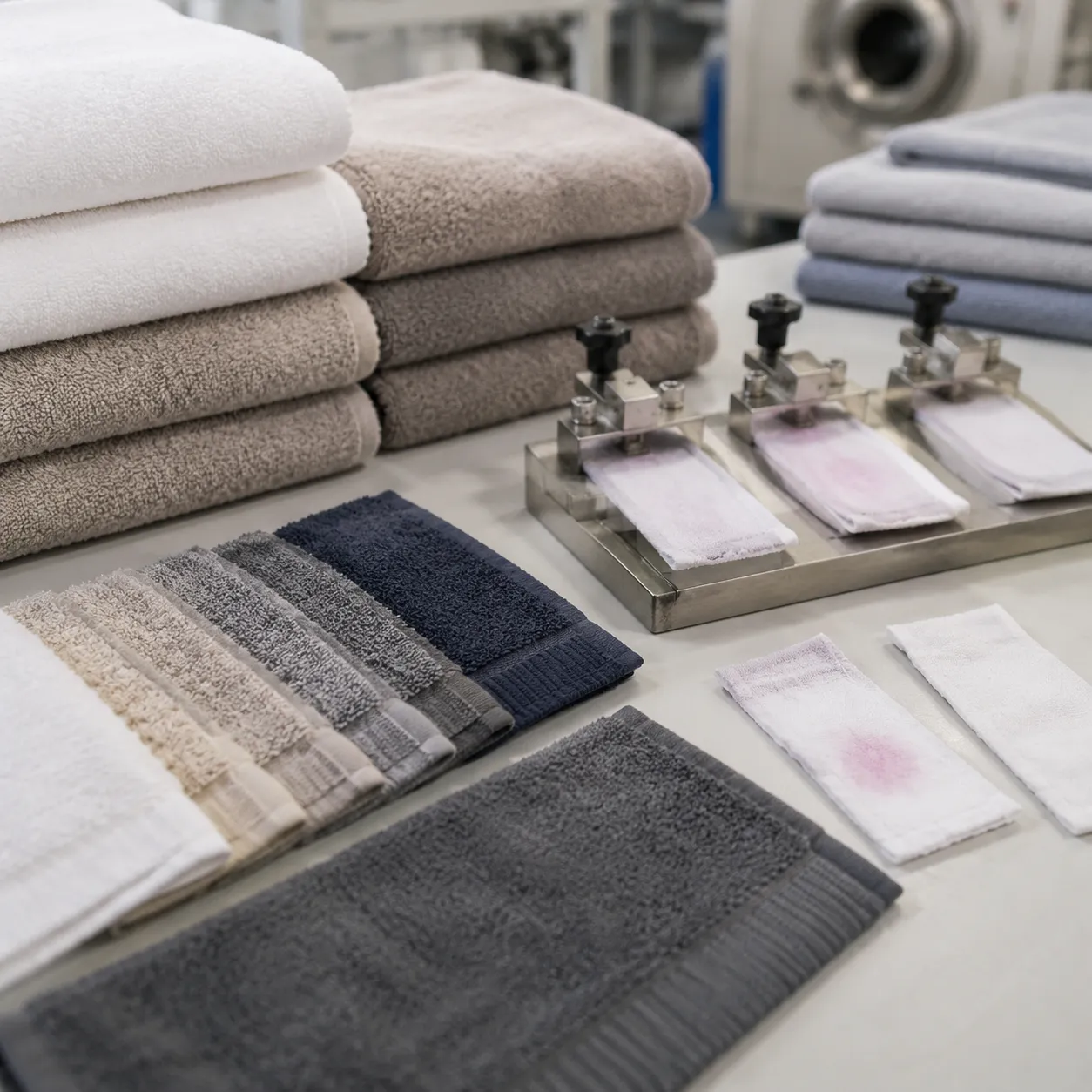
Why color failure starts before the first wash
Color complaints in hotel towels rarely come from one dramatic mistake. More often, the failure is built from several small decisions: a dark reactive dye shade on a high-loop pile, insufficient soaping after dyeing, no rubbing test on the border, and a laundry program that uses oxidizing chemicals stronger than the buyer expected.
At our Gaoyang mill, we treat colorfastness as a gate before bulk production, not as a final inspection note. We are a 220-employee towel manufacturer operating since 2007, with OEKO-TEX Standard 100 Class I, BSCI, and ISO 9001 certification. Those certifications do not automatically mean every navy towel will survive every hotel laundry formula. They mean we have a documented system; the buyer still needs a test plan tied to the towel color, GSM, yarn, and washing environment.
For hotel bath towels, the highest-risk shades are not only black and navy. Camel, terracotta, bottle green, charcoal, and some spa-style mushroom tones can show migration or edge staining if the dye recipe is pushed too hard. White towels have a different risk: optical brightener consistency, yellowing, and reaction to chlorine or peroxide.
| Risk point | What we check | Buyer consequence if missed |
|---|---|---|
| Residual unfixed dye | Soaping water clarity and ISO 105 wash staining | Color bleeding in hotel laundry onto white robes or sheets |
| Loop-to-border shade drift | Visual check under D65 light and grey scale rating | Bath towel body looks different from dobby border |
| Wet rubbing weakness | Crocking test on pile and hem area | Dark lint or shadow marks on bathroom surfaces |
| Chemical sensitivity | Controlled wash with peroxide or low-level chlorine exposure | Patchy fading after outsourced laundry cycles |
| Lot-to-lot shade movement | Lab dip, pre-production sample, and bulk shade band | Replacement orders no longer match existing linen stock |
A practical hotel bath towel colorfastness test protocol
A workable hotel bath towel colorfastness test protocol should separate laboratory colorfastness from real laundry simulation. Laboratory methods give repeatable ratings. Laundry trials show how the towel behaves in the buyer’s actual wash formula. We use both because each one catches different failure modes.
For a normal dyed cotton hotel bath towel, our baseline is ISO 105 colorfastness testing for washing and rubbing, plus a mill wash trial before shipment. If the towel is for a resort laundry using peroxide at high temperature, we add a chemical-resistance check. If the towel has embroidery or woven logo detail, we test the decoration thread and towel body separately because polyester embroidery can hold color while the cotton ground changes.
- Confirm the color standard: Pantone TCX, physical towel swatch, or approved lab dip under D65 lighting.
- Approve yarn and construction first, including GSM, pile height, border width, and cotton type.
- Run lab dip tests on the intended shade, not a similar stock color.
- Wash the pre-production towel, then measure shade change and staining against grey scale.
- Test dry and wet rubbing on pile, hem, and border, not only on a flat fabric cutting.
- Run a laundry simulation matching the hotel’s detergent, temperature, and bleaching practice.
- Lock an approved production shade band before bulk dyeing begins.
- Inspect bulk cartons by dye lot and keep retained samples for reorder comparison.
This sequence is slower than simply approving a color by photo, but it prevents the expensive problem: receiving 3,000 towels that pass weight inspection yet cannot be mixed safely with existing white linen.
The ISO methods we normally write into the PO
Buyers do not need to memorize every ISO standard, but the PO should name the test method and target rating. Otherwise, “good colorfastness” becomes an argument after goods arrive. For cotton terry hotel towels, we usually reference ISO 105-C06 for colorfastness to domestic and commercial laundering, ISO 105-X12 for rubbing, and ISO 105-A02/A03 grey scale evaluation for shade change and staining.
Some buyers ask whether OEKO-TEX replaces these tests. It does not. OEKO-TEX Standard 100 Class I restricts harmful substances and is important for skin-contact textiles. Colorfastness testing evaluates whether the dye stays where it should during washing, rubbing, and chemical exposure. A towel can be OEKO-TEX certified and still have poor shade stability if the dyeing and after-soaping process are weak.
| Test item | Common method | Typical acceptance target for hotel bath towels | Where we test |
|---|---|---|---|
| Washing color change | ISO 105-C06 | Grade 4 minimum for medium shades; 4-5 preferred for white-adjacent programs | Cutting from towel body after lab dip or PPS |
| Staining on adjacent fabric | ISO 105-C06 with multifibre | Grade 4 minimum; no visible staining on cotton and polyester strips | Pile area and dyed border area |
| Dry rubbing | ISO 105-X12 | Grade 4 minimum for most colors | Pile face, dobby border, hem fold |
| Wet rubbing | ISO 105-X12 | Grade 3-4 minimum for dark reactive dye towels; Grade 4 for light and medium shades | Pile face and border separately |
| Shade evaluation | ISO 105-A02 grey scale | Grade 4 minimum after first controlled wash | Compared with approved standard under D65 |
| Perspiration risk for gym-hotel use | ISO 105-E04 when relevant | Grade 4 staining target | Only added for fitness-center towel programs |
We do not promise Grade 5 on every dark cotton towel because that can force an unrealistic dye recipe or extra chemical treatment that changes handfeel. For a charcoal 650 GSM bath sheet, a wet rubbing result of Grade 3-4 may be commercially acceptable if the towel is washed separately from white sheets. For a pale blue 500 GSM guest-room towel that will be mixed with white bath mats, we push the requirement higher.
How towel construction changes the result
Colorfastness is not only a dyehouse issue. Terry construction changes how much dye is held in the pile and how much loose fiber remains after finishing. A 16/1 open-end yarn towel at 430 GSM behaves differently from a 21/2 ring-spun combed cotton towel at 620 GSM, even when both use reactive dye.
Higher GSM towels hold more liquor during dyeing and require longer rinsing and soaping. Thick pile can hide unfixed dye until the first commercial wash. Borders are another weak point. The dobby area is flatter and denser than the pile, so it may appear darker after dyeing even when the same yarn and dye bath are used. If a hotel wants a very even tone across body and border, we need to test a full towel sample, not only a lab-dyed yarn cutting.
- 430-500 GSM economy hotel towels: faster drying, lower dye load, but more visible shade variation if yarn quality is inconsistent.
- 520-620 GSM standard hotel bath towels: balanced absorbency and laundry life; most reliable range for stable medium shades.
- 650-750 GSM luxury towels: heavier pile needs stronger rinse and soaping control; dark shades carry higher bleeding risk.
- Zero-twist or low-twist constructions: softer hand, but surface fiber release can make early wash water look darker even when staining rating is acceptable.
- Dobby or jacquard borders: must be tested separately because dense woven zones can rub differently from the terry pile.
For more on weight selection before color work begins, we often point buyers to towel GSM decision framework and building a towel tech pack mills can quote. A vague spec such as “heavy hotel towel, dark green” is not enough for controlled dyeing.
Acceptance limits by hotel use case
The correct acceptance target depends on how the towel will be laundered and where it sits in the linen system. A boutique hotel that washes colored towels in-house can tolerate a different risk level from a 600-room resort that sends mixed loads to a commercial laundry. Instead of saying “case by case,” we divide the decision by operational exposure.
| Hotel situation | Recommended color range | Minimum test targets | Operational note |
|---|---|---|---|
| White-room linen program with occasional accent towels | White, ivory, pale grey, pale blue | Wash change Grade 4-5; staining Grade 4-5; wet rubbing Grade 4 | Accent towels may contact white sheets and robes |
| Spa or wellness floor using earth tones | Sand, sage, taupe, clay | Wash change Grade 4; staining Grade 4; wet rubbing Grade 3-4 to 4 | Check massage oil residue and peroxide wash compatibility |
| Pool-facing bath towel program | Medium blue, teal, striped yarn-dyed options | Wash change Grade 4; staining Grade 4; rubbing Grade 4 dry and 3-4 wet | Sunscreen and chlorine residue can affect shade over time |
| Luxury dark towel concept | Charcoal, espresso, navy | Wash staining Grade 4; dry rubbing Grade 4; wet rubbing Grade 3-4 minimum | Should be washed separately from white linen during early cycles |
| Replacement reorder for existing hotel | Must match retained standard | Delta E target agreed before PO; grey scale Grade 4 after wash | Old towels may have aged, so match current approved standard, not a showroom photo |
We also ask how many washes the hotel expects before replacement. A city hotel rotating towels every 120-150 uses may prioritize low staining and consistent whiteness. A resort with visible branded color may accept gradual fading if the towel remains soft and does not bleed. These are not the same specification.
Laundry simulation: the test buyers should not skip
ISO lab tests are controlled, but hotel laundries are not identical. One laundry may wash cotton towels at 60°C with peroxide oxygen bleach. Another may use 75°C water, strong alkali, and occasional chlorine rescue washes for stain removal. If we do not know the formula, we can only test against a general standard.
For dyed hotel towels, our recommended laundry simulation is 5 controlled cycles before bulk approval for medium shades and 10 cycles for dark shades or new dye recipes. A typical mill-side trial uses 60°C water, neutral to mildly alkaline detergent, mechanical tumble drying, and a measured oxidizing agent if the buyer confirms peroxide use. If the hotel uses chlorine, we need the concentration and frequency. Cotton reactive dyes are not designed for repeated strong chlorine exposure.
- Ask the laundry vendor for wash temperature, detergent type, bleach chemistry, pH range, and drying temperature.
- Confirm whether colored towels are washed separately during the first 3-5 cycles.
- For peroxide programs, request the active oxygen dosage rather than only the brand name of the chemical.
- For chlorine rescue washing, define how often it happens; weekly chlorine exposure is very different from emergency stain treatment.
- Keep a washed sample and an unwashed control together for final shade approval.
A realistic example: for a 550 GSM stone-grey bath towel at 70 x 140 cm, we would normally quote a 5-cycle pre-bulk wash check as part of sample validation. If the same towel is changed to deep forest green for a spa floor and the laundry uses peroxide, we would add a 10-cycle trial before approving the bulk dye recipe. The extra test time is usually 3-5 days, much cheaper than segregating a failed color for the rest of its service life.
Bulk production controls after lab approval
Lab dips can pass while bulk fails if the production bath is not controlled. Our dyehouse team records liquor ratio, temperature curve, salt and alkali additions, hold time, rinse sequence, and after-soaping time. For reactive dye towels, after-soaping is critical because it removes hydrolyzed dye that is no longer bonded to the cotton fiber.
Bulk shade control also depends on lot discipline. If 8,000 bath towels are split across two dye lots, we do not pack them randomly without identification. Each carton label should show PO number, color, size, GSM, lot number, and quantity. For hotel replacement programs, this helps the buyer trace whether a shade complaint comes from one lot or the full order.
- Approve lab dip with physical signature or buyer email reference, not only a phone photo.
- Make one pre-production sample using bulk yarn and planned finishing route.
- Compare PPS against lab dip under D65 and store lighting if the hotel has warm bathroom light.
- Run wash and rubbing tests on PPS before cutting bulk yarn.
- During dyeing, hold shade within the agreed standard using light-box evaluation and retained samples.
- Separate cartons by dye lot and keep 2 retained towels from each lot for at least 12 months.
- Attach inspection records to shipment documents when requested by procurement or QA.
Our internal final inspection follows ISO 9001 document control and customer-approved AQL sampling plans. For visual shade and staining defects, we normally classify obvious cross-staining, oil marks, dye spots larger than the agreed tolerance, and mixed-lot carton packing as major defects. The exact AQL level should be written into the PO; for hotel towel programs we commonly see General Inspection Level II with AQL 2.5 for major defects and 4.0 for minor defects.
Pricing and timing impact of proper testing
Colorfastness control adds small costs compared with the towel itself. The larger impact is calendar discipline. If the buyer approves a shade late or changes laundry requirements after bulk dyeing, the production schedule suffers. Our MOQ remains 500 pcs per design per color, but color testing is more efficient when one dye lot carries at least 1,000-1,500 bath towels.
| Order volume per color | Typical FOB China price for 500-620 GSM dyed bath towels | Testing and setup impact | Typical production timing after approval |
|---|---|---|---|
| 500-999 pcs | USD 5.10-7.40 per pc | Lab dip and PPS cost spread over fewer towels; color changes are expensive | 25-35 days |
| 1,000-2,999 pcs | USD 4.55-6.80 per pc | Better dye-lot efficiency; ISO wash and rubbing checks practical | 30-40 days |
| 3,000-7,999 pcs | USD 4.15-6.25 per pc | Bulk lot control and retained samples recommended by lot | 35-45 days |
| 8,000+ pcs | USD 3.85-5.90 per pc | Multiple lots may be needed; carton-level lot tracking should be planned | 40-55 days |
Sampling usually takes 7-12 days for lab dips and 10-18 days for a full pre-production towel, depending on yarn availability and whether embroidery, jacquard border, or special packaging is included. A laundry simulation adds 3-7 days. Sea freight is separate; buyers comparing delivery plans can review container vs air freight towel orders.
A cost-per-use view helps. Suppose a 600-room hotel buys 4,800 bath towels at USD 5.35 each, landed towel cost before local freight and duty. If poor dye fixation forces replacement after 45 laundry cycles instead of the planned 110 cycles, the towel cost per laundry use moves from about USD 0.049 to USD 0.119. Even a USD 180-260 pre-bulk lab and wash validation package is minor compared with replacing an entire color lot early.
What to write on the spec sheet
A strong colorfastness clause should be short, measurable, and tied to the buyer’s laundering reality. Long legal wording does not help if it omits the test method. We prefer one table in the tech pack that names the standard, target grade, sample stage, and who pays for retesting if the standard is not met.
- Color reference: Pantone TCX, physical swatch, or approved towel standard with date.
- Fabric: size, GSM, yarn count, cotton type, pile construction, border structure, and finishing handfeel.
- Test standards: ISO 105-C06 washing, ISO 105-X12 rubbing, ISO 105-A02/A03 grey scale assessment.
- Laundry simulation: number of cycles, temperature, detergent, bleach type, drying method, and pass/fail criteria.
- Inspection plan: AQL level, major/minor defect definitions, carton lot marking, retained sample requirement.
- Certification documents: OEKO-TEX Standard 100 Class I certificate scope, BSCI audit status, ISO 9001 certificate, and any customer restricted substances list.
Buyers sourcing for mixed hotel categories may also find hotel towel sourcing guide 2026 useful for broader towel program planning, and how to read an OEKO-TEX certificate for checking whether the certificate scope matches the towel product being ordered.
Related reads: for color selection before lab testing, see Pantone color matching custom towels. For construction choices that affect dye behavior, compare combed vs zero-twist cotton explained and towel sizes dimensions complete guide.
Questions we ask before quoting a dyed hotel towel
The fastest way to avoid rework is to answer laundry and shade questions before we calculate price. If the RFQ only says “hotel bath towel, 600 GSM, dark grey,” we can quote a rough range, but we cannot confirm the safest dye route or test package.
- Will the towel be washed with white linen, colored linen, or separately for the first service cycles?
- Does the laundry use peroxide, chlorine, quaternary disinfectant, or enzyme detergent?
- What replacement life is expected: 60, 90, 120, or 150 wash cycles?
- Is the towel used only in guest bathrooms, or also in spa, pool, gym, or treatment rooms?
- Do future reorders need to match an existing towel already aged by laundering?
- Is decoration involved, such as embroidery, jacquard logo, woven label, or contrast piping?
For decoration-heavy towels, colorfastness must cover the complete product. Embroidery thread, label tape, border yarn, and body pile may all behave differently. Our decoration team’s comparison in embroidery vs sublimation vs jacquard is a useful reference when logos are part of the hotel program.
LUMA & CO. TEXTILE supplies OEM towel programs to more than 80 brand clients across 47 countries, with annual output around 2.4 million towels. For dyed hotel bath towels, the most reliable projects are the ones where color testing is agreed before deposit, not negotiated after a failed wash. MOQ is 500 pcs per design per color, and we can quote with lab testing, retained sample control, and carton lot marking included in the production plan.
Build a safer hotel towel color plan
Send us your towel GSM, color target, laundry formula, and order quantity. We will recommend test methods, acceptance grades, FOB price range, and lead time before sampling. WhatsApp: +86 13205717266 or email [email protected].
Request a colorfastness quote →