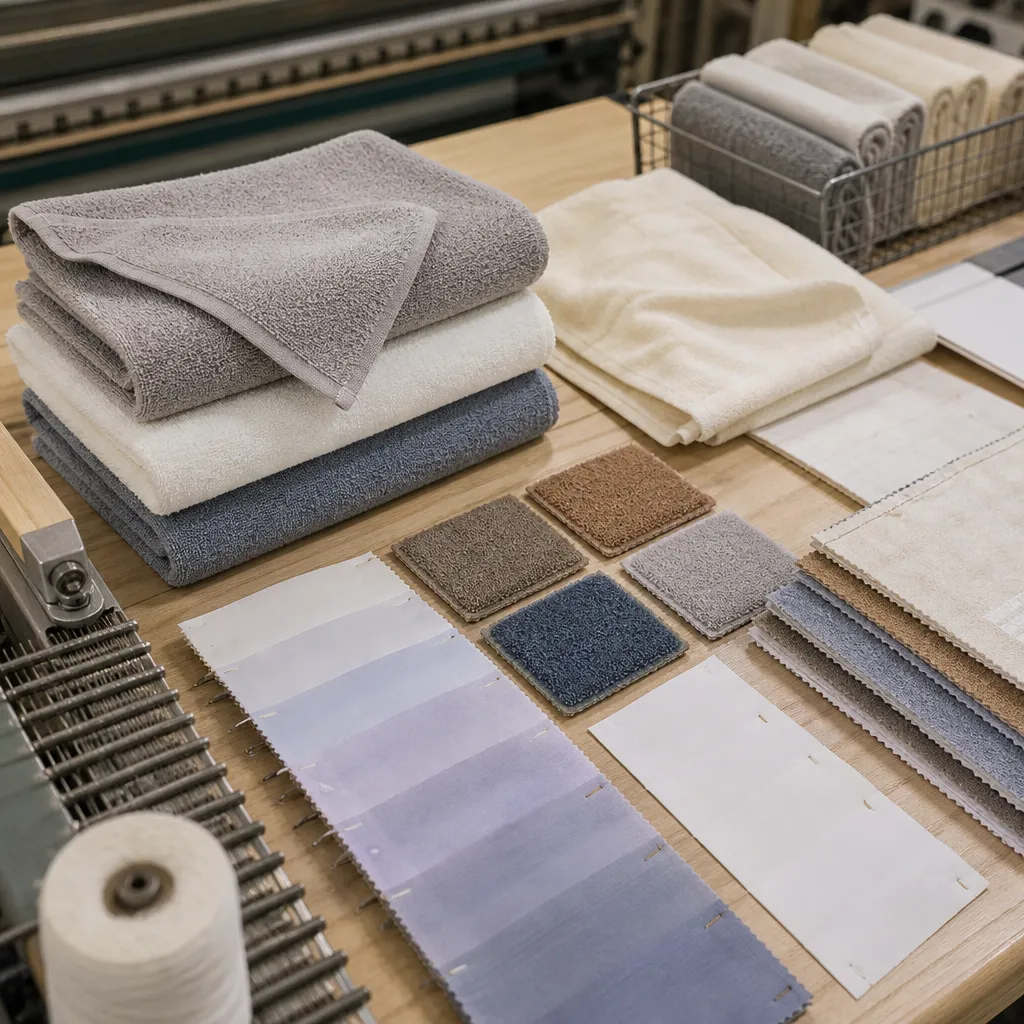
The MOQ Floor We Can Actually Hold
For our mill, the standard MOQ is 500 pcs per design / per color. That is the lowest point where dyeing, cutting, logo setup, inspection, and export carton handling can be controlled without charging sample-room pricing. For neck cooling towels, MOQ pressure usually comes from color splits. A single 2,000 pc order in one Pantone color runs efficiently; four colors at 500 pcs each create four dye lots, four shade approvals, and more leftover fabric risk.
We make two main constructions for this item: polyester-polyamide microfiber knit at 150-230 GSM, and PVA sponge-sheet cooling towels at roughly 250-360 GSM equivalent wet-feel density. Microfiber is softer and easier for retail graphics. PVA gives a stronger cold sensation when wet, but it must be packed slightly damp or sealed correctly because dry PVA becomes stiff and can crack at fold lines during long storage.
| Order structure | Workable MOQ | Factory comment |
|---|---|---|
| One size, one color, no logo | 500 pcs | Lowest practical bulk run; buyer should accept standard carton pack and existing fabric shade if available |
| One size, one color, printed logo | 500 pcs | Screen or heat-transfer setup is spread across the run; logo unit cost is still high below 1,000 pcs |
| Two colors, same logo | 500 pcs per color | Separate lab dips and bulk shade control; do not combine colors into one acceptance sample |
| Retail pouch, barcode, insert card | 1,000 pcs preferred | Packaging setup adds material loss and manual packout time |
| Four or more colorways | 2,000-3,000 pcs total | Better for bulk cooling towels because dyeing and cutting can be grouped by shade family |
If a buyer asks us to quote 200 pcs in six colors, the honest answer is that the unit price becomes a sampling price. For example, a 30×100 cm microfiber cooling towel at 180 GSM may cost around USD 1.05-1.32 FOB Ningbo at 3,000 pcs with one-color print. At 200 pcs per color, the same towel can move to USD 2.10-2.70 because fixed logo screens, cutting setup, and export document handling are divided over too few units.
Cooling Towels for Neck MOQ and Pricing by Spec Tier
The price band below is based on our 2026 factory inputs: polyester filament yarn, polyamide blend ratio, disperse dyeing, standard labor time, AQL inspection, inner polybag or mesh pouch, and FOB Ningbo loading. It is not a marketplace resale estimate. Final pricing changes with exchange rate, artwork size, packaging material, and whether the buyer needs third-party testing before shipment.
| Spec tier | Typical GSM / construction | 500 pcs | 1,500 pcs | 5,000 pcs |
|---|---|---|---|---|
| Entry sport giveaway | 150-165 GSM microfiber mesh, overlock edge, one-color logo | USD 1.18-1.55 | USD 0.82-1.08 | USD 0.62-0.79 |
| Retail fitness towel | 175-200 GSM 80/20 microfiber knit, bound edge, heat transfer logo | USD 1.46-1.95 | USD 1.05-1.38 | USD 0.78-1.03 |
| Club or race pack towel | 200-230 GSM dense knit, woven label, zipper pouch | USD 1.92-2.68 | USD 1.42-1.88 | USD 1.08-1.46 |
| PVA neck towel | PVA sheet with embossed texture, tube case or sealed pouch | USD 2.25-3.10 | USD 1.70-2.32 | USD 1.28-1.76 |
These bands assume a common size range of 28×90 cm, 30×100 cm, or 32×110 cm. A wider towel is not only more fabric. It changes roll yield. If the roll width is 160 cm and the towel cuts at 32 cm before hemming, we get a clean five-across cut. If the buyer changes width to 35 cm, the marker may drop to four-across, and the fabric waste can rise by 8-13% depending on shrinkage allowance.
- Fabric weight: every additional 20 GSM on a 30×100 cm towel adds about 60 g of fabric per 10 pcs, which affects both yarn cost and carton weight.
- Logo area: a 6×6 cm corner print is very different from a 24 cm chest-style slogan across the towel length.
- Packout: mesh bag, EVA case, belly band, and barcode sticker each add material and labor; they should be quoted as separate RFQ lines.
- Testing: OEKO-TEX, colorfastness, and cooling performance reports are real costs if the buyer requires current lot testing rather than certificate review.
Fabric Choice Changes Both Cold Feel and Claim Risk
The phrase evaporative cooling towel covers several fabrics. For neck use, the fabric must hold water, expose surface area to air, and remain comfortable against skin. We normally steer fitness brands toward microfiber knit because it is light, printable, and less fragile in dry storage. For outdoor labor kits or heat-relief campaigns, PVA can work well, but the packaging must prevent overdrying before the user opens it.
| Fabric option | Best use | Risk to control | Normal GSM range |
|---|---|---|---|
| Microfiber mesh knit | Race events, gym retail, resort activities | Edge curl if heat setting is weak; logo cracking if transfer film is too thick | 150-185 GSM |
| Dense microfiber suede knit | Retail custom neck towel with full-color artwork | Slower evaporation if GSM is pushed too high | 180-230 GSM |
| PVA sponge sheet | Industrial heat kits, outdoor crews | Dry brittleness, odor if packed with excess moisture | 250-360 GSM equivalent |
| Microfiber-polyester pique | Sports teams and training programs | Snagging on hook-and-loop closures in gym bags | 170-210 GSM |
A cooling claim should be controlled with a simple internal method before shipment. Our QC team wets the towel in 25°C water for 60 seconds, wrings it to a repeatable hand-wring weight, snaps it three times, then records surface temperature at 0, 2, 5, and 10 minutes using an infrared thermometer in a room held at 26-28°C and 55-65% RH. We do not promise medical-grade cooling; we verify that the fabric gives a measurable evaporative drop and does not lose shape after activation.
For buyers comparing microfiber with cotton, our microfiber vs cotton towel comparison explains why cotton feels familiar but dries too slowly for most neck-cooling programs. If the item sits next to gym towels in a kit, the sizing logic in our sweat towel spec guide is also useful.
Logo Method: Where Cheap Quotes Usually Move Cost Elsewhere
Decoration is often the hidden price driver. A blank microfiber cooling towel is simple. A towel with a full-color sponsor logo, retail hangtag, and individual pouch requires artwork separation, print registration, curing temperature control, and rub testing. On microfiber, poor curing shows up as tacky logo feel or fine cracks after wash. On PVA, some inks sit poorly on the sponge surface, so we prefer sleeve labels or case printing instead of printing directly onto the towel.
| Logo method | Suitable fabric | Typical setup cost | Unit add-on at 1,500 pcs | QC point |
|---|---|---|---|---|
| One-color screen print | Microfiber mesh or suede | USD 35-60 per color | USD 0.06-0.12 | Check edge sharpness after ISO 105-X12 rubbing |
| Heat transfer | Microfiber knit | USD 45-90 per artwork | USD 0.12-0.28 | Check film cracking after 10 wash cycles |
| Sublimation panel print | White polyester-rich microfiber | USD 70-130 artwork handling | USD 0.20-0.46 | Check shade drift and ghosting at towel edge |
| Woven label plus pouch print | Microfiber or PVA | USD 55-110 label setup | USD 0.10-0.24 | Check label position tolerance within ±5 mm |
For sponsor merchandise, sublimation can look attractive because it allows full-color graphics. It also needs white or light base fabric and polyester-rich yarn. If the buyer needs a dark navy towel with a bright yellow logo, heat transfer or screen print normally gives better control. Our decoration team covers broader trade-offs in embroidery vs sublimation vs jacquard, although for this thin sport item we rarely recommend embroidery because the stitches can feel scratchy on the neck.
- Avoid logo placement directly on the fold line of a PVA towel; repeated drying can create a permanent crease through the print area.
- Keep heat-transfer films thin and elastic; thick films trap heat and reduce the towel's cooling feel under the logo.
- For sublimation, approve both dry and wet shade because wet microfiber can appear 0.5-1.0 shade level darker.
- Request logo durability testing against the final bulk fabric, not a generic white sample from the print room.
Testing and Certificates That Support the Price
A low quote without test coverage can become expensive after shipment. We hold OEKO-TEX Standard 100 Class I, BSCI, and ISO 9001 certifications at factory level. For a buyer using the towel in a skin-contact sport pack, OEKO-TEX documentation matters because the towel is often worn wet around the neck. The correct check is certificate scope and validity, not just a logo on a quotation sheet. Our article on how to read an OEKO-TEX certificate shows what fields should match the supplier and product type.
For bulk approval, we normally build the inspection plan around ISO 2859-1 sampling with AQL levels agreed in the PO. A common setting is AQL 2.5 for major defects and 4.0 for minor defects, with critical defects at zero tolerance. Cooling towels also need functional checks because a towel can pass size and stitching inspection but still fail after wet activation.
- Confirm fabric composition by supplier declaration and, if required, third-party fiber analysis.
- Run colorfastness to washing under ISO 105-C06 and rubbing under ISO 105-X12 for printed or dark colors.
- Check dimensional change after 3-5 wash cycles at 40°C, then measure length and width recovery after air drying.
- Wet, wring, snap, and record cooling response at fixed room temperature and humidity.
- Inspect odor after sealed storage for PVA towels, especially if packed in tube cases or moisture-retaining pouches.
We also test practical user failure modes: seam torque, edge wave, transfer peeling, pouch zipper breakage, and barcode scannability after carton compression. For race events or corporate heat kits, the towel may be opened only once by the end user. Even then, a cracked logo or sour odor creates a claim because the item is tied to a public brand moment.
Lead Time From RFQ to FOB Loading
Cooling towels move faster than heavy hotel bath towels, but the calendar still depends on lab dips, artwork approval, and packaging. A clean repeat order with approved color and logo can ship in 18-25 days after deposit. A new retail program with custom pouch, barcode, and third-party testing usually needs 35-48 days before FOB loading.
| Stage | Normal days | What can delay it |
|---|---|---|
| RFQ and spec cleanup | 1-3 days | Missing GSM, towel size, logo file, or packout requirement |
| Lab dip / fabric strike-off | 4-7 days | Pantone shade on wet microfiber differs from dry approval |
| Pre-production sample | 5-9 days | Heat-transfer film, pouch artwork, or PVA case mold color not approved |
| Bulk knitting, dyeing, cutting | 9-16 days | Small color splits interrupt dye lot scheduling |
| Logo and packout | 5-12 days | Retail sticker files or barcode data arrive late |
| Final inspection and FOB loading | 3-5 days | AQL recheck, carton mark correction, or vessel cutoff change |
Air freight is possible for urgent event orders, but towels contain water-absorbent bulk and cartons cube out quickly. A 30×100 cm towel in mesh pouch may pack 100 pcs per export carton, around 52×36×38 cm, with gross weight near 15-18 kg depending on GSM and pouch. Sea freight is more stable for 5,000 pcs and above. For freight math, our container vs air freight towel orders gives a better framework than comparing freight quotes by carton only.
How to Write the RFQ So the Quote Is Comparable
Cooling towels for neck MOQ and pricing become messy when three suppliers quote three different assumptions. One quote may include a mesh pouch, another may include only a polybag. One may price a 150 GSM towel while another uses 210 GSM. The landed cost difference is then hidden inside the spec, not the supplier margin.
- State size in centimeters after wash, for example 30×100 cm ±3% after 3 washes.
- Specify fabric type and GSM, such as 80/20 polyester-polyamide microfiber mesh, 180 GSM.
- Name the edge finish: overlock, bound edge, ultrasonic cut, or hemmed edge.
- Attach vector artwork and define logo size, placement tolerance, and number of colors.
- List packaging as a separate line: individual polybag, mesh pouch, tube case, insert card, barcode, master carton marks.
- Ask for FOB port, MOQ per design/color, sample fee, bulk lead time, and AQL standard in the same quotation.
A strong tech pack reduces price padding. Our team can quote faster when buyers use the structure explained in build a towel tech pack that mills can quote. If the order is below a normal production run, review how to negotiate towel MOQ without killing margin before splitting the program into too many colors.
Cost-Per-Use: A Small Upgrade Can Be Cheaper
The cheapest neck towel is often the one that gets discarded fastest. For a fitness chain, we compared two internal prototypes for a summer member kit. Prototype A was a 155 GSM mesh towel with overlock edge at USD 0.74 FOB at 6,000 pcs. Prototype B was a 190 GSM 80/20 knit with bound edge at USD 0.96 FOB. After 12 wash-and-dry cycles, Prototype A showed edge waviness on 18 of 50 tested pieces and the logo film lifted on 6 pieces. Prototype B had 2 pieces with minor edge distortion and no film lift.
If the chain expected members to reuse the towel at least 20 times, Prototype A worked out to about USD 0.037 per expected use only if it survived the full cycle. With a conservative 25% early discard rate, the practical cost moved closer to USD 0.049 per retained use. Prototype B, even with the higher FOB, stayed near USD 0.048 per use with better brand appearance. That is why we push back when a quote target removes 20-30 GSM and switches to the cheapest edge finish at the same time.
For neck cooling towels, price pressure should come after fabric, edge, logo, and packout are fixed. If the spec changes during negotiation, the cheaper quote may be a different product.
Factory Proof Buyers Should Request Before Deposit
A supplier can claim low MOQ and fast lead time, but proof should sit in documents and samples. We are a 220-employee mill operating since 2007, producing about 2.4 million towels per year for 80+ brand clients across 47 countries. For a new cooling towel order, we share certificate copies, sample photos, carton details, and a written quotation that separates fabric, decoration, packaging, and testing. That separation makes it easier for procurement teams to compare us with other factories.
- Current OEKO-TEX Standard 100 certificate number and scope, checked against the issuing body database.
- BSCI audit status or latest audit summary for social compliance review.
- ISO 9001 certificate for quality management, plus the factory name matching the commercial invoice entity.
- Pre-production sample tagged with GSM, size, color code, logo method, and packaging version.
- AQL inspection plan under ISO 2859-1, including major, minor, and critical defect definitions.
- Carton specification with pcs/carton, gross weight, carton dimensions, and drop-test requirement if retail packaging is fragile.
Related reads: for buyers placing cooling towels inside a broader sport assortment, see our sport towel microfiber OEM spec guide and workout towel wash spec notes. For event-style timing, the production discipline in custom rally towel lead-time and logistics applies to towel campaigns with fixed delivery dates.
Related reads: if your program uses full-color artwork, review printed towel artwork and fabric choices. For compliance-driven sourcing, the certificate checks in OEKO-TEX towel buying guidance help procurement teams avoid expired or mismatched paperwork.
Send Us Your Cooling Towel RFQ
Share size, GSM, fabric type, logo artwork, quantity by color, packaging, delivery country, and target ship date. We will return MOQ, FOB price band, sample timing, and carton data. WhatsApp: +86 13205717266. Email: [email protected].
Request a Quote →