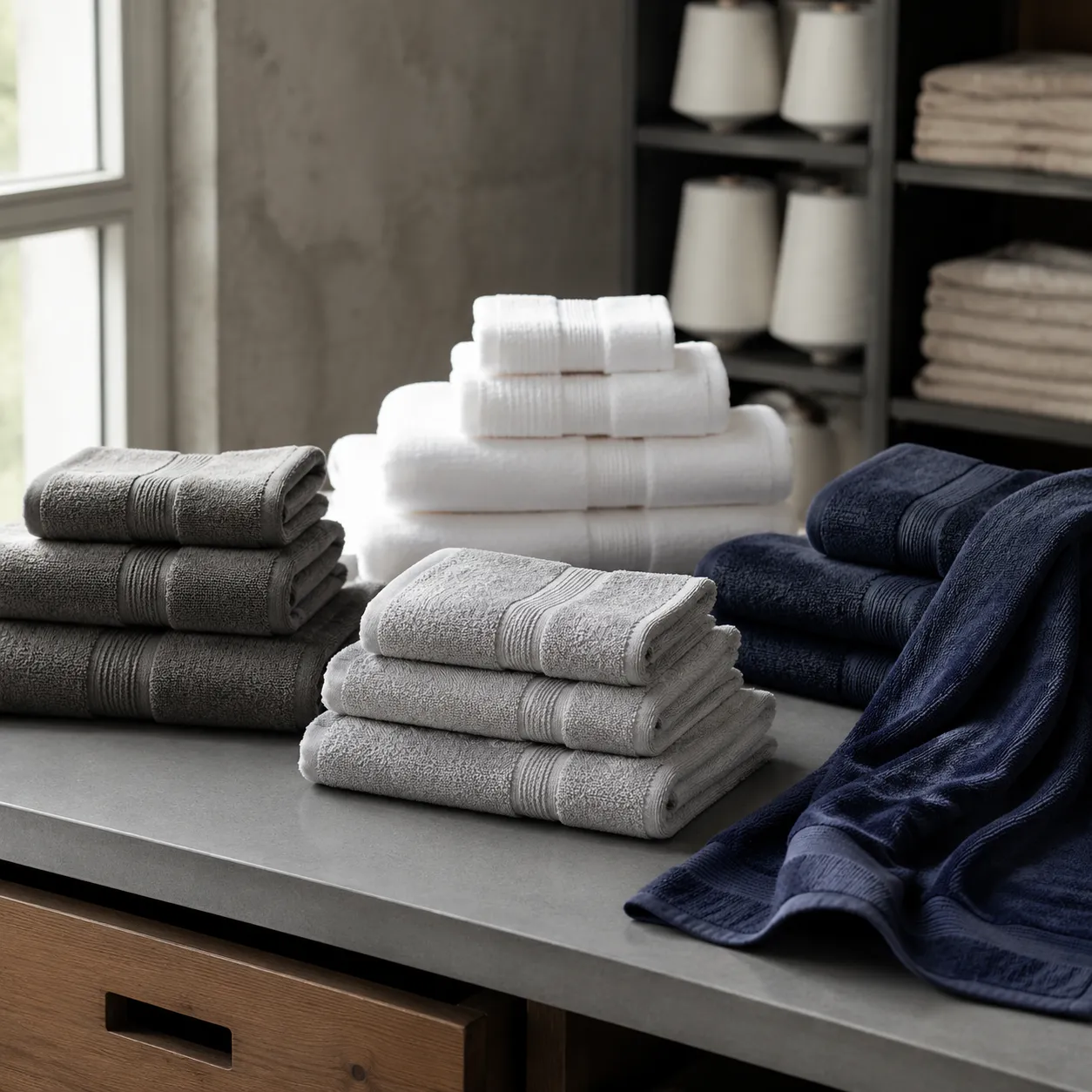
Start with the use case, not the catalog size
In our mill, the first question we ask is where the towel will live during the day. A towel issued at reception for wiping sweat needs a different footprint from a locker-room towel stacked in cubbies or a rental towel used on strength benches. The wrong size does not only annoy members; it changes wash load weight, folding labor, shelf density, shrinkage tolerance, and replacement rate.
For B2B programs, we usually separate gym towels into three families: compact sweat towels, bench or workout towels, and shower towels. All three can be made in cotton terry, cotton-poly blends, or microfiber, but the dimensions decide whether the program runs smoothly. A 30 x 50 cm towel is fast to wash and cheap to replace, but it will not cover a commercial incline bench. A 70 x 140 cm bath towel feels familiar to hotel buyers, but in a gym it often becomes a theft risk and a laundry bottleneck.
Our MOQ is 500 pcs per design and per color. That minimum is workable for a pilot program, but size decisions should still be made from operations data: average daily check-ins, towel return rate, shelf depth, washer capacity, and whether members carry towels onto cardio equipment or only use them in the locker room.
| Use case | Practical size range | Typical GSM | Where it works |
|---|---|---|---|
| Face and sweat towel | 28 x 45 cm to 32 x 50 cm | 360-480 GSM cotton terry or 220-300 GSM microfiber | Treadmills, spin studios, reception baskets |
| Bench / workout towel | 38 x 80 cm to 45 x 90 cm | 400-520 GSM cotton terry or 260-340 GSM microfiber | Weight rooms, HIIT studios, yoga-pilates hybrids |
| Compact shower towel | 60 x 120 cm to 65 x 130 cm | 420-560 GSM cotton terry | Budget locker rooms, staff gyms, high-turnover clubs |
| Full locker-room bath towel | 70 x 135 cm to 75 x 150 cm | 500-650 GSM cotton terry | Premium clubs, spas, hotel fitness centers |
Gym towel size: what we quote most often
For the primary keyword gym towel size, most online answers stop at generic dimensions. On the factory side, we quote from cut size, expected shrinkage, and finished size after washing. Cotton terry can shrink 4-8% in length after correct pre-wash and home-style tumble testing. If a buyer wants a finished 40 x 80 cm workout towel, we may weave and cut closer to 42 x 84 cm depending on yarn, pile height, and border construction.
The two sizes we quote most for gyms are 30 x 50 cm and 40 x 80 cm. The first is a true sweat towel size: small, stackable, low cost per laundry cycle. The second is better for benches and mats because it gives enough surface area without becoming a bath towel. For a club with 900 weekday check-ins and free towel service, that difference is material. At 450 GSM, a 30 x 50 cm towel weighs about 68 g before decoration. A 40 x 80 cm towel at the same GSM is about 144 g. If 1,600 towels cycle through laundry per day, the larger towel adds roughly 115 kg of dry textile weight before water retention.
That does not mean smaller is always better. We see more member complaints when a 30 x 50 cm towel is expected to protect benches, because it bunches under shoulders and slides when the user changes angle. On smooth vinyl benches, a narrow towel also migrates during use. A 40 x 85 cm towel with a slightly denser border solves that defect better than increasing GSM alone.
- Choose 30 x 50 cm when the towel is mainly for face, hands, and cardio sweat.
- Choose 35 x 70 cm when members use towels across both cardio and short bench sessions.
- Choose 40 x 80 cm or 45 x 90 cm when the towel must cover weight benches or reformer pads.
- Choose 60 x 120 cm or larger only when the towel is issued for shower use, not general floor circulation.
The hidden cost is laundry weight
Gym procurement teams sometimes focus on unit price and forget that towels are washed hundreds of times. For a 24-month program, laundering can exceed the original towel cost. We calculate this early because size and GSM are both weight decisions.
Here is a realistic example from a mid-size urban gym group. They considered a 35 x 70 cm cotton towel at 430 GSM and a 45 x 90 cm towel at 500 GSM. The first towel weighs about 105 g before hem and label allowance; the second is about 203 g. At 2,200 towel uses per day across four branches, the larger option adds about 216 kg of dry goods per day. If the laundry charges USD 0.92 per kg for wash, dry, and fold, that is around USD 199 extra per day, before detergent and replacement loss. Over 300 operating days, the larger towel adds nearly USD 59,700 in laundry expense.
That larger towel may still be correct for a premium locker-room promise. It is not correct if the towel will be handed out for treadmill use. This is where cost-per-use becomes more useful than unit price. A 40 x 80 cm towel at USD 1.42 may survive 130 commercial wash cycles if the yarn, hem, and vat dyeing are specified correctly. A cheaper 40 x 80 cm towel at USD 1.06 may start losing border stability after 55-70 cycles. The lower purchase price can become higher cost per usable cycle once labor and complaints are counted.
| Finished size | GSM | Approx. dry weight | Operational comment |
|---|---|---|---|
| 30 x 50 cm | 420 GSM | 63 g | Low laundry load, best for high-volume sweat service |
| 35 x 70 cm | 450 GSM | 110 g | Balanced size for boutique fitness and front desk issue |
| 40 x 80 cm | 480 GSM | 154 g | Good bench coverage with manageable laundry weight |
| 45 x 90 cm | 520 GSM | 211 g | Useful for premium strength areas, heavier in daily cycles |
| 65 x 130 cm | 540 GSM | 456 g | Locker-room towel, not efficient as a workout towel |
Cotton, microfiber, or blend for each size
Cotton terry remains the standard for locker room towels because users expect the handfeel and absorbency. For sweat towels, microfiber can be useful because it dries faster and packs tighter. We do not recommend microfiber for every gym program, especially if the brand promise is spa-like comfort or if members dislike the grabby surface on dry skin.
For cotton, we normally build gym towels with ring-spun cotton or a cotton-poly base depending on the laundering system. A 16s or 21s terry yarn is common for durable workout towels. For microfiber, 80/20 polyester-polyamide is the usual composition, with split fiber construction verified through absorbency and lint checks. Microfiber at 280 GSM can look thin beside cotton, but it may dry faster after a spin class and reduce mildew odor if towels sit in return bins.
A construction quirk that matters for fitness towel size is the border. A wide dobby border can look clean with a woven logo, but if it is too stiff on a 30 x 50 cm towel, almost 15-18% of the towel becomes non-absorbent border. For compact sweat towels we keep borders narrow, usually 1.0-1.5 cm, and use a locked hem that survives commercial tumbling. For 40 x 80 cm bench towels, a 2.0-2.5 cm end border is acceptable and helps the towel fold neatly.
- Cotton terry, 380-460 GSM: good for sweat towels where softness matters more than fast drying.
- Cotton terry, 460-560 GSM: better for bench towels and compact shower towels.
- Microfiber, 240-320 GSM: fast-drying option for workout towels bulk programs and travel kits.
- Cotton-poly base construction: useful when laundries use aggressive tumble drying and high alkaline wash chemistry.
Fit tests we run before bulk approval
A gym towel should be tested on actual equipment, not only reviewed on a table. We ask buyers to send photos or measurements of the benches, treadmill rails, cubby shelves, towel return bins, and laundry bags. A 40 x 80 cm towel behaves differently on a narrow flat bench than on a 32 cm wide adjustable bench with a vinyl slope.
For sampling, we usually make two adjacent sizes instead of one perfect-looking size. If a buyer thinks they need 35 x 70 cm, we may sample 35 x 70 cm and 40 x 80 cm in the same yarn and GSM. That isolates the size decision. If GSM, yarn, and dye also change, the feedback becomes confusing.
- Measure the narrowest and widest bench pads, including curved edges.
- Place the towel under shoulder and back contact points, then test three common movements.
- Fold the towel as staff will fold it and check stack height on real shelving.
- Wash the sample 10 times at the intended laundry temperature before final sizing approval.
- Weigh the washed towel and calculate daily laundry load from actual issue volume.
Two defect modes show up during these tests. The first is edge curling, often caused by uneven tension between the terry body and hem after repeated drying. The second is bench slip, usually made worse by a towel that is too narrow or by microfiber with a slick back face. We correct edge curling with hem density and stitch settings; we correct slip with dimension, pile structure, or a different surface texture.
| Test or standard | What we check | Why gym buyers should care |
|---|---|---|
| ISO 5077 | Dimensional change after washing and drying | Confirms whether gym towel dimensions remain usable after shrinkage |
| ISO 6330 | Domestic-style washing and drying procedure | Creates repeatable wash conditions for sample comparison |
| ISO 105-C06 | Color fastness to domestic and commercial laundering | Reduces dye bleed and shade change in white or dark towel programs |
| AATCC 135 | Dimensional changes after home laundering | Useful for North American buyers comparing shrinkage data |
| Internal lint release check | Lint after tumble and rub testing | Important for black gym uniforms, rubber flooring, and member complaints |
Decoration changes the usable area
Branding is not only a visual decision. Embroidery, jacquard, woven labels, and prints all affect how much of the towel remains comfortable and absorbent. On small towels, the logo area can become a problem quickly. A 9 cm embroidered logo on a 30 x 50 cm sweat towel may feel bulky if placed where users wipe their face. For that size, we usually keep embroidery within 5-7 cm wide or use a woven label at the hem.
For 40 x 80 cm bench towels, embroidery works better near one short end. Jacquard is possible but has MOQ and yarn-planning implications; it is better when the logo or pattern is part of the whole towel identity. Sublimation is mainly for polyester or microfiber towels and gives strong graphic coverage, but it does not create the cotton-terry feel many locker-room users expect.
If you are comparing decoration methods, our article on embroidery vs sublimation vs jacquard explains the trade-offs in more detail. For color control, especially on franchise gym colors, we also recommend reading Pantone color matching custom towels.
| Decoration | Best size fit | Typical added cost | Risk to manage |
|---|---|---|---|
| Small embroidery | 30 x 50 cm and larger | USD 0.08-0.22 per pc | Hard handfeel if stitch count is too high |
| Woven hem label | All sizes | USD 0.04-0.11 per pc | Label corners must not scratch face or skin |
| Jacquard logo | 40 x 80 cm and larger | USD 0.18-0.45 per pc plus setup depending on yarn colors | Longer sampling and less flexibility for small artwork changes |
| Sublimation print | Microfiber sizes | USD 0.20-0.55 per pc | Color shift on dark artwork and different absorbency feel |
Pricing bands by size and volume
Prices move with cotton cost, exchange rate, dyeing method, packaging, decoration, and test requirements. The bands below are realistic FOB China references for OEM production from our mill, not reseller shelf pricing. They assume standard carton packing, single color, and no unusual compliance paperwork beyond our normal quality files.
For custom work, our MOQ is 500 pcs per design and per color. Below that, cutting, dyeing, decoration setup, and QC time do not spread cleanly. We can sometimes group colors or share yarn with another production lot, but we will not pretend that a 120 pc custom color run can carry the same unit economics as 3,000 pcs.
| Spec | 500 pcs | 2,000 pcs | 8,000 pcs |
|---|---|---|---|
| 30 x 50 cm cotton terry, 420 GSM | USD 0.72-0.98 | USD 0.56-0.78 | USD 0.47-0.66 |
| 35 x 70 cm cotton terry, 450 GSM | USD 1.18-1.55 | USD 0.96-1.28 | USD 0.82-1.08 |
| 40 x 80 cm cotton terry, 480 GSM | USD 1.58-2.10 | USD 1.32-1.72 | USD 1.15-1.48 |
| 45 x 90 cm cotton terry, 520 GSM | USD 2.18-2.85 | USD 1.86-2.38 | USD 1.62-2.05 |
| 40 x 80 cm microfiber, 300 GSM | USD 1.28-1.76 | USD 1.04-1.42 | USD 0.90-1.20 |
If your club is buying sweat towels for gym, the lower size bands often make sense. If you are building a full towel service with locker-room towels, our hotel towel sourcing guide is useful because hospitality specifications overlap with premium clubs. For broader material decisions, see microfiber vs cotton towel comparison.
Compliance and quality files buyers should request
Gym towels touch face, skin, and sometimes children in family clubs, so compliance is not just a box for import paperwork. LUMA & CO. TEXTILE holds OEKO-TEX Standard 100 Class I, BSCI, and ISO 9001 certifications. For a gym towel program, we normally provide product specification sheets, color approvals, pre-production sample records, inline inspection notes, and final AQL reports.
OEKO-TEX Standard 100 Class I is stricter than many adult-only textile requirements because it is designed for baby articles. Some buyers do not need Class I, but it gives procurement teams a cleaner internal answer when towels are used across family areas, hotel gyms, cruise gyms, or wellness clubs. If you are reviewing certificates from several suppliers, how to read an OEKO-TEX certificate will help you check scope, expiry, and product class.
- OEKO-TEX Standard 100 Class I: chemical safety scope suitable for sensitive skin use cases.
- BSCI: social compliance audit framework for factory working conditions.
- ISO 9001: quality management system, useful for repeat orders and corrective action tracking.
- AQL final inspection: we commonly use AQL 2.5 for major defects and AQL 4.0 for minor defects unless the buyer specifies otherwise.
- Color and shrinkage records: important when multiple branches reorder at different times.
Timeline from sample to repeat order
A clean gym towel order does not need a long development cycle, but it does need enough time for sample washing and logo approval. Rushing size approval without wash testing is a common mistake. A towel that looks perfect from the cutting table can lose 3 cm in length and change folding behavior after the first commercial wash.
| Stage | Typical time | Factory note |
|---|---|---|
| Spec confirmation | 1-3 days | Confirm size, GSM, yarn, color, logo placement, packing |
| Lab dip or color standard | 4-7 days | Needed for custom Pantone shades or franchise color matching |
| Proto sample | 6-10 days | Longer if jacquard or special border is required |
| Washed sample review | 3-5 days | We recommend at least 5-10 wash cycles before bulk approval |
| Bulk production | 18-30 days | Depends on quantity, dyeing schedule, and decoration workload |
| Final QC and packing | 2-4 days | Carton weight, barcode, polybag, and AQL inspection |
| Ocean freight to major ports | 18-35 days | Route-dependent; air freight is possible but costly for wet-weight textiles |
For first orders, plan 35-55 days from approved spec to ready-to-ship goods. For repeat orders using the same color and construction, we can often reduce the factory portion to 20-28 days if greige stock and dyeing capacity are available. Logistics planning matters more for bulky bath towels than compact sweat towels; our article on container vs air freight towel orders explains why carton cube can be as important as unit weight.
A practical spec we would start with
If a buyer asks us for one starting point for a general fitness towel size, we usually propose 40 x 80 cm, 460-500 GSM cotton terry, narrow dobby border, colorfast vat dye for dark shades, and either a small embroidery or woven hem label. It is large enough for most benches, still compact enough for laundry, and easier for staff to fold than an oversized towel.
For budget cardio-only service, we would reduce the size to 30 x 50 cm or 32 x 55 cm at 380-440 GSM. For premium locker rooms, we would separate the program: a 35 x 70 cm workout towel at the fitness desk and a 70 x 140 cm bath towel inside the changing area. Mixing these two use cases into one towel usually creates either member complaints or unnecessary laundry cost.
- For boutique studios: 35 x 70 cm, 430-470 GSM cotton, woven label, shelf-friendly fold.
- For strength gyms: 40 x 80 cm, 480-520 GSM cotton, reinforced hem, darker colors tested to ISO 105-C06.
- For hotel fitness centers: 30 x 50 cm sweat towel plus separate locker-room bath towel under the hotel linen program.
- For outdoor or travel fitness kits: 40 x 80 cm microfiber, 260-300 GSM, sublimated or hem-label branding.
Related reads: for failure modes after repeated laundering, see why gym towels fail after 50 washes. For dimension planning beyond gyms, our complete towel sizes guide is a useful reference. If you need a quote-ready document, start with building a towel tech pack that mills can quote.
Send us your gym towel size target
Share your intended use, quantity, color, GSM target, and logo method. We will check the size against laundry weight, MOQ, and production timing before quoting. WhatsApp: +86 13384590853 or email [email protected].
Request OEM towel quote →