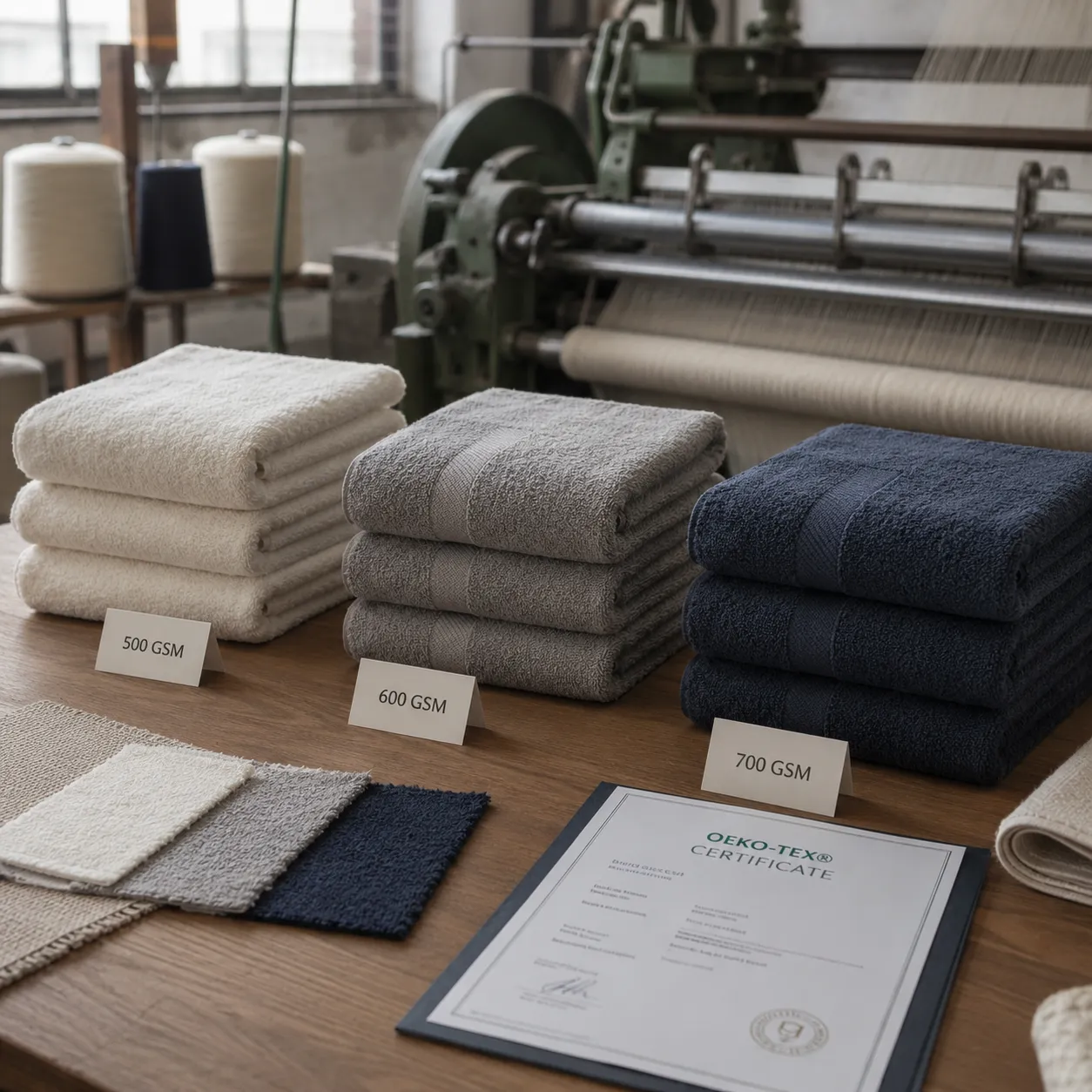
Start With the Certificate Scope, Not the GSM
On our merchandising desk, the most common mistake is treating OEKO-TEX as a blanket approval for every towel style a mill can make. It is not. STANDARD 100 by OEKO-TEX is issued to a certified article group, production route, material composition, and processing scope. If a certificate covers white 100% cotton terry towels, it does not automatically cover a reactive-dyed jacquard towel with polyester label, metallic embroidery thread, and silicone softener.
For baby, spa, face, and hotel skin-contact towels, we normally quote against OEKO-TEX STANDARD 100 Class I when requested. Class I has stricter limits because it is suitable for babies and toddlers up to 36 months. Some adult hospitality programs accept Class II, but we ask the buyer to confirm the end use in writing before sampling. That small step prevents a late-stage problem when a retailer, cruise group, or hotel compliance team asks why the certificate class does not match the selling claim.
GSM still matters, but it is a fabric engineering number, not a chemical-safety number. A 500 GSM towel can pass OEKO-TEX and still feel thin after alkaline washing if the pile is too short. A 720 GSM towel can also pass and still create housekeeping complaints if the drying cycle is overloaded. The certificate answers “restricted substances”; GSM answers “mass per square meter.” We need both, but they solve different problems.
| Document or test | What it proves | What it does not prove |
|---|---|---|
| OEKO-TEX STANDARD 100 certificate | The certified article group meets restricted-substance limits under the stated class and scope | It does not prove towel absorbency, lint level, pile retention, or laundry life |
| GSM measurement by ISO 3801 method | Fabric mass per square meter after cutting and weighing a conditioned specimen | It does not identify cotton grade, twist level, or finishing chemistry |
| ISO 105-C06 colorfastness to washing | Dyed towel resistance to washing under a defined lab condition | It does not guarantee every industrial laundry formula will be mild |
| ISO 6330 dimensional change wash | Shrinkage behavior after controlled domestic-type laundering | It is a benchmark, not a replacement for buyer laundry trials |
OEKO-TEX Certificate Towels GSM Comparison
For an oeko tex certificate towels gsm comparison, we first group towels by use case. The same certificate class can apply across several weights, but the risk profile changes with construction. Lower GSM towels expose more ground structure and can feel harsh if yarn twist is high. Higher GSM towels hold more water, which improves handfeel but raises drying cost and carton weight.
At LUMA & CO. TEXTILE, we manufacture from roughly 300 to 800 GSM for cotton terry, with some flat-woven hammam products below that range and some dense hotel bath mats above it. Our MOQ is 500 pcs per design and per color. For custom-dyed OEKO-TEX work, we prefer to keep each color above 800 to 1,000 pcs when possible because lab dips, shade control, and finishing setup costs spread more cleanly.
| GSM band | Common towel type | Mill-side notes |
|---|---|---|
| 300-380 GSM | Promo gym towel, travel towel, low-bulk hand towel | Quick drying and light cartons, but pile coverage must be checked after shearing and washing |
| 400-480 GSM | Fitness towel, pool hand towel, budget hotel hand towel | Good cost control; avoid over-softening because absorbency can drop in first 3 washes |
| 500-580 GSM | Hotel bath towel, spa hand towel, retail bath range | Balanced absorbency and drying time; often the safest OEM starting point |
| 600-690 GSM | Upper-tier hotel bath towel, resort pool towel | Fuller handfeel; needs realistic laundry drying capacity and carton planning |
| 700-800 GSM | Heavy bath sheet, luxury spa towel, dense bath mat variant | High perceived value, but slow drying and higher freight cost can offset the selling story |
A practical example: a 76 x 152 cm pool towel at 520 GSM has a theoretical fabric mass of about 601 g before hem, label, and moisture variation. The same size at 650 GSM moves to about 751 g. Across 5,000 pcs, that is roughly 750 kg more textile weight before cartons. Certification status is unchanged, but freight, drying energy, and shelf handling all change.
Where GSM and Chemical Safety Interact
GSM itself does not create an OEKO-TEX pass or fail. The risk usually sits in dyeing, finishing, thread, label, print paste, and after-treatment. Still, heavier towels often receive more finishing attention because buyers expect a softer handfeel. That is where we watch the recipe carefully. A silicone softener that gives a slippery touch may reduce initial absorbency, and any auxiliary must sit within the certified chemical input system.
For towels used on the face or skin immediately after treatment, we also check pH under ISO 3071. Most buyers ask for a skin-friendly range, commonly around pH 5.5-7.5, but the exact acceptance limit should be written into the tech pack. We do not present that as an OEKO-TEX substitute. It is a separate quality-control data point that helps avoid harsh handle or irritation complaints.
- Reactive dyes are our normal route for cotton terry because they give better wash fastness than direct dyes in repeated laundering.
- Disperse-dyed polyester trims must be covered by the certificate scope if they touch skin or appear on the finished towel.
- Embroidery thread needs its own compliance check; rayon, polyester, and metallic yarns do not behave the same in testing.
- Printed care labels can become a weak point if ink or coating is sourced outside the certified route.
This is why we ask for the decoration decision early. A plain white 560 GSM bath towel can be straightforward. Add navy embroidery, a woven edge stripe, and a retail belly band, and the compliance file becomes more layered. For decoration trade-offs, our team often points buyers to embroidery vs sublimation vs jacquard before we lock the sample.
Mill QC Tolerances We Will Actually Put in Writing
QC tolerance is not the same as a legal certification requirement. OEKO-TEX does not tell a mill that every towel must land within a certain GSM window. That tolerance is negotiated between buyer and manufacturer. We normally quote cotton terry with a finished GSM tolerance of plus or minus 5% after conditioning. For very heavy constructions, we may tighten or loosen that only after trial weaving, because pile height, yarn count, and finishing shrinkage move together.
Our inspection room conditions samples before weighing whenever schedule allows, using ISO 139 textile atmosphere as the reference principle: 20 degrees Celsius and 65% relative humidity. Export factories are not climate laboratories, so for production release we combine measured GSM, finished size, visual pile density, and wash-test history. If a buyer requires an accredited third-party lab value, we support that, but the PO should state the lab method and tolerance before deposit.
| QC point | Typical working tolerance | Caveat |
|---|---|---|
| Finished GSM | ±5% for standard cotton terry | Must be measured on conditioned samples; thick borders can distort small specimen cuts |
| Finished size | ±2 cm on bath and beach sizes; ±1 cm on hand and face towels | High-temperature washing may shrink further if the buyer laundry exceeds the test condition |
| Carton gross weight | ±6% from packing estimate | Moisture regain, carton board, and polybag choice affect the final shipping value |
| Shade lot | Commercial match against approved lab dip or PPS | Instrument delta E can be specified, but visual approval under D65 is still important for terry pile |
One construction quirk matters here: terry loops lean and compress after finishing. If the lab cuts a GSM specimen across a dobby border, the result can understate or overstate the body weight. We mark body-zone cutting positions for formal tests so a decorative border does not become a false quality dispute.
GSM Choices by End Use
The best GSM is usually the one that fits laundry reality. A resort may love a 700 GSM pool towel in the sample room, then reject it after the first peak-season weekend because dryers cannot turn rooms fast enough. A boutique gym may ask for the cheapest 320 GSM sweat towel, then discover members treat it like disposable stock. We try to price both scenarios with expected loss and wash cycles instead of only unit cost.
- Fitness and gym: 360-460 GSM is common for sweat towels; use tighter pile and stronger hems rather than chasing plushness.
- Hotel bath: 500-620 GSM covers most operational programs; above 650 GSM should be tested in the actual laundry.
- Spa treatment: 480-600 GSM works for hand, face, and treatment-room towels where softness and pH control matter.
- Pool and resort: 520-650 GSM is a practical range; oversized towels need carton and drying calculations before approval.
- Baby or facial retail: 400-550 GSM can work, but OEKO-TEX Class I and trim scope become more important than weight alone.
For a hotel group replacing 8,000 bath towels, we recently modeled a 540 GSM option against a 640 GSM option in a 70 x 137 cm size. The heavier option added about 77 g per piece before packaging. At 8,000 pcs, that created roughly 616 kg extra towel mass moving through laundry and freight. The heavier towel felt better on the approval table, but the 540 GSM construction with a combed cotton pile and reinforced lockstitch hem gave a lower cost per occupied room for that property.
For deeper size planning, our towel sizes and dimensions guide is more useful than a GSM table alone. For cotton feel, twist, and absorbency decisions, see combed vs zero-twist cotton explained.
Price Bands With the Necessary Caveats
FOB pricing changes with cotton futures, yarn count, dye depth, exchange rate, packaging, and certificate scope. The bands below are not a standing offer; they are realistic 2026 factory-side guide ranges for OEM cotton terry towels from our type of production setup in China, excluding import duty, destination freight, retail packaging development, and third-party inspection fees.
| Order volume | Typical GSM and size mix | Indicative FOB China range |
|---|---|---|
| 500-999 pcs | 400-600 GSM hand, gym, or bath towel | USD 1.35-5.90 per pc depending on size, dye, and trim |
| 1,000-2,999 pcs | 450-650 GSM hotel or spa towel | USD 1.05-5.25 per pc with simpler packaging |
| 3,000-9,999 pcs | 500-680 GSM bath, pool, or resort towel | USD 0.92-4.80 per pc when yarn and dye lots are consolidated |
| 10,000+ pcs | Program orders across several sizes | USD 0.78-4.45 per pc, subject to cotton and carton specification |
A dark reactive-dyed 600 GSM towel costs more than a white towel of the same size because dye, washing, water treatment, and shade control are heavier. A 420 GSM towel with complex embroidery can cost more than a plain 520 GSM towel. This is why we quote from a tech pack rather than from GSM alone. If your team has not built one, start with how to build a towel tech pack that mills can quote.
- Confirm certificate class and whether the finished article, trims, and decoration are covered.
- Select GSM by end use, not by the highest number that fits the budget.
- Approve lab dip or strike-off before bulk yarn dyeing or piece dyeing.
- Run pre-production wash checks before releasing full cartons.
- Keep one sealed approved sample at the mill and one with the buyer for final inspection.
Sampling and Production Timing
The sample timeline depends on whether we can use stock yarn and existing certified routes. A plain white towel in an existing construction can move quickly. A yarn-dyed jacquard towel with new colors, embroidery, and retail labels needs more time because each component must match both the design and the compliance file.
- Lab dip or yarn shade approval: 5-8 days for standard reactive cotton colors, longer for deep navy, black, or fluorescent shades.
- Prototype towel sample: 7-14 days for existing terry construction; 15-22 days for new jacquard or special border work.
- Pre-production sample: 6-10 days after color and construction are approved.
- Bulk production: 25-38 days for most 500-10,000 pc cotton terry orders after deposit and PPS approval.
- Inspection and export packing: 3-6 days depending on carton count, labeling, and whether third-party inspection is booked.
For OEKO-TEX certificate towels gsm comparison work, the slow step is often not weaving. It is confirming whether the exact finished article sits inside the existing certificate scope or whether a supplementary lab check is needed. If a buyer changes from white to a deep garment-like black after sample approval, we treat it as a new risk review, not a color swap.
Our mill has operated since 2007 with 220 employees, about 2.4 million towels annual output, and 80+ brand clients across 47 countries. We maintain OEKO-TEX 100 Class I capability, BSCI social compliance, and ISO 9001 quality-management certification. Those systems help, but they do not replace order-specific sign-off. A certificate file is only useful when it matches the towel being shipped.
What to Ask Before Approving Bulk
A short, edited approval list works better than a long generic checklist. We want the buyer, mill merchandiser, dyeing team, and QC inspector looking at the same few risk points. For this topic, the risk points are certificate scope, construction weight, absorbency after finishing, and wash behavior.
- Ask for the OEKO-TEX certificate number, class, expiry date, issuing institute, and article description.
- Check whether embroidery, labels, binding, print, and packaging claims are included or separately documented.
- State GSM tolerance, finished size tolerance, and the test method in the purchase order.
- Wash the approved sample at least 3 cycles before judging lint, shrinkage, and handle.
- Keep FOB price comparisons tied to the same size, GSM, yarn, dye depth, and packaging specification.
If an internal compliance team needs to read the document, our guide on how to read an OEKO-TEX certificate explains certificate number checks and scope language. If the discussion is mainly about whether 450, 550, or 650 GSM is appropriate, use our towel GSM decision framework. For hotel programs, hotel towel sourcing guide 2026 covers replacement ratios and operational planning.
Our Practical Recommendation
For most OEM programs, we recommend choosing the certificate class first, then narrowing GSM through the laundry and use case. A certified 520-580 GSM cotton bath towel is often more operationally stable than a heavier towel chosen only for sample-room feel. For gym and spa programs, lower GSM can still be correct if the yarn, hem, and wash behavior are controlled.
The corrected way to use an oeko tex certificate towels gsm comparison is not to rank towels from light to heavy. It is to confirm the chemical-safety scope, then test whether the chosen construction holds up in the real wash cycle. That is the difference between a compliant towel on paper and a towel program that survives reorder season.
Check Your Certificate and GSM Spec
Send us your towel size, target GSM, end use, color, decoration plan, and required OEKO-TEX class. We will review feasibility, MOQ, FOB range, and production timing before sampling. WhatsApp: +86 13205717266. Email: [email protected].
Request a spec review →