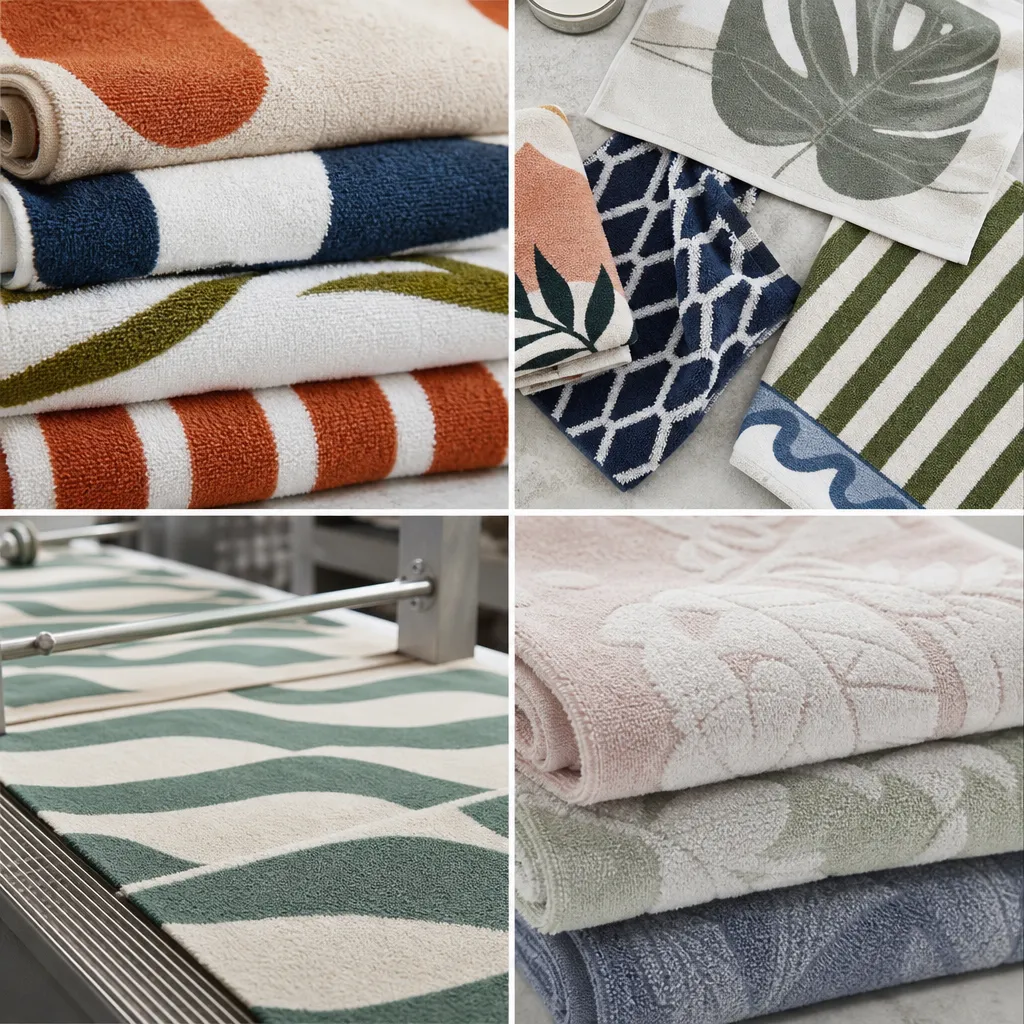
Start with the surface, not the artwork
The first decision is whether the design needs to sit on a sheared cotton face, a velour beach surface, or a microfiber print face. Buyers often send us a beautiful full-bleed file before locking the fabric, but print sharpness changes dramatically depending on how much pile stands up from the ground. On an unsheared terry face, loops scatter light and soften edge definition. On a sheared velour face, the print reads cleaner because we crop the loop tops before printing.
For bath programs, we usually steer brand teams toward 380-500 GSM cotton velour with a terry back if the front graphic matters and the towel still needs real absorbency. For promotional event pieces, 300-380 GSM can work if the design is the priority and the towel is not expected to survive heavy institutional laundering. For sports, travel, and retail packs where image clarity matters most, microfiber suede or waffle constructions around 220-300 GSM are more forgiving for dense graphics.
| End use | Typical construction | Usual GSM | What the print looks like |
|---|---|---|---|
| Resort or beach retail | 100% cotton velour face, terry back | 380-460 | Good saturation, softer edges than paper print |
| Gift or bath set | Cotton velour face, ring spun yarn | 420-500 | Cleaner logo areas, better handfeel |
| Gym or travel print item | 80/20 polyester-polyamide microfiber | 230-280 | Sharp image, high line definition |
| Promo giveaway | Cotton terry or cotton-poly blend | 300-360 | Acceptable for simple logos, weak for photo detail |
The three print routes we quote most often for custom printed towels
We do not treat printing as one category because the technical limits are different. The three routes we quote most often are reactive printing on cotton, pigment printing on selected cotton programs, and sublimation on polyester-rich microfiber. Each solves a different problem and each creates a different risk profile for wash performance, strike-off approval, and unit cost.
- Reactive print on cotton: best for better handfeel and deeper bond with the fiber. It requires controlled pre-treatment, steaming, soaping, and thorough washing-off to remove hydrolyzed dye.
- Pigment print on cotton: useful for simpler artwork and lower budgets, but the print film can stiffen the face if coverage is high. We are cautious with large solid panels.
- Sublimation on microfiber: strongest option for photo art, gradients, and tight registration. It will not work on 100% cotton towels because the dye needs polyester to transfer and lock in.
A practical point that gets missed: if the buyer wants a highly detailed front image and also expects a thick, hotel-like absorbent bath towel, one product may not satisfy both goals. That is where we push back a little. A 480 GSM cotton velour printed towel can work well for resort retail or branded bath sets, but it will never reproduce tiny type the way a 250 GSM microfiber face can.
Artwork failures usually come from pile direction and dot gain
Two technical issues explain most disappointing approvals. First is pile direction. On velour towels, brushing and shearing create a nap. If the nap lies inconsistently, dark solids can look lighter in one panel and richer in another. We control this by standardizing brushing direction before print and checking face appearance under both top light and side light during inline inspection.
Second is dot gain. Towels are not flat paper. Ink or dye spreads differently on a fibrous surface, especially around fine text and thin outlines. A line that looks safe at 1.2 mm in digital artwork may read visually broken once it lands on a loop-rich or loosely sheared face. For that reason, we often ask buyers to increase minimum stroke weight and open up negative spaces in letters.
- For cotton velour, we prefer logo lines above 1.5 mm and reversed-out text above 4 mm height.
- Large black grounds need special review because reflected pile direction can make them appear cloudy even when color measurement passes.
- On microfiber print faces, small typography is safer, but seam distortion near hems can still bend straight artwork if sewing allowance is too narrow.
The most expensive artwork problem is not a wrong Pantone. It is approving a design style that the towel surface was never able to hold.
Where cotton works, and where microfiber is the honest answer
Brand teams sometimes specify cotton because the category is "bath" and they assume polyester will feel wrong. Sometimes they are right; sometimes they are paying for the wrong substrate. If the product is a resort gift shop beach towel, cotton velour usually makes sense because the customer expects bulk, a familiar hand, and a terry back for drying. If the item is a travel, fitness, or event towel with photography, map graphics, or all-over patterning, microfiber is usually the cleaner manufacturing answer.
| Question | Cotton printed towel | Microfiber printed towel |
|---|---|---|
| Can it reproduce photo detail well? | Moderate | High |
| Absorbency feel | Better in terry-backed constructions | Fast surface pickup, different handfeel |
| Best for bath-use perception | Yes | Not usually |
| Best for tight color gradients | Fair | Strong |
| Typical MOQ at our mill | 500 pcs per design per color | 500 pcs per design |
| Common defect to watch | Uneven face shading from nap | Heat ghosting or transfer blur |
On the cotton side, our stronger bath-range programs use ring spun cotton, usually 16s or 21s yarn depending on target weight and handle. On microfiber, print quality depends heavily on the knit or woven face stability before transfer. We reject rolls with excessive skew because a strong geometric print will reveal that distortion immediately after hemming.
Color approval needs more than a mockup
A digital mockup is not a color standard. For OEM orders, we prefer one of three approval routes: physical lab dip plus strike-off for cotton reactive work, transfer strike-off for sublimation, or sealed swatch against a Pantone reference with an agreed viewing condition. For darker or branded signature shades, we measure against a tolerance rather than relying on phone photos.
Our internal QC team normally checks color under D65 lighting, and for repeat orders we keep the approved cutting as a control sample. On cotton print programs, post-wash appearance can shift after the soaping stage, so the final approval should reference the washed strike-off, not the pre-wash panel. Buyers who skip this step usually run into avoidable disputes later.
- Ask for a washed strike-off, not only a fresh print panel.
- If your design includes skin tones or pale sand shades, request side-by-side photos under neutral lighting plus a couriered swatch.
- For chain-store replenishment, specify acceptable color tolerance in writing and identify the approval master by date and sample code.
Testing that actually matters after the first 20 washes
Claims about durability should be tied to test methods. For printed cotton towels, we usually review colorfastness to washing under ISO 105-C06 and colorfastness to rubbing under ISO 105-X12. For absorbency-related bath products, a pretty print means little if the sheared face and finishing chemistry leave the towel slow to wet out, so we also monitor water uptake behavior after finishing adjustments.
For microfiber print items, wash appearance still matters, but edge curling, print migration, and lint pickup often become more visible failure points than simple shade loss. We run repeated domestic wash evaluations and compare image integrity around folded hems and corner stitch points because those areas take the highest mechanical stress.
| Test area | What we check | Typical concern on printed towels |
|---|---|---|
| ISO 105-C06 wash fastness | Shade change and staining after washing | Under-fixed print or poor washing-off |
| ISO 105-X12 rubbing | Dry and wet crocking | Dark grounds transferring onto lighter fabrics |
| Dimensional stability | Shrinkage after wash | Artwork distortion near borders |
| Visual panel review | Nap reflection, banding, ghosting | Uneven print appearance not captured by numbers alone |
For a recent cotton velour bath order with dense navy artwork, our pre-shipment pass standard required wash fastness grade 4 for shade change and at least 3-4 for staining on adjacent fabric, with shrinkage held under 5% after the agreed care cycle. That is the kind of language buyers should ask for in the PO instead of broad wording like "washable" or "long lasting".
Price bands by method, size, and volume
Prices move with fiber content, print route, towel size, and packing. The fastest way to get a bad comparison is to benchmark a cotton velour beach size against a thin microfiber promo piece. Below are realistic FOB China working ranges we are quoting in mid-2026 for standard OEM packing, based on our MOQ of 500 pcs per design per color.
| Product type | Approx size | Volume | FOB USD/pc |
|---|---|---|---|
| Cotton velour printed bath towel | 70 x 140 cm, 430-470 GSM | 500-1,499 pcs | 4.65-6.10 |
| Cotton velour printed beach towel | 80 x 160 cm, 380-430 GSM | 1,500-4,999 pcs | 5.25-6.95 |
| Microfiber sublimation towel | 70 x 140 cm, 240-280 GSM | 500-1,499 pcs | 2.15-3.05 |
| Microfiber sports or travel towel | 40 x 80 cm, 220-260 GSM | 3,000+ pcs | 0.88-1.34 |
A few cost drivers deserve precision. Full-face dark grounds on cotton raise chemistry, washing, and yield risk. Pantone-sensitive resort palettes can add sampling cycles. Individual polybags with insert cards add around USD 0.08-0.24 per unit depending on material and print. If the order includes a hang tag, belly band, and barcode sticker pack-out, that often adds another 2-4 packing days once goods reach finishing.
Cheap comparisons also hide cost-per-use. We recently modeled two bath-retail concepts for a buyer: one 340 GSM pigment-printed cotton piece at USD 3.42 FOB, and one 445 GSM reactive-printed velour at USD 5.08 FOB. After 30 home-laundry cycles, the lighter option had visible face harshness and edge torque that made it unsuitable for repeat gift-box retail, while the heavier program still merchandised cleanly. If the retail margin depends on appearance at reorder time, the lower entry price is often not the lower commercial cost.
Lead times: where the real calendar goes
Printed towel schedules are rarely delayed by weaving alone. The longer path is usually artwork cleanup, strike-off approval, and finishing queue. For a straightforward repeat microfiber sublimation order, we can often move from approved art to shipment in about 18-24 days. For a new cotton reactive print with new labels and carton marks, 32-45 days is more realistic after sample approval.
- Artwork check and file correction: 1-3 days depending on complexity.
- Strike-off or transfer sample: 4-8 days.
- Buyer approval window: often the biggest variable; plan 2-7 days.
- Bulk production and sewing: 12-22 days depending on capacity and quantity.
- Final inspection, packing, and booking: 3-6 days.
If the towel has fringes, shaped corners, or decorative dobby borders, lead time gets less predictable because print registration near those features needs extra handling. This is one reason we ask brand teams to freeze hem width early in development. A 25 mm hem and a 40 mm hem change not only the appearance but the printable field and fold presentation.
Specs we need before we can quote accurately
We can quote faster when the request includes the details that actually affect production. A surprising number of inquiries for custom bath towels arrive with only a mood board and no target size or ground material. That forces factories to guess, and guessed quotes create friction later. If you want a stable offer, the tech pack should tell us what the towel is expected to do, not only how the art should look.
- Finished size and tolerance, for example 70 x 140 cm ±3%.
- Target construction: cotton velour/terry back, terry all over, or microfiber suede/waffle.
- Target weight range in GSM and acceptable finished weight tolerance.
- Artwork file format, print area, bleed requirement, and whether the design crosses hems.
- Packing method, barcode needs, carton quantity, and destination market labeling.
Buyers building those specs for the first time may find our guides on building a towel tech pack mills can quote and pantone color matching for custom towels useful. If your team is still comparing decoration routes, the breakdown in embroidery, sublimation, and jacquard helps clarify what printing can and cannot do.
Common mistakes we see before PO placement
Some failures are avoidable if they are discussed before deposit. One is placing photographic artwork onto a cotton terry face and expecting catalog-sharp detail. Another is specifying a very soft zero-twist style for a dense all-over print; that yarn style can look attractive in hand but is less stable for crisp front-face decoration. We also see orders where buyers ask for one blanket approval sample to cover both color and absorbency, even though finishing changes made after print can alter both.
- Approving from phone images only instead of a couriered washed sample.
- Using very narrow hems, then rejecting border waviness after bulk sewing.
- Sending RGB artwork with no Pantone intent for brand-critical colors.
- Ignoring destination wash conditions, especially chlorine-heavy hospitality laundries.
For hospitality or club environments, printed pieces should be spec'd differently from plain-stock bath towels. If your larger linen program is still being defined, our articles on hotel towel sourcing, setting up a 90-day linen roadmap, and how to read an OEKO-TEX certificate are the right background before moving into decorated items.
Compliance, MOQ, and the practical buying window
Our standard MOQ is 500 pcs per design per color. For some microfiber sublimation programs we can combine sizes within the same artwork family, but the print file and packing breakdown need to be clean. Cotton printed bath and beach programs are less flexible because face preparation, shade control, and sewing balance become harder when too many variations sit in one run.
For compliance, the baseline documents buyers ask us for most often are OEKO-TEX Standard 100 Class I, BSCI, and ISO 9001. Those documents speak to chemical safety scope, social compliance framework, and quality management system, but they do not replace a product-specific wash plan or approval sample. We share that distinction openly because certificates are often overused as shorthand for performance.
Related reads: if you are comparing absorbent cotton against faster-drying synthetics, see microfiber vs cotton towel comparison. If MOQ is the sticking point, this negotiation guide explains what flexibility is real and what usually damages unit economics. For beach-format developments, the planning notes in our resort towel program guide can save a sampling round.
Quote your custom printed towels with usable specs
Send size, fabric, artwork, target GSM, packing, and destination market. We will recommend the print route, quote realistic FOB bands, and flag wash or color risks before sampling. MOQ 500 pcs per design per color. WhatsApp: +86 13384590853 | Email: [email protected]
Request OEM quote →