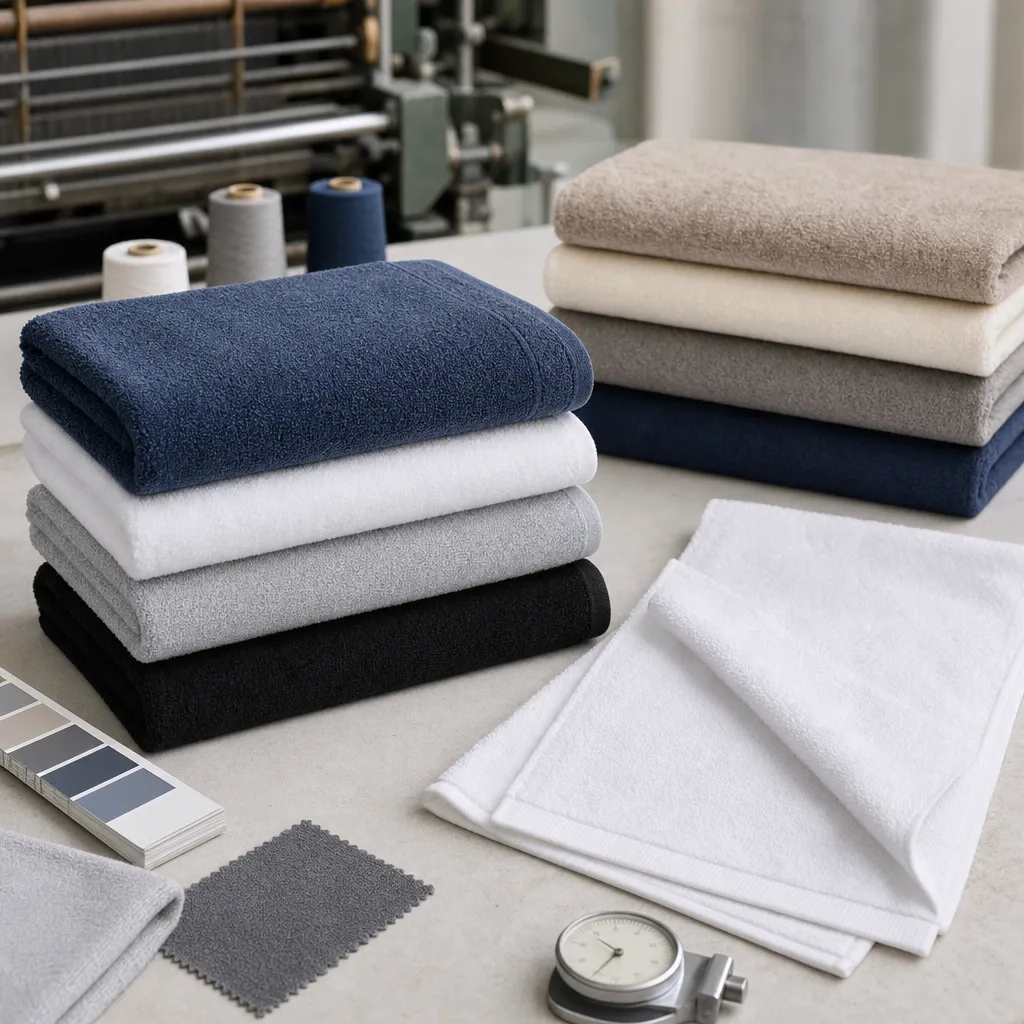
Start With the Wash Cycle, Not the Shelf Photo
For retail towels, a soft handfeel in the sample room can be enough to win approval. For gym programs, the towel has to survive repeated alkaline detergent, hot water, disinfectant, and mechanical abrasion. In our mill, we treat a fitness towel as a laundering product before we treat it as a branding product.
The most common failure we see is not tearing. It is a slow collapse of handfeel: loops flatten, edge stitching puckers, dark colors fade unevenly, and lint sticks to black leggings or rubber gym flooring. These defects usually come from underspecified yarn, loose hems, or too much softener in finishing. Silicone softener can make a pre-production sample feel impressive, but if the finish blocks capillary action, the towel absorbs sweat more slowly in actual use.
For commercial fitness use, we normally quote 360-500 GSM cotton terry for sweat towels, 280-360 GSM microfiber for compact quick-dry towels, and 430-580 GSM cotton for locker-room hand or shower-adjacent use. The right range depends on who launders the towels and how many turns per day the club expects.
| Use case | Typical size | Recommended GSM | Main risk if underspecified |
|---|---|---|---|
| Cardio floor sweat towel | 30 x 80 cm or 35 x 80 cm | 360-430 GSM cotton terry | Feels thin after 25-35 industrial washes |
| Boutique class towel | 40 x 90 cm | 400-480 GSM cotton terry | Logo area curls if border is too wide |
| Compact quick-dry towel | 30 x 70 cm | 280-340 GSM microfiber | Low perceived value for paid memberships |
| Locker-room hand towel | 40 x 70 cm or 40 x 80 cm | 450-560 GSM cotton terry | Slow drying if loops are too dense |
| Retail add-on towel | 35 x 90 cm or 50 x 100 cm | 430-520 GSM cotton or blend | Decoration cost can exceed fabric cost |
Workout Towels: The Spec Range We Quote Most
For workout towels supplied to gyms, studios, hotel fitness centers, and athletic brands, our most frequently approved construction is ring-spun cotton terry at 400-460 GSM, 16/1 or 21/2 yarn depending on target price, with a 1.5-2.0 cm dobby or plain hem. That sounds simple, but the construction choices behind it change the towel's wash behavior.
A 30 x 80 cm towel at 420 GSM uses roughly 101 g of fabric before hemming and processing loss. After cutting, sewing, and final moisture regain, the shipped piece is usually around 108-116 g. If the buyer expects a towel that feels substantial on a treadmill handle, dropping the same size to 320 GSM saves weight but also changes perceived value immediately.
We push buyers away from very high GSM for sweat towels unless the towel is part of a luxury locker-room program. A 600 GSM small towel can feel dense in the hand, but in a busy gym it dries slowly between collection and washing. That raises odor risk, especially when used towels sit in a plastic bin for four to six hours before laundry pickup.
- For high-turn gym service, choose 380-440 GSM cotton terry when laundering is frequent and storage space matters.
- For boutique studios charging higher membership fees, 430-500 GSM gives a better handfeel without making the towel too slow to dry.
- For microfiber cooling or travel pieces, 280-360 GSM is more realistic than trying to imitate cotton bulk.
- For locker rooms where towels may touch wet hair or face, avoid open-end yarn below 360 GSM unless the program is disposable-price driven.
Cotton, Microfiber, or Blended Terry
Cotton still dominates gym sweat towels because members understand the feel. It wipes skin clean, absorbs quickly when correctly finished, and tolerates repeated laundering. Microfiber works better where compact packing, faster line drying, or sublimation printing matters. Blended terry can be useful, but it needs honest positioning because a cotton-poly towel will not behave exactly like a full cotton gym sweat towel.
For cotton, we usually discuss carded, ring-spun, combed, and zero-twist options. Zero-twist is soft but not our first recommendation for heavy fitness rotation because the loops can snag more easily on watch buckles, zipper pulls, and weight machines. Combed cotton gives cleaner yarn and lower lint, but the price increase is only justified when the towel is member-facing or sold as merchandise.
For microfiber, split fiber quality matters more than a buyer's eye can see in a photo. A 80/20 polyester-polyamide blend generally wipes better than 100% polyester. For sublimated designs, we keep one face printable and control heat press temperature so the pile does not glaze. Once microfiber surface fibers melt slightly, the towel may look bright but wipe sweat poorly.
| Material route | Best for | Typical spec | Factory note |
|---|---|---|---|
| Ring-spun cotton terry | Daily club service | 380-460 GSM, 16/1 or 21/2 yarn | Good balance of cost, absorbency, and wash life |
| Combed cotton terry | Boutique fitness retail | 430-520 GSM | Cleaner surface, lower lint, higher yarn cost |
| Cotton-poly terry | Budget promotional programs | 330-420 GSM | Dries faster but feels less absorbent than cotton |
| 80/20 microfiber | Travel, cooling, printed towels | 280-360 GSM | Best for sublimation and compact packing |
| Jacquard cotton | Brand pattern programs | 420-520 GSM | MOQ and weaving setup cost are higher |
Tests We Use Before Approving Bulk Production
A sample that passes a hand squeeze is not enough. For fitness programs, we check absorbency, dimensional stability, colorfastness to washing, perspiration response, and lint. Some buyers only ask for OEKO-TEX, which is important, but chemical safety certification does not replace performance testing.
For absorbency, we commonly reference AATCC 79 as a quick water drop method, plus an internal strip-wicking check after wash. A towel that absorbs in two seconds before washing but takes eight seconds after finishing has too much hydrophobic residue. We correct that by adjusting softener level, scouring, and drying temperature.
For color, we use ISO 105-C06 for domestic and commercial laundering simulation, ISO 105-E04 for perspiration, and ISO 105-X12 for rubbing where dark towels or contrast logos are involved. These matter because sweat contains salts and oils that can shift color, especially on navy, charcoal, red, and reactive black. A towel can pass a normal wash test and still mark a white bench cover if rubbing fastness is poor.
- Absorbency: target water drop absorption under 3 seconds after one wash for cotton terry sweat towels.
- Shrinkage: keep length and width change normally within 3-5% after test washing, depending on construction.
- Lint: run tumble-dry inspection after dark-color laundering because white lint on black towels is a common member complaint.
- Edge strength: inspect side hems after 10-cycle wash testing, not only after sewing inspection.
- Colorfastness: use ISO 105-E04 when towels are exposed to heavy sweat and deodorant residue.
Logo Decoration Has to Survive Friction
Fitness towels get twisted, stepped on, clipped to bags, and washed in bulk nets. Decoration must be chosen for that abuse. Embroidery is durable, but a dense stitch area can feel scratchy if placed where the towel rubs the neck or face. Sublimation gives full-color graphics on microfiber, but it is not suitable for cotton terry. Jacquard is the cleanest long-life route for repeated washing, although it needs a simpler artwork mindset.
For embroidered cotton workout towels, we usually keep the logo under 8 x 5 cm on 30 x 80 cm towels, with stitch counts below 7,000 unless the towel is mostly promotional. A satin stitch border over a thick terry surface can sink into the pile, so we often recommend a filled mark with underlay adjusted after one strike-off. For small towels, logo placement 5-7 cm above the lower hem avoids folding distortion during use.
Jacquard is stronger for tone-on-tone fitness clubs that want the brand woven into the towel. The limitation is detail: thin letter strokes below about 2.5 mm can break visually after washing because terry loops open and twist. For buyers comparing decoration choices, our longer guide on embroidery vs sublimation vs jacquard explains the trade-off in more detail.
| Decoration method | Works on | Typical MOQ impact | Fitness towel caution |
|---|---|---|---|
| Embroidery | Cotton terry, microfiber edge panels | 500 pcs per design/color | Avoid dense stitching on face-contact zones |
| Sublimation | Polyester microfiber | 500 pcs per design/color | Heat can flatten pile if press settings are wrong |
| Jacquard weave | Cotton terry | Usually 800-1,200 pcs for efficient weaving | Artwork must be simplified before loom setup |
| Woven label | Most towel types | 500 pcs per design/color | Label corners can irritate skin if placed on wiping surface |
| Dobby border logo | Cotton terry | Depends on loom setup | Narrow borders wash flatter than wide decorative bands |
Bulk Pricing and MOQ Reality
Our standard MOQ is 500 pcs per design per color. That is the lowest point where dyeing, cutting, sewing, inspection, and export packing can be controlled without pushing too much cost into each towel. Below 500 pcs, the factory time is similar but the fixed setup cost is spread across fewer units.
For fitness towels wholesale buyers, price depends on size, GSM, yarn grade, color depth, decoration, packing, and test requirements. Dark reactive colors cost more than white or light gray because dye consumption, rinsing time, and colorfastness control are higher. Individual polybags add labor and material; bulk carton packing is cheaper and better for most gym service programs.
As a realistic benchmark, a 35 x 80 cm ring-spun cotton terry towel at 420 GSM with one small embroidery is usually quoted around USD 1.42-1.88 at 500 pcs, USD 1.18-1.55 at 2,000 pcs, and USD 0.98-1.31 at 8,000 pcs, depending on color and packaging. A microfiber sublimated towel of similar gym size may land around USD 1.05-1.46 at 500 pcs and USD 0.78-1.08 at 8,000 pcs.
| Program volume | Cotton terry towel, 35 x 80 cm, 400-450 GSM | Microfiber printed towel, 30 x 80 cm | Typical lead time after approval |
|---|---|---|---|
| 500 pcs | USD 1.42-1.88/pc | USD 1.05-1.46/pc | 24-32 days |
| 2,000 pcs | USD 1.18-1.55/pc | USD 0.88-1.22/pc | 28-36 days |
| 8,000 pcs | USD 0.98-1.31/pc | USD 0.78-1.08/pc | 34-45 days |
| 20,000 pcs | USD 0.86-1.18/pc | USD 0.69-0.96/pc | 42-55 days |
A lower unit price can still be expensive in use. One buyer asked us to match a 300 GSM open-end cotton towel at USD 0.71 for a regional gym chain. We priced a 410 GSM ring-spun option at USD 1.09. In their laundry, the cheaper towel needed replacement after about 38 washes, while the heavier ring-spun towel was still acceptable after 92 washes. The first option cost roughly 1.87 cents per use before freight; the second cost about 1.18 cents per use. That is why we ask for wash expectations before chasing the lowest quote.
Production Timeline From Lab Dip to Carton
A normal OEM towel program does not begin with bulk weaving. It starts with artwork, yarn decision, lab dip, strike-off if decorated, and buyer approval. Rushing these steps usually costs more than it saves, especially when a brand color must match a Pantone reference under store lighting and gym lighting.
- Confirm size, GSM, material, color, logo method, packing, and target order quantity. A complete tech pack can reduce two to four days of clarification.
- Make lab dips for dyed cotton or printed color tests for microfiber. Normal timing is 4-7 days.
- Produce a pre-production sample or decoration strike-off. Embroidery and woven label samples usually take 5-9 days; jacquard strike-offs take longer.
- Run buyer approval and test washing. We recommend at least one wash before signing off logo placement and towel handfeel.
- Start bulk yarn preparation, dyeing or weaving, cutting, sewing, inspection, packing, and export booking.
For repeat programs, we can often ship in 22-35 days after deposit and artwork confirmation. For first orders with custom dyeing and decoration, 30-45 days is more realistic. Jacquard towels, dark reactive dye lots, or third-party testing can add 7-14 days. Air freight can rescue a launch date, but for towels the freight cost per cubic meter is high, so we plan sea freight whenever the calendar allows.
For buyers building a full gym towel system, it helps to separate service towels from retail towels. Service towels can run in bulk cartons with simple woven labels. Retail pieces may need barcode stickers, belly bands, or individual bags, which adds 2-5 days for packing material confirmation and line work.
Compliance, Documentation, and Factory Controls
LUMA & CO. TEXTILE operates with OEKO-TEX Standard 100 Class I coverage, BSCI social compliance, and ISO 9001 quality management. For fitness buyers, OEKO-TEX matters because towels touch face, skin, and sometimes children in family gyms. Class I is the strictest category, originally designed for baby and toddler products, so it gives procurement teams a conservative chemical-safety basis.
Documentation should match the product being shipped. If a buyer orders dyed cotton workout towels, we keep lab dip approval, color standard, GSM record, size tolerance, carton mark, and inspection report in the order file. For microfiber, we add print artwork records and heat setting checks. For decorated orders, we keep approved stitch files, woven label artwork, or jacquard loom files so repeat orders do not drift.
- Ask whether the certificate holder name, product scope, and expiry date match the supplying mill.
- For private-label fitness brands, confirm care label fiber content before bulk production, especially for cotton-poly blends.
- For gyms using outside laundries, share detergent temperature and drying method with the towel supplier before finalizing GSM.
- For export cartons, specify whether towels ship loose packed, bundle packed, or retail packed because carton cube changes freight cost.
- For repeat orders, keep one approved sealed sample at the mill and one with the buyer to control handfeel and color drift.
Common Defects We Watch on the Line
Workout towels look simple, so they are often inspected too casually. On our production floor, we check the same defects repeatedly because they are the ones that come back as buyer complaints after real use.
One construction quirk is border behavior. A wide dobby border can shrink differently from the terry field, creating a curled end after tumble drying. This is more visible on narrow gym towels than on bath towels because the towel has less fabric weight to pull itself flat. For a 30 x 80 cm piece, a clean 1.5 cm hem often behaves better than a decorative 5 cm border.
Another problem is loop snagging around metal fitness equipment. Very long loops feel plush at first, but they catch more easily on zipper teeth and bench hardware. For service towels, we keep loop height moderate and use tighter side hemming rather than chasing a spa-like pile.
- Skewed shape: caused by poor fabric relaxation before cutting or uneven tension in sewing.
- Hard handfeel: often from over-drying, harsh dyeing, or low-grade yarn rather than GSM alone.
- Logo puckering: dense embroidery on light GSM terry pulls the ground fabric after washing.
- Color staining: reactive dye not rinsed sufficiently can transfer during first industrial washes.
- Lint shedding: weak yarn and insufficient pre-wash control show up fastest on dark towels.
How to Brief a Mill So the Quote Is Useful
A useful quote needs more than 'small gym towel with logo.' The mill needs to know the wash environment, towel role, size, target handfeel, decoration, packing, and expected reorder rhythm. We can estimate from photos, but clear numbers prevent the common mistake of comparing two towels that only look similar on a spreadsheet.
For a first inquiry, send size in centimeters, target GSM or reference weight, material preference, Pantone or lab dip direction, logo artwork, order quantity by color, packing method, destination port, and any required standards. If you do not know the GSM, send a towel you like and tell us what you dislike about it after washing. That feedback is more useful than a generic request for 'good quality.' Our guide on building a towel tech pack shows the fields we actually use on the factory side.
Related reads: compare material behavior in microfiber vs cotton towel comparison, review service-life failures in why gym towels fail after 50 washes, and use towel GSM decision framework if your team is still choosing weight.
Related reads for procurement teams: see negotiate towel MOQ without killing margin before splitting too many colors, and check container vs air freight towel orders when a launch date is close. For product range planning, our gym towel product category is the shortest route to compare service and retail options.
Build a Fitness Towel Spec That Holds Up
Send us your size, GSM target, logo artwork, wash method, and volume. MOQ is 500 pcs per design per color. We quote with realistic fabric, decoration, testing, and freight assumptions. WhatsApp +86 13205717266 or email [email protected].
Request a Towel Quote →