Start with the event date, then work backward
For rally towels, the in-hands date is the only date that counts. A promotion tied to a home opener, sponsor activation, political rally, or finals series has almost no value if cartons arrive three days late. We usually ask buyers for four fixed points on day one: event date, required warehouse date, ship-to postal code, and whether the design is screen printed, sublimated microfiber, or jacquard woven.
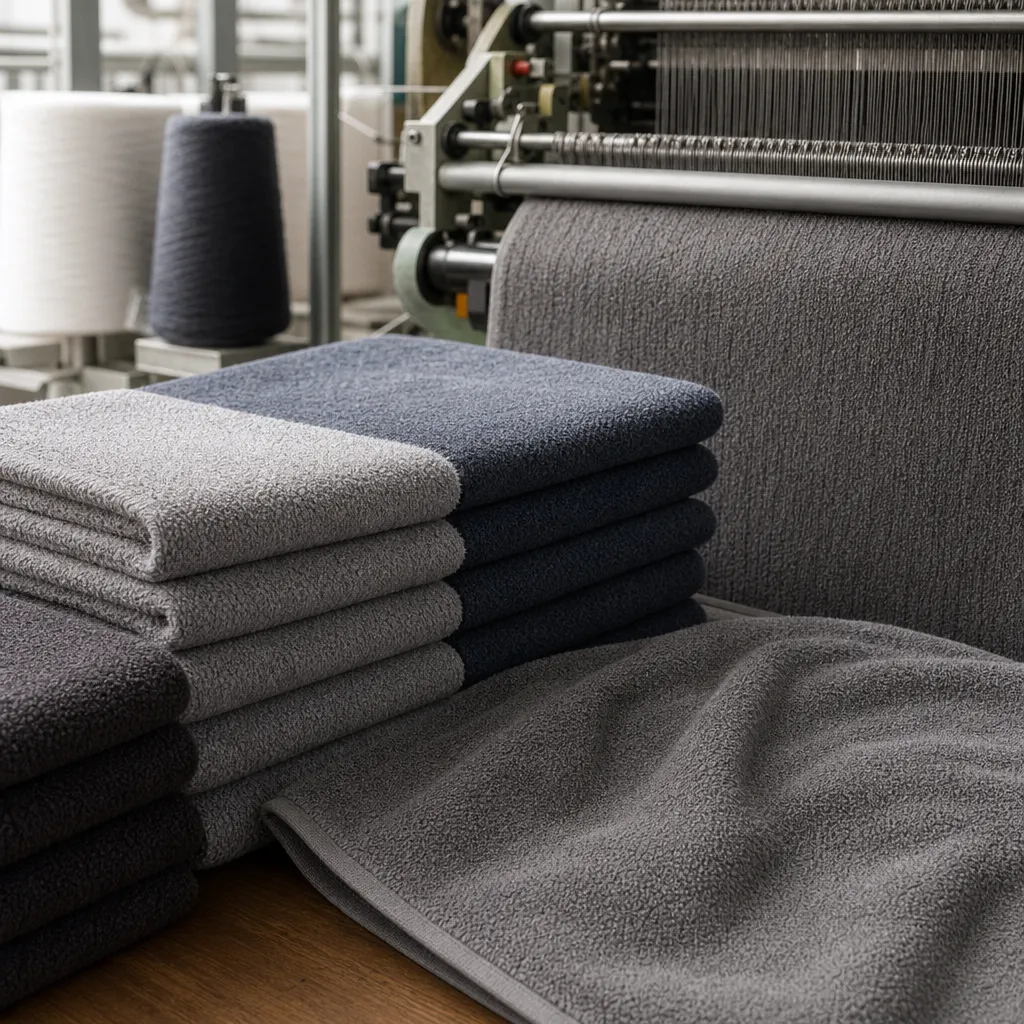
That is because the production path changes by construction. A 100% cotton terry towel with a one-color plastisol print moves through dyeing, shearing, printing, curing, trimming, metal detection, and packout. A polyester microfiber rally towel skips several wet-process steps but adds print file preparation, transfer paper scheduling, and heat-transfer capacity. A jacquard towel needs loom planning first, which is usually the least flexible step in the calendar.
| Decoration / construction | Typical size | Common GSM | Bulk production window after approval |
|---|---|---|---|
| Cotton terry + 1-2 color screen print | 30x50 cm to 38x63 cm | 320-420 GSM | 16-24 days |
| Microfiber + full sublimation | 30x50 cm to 40x70 cm | 200-260 GSM | 12-18 days |
| Cotton jacquard woven | 30x50 cm to 40x70 cm | 360-500 GSM | 22-32 days |
| Cotton terry + hem label + polybag set | 30x50 cm to 38x63 cm | 320-420 GSM | 19-27 days |
- If artwork is still open, build time from final signed artwork, not from inquiry date.
- If the order is split across multiple venues, use the earliest required receipt date as your planning anchor.
- If your event is fixed, reserve freight space before bulk packing finishes; waiting for finished cartons can lose 2-4 days in peak weeks.
What actually adds days inside the factory
Editors are right to be skeptical of vague lead-time claims, so here is how we break it down at mill level. For a standard cotton rally towel order around 10,000 to 25,000 pieces, the schedule is usually built from yarn readiness, greige weaving capacity, dye lot booking, print line queue, and final inspection. The day count changes less from sewing than from queue management between these departments.
Two process details matter more than most buyers expect. First, dark ground colors often need a longer stabilization window after dyeing before screen printing, otherwise ink adhesion and shade consistency can drift across lots. Second, if the towel face is sheared for a cleaner print surface, we need to watch pile height very closely; over-shearing can expose ground yarn and make solid areas print unevenly.
| Production step | Normal days | What changes the timing |
|---|---|---|
| Lab dip or strike-off approval | 2-4 days | Pantone match tolerance, sponsor color sensitivity, weekend response lag |
| Weaving / knitting preparation | 3-6 days | Existing greige stock versus new loom allocation |
| Dyeing and drying | 3-5 days | Dark shades, reactive dye recipe complexity, re-dye risk |
| Screen print or sublimation run | 2-5 days | Color count, artwork registration, line booking |
| Cutting, hemming, loose thread cleaning | 2-4 days | Special folded size, hang loop, care label insertion |
| AQL inspection, carton packing, booking release | 2-3 days | Retail barcode sorting, assortment by carton, drop-test requirement |
For cotton print orders, our internal release usually waits for two checks that buyers rarely see written into quotations: print crocking review after cure, and finished measurement after first wash. We typically verify colorfastness to rubbing under ISO 105-X12 and dimensional change under ISO 5077 or equivalent buyer method before we clear bulk shipment. Those tests do not add a week, but they do add discipline, especially on dark red, navy, and black grounds.
Rush orders usually fail at approval, not at sewing
If a rally towel program misses date, the root cause is often late signoff rather than slow manufacturing. Buyers will spend six days revising logo placement by 8 mm, then ask the mill to recover those six days in production. Sometimes we can compress, but not every step can be compressed safely.
- Artwork arrives in RGB web files instead of vector outlines, so separations have to be rebuilt.
- The buyer changes from one-color print to two-color print after strike-off approval.
- Folding method changes after carton dimensions are already calculated.
- The consignee asks for mixed-size barcode labels or venue-specific carton marks at the end of packing.
On a 15,000-piece cotton order, adding a second spot color after print screens are prepared can add about 2-3 working days between new film output, screen coating, registration, and line rebooking. Changing from bulk pack to individual polybag with suffocation warning and barcode sticker often adds another 1-2 days, plus material lead time if the bags are not plain stock.
If the event date cannot move, freeze artwork and packout earlier than feels comfortable. That decision protects more schedule than negotiating one more cent on unit price.
Freight choices for custom rally towels lead-time and logistics
Freight planning for giveaways is mostly a balance between urgency and carton density. Rally towels are lighter than bath towels, but the volume still builds quickly because many are packed flat, folded for handout, or individually bagged for sponsor distribution. For small rush programs, air can be reasonable. For full stadium quantities, sea freight is usually the only economical route.
| Mode | Transit range after departure | Best use case | Indicative cost band |
|---|---|---|---|
| Express courier | 4-7 days | Samples, top-up cartons, under 300 kg | USD 5.60-8.40/kg |
| Air freight | 7-12 days | Rush event orders, 500-3,000 kg | USD 3.10-4.90/kg |
| Sea LCL | 24-38 days | Smaller bulk lots without full container urgency | USD 85-145/CBM plus local charges |
| Sea FCL | 22-35 days | Large-volume stadium or chain programs | USD 2,050-3,650 per 40HQ lane-dependent |
Those transit ranges are not promises; they are planning ranges based on common lanes we book through Ningbo or Shanghai to North America, Europe, and Australia. Port congestion, customs exam, feeder connection misses, and destination drayage capacity can shift actual delivery. For event business, we recommend planning against the slower end of the range, especially in August to October and again before Lunar New Year.
A related detail buyers often miss is cargo ready date versus vessel date. If cartons finish on a Thursday afternoon and the container cutoff was Thursday morning, that cargo is effectively one sailing later. On some routes, missing one weekly sailing is a bigger delay than anything that happened in sewing.
Carton math decides whether your freight quote is real
We see many freight comparisons made on unit count only, which is not enough. The right comparison uses finished towel dimensions, fold method, polybag or no polybag, pieces per carton, and carton outer size. A slim microfiber towel and a looped cotton terry towel with the same face dimensions can ship very differently because terry traps more air and springs back after packing.
| Program example | Packout | Carton size | Pieces/carton | Approx. CBM per 10,000 pcs |
|---|---|---|---|---|
| Cotton terry 35x60 cm, 380 GSM | 50 pcs bulk pack | 54x38x42 cm | 120 | 17.2 CBM |
| Cotton terry 35x60 cm, 380 GSM | 1 pc polybag | 56x40x44 cm | 100 | 24.6 CBM |
| Microfiber 30x50 cm, 220 GSM | 1 pc polybag | 50x36x32 cm | 150 | 12.8 CBM |
| Jacquard cotton 38x63 cm, 430 GSM | 40 pcs bulk pack | 58x40x46 cm | 80 | 33.4 CBM |
That difference is why a unit FOB price can look attractive while total landed cost does not. One recent quote model we built for an event buyer had a cotton screen-printed towel at USD 0.72-0.96 per piece for 10,000-30,000 pieces FOB China, while the same order in individual retail bags added roughly USD 0.05-0.09 per piece in packaging cost and pushed freight cost up by another meaningful amount because carton volume increased.
- Ask for carton outer dimensions and net/gross weight on the quotation, not only unit FOB price.
- If the towels are for handout crews, test whether banded bundles of 10 or 20 work better than single polybags.
- If destination labor is expensive, slightly higher packing cost at origin can still lower total event handling cost.
Where rally towel orders get stuck after production
Once towels are packed, the weak points move from factory control to document and handoff control. For promotional goods, the most common post-production delay is simple document mismatch: consignee address differs between booking and commercial invoice, carton marks omit a PO suffix, or the importer needs an additional declaration for textile composition that was never requested during booking.
Another failure mode is palletization added too late. Some event venues and 3PLs require pallet height caps or slip sheets, but those requirements only show up after cartons are closed. Reworking 180 cartons into a different pallet pattern is manageable; discovering that requirement after the truck has reached the warehouse is more expensive.
- Confirm consignee, notify party, tax ID, and delivery appointment rules before booking.
- Lock carton marks before mass packing starts.
- State whether floor-loaded or palletized cargo is required.
- For split deliveries, provide carton allocation by location in the PO, not by email thread later.
For buyers new to this category, our build-towel-tech-pack-that-mills-can-quote.html article helps on specification control, and container-vs-air-freight-towel-orders.html explains the freight trade-offs in more detail.
A realistic planning window by order size
Below is the planning window we usually give when the buyer wants a credible schedule rather than an optimistic one. These ranges assume artwork is approved, deposit is paid, and the construction is already chosen. They also assume MOQ is met; our standard MOQ is 500 pieces per design per color, but practical pricing for rally towels becomes much more workable from 3,000 pieces upward.
| Order size | Typical FOB unit price | Recommended total calendar for sea | Recommended total calendar for air |
|---|---|---|---|
| 500-1,500 pcs | USD 1.18-1.92 | Usually not suitable unless pre-positioned stock base | 20-32 days |
| 3,000-8,000 pcs | USD 0.84-1.26 | 40-58 days | 22-34 days |
| 10,000-25,000 pcs | USD 0.72-0.96 | 43-61 days | 24-36 days |
| 30,000+ pcs | USD 0.64-0.88 | 45-66 days | 26-39 days |
Those FOB numbers are realistic for common rally towel programs in cotton terry with simple print, packed in export cartons from China. Microfiber sublimation can be lower or higher depending on weight, edge finish, and whether each piece is individually inserted. Jacquard is usually higher because loom setup and weaving time are heavier cost drivers.
The RFQ fields that save the most time later
A clean RFQ shortens both quoting and execution. The buyers who move fastest are not always the biggest buyers; they are the ones who send complete information the first time. We can quote rally towels from a rough brief, but we can schedule them only from a precise one.
- Event date and required in-warehouse date
- Destination city and postal code
- Fabric construction: cotton terry, microfiber, or jacquard
- Finished size and target GSM: for example 35x60 cm at 360 GSM
- Decoration method and artwork status
- Packing method: bulk, bundle, or individual polybag
- Carton marking or barcode requirements
- Incoterm: FOB, CIF, DDP, or ex-warehouse handoff
Related reads: embroidery-vs-sublimation-vs-jacquard.html, towel-gsm-decision-framework.html, and negotiate-towel-moq-without-killing-margin.html.
What we tell buyers who only have three weeks left
If the countdown is already under three weeks, we narrow the options quickly. We usually steer buyers toward smaller sizes, simpler print layouts, lighter GSM, and air shipment. We may also suggest reducing SKUs to one design and one ground color, because each extra variation creates separate approvals, packing separation, and sometimes separate cartons that slow release.
We also push back when the combination does not work. For example, asking for 25,000 cotton jacquard rally towels with custom header cards and sea freight into a fixed event window under 21 days is generally not a planning problem; it is a mismatch between product choice and calendar. In those cases, a printed cotton towel or sublimated microfiber towel is usually the only realistic path.
Our mill runs with OEKO-TEX Standard 100 Class I, BSCI, and ISO 9001 controls, but certifications do not create time that is not there. They matter for process discipline and buyer compliance. They do not override loom booking, vessel cutoff, or customs inspection.
For category context, buyers comparing promotional textiles with other event-use programs can also look at custom-microfiber-towels-wholesale-guide.html and beach-towels-in-bulk-buyers-guide.html.
Need a rally towel timeline checked against a real event date?
Send artwork status, quantity, size, packing method, and destination. We will reply with a production window, freight options, MOQ guidance, and carton estimate. MOQ 500 pcs per design per color. WhatsApp +86 13205717266 or email [email protected].
Request Quote →