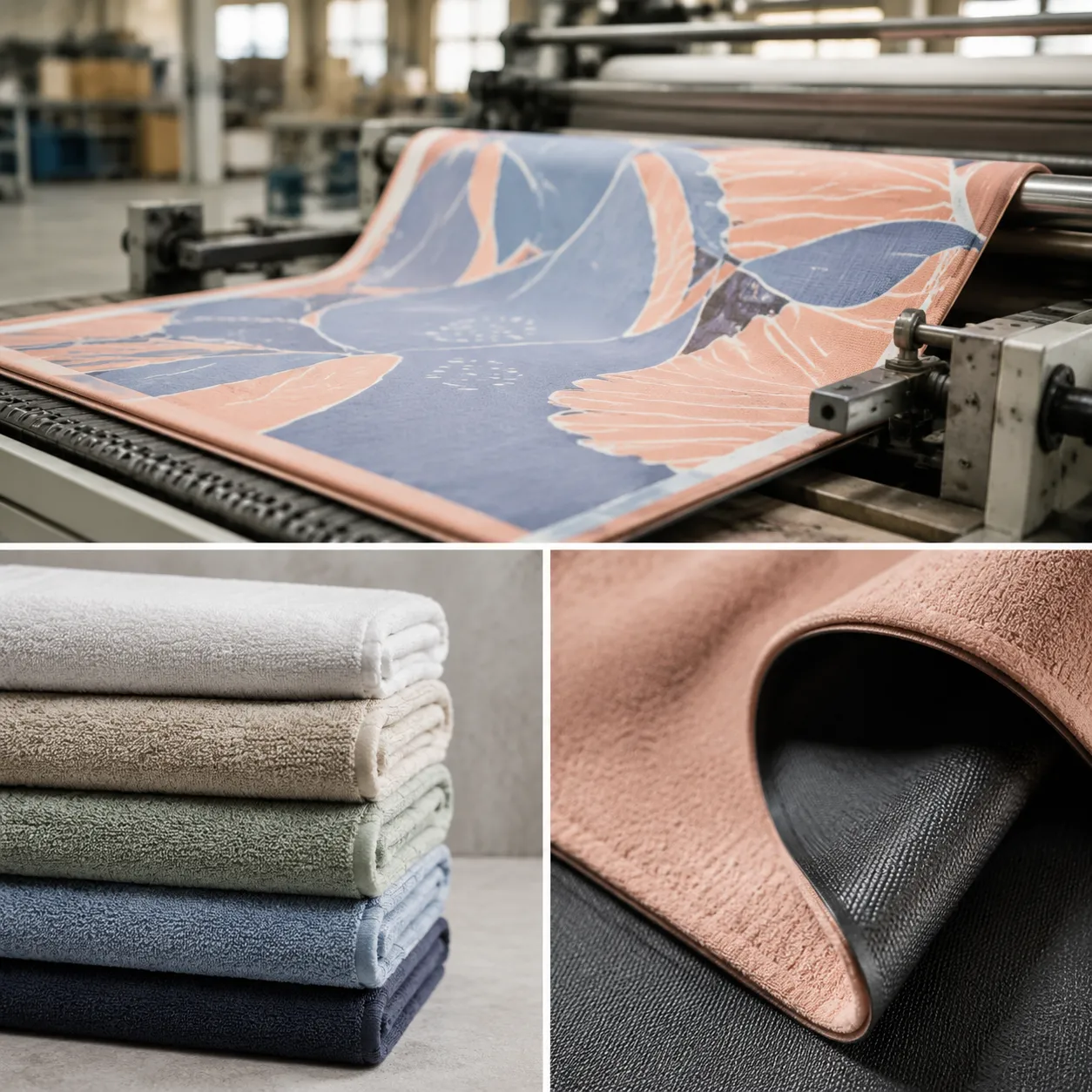
We make oversized beach towels for resort shops, beach clubs, swim teams, DTC launches, and hotel pool programs. The same size that looks generous in a product photo can become expensive in freight, slow in laundry, or unstable after 20 washes if the supplier is only quoting by piece price. This checklist is written from the mill side so buyers can qualify a supplier before deposit, not after cartons are already sealed.
Start With the Use Case, Not the Size
The first question we ask is where the towel will be used and how often it will be washed. A retail beach towel that is washed by a consumer twice a month can tolerate a different construction from a resort pool towel washed daily in a tunnel washer. A 90 x 170 cm towel at 420 GSM and a 100 x 180 cm towel at 560 GSM both count as large beach towels wholesale, but they behave very differently in production and laundry.
| Use case | Common size | Practical GSM range | Main sourcing risk |
|---|---|---|---|
| Resort pool deck | 90 x 170 cm, 100 x 180 cm | 450-600 GSM | Laundry shrinkage and slow drying |
| Beach club retail | 100 x 180 cm, 102 x 178 cm | 380-520 GSM | Handfeel versus shelf price |
| Event or sponsor towel | 80 x 160 cm, 90 x 170 cm | 300-420 GSM | Color strike-through and edge waviness |
| Luxury villa or cabana | 100 x 200 cm, 110 x 200 cm | 550-700 GSM | Weight, carton cube, and drying time |
| Travel beach program | 85 x 170 cm, 90 x 180 cm | 260-360 GSM microfiber or flat weave | Print migration and pilling |
For cotton terry, we normally see oversized beach programs land between 380 and 620 GSM. Below 350 GSM, the towel may be light enough for promotion but usually lacks recovery after repeated laundering. Above 650 GSM, the towel feels substantial but becomes heavy in cartons and can miss drying targets for hotel or beach club operations.
- Ask the supplier to quote size, GSM, yarn count, pile construction, finished weight, and carton cube together.
- Separate retail handfeel from operational laundering. A heavier towel is not automatically better if it stays damp on pool returns.
- For custom oversized beach towels, lock the finished size after washing, not only the loom size before finishing.
- If the towel will carry a large logo, decide the decoration method before approving the fabric base.
Oversized Beach Towels Supplier Checklist
An oversized beach towels supplier checklist should prove that the mill can control large-panel weaving, finishing, decoration, packing, and inspection. Large towels are less forgiving than hand towels because any bowing, skew, shade variation, or border distortion is visible from several meters away. We reject supplier files that show only a beauty photo and a FOB price.
| Checklist item | What to request | Why it matters |
|---|---|---|
| Factory identity | Business license, BSCI audit, ISO 9001 certificate, export history | Confirms the supplier is a manufacturer or accountable trading partner |
| Compliance | OEKO-TEX Standard 100 Class I certificate if used for family or skin-contact programs | Checks restricted substances for direct skin contact |
| Technical data | Finished size tolerance, GSM tolerance, yarn composition, shrinkage target | Prevents disputes after washing |
| Lab testing | ISO 105-C06 wash colorfastness, ISO 105-E04 perspiration, AATCC 61 if required | Shows dye stability before bulk |
| AQL plan | Inspection level, critical/major/minor defects, sampling quantity | Defines pass/fail rules before production |
| Packing spec | Pieces per polybag, carton dimensions, gross weight, barcode placement | Controls freight cost and DC receiving |
For our own export orders, MOQ starts at 500 pcs per design per color. That MOQ works for a plain dyed towel or one embroidery position. For jacquard, yarn-dyed stripe, or full-width woven artwork, the real economical MOQ is often 800-1,200 pcs because loom setup, yarn dyeing, and pattern approval consume more floor time.
Fabric Checks That Expose Weak Suppliers
The easiest way to make a large towel look good at sample stage is to over-soften it. Too much silicone softener gives a smooth first touch, but absorbency drops and lint increases after the first industrial wash. We prefer to test absorbency after one pre-wash, then again after 10 wash cycles when the buyer expects repeated use.
Two topic-specific defects show up often on oversized beach towels. The first is center bow, where the middle of the towel advances faster than the edges during finishing. A towel may measure correctly corner to corner but look curved when folded on a retail shelf. The second is border draw-in, where dobby or jacquard border tension pulls the long sides inward after tumble drying. Both defects are more visible on 180-200 cm lengths than on standard bath towels.
- Request a washed sample measured at four points: top width, center width, bottom width, and full length on both sides.
- For stripe towels, check stripe alignment at both selvedges after washing. A 10 mm drift across the width is already visible.
- For velour beach towels, rub the printed or sheared face with a white cotton cloth after washing to check loose dye and fiber shedding.
- For yarn-dyed jacquard, ask for yarn lot references and a retained shade card before bulk weaving.
| Construction | Typical GSM | Best use | Watch point |
|---|---|---|---|
| Cotton terry, dobby border | 420-560 GSM | Resort and beach club daily issue | Border shrinkage and lint |
| Cotton velour face, terry back | 380-520 GSM | Retail beach towel with printed face | Shearing loss and print handfeel |
| Yarn-dyed jacquard | 450-650 GSM | Logo pattern or club identity towel | Longer setup and shade lot control |
| Flat woven peshtemal style | 240-360 GSM | Travel, spa, hammam, boutique retail | Lower plushness and more visible weave defects |
| Microfiber suede or waffle | 220-350 GSM | Quick-dry travel or sand-resistant towel | Heat sensitivity and edge curling |
Color, Logo, and Decoration Approval
Decoration choice changes the supplier checklist because each method stresses the towel differently. Embroidery is clean for small resort crests, but a dense 95 x 70 mm logo can pucker on a 400 GSM towel if backing and stitch direction are not controlled. Jacquard is durable for large identity patterns, but the artwork must be simplified to weaveable blocks. Sublimation suits microfiber better than cotton because polyester accepts disperse dye; cotton reactive printing needs a different process and higher wash control.
For cotton beach towels, we usually use reactive dyeing for solid colors and yarn dyeing for woven stripes or jacquard. Pantone matching should be handled through lab dips under D65 and TL84 light, then confirmed on fabric after finishing. A paper Pantone approval alone is not enough because pile height, twist, and softener change perceived shade.
- Approve lab dips on the final yarn or fabric base, not a substitute swatch.
- Approve strike-off or counter sample with the actual logo size and placement.
- Run a wash test before bulk if the towel is dark navy, red, black, or high-contrast stripe.
- Set a color tolerance using a visual standard or Delta E target when your company requires instrument control.
- Keep one signed sample at the mill and one with the buyer for final inspection comparison.
Related reads: for decoration trade-offs, see embroidery vs sublimation vs jacquard and beach logo decoration methods. For color control, Pantone color matching custom towels explains why lab dip discipline matters before yarn or bulk dyeing.
Testing and QC Gates Before Shipment
A supplier worth keeping will accept measurable QC gates. For beach towels, our usual internal checks include fabric weight, finished dimensions, colorfastness, appearance after washing, edge strength, pile pull, needle detection when relevant, carton drop condition, and barcode scan where private-label packing is used.
| Test or inspection | Reference method or control | Typical acceptable target |
|---|---|---|
| Finished GSM | Cut sample weight calculation after conditioning | Within +/-5% of approved spec |
| Dimensional change | ISO 6330 wash procedure or buyer laundry method | Length and width shrinkage within 5-7% for cotton terry |
| Colorfastness to washing | ISO 105-C06 or AATCC 61 | Grade 4 or above for most resort colors |
| Colorfastness to rubbing | ISO 105-X12 dry and wet crocking | Dry 4, wet 3-4 minimum depending on shade |
| Perspiration resistance | ISO 105-E04 | Grade 4 target for skin-contact towel programs |
| Inspection sampling | ANSI/ASQ Z1.4, general level II | AQL 2.5 major, 4.0 minor unless buyer sets stricter |
For resort and hotel buyers, we also recommend a 5-piece laundry simulation before bulk approval. Wash the approved sample with detergent, tumble dry, and measure size, lint, shade, handfeel, and edge condition after 5 cycles. This is not a substitute for a full durability program, but it catches the common failures before a 5,000-piece PO is committed.
- Reject towels with open seams, broken selvedge, oil marks, hard stains, missing labels, wrong barcode, or visible shade panels.
- Classify loose thread under 30 mm as minor only if it can be trimmed without seam damage.
- Treat wrong size, wrong GSM, mixed shade cartons, and failed colorfastness as major defects.
- Treat mold odor, needle contamination, and restricted-substance failure as critical defects.
Related reads: beach towel pre-shipment QC inspection, beach towel colorfastness test protocol, and how to read OEKO-TEX certificate cover the documents and tests buyers should keep in the PO file.
Price Bands and What Moves Them
For an oversized beach towels supplier checklist, price should be reviewed with size, weight, decoration, and packing. A low quote can be real if the towel is lighter, packed loose, and shipped in large cartons. It can also be a trap if the supplier removed pre-shrinking, reduced yarn quality, or quoted a smaller finished size than your brief.
| Order volume | Spec example | FOB China price band |
|---|---|---|
| 500-999 pcs | 90 x 170 cm cotton terry, 420-460 GSM, plain dyed, one woven label | USD 6.10-8.40 / pc |
| 1,000-2,999 pcs | 100 x 180 cm cotton terry or velour, 460-540 GSM, reactive dyed, simple logo | USD 7.20-10.90 / pc |
| 3,000-7,999 pcs | 100 x 180 cm yarn-dyed stripe or jacquard, 480-600 GSM, retail band or belly wrap | USD 8.60-13.80 / pc |
| 8,000+ pcs | Programmed resort towel, repeated colors, carton and barcode standardization | USD 7.40-12.20 / pc depending on yarn and finishing |
As a cost-per-use example, consider a beach club choosing between a 410 GSM towel at USD 6.35 and a 520 GSM towel at USD 8.95. If the lighter towel lasts 38 commercial washes before edge fray and the heavier towel lasts 72 washes, towel cost per wash is about USD 0.167 versus USD 0.124. The more expensive towel is cheaper in operation, provided drying time and theft loss are controlled.
Freight can change the decision. A 100 x 180 cm, 540 GSM cotton towel may finish around 970 g before packing. With polybag, label, and carton allowance, 1,000 pcs can exceed 1.05 metric tons and take around 8-10 CBM depending on fold and carton strength. For a rush launch, air freight can cost more than the towel margin, so production calendar and freight mode should be discussed before the PO.
Production Timing and MOQ Reality
Our standard MOQ is 500 pcs per design per color. That is the floor for efficient cutting, dyeing, finishing, QC, and packing. For a new resort beach towel supplier relationship, buyers sometimes ask for 150 pcs per color across six colors. We can sample those colors, but bulk production at that split raises dyeing loss, shade risk, and unit price because each color still needs setup and QC time.
- Tech pack and quote review: 1-3 days if size, GSM, artwork, packing, and compliance needs are clear.
- Lab dip or yarn color approval: 5-9 days for standard cotton colors; longer for yarn-dyed stripe programs.
- Counter sample: 7-14 days for plain dyed or embroidered towels, 14-22 days for jacquard or custom border weaving.
- Bulk production: 25-40 days after deposit and approvals for most oversized beach towel orders.
- Final inspection and export packing: 2-4 days, depending on carton labeling and mixed-SKU packout.
- Ocean freight planning: usually 18-35 days port to port depending on destination, plus inland trucking and customs clearance.
For seasonal buyers, the calendar matters more than the quoted production days. April and May beach programs compete for dyeing capacity with pool towel, gym towel, and hospitality replenishment orders. If your sell-in date is fixed, approve lab dips and packaging artwork before the factory calendar fills.
Audit Questions That Save Claims Later
A supplier audit for bulk oversized beach towels does not need to be complicated, but it must go beyond showroom samples. Ask who controls weaving, dyeing, finishing, embroidery, printing, inspection, and packing. If a supplier outsources major steps, they need clear control records and retained samples from each subcontracted process.
- Can the mill show recent production records for towels above 90 x 170 cm, not only standard bath sizes?
- Does the factory condition towels before GSM and size measurement, or measure straight from tumble drying?
- Are lab dips, bulk shade bands, and retained samples stored under clear buyer names and PO numbers?
- How are shade lots separated in carton packing so a resort does not receive mixed-tone pool stacks?
- Can the supplier provide OEKO-TEX 100 Class I, BSCI, and ISO 9001 documents matching the factory or product scope?
- Does final inspection open cartons from multiple pallet positions, including top, center, and bottom stacks?
We operate as a 220-employee mill established in 2007, supplying 80+ brand clients across 47 countries with annual output around 2.4M towels. That scale is useful only when the buyer also gives a measurable spec. A vague “make it like the photo” brief leaves too much room for interpretation on pile height, border size, finishing handfeel, and packing presentation.
Related reads: build towel tech pack that mills can quote, beach towel B2B sourcing risk checklist, and negotiate towel MOQ without killing margin are useful before comparing supplier price sheets.
PO Lines We Want Buyers to Lock
The final PO should read like a production instruction, not just a purchase agreement. For custom oversized beach towels, the most important lines are finished size after normal finishing, GSM tolerance, fiber composition, color reference, decoration size and placement, label content, packing method, carton marking, inspection standard, compliance documents, and shipment window.
A clean PO prevents avoidable claims. If the PO says only “100 x 180 cm blue beach towel,” the supplier may ship a towel that is technically blue and large but wrong for your laundry system, retail shelf, or resort stack height. If the PO includes 100 x 180 cm finished size, 500 GSM +/-5%, reactive dyed cotton terry, ISO 105-C06 grade 4 washing colorfastness, OEKO-TEX 100 Class I, AQL 2.5/4.0, 12 pcs per export carton, and barcode position, there is a shared basis for inspection.
A strong oversized towel program is not built by choosing the heaviest sample. It is built by fixing the finished dimensions, wash behavior, color method, packing cube, and inspection rules before bulk yarn or dyeing starts.
For buyers comparing a resort beach towel supplier against a trading company, ask both to complete the same oversized beach towels supplier checklist and attach evidence. The stronger file is usually clear within one day: real test reports, production photos, inspection records, and a quote that explains the cost drivers instead of hiding them.
Build a Supplier-Ready Beach Towel Spec
Send us your target size, GSM, artwork, packing needs, volume, and delivery market. We will return a practical OEM quote with MOQ, FOB price band, sampling path, and QC checkpoints. WhatsApp: +86 13205717266. Email: [email protected].
Request a Quote →