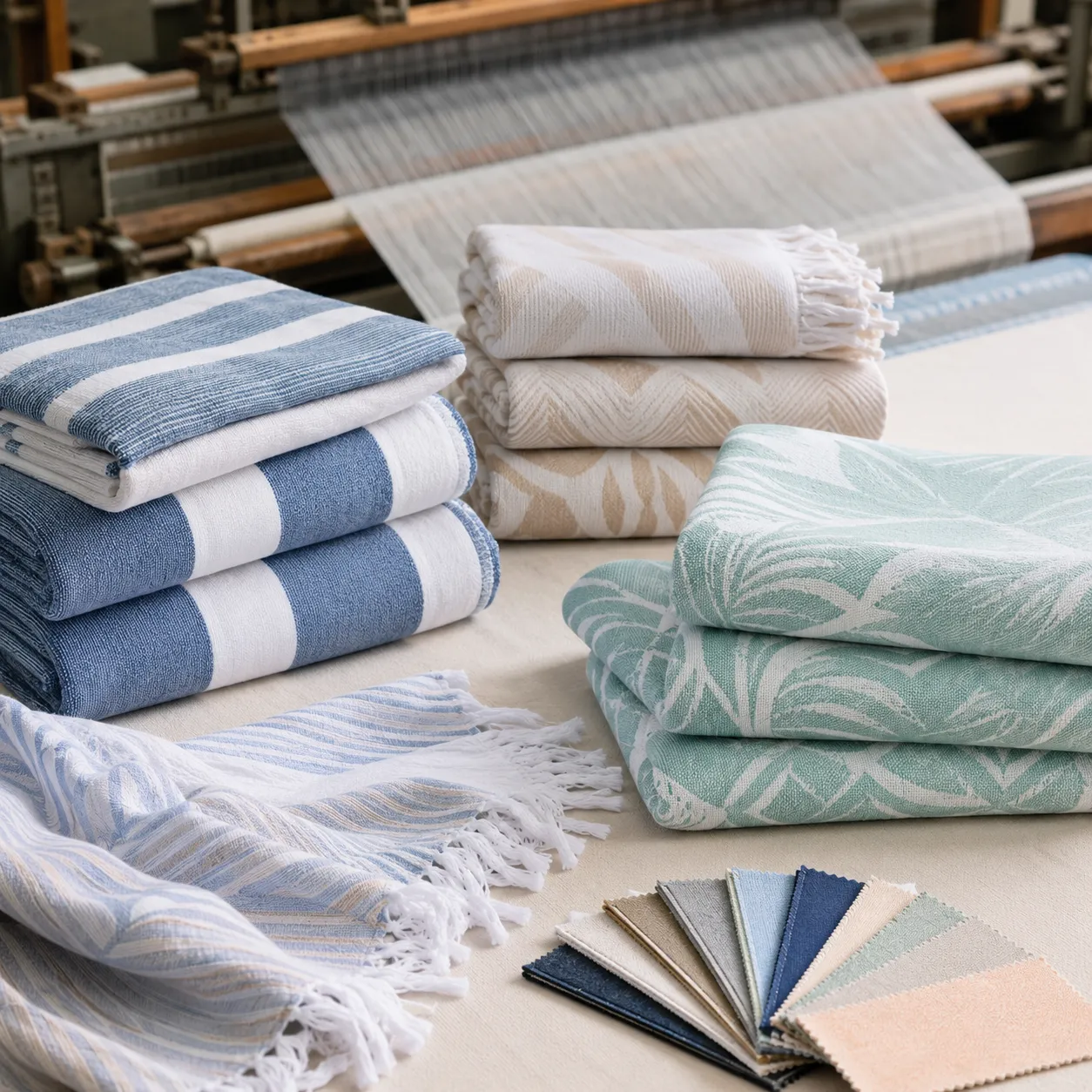
Use the Custom Beach Towel B2B Sourcing Risk Checklist Before Price Negotiation
Price negotiation is usually where buyers start, but it is not where we start when we review an OEM beach towel sourcing file. We first check whether the towel can survive the use case: beach sand, sunscreen, pool chlorine, high-temperature laundry, wet storage, and repeated guest loss replacement. A quote that looks USD 0.45 lower can become expensive if the towel twists after 12 washes or if the edge stitching opens during the first holiday weekend.
At LUMA & CO. TEXTILE, our baseline MOQ is 500 pcs per design / per color. We have operated since 2007 with a 220-person team, annual output around 2.4M towels, and certification coverage including OEKO-TEX Standard 100 Class I, BSCI, and ISO 9001. Those facts help, but they do not remove sourcing risk by themselves. A buyer still needs written controls on GSM tolerance, yarn construction, colorfastness, decoration, packing, inspection level, and lead time.
- Commercial risk: MOQ split, payment terms, sample charges, tooling, and reorder price validity.
- Technical risk: GSM tolerance, size shrinkage, pile height, color bleeding, and border distortion.
- Compliance risk: OEKO-TEX certificate scope, BSCI audit validity, ISO 9001 process control, and restricted substance declarations.
- Logistics risk: carton cube, polybag rules, pallet plan, humidity control, and export document accuracy.
- Operational risk: sample signoff discipline, pre-shipment AQL plan, production slot booking, and holiday shutdown timing.
| Risk area | What to ask the supplier | Buyer red flag |
|---|---|---|
| Factory identity | Business license, export entity, BSCI audit report, and production site address | Trading company avoids naming the actual mill |
| Fabric control | Target GSM, yarn count, loop or velour face, and tolerance after washing | Supplier quotes only by size and says GSM is flexible |
| Dyeing control | Reactive dye recipe, lab dip approval, colorfastness methods, and bulk shade tolerance | Only a digital mockup is offered before bulk |
| Decoration control | Jacquard, embroidery, yarn-dyed stripe, or print method with artwork limits | Logo size is approved without stitch count or weave repeat |
| Shipment control | Carton dimensions, gross weight, packing ratio, and inspection booking date | Freight estimate is given without carton cube |
Risk 1: Quoted GSM Does Not Match the Towel in Hand
Beach towels are often sold visually, but GSM is where cost and performance meet. A 360-420 GSM towel is common for promotional events and travel retail because it packs small and dries fast. A resort pool deck normally needs 450-550 GSM. A heavier 580-680 GSM towel can feel substantial for a beach club or retail drop, but it increases carton volume and washing load. For oversized beach towels, we rarely recommend going above 700 GSM unless the buyer has checked freight and laundry capacity.
The risk is not only a supplier quoting the wrong GSM. The deeper risk is uncontrolled variance across bulk. If the towel is specified at 500 GSM and bulk production averages 462 GSM after finishing, the buyer may receive a towel that looks acceptable in a folded photo but feels thin on a lounger. We normally write ±5% GSM tolerance into the approved specification, with weight checks taken after conditioning the towel at standard room conditions, not directly off a humid finishing line.
One construction quirk matters for beach towels: velour shearing removes loop tips on one face to create a printable or plush surface. If the pile is sheared too aggressively, the towel loses absorbency and can show pale streaks along the shear path. If shearing is uneven near the dobby border, the logo area may look patchy even when the yarn is correctly dyed.
| Use case | Practical GSM range | Typical construction | Risk control |
|---|---|---|---|
| Event giveaway | 330-400 GSM | Terry loop or thin velour | Check linting and edge stitch strength |
| Beach club rental | 430-520 GSM | Reactive dyed cotton terry | Add wash shrinkage and chlorine exposure tests |
| Resort retail shop | 480-620 GSM | Velour front with terry back | Approve shearing handfeel and print clarity |
| Luxury cabana service | 600-720 GSM | Combed cotton terry or jacquard | Confirm laundry weight and carton cube before PO |
Risk 2: The Sample Is Approved Without Wash Evidence
A showroom sample can lie. It has been steamed, brushed, folded, and handled carefully. Bulk towels face industrial washing, sunscreen residue, sea salt, and staff who may store damp returns overnight. For a real beach towel supplier audit, we ask whether the mill can test the approved sample before bulk cutting and repeat the same checks on shipment samples.
For cotton beach towels, our common lab references include ISO 105-C06 for colorfastness to domestic and commercial laundering, ISO 105-E03 for chlorinated water exposure, ISO 105-X12 for rubbing or crocking, and ISO 5077 for dimensional change after washing and drying. For U.S. buyers, we also see AATCC 61 and AATCC 8 requested. The method matters because a towel that passes a mild hand-wash test may still transfer navy dye onto white pool furniture after repeated wet rubbing.
- Approve lab dip or strike-off under D65 light, TL84 light, and store lighting if retail display matters.
- Wash the sample three times before signing the bulk GSM, shrinkage, and handfeel.
- Rub-test dark shades in dry and wet conditions, especially navy, black, bottle green, and saturated red.
- Check border waviness after tumble drying because dobby areas shrink differently from pile zones.
- Keep one sealed approval sample at the factory and one with the buyer for shipment comparison.
We have seen one specific defect on striped beach towels: the yarn-dyed border remains stable, but the piece-dyed ground shrinks more, causing a slight hourglass shape after washing. It may pass a flat photo check before washing. It will not sit straight on a hotel lounger after laundry.
Risk 3: Decoration Is Chosen for Artwork, Not Use
Beach towel decoration is a sourcing risk because buyers often approve the artwork before they approve the towel construction. Jacquard, embroidery, yarn-dyed stripes, reactive printing, pigment printing, and sublimation on microfiber each have a different failure mode. A large embroidery on a 380 GSM towel can pucker. A pigment print may sit on top of the pile and stiffen the face. A jacquard logo can lose small text if the weave repeat is too coarse.
For cotton beach towels, jacquard is durable because the logo is woven into the towel. The cost comes from yarn setup, loom time, and lower flexibility for fine gradients. Embroidery is good for club crests, member names, and limited placement, but we control stitch density carefully. For a 10 cm wide chest-style crest on terry, 6,000-9,500 stitches is common. Above that, the towel can become stiff unless backing and placement are adjusted.
If the project needs full-surface photography or sharp gradients, microfiber sublimation may be better than cotton. That is a different product path: usually 200-300 GSM polyester or polyamide blend microfiber, with heat transfer at controlled temperature and dwell time. It dries fast and prints cleanly, but it does not feel like a cotton resort towel. For more on method selection, see embroidery vs sublimation vs jacquard and printed towel artwork and fabric OEM guide.
| Decoration method | Best fit | Main risk | Control point |
|---|---|---|---|
| Jacquard weave | Large logos, stripes, repeated patterns | Small text becomes broken | Approve weave simulation and strike-off |
| Embroidery | Crests, names, boutique branding | Puckering on lighter GSM towels | Set stitch count, backing, and placement |
| Reactive print on cotton | Bold artwork on velour face | Shade variation after washing | Test ISO 105-C06 and wet rubbing |
| Sublimation microfiber | Photo artwork and travel towels | Different absorbency feel from cotton | Confirm fabric blend and print edge clarity |
Risk 4: Compliance Documents Do Not Cover the Product
Compliance documents are sometimes treated as attachments instead of evidence. A supplier may have an OEKO-TEX certificate, but the certificate must cover the product class, fiber, dyeing route, and factory process relevant to the towel being purchased. For infant, family resort, and spa-adjacent programs, buyers often request OEKO-TEX Standard 100 Class I or Class II depending on end use. We maintain OEKO-TEX 100 Class I coverage because it gives the broadest safety margin for skin contact.
BSCI is a social compliance framework, not a towel quality certificate. ISO 9001 confirms a quality management system, not that a specific towel will pass colorfastness. A strong towel factory compliance checklist separates these documents instead of using one certificate to cover every risk. Ask for issue date, expiry date, certificate holder name, product scope, and whether the audited factory is the same site weaving, dyeing, cutting, sewing, and packing your order.
- OEKO-TEX: Confirm certificate number, product class, validity, and whether accessories such as labels or embroidery thread are covered.
- BSCI: Check the audit date, rating, corrective action plan, and factory address.
- ISO 9001: Ask how incoming yarn, dyeing, sewing, and final inspection records are controlled.
- Restricted substances: Request declarations for azo dyes, formaldehyde, heavy metals, and phthalates where applicable.
- Chain of process: Identify any subcontracted dyeing, printing, embroidery, or packing step before deposit.
Related reads: how to read an OEKO-TEX certificate, sustainable towel buyer checklist 2026, and audit low MOQ towel factory before deposit are useful when your procurement team needs a document review flow before sampling.
Risk 5: Low Price Hides Carton and Freight Cost
Beach towels are bulky. Freight can move the landed cost more than buyers expect, especially for 600 GSM towels or oversized formats. A 90 x 170 cm towel at 560 GSM uses about 857 g of fabric before labels and packaging. If packed 20 pcs per export carton, one carton may reach roughly 18.5-20.5 kg gross weight depending on polybag, insert card, and moisture. That carton weight is manageable, but the cube can still push sea freight cost up.
This is why the custom beach towel b2b sourcing risk checklist must include carton dimensions before final price comparison. If Supplier A quotes USD 4.95 and packs inefficiently while Supplier B quotes USD 5.18 with tighter compression and better carton cube, the landed result may reverse. For DTC brands, individual polybags, barcode stickers, carton labels, and carton assortment rules can add USD 0.08-0.28 per towel before freight.
| Order volume | Typical FOB China price band | What drives the band |
|---|---|---|
| 500-999 pcs | USD 5.10-8.40 / pc | Sampling, dye minimums, decoration setup, and low packing efficiency |
| 1,000-2,999 pcs | USD 4.35-7.20 / pc | Better yarn allocation, steadier sewing line setup, and carton optimization |
| 3,000-7,999 pcs | USD 3.85-6.55 / pc | Longer weaving runs, lower setup cost per towel, and stronger label pricing |
| 8,000+ pcs | USD 3.45-5.95 / pc | Best fabric utilization, negotiated dyeing batch cost, and stable export packing |
These bands assume cotton beach towels around 430-620 GSM with standard private label packing. Heavy jacquard, oversized dimensions, special retail boxes, recycled yarn claims, or complex embroidery can push above the range. Very cheap quotes below the band usually remove something: lower pile weight, shorter staple yarn, weaker sewing thread, skipped testing, or unverified subcontracting.
Risk 6: Timeline Is Built Around Ship Date Only
A beach season program should be planned backward from the in-store, pool-deck, or opening weekend date. The production ship date is only one milestone. Sampling, lab dip correction, bulk yarn booking, weaving, dyeing, decoration, washing, final inspection, and vessel booking all need time. If a buyer approves artwork late, the factory may still ship on paper, but only by removing sensible buffers.
For our mill, a normal cotton beach towel project takes 7-10 days for digital artwork review and quotation if the tech pack is complete, 10-18 days for lab dip or strike-off sampling, and 28-45 days for bulk production after deposit and approval. Complex jacquard or yarn-dyed stripe programs can need 45-60 days, especially if custom yarn colors are involved. Add sea freight time separately: often 18-35 days port-to-port depending on destination and sailing schedule.
- Day 0-3: Confirm size, GSM, artwork, quantity split, packaging, and compliance requirements.
- Day 4-12: Develop lab dips, weave simulation, embroidery sample, or print strike-off.
- Day 13-20: Buyer wash test, shade approval, and final tech pack lock.
- Day 21-55: Bulk yarn preparation, weaving, dyeing, decoration, sewing, washing, and finishing.
- Day 56-62: Final inspection, carton marking check, export documents, and vessel or air booking.
Related reads: setting up hotel linen program 90-day roadmap, container vs air freight towel orders, and beach club resort towel program explain how we build buffers for hospitality launches.
Risk 7: Inspection Is Only a Carton Count
Bulk beach towel quality control should inspect more than quantity. We normally define AQL before production, not after the goods are packed. A common plan is ANSI/ASQ Z1.4 general inspection level II, with critical defects at 0, major defects at 2.5, and minor defects at 4.0. Some resort buyers tighten major defects to 1.5 for first orders or dark color programs.
Inspection should open cartons across the lot, not only top cartons near the warehouse door. We check finished size, piece weight, GSM calculation, color shade, edge stitching, skipped stitches, stains, pile pulls, broken loops, label placement, barcode accuracy, carton marks, and carton weight. For velour towels, we also check directional nap. Mixed nap direction inside one retail carton makes the same shade appear like two colors under store lighting.
- Critical defects: Mold odor, needle contamination, banned substance risk, wrong fiber claim, or unsafe packaging.
- Major defects: Wrong size beyond tolerance, severe shade variation, open seam, missing logo, barcode mismatch, or carton shortage.
- Minor defects: Small loose thread, light crease mark, slightly uneven fold, or non-facing label within agreed tolerance.
- Functional checks: Wet rubbing on dark shades, seam pull at corner binding, and pile pull check near embroidered zones.
For beach towels, we also watch for mildew risk caused by packing before the towel is fully conditioned. A towel packed warm after drying can trap moisture in the core of a compressed carton. We use moisture checks and allow cooling before final sealing when humidity is high in the finishing room.
What We Put in the PO Before Deposit
A purchase order should not repeat only the supplier quotation. It should lock the technical file. We prefer a PO pack with signed artwork, approved sample photos, GSM and size tolerance, yarn and construction, color references, decoration method, label and packing layout, inspection standard, compliance requirements, delivery terms, and remedy language if bulk fails the agreed standard.
For a custom beach towel b2b sourcing risk checklist, the strongest control is a shared document that merchandising, QA, and logistics can all read. If procurement negotiates price without QA input, the towel can be under-specified. If design approves artwork without logistics input, the towel can be beautiful but too bulky to land at the required cost.
- MOQ: 500 pcs per design / per color, with any color split approved before sampling.
- Size tolerance: normally ±2 cm on length and width after washing unless a tighter standard is agreed.
- GSM tolerance: normally ±5% against approved sample and bulk measurement method.
- Shrinkage target: commonly within 3-5% after three washes for cotton beach towels, depending on construction.
- Packing: units per polybag, inner carton rules, master carton dimensions, gross weight, and carton drop expectation.
- Contact route: confirm one commercial owner and one technical owner before deposit to avoid conflicting approvals.
For technical setup, the most useful companion documents are build towel tech pack that mills can quote, towel GSM decision framework, and towel sizes dimensions complete guide. They help remove vague terms like heavy, soft, oversized, and luxury from the RFQ and replace them with numbers a mill can produce.
A Practical Way to Score Supplier Risk
We recommend a simple 100-point risk score before placing a first order. It does not need to be complicated. The purpose is to make weak areas visible. If a supplier has good pricing but cannot provide lab test methods, the score should show that gap. If another supplier is slightly higher but controls packing, compliance, and inspection better, the buyer can compare landed risk instead of FOB price only.
| Score area | Points | Pass condition |
|---|---|---|
| Factory and compliance | 20 | Valid OEKO-TEX scope, BSCI record, ISO 9001 system, and traceable production site |
| Technical specification | 20 | Signed size, GSM, construction, decoration, and tolerance sheet |
| Testing and sample control | 20 | Wash, rubbing, shrinkage, and shade checks linked to approved sample |
| Cost transparency | 15 | FOB price, decoration setup, label cost, packing cost, and carton cube separated |
| Production timeline | 15 | Sampling, approval, bulk, inspection, and shipping dates documented with buffers |
| Inspection and remedy | 10 | AQL standard, defect list, replacement rule, and claims window agreed |
A score above 85 is usually workable if the sample is strong. Between 70 and 85, we would isolate the weak area before deposit. Below 70, the buyer should slow down even if the unit price looks attractive. For resort towel procurement risk, the expensive failure is not one rejected carton. It is a late-season towel that cannot be reordered, matched, or laundered consistently.
If you want us to review a beach towel RFQ, send the size, GSM target, artwork, quantity by color, destination country, packing requirement, and any certification needs. We can reply with a risk-marked quote and production path. WhatsApp: +86 13205717266. Email: [email protected].
Build a Safer Beach Towel RFQ
Send us your artwork, GSM target, order quantity, and delivery window. We will flag sourcing risks before sampling and quote against a controlled specification.
Request a Risk-Checked Quote →