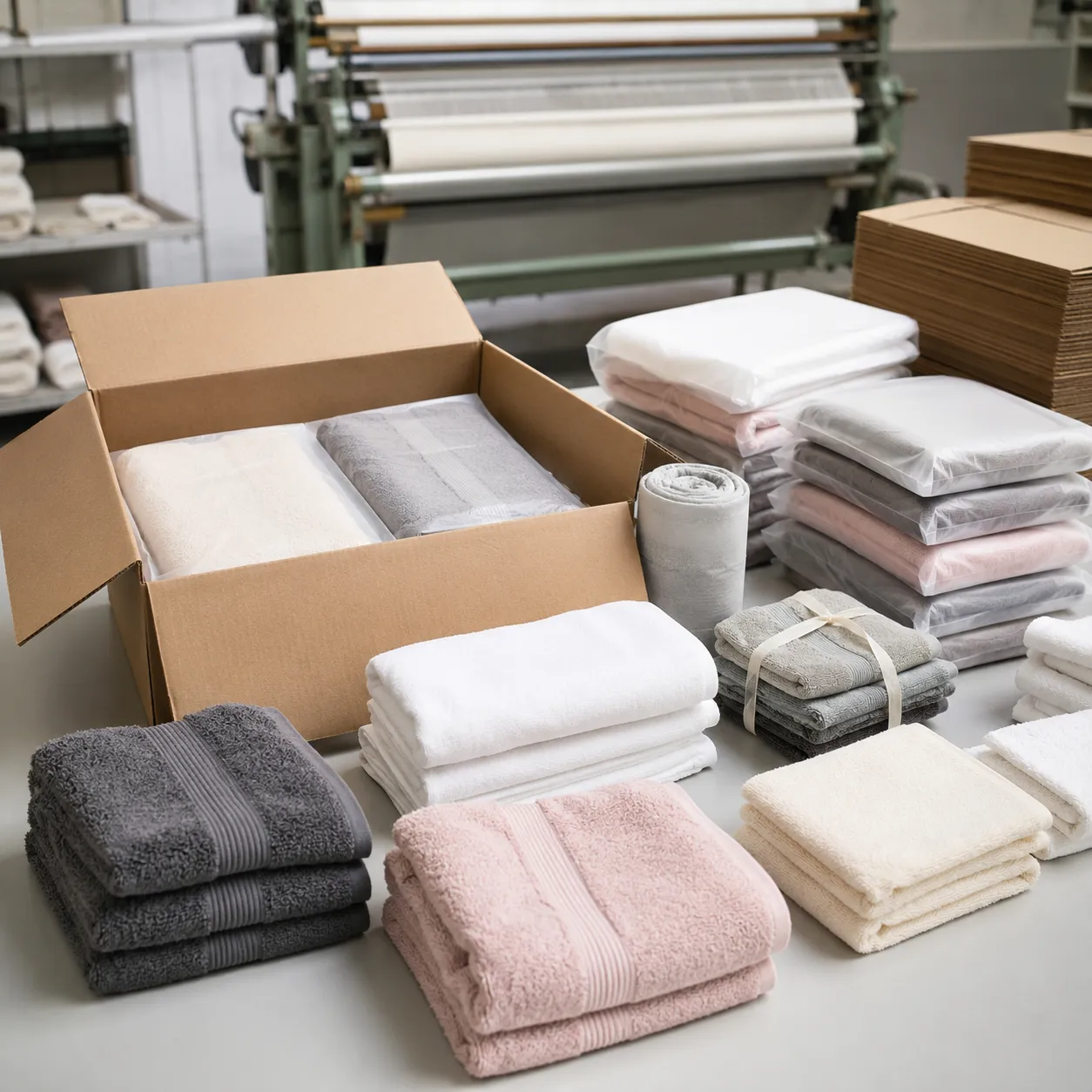
Where low moq towels private label packaging gets expensive
At LUMA & CO. TEXTILE, our towel MOQ is 500 pcs per design / per color. That number works for hotels testing a new linen program, DTC brands launching a first SKU, and clubs ordering seasonal merchandise. Packaging becomes difficult when the buyer treats every trim item as if it has the same MOQ as the towel. It does not.
A woven neck label, paper belly band, polybag warning print, barcode sticker, carton side mark, care label, and hangtag are all sourced or printed through different workflows. Some can be produced in 500 pcs with a modest setup fee. Others only make sense if the buyer accepts leftover inventory for the next reorder. The practical job is to separate what must be custom now from what can stay generic until sell-through is proven.
| Packaging element | Practical low-MOQ approach | Risk if over-customized too early |
|---|---|---|
| Woven brand label | Run 1,000-2,000 labels and store extras for repeat orders | Unit cost rises sharply if only 500 are woven |
| Belly band | Digital print 500-800 pcs for launch batches | Offset print plates make small revisions expensive |
| Hangtag | Use one brand tag across towel sizes | Size-specific tags create dead stock |
| Barcode sticker | Print per SKU after final packing list approval | Wrong UPC or FNSKU causes relabeling delays |
| Master carton mark | Black one-color print or A4 shipping label | Full-color carton print needs larger carton MOQ |
For a 500-piece test order, we usually push buyers toward custom woven labels plus a printed belly band or sticker, not a full retail packaging system. That still looks controlled at delivery, but it avoids spending packaging budget on materials the brand may revise after the first sales cycle.
Start with the sales channel, not the box
Packaging for hotel back-of-house use is different from retail shelf packaging. For hospitality replenishment, the receiving team needs carton marks, size identification, lot traceability, and clean bundling. For e-commerce, the pack must survive parcel handling and carry a barcode that matches the selling platform. For wholesale retail, the towel often needs a belly band, hangtag, or shelf-ready fold.
- Hotel or spa receiving: prioritize size, GSM, color, purchase order number, and carton count on the outer mark.
- DTC e-commerce: specify barcode type, polybag thickness, suffocation warning language, and packed dimensions.
- Resort boutique or golf shop: make the folded face look consistent, because staff will restack towels by hand.
- Amazon-style fulfillment: confirm FNSKU placement, scannability after shrinkage, and whether each unit needs an individual bag.
- Corporate gifting: focus on logo presentation, insert card sequence, and carton protection for mixed-address distribution.
If the same towel may move through two channels, we recommend using the towel label as the permanent brand element and the outer pack as the flexible element. A woven label sewn into a 450 GSM hand towel or 620 GSM bath towel can stay the same for several seasons, while belly bands and stickers can change by region, barcode, or promotion.
Related reads: buyers building their first product file should start with build a towel tech pack that mills can quote, then use private label vs white label towel programs to decide how much brand control is worth paying for in the launch order.
Packaging choices that work at 500-1,000 pcs
Small batch towel packaging works best when the custom parts are flat, printable, and easy to change. The towel itself carries most of the perceived value. Packaging should protect the fold, identify the SKU, and communicate the brand without adding avoidable labor minutes at the packing table.
| Option | Best use case | Typical MOQ | Factory note |
|---|---|---|---|
| Sewn woven label | Retail, hotel, spa, membership clubs | 500 towels, labels usually woven at 1,000+ pcs | Extra labels can be held for reorder if artwork is stable |
| Printed cotton care label | Bath, hand, gym, and beach towels | 500 pcs | Must align with fiber content and wash symbols |
| Digital belly band | Retail shelf or gifting | 500 pcs | Good for launch runs because artwork can change |
| Kraft hangtag with string | Golf, beach, boutique retail | 500-800 pcs | Adds handwork; allow more packing time |
| Clear PE bag with sticker | E-commerce and warehouse picking | 500 pcs | Low cost, but not a premium shelf presentation |
| Custom carton label | Distributor or hotel receiving | 500 pcs | Fastest way to add PO and SKU control |
The construction of the towel affects the packaging choice. A zero-twist 650 GSM bath towel compresses poorly and rebounds inside a tight belly band, so the band may bow or tear at the glued seam. A 360 GSM flat-weave hammam towel accepts a neat sleeve, but the fold must be locked with a sticker or the ends creep during carton vibration. A microfiber gym towel at 220-280 GSM can be individually bagged efficiently, but static attracts paper dust from low-grade inserts.
These details sound minor until the buyer receives cartons with inconsistent folds. We run a packing table trial on the approved pre-production sample before bulk packing starts. For retail packs, our QC team checks band tension, barcode position, visible logo alignment, and carton compression after stacking.
Real cost bands for small packaging runs
Low MOQ does not mean every component should be cheap. A USD 0.06 sticker can be the correct choice for a hotel stockroom, while a USD 0.34 belly band can be justified for a towel selling at USD 18-28 retail. The mistake is adding five custom pieces to a towel where the end user only sees one of them.
| Order volume | Towel type example | Packaging scope | Estimated FOB packaging add-on |
|---|---|---|---|
| 500-799 pcs | 450-520 GSM hand towel or gym towel | Woven label, care label, barcode sticker, standard carton | USD 0.18-0.42 per pc |
| 800-1,499 pcs | 560-650 GSM bath towel | Woven label, digital belly band, individual PE bag, carton mark | USD 0.46-0.88 per pc |
| 1,500-2,999 pcs | 380-500 GSM beach or pool towel | Woven label, hangtag, belly band, retail carton label | USD 0.39-0.76 per pc |
| 3,000-5,999 pcs | Mixed towel set | Custom labels, printed insert, size stickers, grouped inner cartons | USD 0.31-0.64 per pc |
| 6,000+ pcs | Program replenishment SKU | Optimized trim run, negotiated carton supply, stored labels | USD 0.22-0.51 per pc |
For the towel itself, common FOB bands from our Gaoyang production line vary by yarn, GSM, size, and decoration. A 30×50 cm cotton hand towel at 450-500 GSM may sit around USD 0.68-1.05 at 1,000 pcs. A 70×140 cm bath towel at 580-680 GSM often falls around USD 3.05-4.85 at 1,000 pcs. A 80×160 cm velour beach towel at 420-500 GSM with one-side print can land around USD 4.10-6.40 at 1,000 pcs. Packaging is quoted separately so buyers can see what is actually driving the landed cost.
For first orders, we would rather see one clean brand label and one accurate barcode than a complicated pack that slows inspection, adds rework, and still changes after launch.
What we need in the packaging brief
A private label towel manufacturer can quote faster when the buyer separates towel specs from packaging specs. The towel file should define size, GSM, yarn, weave, color, decoration, and wash target. The packaging file should define fold, label position, barcode, pack type, carton quantity, and shipping marks. If those items are mixed across emails, mistakes happen during sampling.
- Confirm towel SKU details: size, GSM, color, decoration method, and target channel.
- Send editable artwork for woven label, care label, belly band, hangtag, sticker, and insert card.
- Specify barcode format: UPC-A, EAN-13, Code 128, QR code, FNSKU, or customer warehouse code.
- Define folded dimensions and whether the logo must face outward on the pack.
- Choose unit packing: no bag, belly band only, PE bag, paper sleeve, tied bundle, or set carton.
- Approve carton marks before bulk packing, including PO number, SKU, color, quantity, gross weight, and destination.
- State any restricted materials, such as PVC-free packaging, recycled paper, FSC paper request, or no individual polybag.
Two checks are especially important for barcode-heavy orders. First, barcode print contrast should meet ISO/IEC 15416 principles for linear barcode quality, even if a full formal grade report is not required. Second, the barcode must remain flat after the towel is bagged or banded. A sticker placed across a folded edge may scan during sampling but fail after carton compression.
For care labels, we align symbols with ISO 3758 care labeling conventions where applicable. For fiber content, wash wording, and country-of-origin claims, the buyer must confirm market requirements. We can produce and sew the label, but the brand owner should approve legal copy for the destination country.
Certification and compliance in branded packaging
Our mill holds OEKO-TEX Standard 100 Class I, BSCI, and ISO 9001 certifications. These cover important parts of the towel supply chain and factory management system, but buyers should understand what each certificate does and does not prove. OEKO-TEX Standard 100 Class I concerns tested harmful substances on textile materials. BSCI relates to social compliance auditing. ISO 9001 relates to quality management systems.
Packaging materials may require their own declarations, especially for recycled paper, soy-based ink claims, FSC paper, compostable bags, or retailer chemical restrictions. If a brand wants to print an environmental statement on a belly band, we ask for the exact wording before sampling. Vague claims such as eco-friendly packaging are risky and often not specific enough for retailer compliance teams.
- Ask whether the packaging claim applies to paper, ink, adhesive, polybag, or the towel itself.
- Keep OEKO-TEX wording tied to the certified textile material, not automatically to all packaging parts.
- Use recycled-content statements only when the paper supplier can support the percentage.
- Avoid printing care instructions that conflict with the towel's dyeing and finishing route.
- Store approved certificates with the purchase order so receiving teams can match documents to the shipped lot.
Related reads: for certificate checking, use how to read an OEKO-TEX certificate. For material decisions that affect label claims, compare combed vs zero-twist cotton and microfiber vs cotton towels.
Sampling sequence and production timing
Packaging samples should not be approved in isolation. We need to test the actual towel bulk, fold thickness, label placement, and carton loading method. A 500 GSM towel with sheared velour behaves differently from a terry loop towel at the same weight because the surface friction against a belly band changes.
| Stage | Typical time | What happens |
|---|---|---|
| Artwork and spec review | 1-3 days | We check files, barcode format, label dimensions, and pack construction |
| Towel lab dip or strike-off | 5-9 days | Color and decoration direction are confirmed before bulk yarn or dyeing |
| Packaging mock-up | 4-7 days | Digital belly band, label, sticker, or hangtag sample is assembled |
| Pre-production sample | 7-12 days | Actual towel plus packaging is folded and reviewed as one unit |
| Bulk towel production | 18-32 days | Weaving, dyeing, finishing, sewing, and decoration run through QC gates |
| Bulk packaging and final inspection | 3-6 days | Unit packing, carton marking, AQL inspection, and loading preparation |
| Export documents and vessel handoff | 2-5 days | Packing list, invoice, certificates, and forwarder coordination are completed |
For low moq towels private label packaging, realistic total lead time is usually 32-55 days after artwork approval and deposit, depending on dyeing queue, decoration method, and packaging complexity. Embroidery adds thread matching and hooping approval. Jacquard requires loom setup and yarn planning. Sublimation or microfiber printing requires print strike-off approval before bulk heat transfer.
If the launch date is fixed, we reduce risk by freezing the towel construction first and letting the packaging carry late-stage SKU details. That is why a printed sticker over a neutral belly band can be smarter than reprinting 1,200 full-color sleeves because a UPC changed.
QC checks specific to packed towels
Packed towel inspection is not only towel inspection. We still check GSM, size tolerance, color, absorbency, stitching, decoration alignment, and loose threads, but private label packaging adds its own failure modes. The most common problems are not dramatic. They are small errors repeated across hundreds of units.
- Band creep: the belly band slides off because the folded towel has low friction or the band is too wide.
- Barcode curve: the sticker crosses a fold radius and scanners fail on warehouse intake.
- Label twist: sewn labels are pulled off-grain, making the brand mark look crooked after folding.
- Carton bulge: towels are over-compressed, causing cartons to round and stack poorly on pallets.
- Color transfer risk: dark towel lint or residual moisture marks light paper sleeves after packing too soon.
We use AQL inspection based on ISO 2859-1 sampling logic for finished goods checks when the buyer requests formal AQL. For packaging, we add SKU accuracy checks: barcode scan, carton count, inner pack count, label position, and artwork match against the approved file. If a buyer supplies their own labels or tags, we count inbound trim before production and record shortages before sewing starts.
One factory-floor detail matters: towels should rest after finishing before tight packing. If high-pile cotton towels are packed immediately after tumble drying and brushing, trapped heat and moisture can soften paper bands and affect carton shape. For thick bath towels above 650 GSM, we often allow a settling window before final banding.
How to keep MOQ low without weakening the brand
The best low-MOQ private label programs use a layered system. The permanent elements stay stable, and the flexible elements change by market or SKU. This keeps the brand consistent while avoiding packaging waste after a small first order.
- Use one woven brand label across bath, hand, beach, and gym towel SKUs when possible.
- Keep care label size consistent, changing only the fiber content and washing text by product.
- Use digital belly bands for the first two orders before moving to offset print or custom cartons.
- Let carton labels carry PO-specific information instead of printing a new carton for every buyer.
- Store unused approved woven labels at the mill for reorder, but set an expiry review if brand artwork may change.
A realistic example: a boutique fitness brand ordering 900 pieces of 40×80 cm sweat towels at 420 GSM wanted a custom woven label, black tissue wrap, printed insert, individual kraft mailer, and color carton. The packaging add-on was close to USD 1.12 per towel, while the towel itself was around USD 1.38 FOB. We suggested cutting the tissue and mailer for wholesale cartons, keeping the woven label and a 250 gsm kraft belly band. Packaging dropped to about USD 0.47 per towel, and the brand still had a shelf-ready face for studio retail.
For towel decoration decisions, see embroidery vs sublimation vs jacquard. If packaging budget is being squeezed because towel GSM is too high, the towel GSM decision framework can help decide where weight adds value and where it only adds freight.
Factory rules we will not bend
We are flexible on launch quantities, but some shortcuts create claims later. We will not pack damp towels to meet a vessel cutoff. We will not apply a barcode supplied as a low-resolution screenshot. We will not print OEKO-TEX wording on packaging unless the certificate scope supports the claim. We also will not quote a retail pack from a mood board without dimensions, material, and carton quantity.
Our base MOQ remains 500 pcs per design / per color. Below that, towel dyeing, loom setup, sewing line changeover, and inspection time usually make the unit cost unattractive. For low moq towels private label packaging, 500 pcs is workable when the packaging system is disciplined. At 1,000-1,500 pcs, more trim options open up and unit costs become less jumpy.
LUMA & CO. TEXTILE has 220 employees and has operated since 2007. We supply more than 80 brand clients across 47 countries and produce about 2.4M towels annually. That scale helps us buy trims and schedule packing efficiently, but low MOQ still requires clear choices. The earlier the packaging brief is locked, the less rework appears at the end of production.
Quote a small-batch private label pack
Send towel specs, packaging artwork, target channel, and order volume. We will separate towel cost from packaging add-ons and flag MOQ risks before sampling. WhatsApp: +86 13384590853. Email: [email protected].
Request packaging quote →