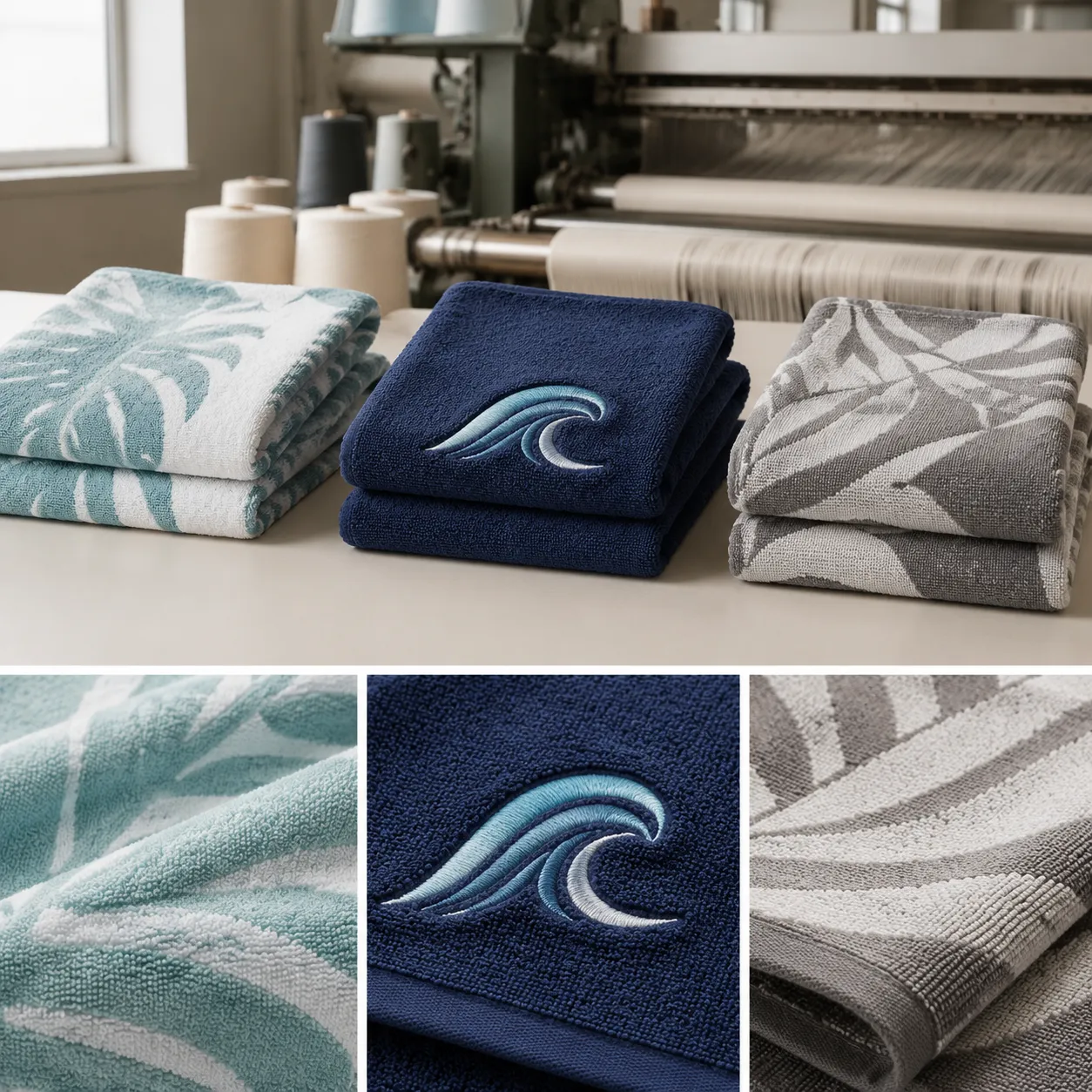
Start With How the Towel Will Be Used
A logo that works for a retail beach towel may be wrong for a pool deck, even if the artwork is the same. Beach towels are handled roughly: sun lotion, chlorine splash, sand abrasion, commercial washing, and repeated folding all stress the decoration area. We usually decide decoration before final GSM because the logo process can change the towel construction, especially with jacquard and reactive printing.
For beach and resort programs, the decoration choice should be tied to four facts: expected wash count, logo size, artwork detail, and whether guests will use the towel as a dry-off towel or a visual branding item on loungers. A 380 GSM promotional towel can carry a large printed graphic, but it will not feel or survive like a 520 GSM yarn-dyed jacquard towel in hotel laundry. The cheaper option is not automatically wrong; it is wrong only when the use case demands a different construction.
| Use case | Typical GSM | Best-fit decoration | Why it fits |
|---|---|---|---|
| Beach club pool deck | 450-560 GSM | Yarn-dyed jacquard or dobby border logo | Good wash stability and visible branding from distance |
| Retail beach towel | 360-480 GSM | Reactive print or velour print | Allows artwork, gradients, seasonal graphics, and full-face designs |
| Corporate giveaway | 300-420 GSM | Screen print or edge embroidery | Lower unit cost when wash target is moderate |
| Luxury resort cabana | 520-650 GSM | Jacquard with optional small embroidery | Heavier hand feel and durable branding under commercial laundry |
| Surf or outdoor brand drop | 380-500 GSM | Reactive print on sheared face | Better detail for illustration, maps, or multi-color art |
Our normal MOQ is 500 pcs per design / per color. That minimum applies differently by process: a jacquard logo needs loom setup, a print needs screens or digital files and strike-off checks, and embroidery needs thread color approval plus stitch testing. For orders under 1,000 pcs, the setup cost often matters more than the cotton cost.
custom beach towel logo decoration comparison
The practical comparison is not just visual. We check whether the logo becomes stiff, whether yarn floats catch on rings or pool furniture, whether printed areas lose absorbency, and whether the logo color migrates during washing. Below is the factory-side view we use when a buyer sends one artwork file and asks for several decoration options.
| Decoration method | Best logo type | Common GSM range | Durability target we usually specify | Main limitation |
|---|---|---|---|---|
| Yarn-dyed jacquard | Large logos, repeats, geometric marks | 420-650 GSM | 40-80 commercial wash cycles depending on yarn and laundry chemistry | Fine curves and small text lose sharpness |
| Dobby border logo | Simple words or icon in border | 400-600 GSM | 50-90 washes when border tension is balanced | Logo area is limited to border height |
| Embroidery | Small crest, monogram, club name | 450-700 GSM | Thread and backing must pass wash and abrasion checks | Large embroidery feels heavy and can pucker |
| Reactive print | Full-face artwork, gradients, lifestyle graphics | 320-520 GSM | 30-60 washes with proper fixation and neutralization | Color approval takes time and dark grounds are harder |
| Pigment or screen print | Event logos, simple spot colors | 280-430 GSM | 15-35 washes for normal promotional use | Print hand can feel coated; cracking risk if overloaded |
For most resort buyers, jacquard and reactive print are the two serious contenders. Jacquard is built into the towel, so it looks stable after repeated laundering. Reactive print gives stronger artwork freedom but needs tighter process control: paste viscosity, steaming time, washing-off, and final pH all affect the result. Embroidery is useful for controlled placement, but we rarely recommend a large center embroidery on a beach towel because the stitched area can feel hard against skin and trap sand around dense thread.
- Choose jacquard when the logo is bold, the order repeats every season, and laundry durability matters more than illustration detail.
- Choose reactive print when the artwork covers most of the towel face or includes gradients, drawings, maps, or many Pantone references.
- Choose embroidery for small marks under about 90 mm wide, especially on a corner, border, or retail gift towel.
- Choose screen print for short-event programs where price and delivery speed matter more than long wash life.
Jacquard Logos: Built Into the Weave
Jacquard beach towels use colored yarns and a programmed loom structure to create the logo. The decoration is not added after weaving; it is part of the fabric. That is why jacquard is usually the most stable choice for hotel groups, beach clubs, and cruise operators that launder towels repeatedly. It also means the artwork must be simplified before sampling.
The construction quirk buyers need to understand is float length. If a logo has long diagonal lines or thin isolated shapes, yarn floats on the reverse can become too long. Those floats may snag during laundering or when a guest drags the towel across a lounger hinge. We control this by redrawing the logo into weave-friendly blocks, adjusting pick density, or adding a ground texture behind the mark.
For jacquard, our usual beach towel range is 420-650 GSM. Below 420 GSM, the logo can look thin and the towel may not have enough pile cover. Above 650 GSM, the towel feels substantial but freight and drying time increase. A 100 x 180 cm towel at 560 GSM weighs about 1,008 g before packaging; that affects carton count, container loading, and laundry drying cost.
- Use 2-4 yarn colors for stable bulk production; more colors increase setup work and shade-control risk.
- Keep minimum logo stroke width around 6-8 mm on high-pile jacquard; finer lines blur after terry relaxation.
- Avoid small legal text inside the terry field; use a sewn label or printed belly band instead.
- Approve both face and reverse, because jacquard contrast can look different on each side.
We test jacquard samples for dimensional change using ISO 6330 domestic washing as a controlled reference, then adjust for the buyer's real laundry route if they use commercial tunnels. For color fastness, ISO 105-C06 gives a useful wash reference, but we also check visual contrast after repeated laundering because a logo can technically pass staining while still losing shelf appeal.
Printed Beach Towels: Artwork Freedom With Process Control
Printed beach towels are chosen when the towel must carry artwork rather than a simple mark. Reactive printing works best on cotton because the dye bonds with the fiber after steaming and washing-off. It gives a softer hand than a heavy pigment layer and is better for large designs that guests will lie on. Pigment or screen print can be economical for simple event logos, but the printed surface often feels less absorbent.
For reactive print, we normally use a sheared velour face or a low-pile terry face. Shearing creates a smoother print surface, but it removes part of the loop height on one side. If the towel is expected to dry guests after swimming, we keep the reverse side looped so the towel still absorbs. A common construction is velour face / terry back at 380-500 GSM.
| Print route | Typical order fit | Setup timing | Bulk price band at 500 pcs | Bulk price band at 3,000 pcs |
|---|---|---|---|---|
| Reactive print cotton | Retail, resort artwork, full-face graphics | Strike-off 7-10 days | USD 6.20-9.80 / pc | USD 4.90-7.40 / pc |
| Pigment screen print | Events, simple spot logos | Screen sample 5-8 days | USD 3.10-5.60 / pc | USD 2.45-4.20 / pc |
| Sublimation microfiber | Quick-dry beach or travel towel | Printed proof 4-7 days | USD 2.80-5.10 / pc | USD 2.10-3.70 / pc |
| Yarn-dyed jacquard cotton | Hotels, clubs, repeat resort programs | Loom sample 10-14 days | USD 7.40-12.60 / pc | USD 5.80-9.30 / pc |
The table shows why a custom beach towel logo decoration comparison cannot be separated from quantity. At 500 pcs, screen charges, yarn dyeing, sampling, and machine setup are spread over a small base. At 3,000 pcs, the same program becomes more efficient, especially for jacquard and reactive print. These are FOB China bands for typical 70 x 140 cm to 100 x 180 cm specifications; final quotes move with cotton price, size, GSM, packing, and carton requirements.
Print quality depends heavily on pre-treatment and washing-off. If residual alkali remains after reactive fixation, the towel can feel harsh and show shade change after storage. We check final fabric pH, usually targeting roughly 6.0-7.5 for cotton towel shipments, and we confirm that dark printed areas do not bleed onto white ground during wet rubbing checks based on ISO 105-X12 principles.
Embroidery: Good for Small Marks, Risky for Big Ones
Embroidery gives a clean raised logo, but it adds thread and backing onto the towel surface. On beach towels, that extra mass matters. A dense 120 mm crest may look good on a sample board and still be uncomfortable when a guest lies on it. Dense stitching can also distort terry loops, causing a shallow depression around the logo after washing.
We treat embroidery as a placement tool, not a full-towel decoration method. It works well on a corner, dobby border, pocket towel, club gift towel, or monogrammed retail towel. For bigger visual branding, jacquard or print is usually better. If embroidery is required, we prefer polyester embroidery thread with OEKO-TEX Standard 100 Class I compliance available for infant-contact safety level, even though beach towels are usually not sold as baby goods. It keeps the compliance file simple for mixed retail programs.
- Keep most beach towel embroidery under 8,000-12,000 stitches unless the towel is thick enough to support it.
- Use tear-away or wash-away backing only after testing; leftover backing can feel scratchy on velour faces.
- Avoid embroidery over high-low jacquard textures because needle deflection can create uneven edges.
- Request a wash sample after embroidery, not only a fresh stitch-out on loose fabric.
A specific defect we watch for is terry loop pull-through around satin stitches. The needle can drag loose loops into the embroidery edge, especially on low-twist yarns. During sample review, we run a light fingernail check around the stitched border and inspect the reverse for trapped loops before approving bulk.
Color Approval Is Different for Each Method
Buyers often send one Pantone number and expect the same result across jacquard, embroidery, and print. That is not realistic. Yarn-dyed cotton, reactive dye on cotton pile, pigment paste, and embroidery thread all reflect light differently. A navy Pantone can look deeper in thread, softer in dyed yarn, and slightly flatter in pigment print.
For jacquard, we match dyed yarn under D65 light and check metamerism under store or hotel lighting if the buyer has a standard. For reactive print, we approve a lab dip or strike-off on the actual towel base, not on flat cotton fabric. For embroidery, we match from thread cards and then stitch onto the towel because pile color changes perceived contrast.
- Confirm artwork scale on the actual towel size, including hem and border position.
- Approve color under a named light source, normally D65 for daylight review.
- Check wet and dry rubbing on dark logos, especially navy, black, red, and saturated green.
- Wash the decorated sample before final sign-off if the towel is for hotel or resort use.
- Keep one signed physical sample at the mill and one with the buyer for bulk comparison.
Our QC file usually includes the Pantone target, internal yarn or dye lot reference, approved sample photos, and tolerance notes. We do not promise that a terry towel will match coated paper exactly. Instead, we define an acceptable fabric standard before bulk production so the inspection team has something measurable and visual to compare against.
Wash and Abrasion Checks We Actually Use
Wash-cycle claims need context. A towel can survive 60 washes in a mild domestic cycle and fail much earlier in a high-alkali commercial laundry. For that reason, we avoid writing a single universal wash number into the spec unless the buyer defines the laundry chemistry, temperature, drying method, and reject standard.
For development, we use ISO 6330 as a repeatable wash reference, ISO 105-C06 for color fastness to washing, ISO 105-X12 for rubbing behavior, and AATCC TM61 when a buyer asks for accelerated laundering data used by many North American labs. These standards do not replace real laundry trials, but they create a controlled baseline before bulk.
| Risk area | What we check | Why it matters | Typical reject sign |
|---|---|---|---|
| Jacquard float snagging | Reverse floats and raised logo edges after washing | Long floats catch in laundry or on furniture | Pulled yarns longer than buyer tolerance |
| Print fixation | Wash-off, pH, wet rubbing, shade change | Poor fixation causes bleeding and dull artwork | Color transfer to white ground or crocking cloth |
| Embroidery puckering | Logo flatness after wash and tumble dry | Dense stitches shrink differently from terry ground | Wrinkled halo around logo |
| Border distortion | Hem and dobby border measurements | Decoration tension can twist the towel | Skewed border or uneven folding |
| Absorbency loss | Drop test or buyer lab method on printed zones | Heavy print paste can block cotton surface | Water beads on logo area too long |
For commercial clients, we usually recommend a small laundry pilot before ordering a full season. For example, 24 sample towels can be split into three groups: new control, 10-wash group, and 25-wash group. The buyer's laundry then records detergent, bleach or peroxide use, wash temperature, dryer temperature, and rejects. This produces better evidence than a generic durability claim copied from a catalog.
Cost Drivers Buyers Miss in Logo Quoting
Decoration pricing is not only a unit decoration charge. The towel base changes, the setup route changes, and inspection time changes. A jacquard towel needs yarn dyeing and loom programming. Reactive print needs artwork separation, strike-off, steaming, washing-off, and shade control. Embroidery needs digitizing, thread selection, backing, and stitching time after towel production.
Our MOQ remains 500 pcs per design / per color, but the most efficient quantity differs by method. For 500-800 pcs, a simple screen print can be the lowest cash outlay. For 1,500-5,000 pcs, jacquard and reactive print become more competitive because setup is spread across more towels. If a buyer plans repeat orders, we would rather build the correct jacquard or print standard once than chase a cheaper method that fails after the first season.
| Quantity | Jacquard logo towel | Reactive printed cotton towel | Embroidered corner logo | Screen printed promo towel |
|---|---|---|---|---|
| 500 pcs | USD 7.40-12.60 / pc | USD 6.20-9.80 / pc | USD 5.30-8.70 / pc | USD 3.10-5.60 / pc |
| 1,000 pcs | USD 6.60-10.80 / pc | USD 5.60-8.60 / pc | USD 4.80-7.90 / pc | USD 2.80-4.90 / pc |
| 3,000 pcs | USD 5.80-9.30 / pc | USD 4.90-7.40 / pc | USD 4.35-6.80 / pc | USD 2.45-4.20 / pc |
| 10,000 pcs | USD 5.10-8.20 / pc | USD 4.35-6.50 / pc | USD 3.95-6.10 / pc | USD 2.15-3.65 / pc |
Those bands assume standard export packing, BSCI-audited production environment, ISO 9001 quality controls, and OEKO-TEX Standard 100 Class I material route where applicable. Custom belly bands, individual polybags, woven labels, barcode stickers, and master carton sorting add cost. For beach towels, freight can be significant because volume increases quickly at higher GSM.
A realistic cost-per-use view helps prevent under-specification. Suppose a resort buys a 410 GSM pigment-printed towel at USD 3.85 and removes it after about 18 commercial washes because the logo cracks and the towel looks tired. That is about USD 0.214 per wash before freight. A 540 GSM jacquard towel at USD 7.25 lasting 58 acceptable washes lands near USD 0.125 per wash. The higher invoice can be the lower operating cost if the towel is kept in service.
Production Calendar and Sign-Off Points
Decoration affects lead time more than buyers expect. A blank towel program can move quickly if yarn is available. A decorated towel needs artwork review, sample production, color approval, and sometimes re-sampling. We prefer to lock the decoration method before quoting final delivery because switching from print to jacquard after sample review resets the calendar.
- Artwork and tech pack review: 1-3 days if files include size, placement, Pantone targets, and towel dimensions.
- Decoration sampling: 5-14 days, depending on screen print, embroidery, reactive print strike-off, or jacquard loom sample.
- Buyer approval and revisions: 3-10 days; unclear comments can add a full sampling round.
- Bulk yarn dyeing, weaving, printing, or embroidery: 18-35 days after deposit and sample approval.
- Final inspection, packing, and export documents: 3-6 days before vessel or air booking.
For most OEM beach towel logo programs, the safe production window is 30-55 days after sample approval. Jacquard with custom-dyed yarn is often at the longer end. Screen print on available towel base can be shorter, but only if the base fabric and colors are already confirmed. Air freight is possible for urgent launches, but towels are bulky; sea freight is normally more sensible for resort and retail replenishment.
Related reads: for base towel construction, see our beach towels in bulk buyer's guide and beach club resort towel program. For decoration trade-offs beyond beach towels, compare embroidery vs sublimation vs jacquard and Pantone color matching custom towels.
What to Put in the RFQ
A clean RFQ saves time and prevents decoration methods from being compared on uneven bases. If one supplier quotes 360 GSM pigment print and another quotes 560 GSM jacquard, the price gap is not a decoration quote; it is a different product. We ask buyers to define the towel base first, then request logo options against the same size and GSM whenever possible.
- Towel size, GSM, yarn preference, and whether one side should be velour or both sides terry.
- Logo file in vector format, final placement, size in millimeters, and approved Pantone references.
- Expected wash route: domestic resale use, hotel laundry, pool vendor laundry, or guest giveaway.
- Compliance needs: OEKO-TEX Standard 100, BSCI, ISO 9001 documentation, fiber labeling, and destination market rules.
- Packing plan: bulk carton, individual bag, retail band, barcode sticker, carton marks, and mixed-size sorting.
If the buyer is unsure, we usually quote two routes: one visual route and one durability route. For example, reactive print for artwork impact and jacquard for long laundry life. That makes the decision clearer than asking for the cheapest decorated towel and discovering later that the method does not fit the program.
Related reads: build the source file with our towel tech pack guide, check GSM choices with the towel GSM decision framework, and confirm dimensions through the towel sizes guide. For resort pool applications, the chair towels lounger guide is useful when towel branding must align with furniture size.
Our Recommendation by Buyer Type
For hotels, beach clubs, and cruise operators, we usually start with yarn-dyed jacquard at 480-600 GSM. It gives reliable branding, keeps the logo inside the towel structure, and supports commercial wash programs when the yarn and border tension are controlled. For retail beach towels, reactive print at 380-500 GSM is often the better choice because design detail sells the product.
For event and promotional buyers, screen print or sublimation microfiber can make sense when the towel is not expected to live through many laundry cycles. For gift programs using names, initials, or small crests, embroidery is still useful, especially when paired with a stable towel base above 450 GSM. The important step is to test the decorated sample, not a blank towel, before releasing bulk.
LUMA & CO. TEXTILE has produced OEM towel programs since 2007 with a 220-person team in Gaoyang, Zhejiang, supplying 80+ brand clients across 47 countries and about 2.4M towels annually. We work under ISO 9001 quality procedures, BSCI social compliance, and OEKO-TEX Standard 100 Class I material controls where specified. For a custom beach towel logo decoration comparison on your own artwork, send size, GSM target, quantity, and logo file to [email protected] or WhatsApp +86 13205717266.
Compare Logo Methods Before Sampling
Send us your beach towel artwork, target GSM, order quantity, and wash expectations. We will return practical decoration options with MOQ, price band, and sample timing.
Request a decoration quote →