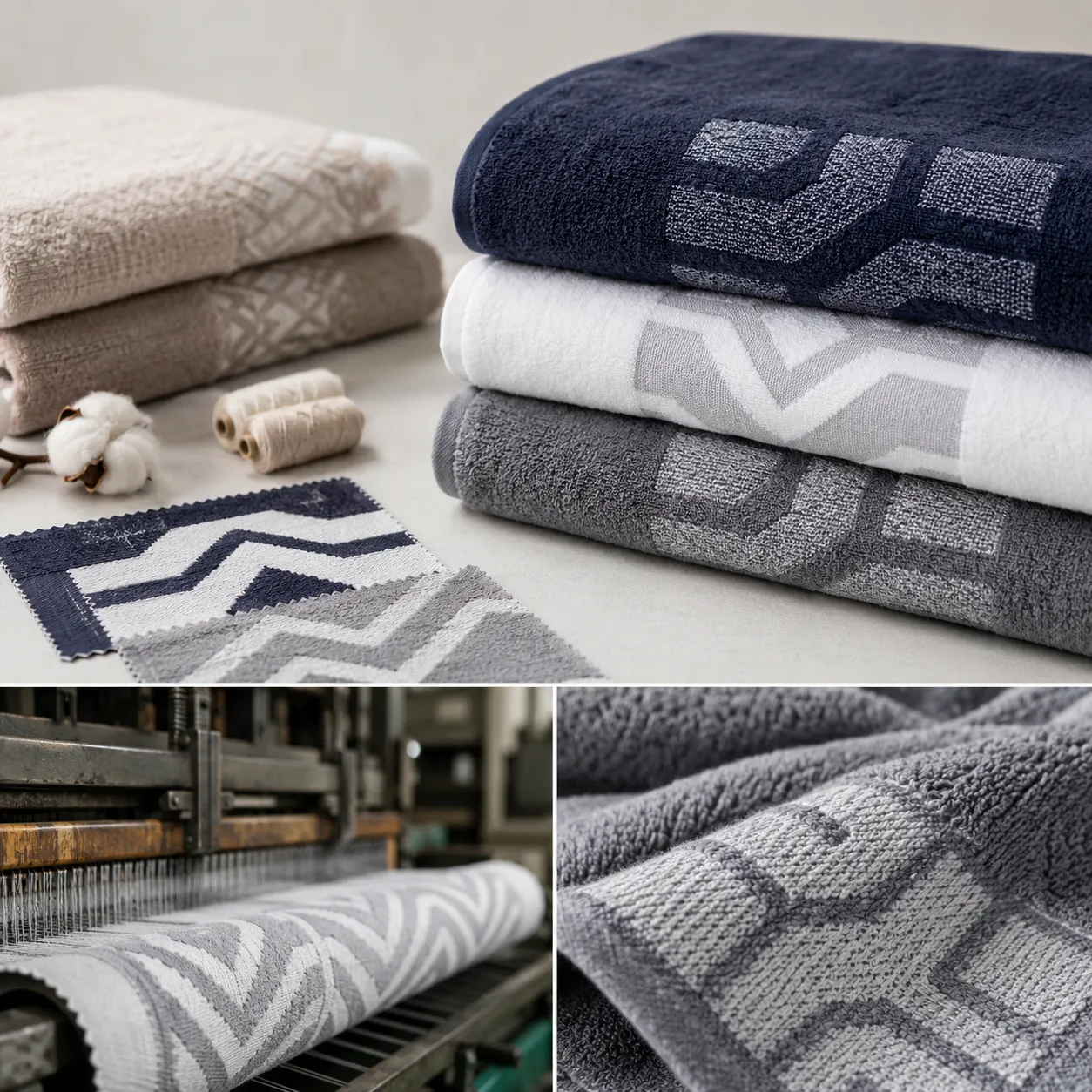
Why Jacquard MOQ Behaves Differently
Jacquard is not a print laid on top of a finished towel. The logo is built into the fabric structure by controlling pile height, pile color, ground weave, or a combination of those elements on the loom. That means the MOQ is tied to yarn preparation, jacquard carding or electronic design files, loom threading, trial weaving, and shade control.
For normal solid-color terry towels, we can often manage 500 pcs per design per color if the size and GSM are within our running production range. For a woven logo towel MOQ, the practical floor is still 500 pcs per design per color at LUMA & CO. TEXTILE, but the cost curve becomes smoother at 800 to 1,200 pcs because loom setup and yarn dyeing are spread across more pieces.
The negotiation point is usually not whether the mill can physically weave fewer pieces. We can run a short lot, but the waste rate is less forgiving: first-meter loom tuning, color shade approval, border alignment, and inspection rejects do not shrink in proportion to order size. A 500-piece jacquard order may still require 35 to 60 kg of prepared yarn across colors, depending on towel size and GSM.
| Construction | Typical GSM | MOQ Pressure | Best Use Case |
|---|---|---|---|
| Single-color raised jacquard logo | 420-520 GSM | Lowest jacquard setup burden | Hotel bath towel, gym towel, club hand towel |
| Two-color yarn-dyed jacquard | 450-580 GSM | Higher yarn dyeing and shade control load | Resort towel, retail towel, sponsor merchandise |
| Tone-on-tone low/high pile jacquard | 500-650 GSM | Medium setup, stronger texture control needed | Luxury hotel, spa, private club |
| Multi-zone jacquard with border wording | 480-620 GSM | Higher loom trial and alignment risk | Brand program or recurring seasonal order |
Jacquard Logo Towel MOQ Negotiation Guide
A useful jacquard logo towel MOQ negotiation guide does not begin with asking for the lowest number. It begins with separating the parts of the order that create fixed cost from the parts that can be flexed. In our quotation room, the biggest fixed items are jacquard artwork conversion, loom trial, dyed yarn lot preparation, and packing material setup if private label packaging is required.
If your target is below 1,000 pcs, we normally advise buyers to hold one size, one logo layout, and one yarn color combination. Splitting 600 pcs into three towel colors usually looks attractive to a marketing team, but it can create three dye lots, three shade checks, and three inspection batches. The result is often a higher unit price than ordering 900 pcs in one color.
- Negotiate color count first, not just total pieces. One towel color at 700 pcs is easier than four colors at 200 pcs each.
- Keep the logo scale stable across sizes. Rebuilding the jacquard file for bath, hand, and wash sizes adds trial time.
- Use stock yarn shades when acceptable. Custom Pantone yarn dyeing usually needs more yarn commitment than towel cutting requires.
- Avoid mixed border constructions in small orders. A logo in the pile plus wording in the dobby border increases loom balancing work.
- Plan reorders upfront. If we know 500 pcs is a launch and 1,500 pcs is likely within 90 days, we can discuss yarn reservation differently.
Our baseline MOQ remains 500 pcs per design per color. For jacquard programs, we can discuss combined production planning when the buyer keeps one woven structure and changes only size or carton packout. What we cannot responsibly do is promise retail-grade woven detail at 150 pcs per color without pushing hidden cost into sampling, rejects, or a weak logo.
What We Can Combine, And What We Cannot
MOQ negotiation works best when both sides understand which specifications are truly shared. A logo towel in 70 × 140 cm and 40 × 70 cm may use the same brand mark, but the jacquard repeat, loom width usage, and border position are different. If the artwork must be re-scaled to keep the logo centered after shrinkage, we treat that as a separate technical setup.
For yarn-dyed jacquard, color is the most common misunderstanding. Pantone references are useful for the buyer brief, but terry yarn shade is approved on dyed cotton yarn and then again after weaving and washing. A navy pile yarn and a white ground yarn can bleed or dull differently in ISO 105-C06 laundering, especially if the towel is washed at 60°C for hotel use.
| Spec Element | Can Usually Combine? | Factory Comment |
|---|---|---|
| Same logo, same towel color, same size | Yes | Best case for MOQ and unit price |
| Same logo and towel color, two sizes | Sometimes | Depends on loom width and logo scale change |
| Same logo, three towel colors | No for color MOQ | Each shade needs separate yarn or dye planning |
| Same towel, different logo per department | No for design MOQ | Each logo requires separate jacquard setup and inspection reference |
| Same towel, different belly band artwork | Often yes | Packaging changes are easier than woven fabric changes |
One practical compromise is to produce a common jacquard towel and vary only removable packaging: belly band, hangtag, carton label, or polybag sticker. This protects the fabric MOQ while giving the buyer some channel separation. For example, a resort group may run one 550 GSM woven pool towel and pack 400 pcs for spa retail, 700 pcs for beach club service, and 300 pcs for VIP gifting.
Cost Drivers Buyers Can Actually Change
Jacquard towel pricing is not only about cotton price. The unit cost moves with GSM, towel size, yarn count, number of colors, loom efficiency, inspection standard, and packaging. A 500 GSM hand towel with a simple raised logo is a very different production problem from a 600 GSM oversized pool towel with a two-color all-over woven pattern.
For bulk jacquard towel pricing in 2026, our FOB China ranges below are realistic for OEKO-TEX 100 Class I compliant cotton terry, BSCI-audited production, and ISO 9001 controlled inspection. They are not meant as fixed offers because exchange rate, cotton basis, and packaging can move month to month.
| Order Volume | Hand Towel 40 × 70 cm, 450-520 GSM | Bath Towel 70 × 140 cm, 500-600 GSM | Pool Towel 80 × 160 cm, 480-580 GSM |
|---|---|---|---|
| 500-799 pcs | USD 1.85-2.55 | USD 5.40-7.20 | USD 7.10-9.30 |
| 800-1,499 pcs | USD 1.55-2.20 | USD 4.85-6.55 | USD 6.45-8.40 |
| 1,500-2,999 pcs | USD 1.32-1.95 | USD 4.35-5.95 | USD 5.85-7.65 |
| 3,000+ pcs | USD 1.18-1.70 | USD 3.95-5.45 | USD 5.25-6.95 |
- GSM reduction has limits. Dropping from 580 GSM to 520 GSM may help price; dropping to 390 GSM can make the jacquard logo look flat and thin.
- Logo size affects loom stability. Very large filled logos can create pile tension imbalance and uneven hand feel.
- Border width changes weight. A 7 cm dobby border uses less pile than full terry but can curl if the structure is not balanced.
- Private label packaging adds setup. Printed belly bands may need 7-10 days and a separate MOQ from the paper supplier.
- Inspection level matters. A retail AQL plan catches more appearance defects than a basic service-linen inspection and costs more time.
A cost-per-use check helps keep decisions practical. Suppose a 520 GSM jacquard bath towel at 1,000 pcs costs USD 5.35 FOB and survives 95 commercial laundry cycles before edge wear becomes visible. The fabric cost is about USD 0.056 per use. If a lighter 430 GSM version costs USD 4.45 but shows pile distortion around 58 cycles, the fabric cost is about USD 0.077 per use. The cheaper invoice can become the more expensive operating towel.
Logo Detail: The Hidden MOQ Trigger
Small lettering is the fastest way to make a jacquard order difficult. Embroidery can handle a narrow letter stroke with thread density, and sublimation can print fine detail on polyester microfiber. Jacquard has to express the mark through woven loops and ground structure. If a letter stroke is narrower than the effective pile spacing, it will blur after washing.
During CAD conversion, our design team checks the logo on a point grid and simulates how it will sit within the towel repeat. Curves become stepped edges if the artwork is too small. Thin gaps inside letters such as A, R, O, and P can close after shrinkage. On yarn-dyed two-color towels, contrast may improve readability, but floats on the reverse side can increase snag risk if the design is too dense.
| Logo Feature | Safer Jacquard Spec | Risk If Ignored |
|---|---|---|
| Minimum letter height | 18-25 mm for service towels | Text fills in after 5-10 washes |
| Fine line thickness | At least 3-4 terry columns | Broken strokes and uneven pile |
| Large solid logo block | Use low/high pile texture or split areas | Heavy patch, slower drying, hand-feel change |
| Reverse-side appearance | Approve both face and back sample | Long floats, snagging, customer complaints |
| Border logo placement | Allow shrinkage tolerance of ±8 mm | Logo drifts toward hem after laundering |
This is why we ask for vector artwork before quoting final MOQ. A buyer may say the logo is only one color, but the real issue is whether the mark can be woven cleanly at the requested towel size. For very detailed badges, we may recommend embroidery instead. For photographic artwork, we usually point buyers to sublimation on microfiber; our comparison in embroidery vs sublimation vs jacquard explains where each method makes sense.
Sample Approval Before You Negotiate Bulk
For jacquard, a digital mockup is not enough. We need either a loom strike-off or a full-size pre-production sample because terry height, yarn swelling, washing shrinkage, and reverse-side floats cannot be judged on screen. A buyer who approves only a flat artwork file may be surprised when the woven logo looks softer than the PDF.
- Send vector artwork, target size, GSM, towel color, and intended laundry condition.
- We convert the logo into jacquard CAD and flag strokes that are too fine for weaving.
- Lab dip or yarn shade is approved against the buyer color target under D65 light.
- A loom trial is woven, washed once under ISO 6330-style conditions, and measured for shrinkage.
- The buyer signs off face appearance, reverse side, hand feel, weight tolerance, and packaging layout.
Jacquard towel sampling cost usually runs USD 120-260 per design for simple raised-logo work and USD 220-480 for two-color yarn-dyed trials, depending on size and yarn availability. Sampling time is normally 10-16 days after artwork confirmation for stock shade yarn and 16-24 days when custom dyed yarn is needed. Bulk production begins only after the signed sample or approved counter-sample is logged.
Our standard bulk tolerance is usually ±5% on piece weight, ±3% on size after wash, and commercially acceptable shade variation within the approved lot. If your customer is a hotel group with central laundry, we advise including a 3-wash check before release. For more on building a quote-ready document, see build a towel tech pack that mills can quote and pantone color matching custom towels.
Lead Time And Capacity Planning
The biggest timing mistake is treating jacquard like a blank towel with logo application. Blank towels can sometimes be decorated after inventory is woven. Jacquard must be planned before weaving, so loom capacity and yarn preparation sit on the critical path.
For a confirmed PO after sample approval, our normal bulk lead time is 28-38 days for 500-1,500 pcs in one color and 35-48 days for 2,000-5,000 pcs with two yarn colors or special packaging. Add 5-9 days if yarn dyeing queues are heavy, and add transit time separately: sea freight to Europe or North America often needs 26-38 days port to port, while air freight may take 5-9 days but is rarely economical for heavy towels.
- Day 1-3: PO review, deposit confirmation, production file lock, carton mark approval.
- Day 4-10: Yarn allocation or dyeing, jacquard file preparation, loom scheduling.
- Day 11-24: Weaving, in-line checks for logo clarity, pile height, and border alignment.
- Day 25-31: Washing, drying, trimming, metal detection if required, and final measurement.
- Day 32-38: AQL inspection, packing, carton weighing, export documents, and loading.
For seasonal clubs and resorts, MOQ negotiation should happen with the reorder calendar, not after stockouts. If the first 700 pcs are a launch order and the next 1,400 pcs are likely before peak season, tell us before yarn purchase. We may be able to hold approved yarn shade references and reduce repeat sampling time. Related planning notes are covered in beach club resort towel program and country club golf towel program.
Quality Tests That Protect Small Runs
Short jacquard runs need tighter front-end control because there is less room to replace rejects. We check first-piece output against the approved sample before bulk weaving continues. On jacquard towels, the defect list is different from plain terry: blurred logo edge, missing pile zones, long reverse floats, skewed border, shade bar, and pile crush after drying are the main issues.
Our internal QC uses ISO 9001 procedures, OEKO-TEX 100 Class I compliant material control, and BSCI-audited social compliance. For performance checks, common references include ISO 105-C06 for domestic and commercial laundering colorfastness, ISO 105-X12 for rubbing colorfastness, ISO 6330 for wash procedure control, and AATCC 79 for absorbency where requested.
- Logo clarity check: compare woven face to approved sample at normal viewing distance and close inspection.
- Reverse float check: reject long loose floats that can catch rings, hooks, or laundry equipment.
- Skew and bow check: measure border line drift after washing and drying, especially on wide pool towels.
- Shade continuity check: inspect towel body, border, and logo zone under consistent light source.
- Weight and size check: verify GSM and finished dimensions after relaxation, not only off-loom measurements.
For small MOQ orders, we prefer AQL 2.5 for major defects and AQL 4.0 for minor appearance defects unless the buyer has a stricter retail standard. If you are sourcing for hospitality service rather than retail shelves, the inspection focus should be wash durability, absorbency, and edge strength. For GSM decisions, towel GSM decision framework is a useful companion read.
A Practical Negotiation Scenario
Here is a realistic case. A boutique hotel group wants 650 bath towels, 350 hand towels, and 250 washcloths with the same crest woven in tone-on-tone ivory. The buyer asks whether the total 1,250 pcs can meet MOQ as one design. Technically the brand mark is the same, but each size needs a different logo scale and border relationship.
Our recommendation would be to make the bath towel the jacquard hero item at 650 pcs, keep hand towels plain with an embroidered crest at 350 pcs, and skip jacquard on the washcloth unless the logo is simplified. Another option is 500 pcs bath towel and 500 pcs hand towel in a shared towel color, with the washcloth moved to a stock solid color. This keeps the custom jacquard towels minimum order quantity realistic without forcing a weak logo onto a small fabric area.
If the hotel insists on all three sizes in woven logo, we would quote three separate setups and explain the cost clearly. A 30 × 30 cm washcloth at 500 GSM weighs only about 45 g before finishing allowance, so a detailed crest may occupy too much of the usable area. That is not a procurement win; it is a specification mismatch.
Related reads: for buyers comparing construction options, see designing for jacquard pattern brief, towel sizes dimensions complete guide, and negotiate towel MOQ without killing margin.
What To Send For A Serious Quote
The fastest way to get a useful quote is to send a clear RFQ rather than asking for a general price. We can quote faster when the buyer defines the commercial target and the technical non-negotiables. If budget is tight, say so; we can then adjust GSM, size, packaging, or decoration method instead of guessing.
- Vector logo file in AI, EPS, or clean PDF format, plus any brand rules for minimum clear space.
- Towel size, target GSM, color target, and whether the logo should be raised, recessed, or two-color.
- Expected order quantity per size and per color, including possible reorder timing.
- Laundry condition: home wash, hotel laundry at 60°C, spa oil exposure, pool chlorine exposure, or retail use.
- Packaging requirements: bulk pack, belly band, barcode sticker, polybag, carton marks, or pallet rules.
- Required certificates: OEKO-TEX 100 Class I, BSCI, ISO 9001, or customer-specific audit documents.
LUMA & CO. TEXTILE is a 220-employee towel mill operating since 2007 in Gaoyang, Zhejiang, China. We produce about 2.4M towels annually for 80+ brand clients across 47 countries. Our standard MOQ is 500 pcs per design per color, and jacquard orders are quoted with the setup logic explained rather than hidden inside a vague unit price.
For a jacquard logo towel MOQ negotiation guide to be useful, the final answer should protect both sides: the buyer gets a towel that survives use, and the factory runs a stable order without burying waste in the price. Send your draft spec to [email protected] or WhatsApp +86 13205717266, and we will mark which parts can be combined, which need separate MOQ, and where the cost can be reduced without damaging the towel.
Review Your Jacquard MOQ Plan
Send us the logo, towel size, GSM target, color split, and reorder estimate. We will return a practical MOQ and FOB range with the setup risks shown clearly.
Request MOQ Review →