Start with the finished size, not the loom size
For an oversized beach towel, the useful buying spec is always the post-wash finished size with tolerance, not the grey fabric width and not the cut size before hemming. On beach programs, we see buyers ask for 100×180 cm, 100×200 cm and 120×180 cm most often. Those are saleable sizes, but each one behaves differently in production because pile direction, hem turn-in and wash relaxation change the final measurement.
In our RFQs, we ask buyers to write the size this way: 100×180 cm after wash, tolerance ±3% length and width, measured after one domestic wash at 40°C. Without that sentence, two factories can quote the same towel and deliver different usable sizes. Oversized pieces magnify the issue because a 3% shift on 180 cm is already 5.4 cm.
| Common finished size | Typical GSM | Approx. net weight per piece | Best fit |
|---|---|---|---|
| 90×170 cm | 380-450 GSM | 580-690 g | High-volume promo and beach club programs |
| 100×180 cm | 400-500 GSM | 720-900 g | Mainstream resort and retail programs |
| 100×200 cm | 420-500 GSM | 840-1,000 g | Premium pool deck and DTC beach lines |
| 120×180 cm | 380-450 GSM | 820-970 g | Lounger coverage and family-use formats |
- Ask for finished size after wash rather than loom width
- Set tolerance separately for width and length if lounger fit matters
- Confirm whether fringes are included in the stated size
- Record hem style: 10 mm lock hem, 15 mm turn hem, or dobby border finish
The risky point in any oversized beach towels supplier checklist is shrinkage control
Large beach towels fail most often on dimensional stability, especially when one side carries heavy print paste or dark reactive shades. We usually test shrinkage by ISO 5077 and verify dimensional change after laundering with the matching care method. For cotton velour beach towels, a realistic control target is warp and weft shrinkage within 5% after one wash, with better programs holding closer to 3.5-4%.
If the supplier only says "pre-shrunk" without a test report, that is not enough. We look at loop density, shearing quality on the velour face, drying tension and whether the fabric is relaxed before cutting. A towel can pass a handfeel check and still lose 6 cm in length after the first wash if those controls are loose.
- Request a wash test report tied to the exact construction and colorway
- For dark navy, black and saturated red, ask for size results by color because dyeing load changes behavior
- Check the inspection method: measure on a flat table after conditioning, not hanging
- Reject bulk if average shrinkage is inside target but outliers exceed the agreed threshold on sampled pieces
Pick the print route before approving artwork scale
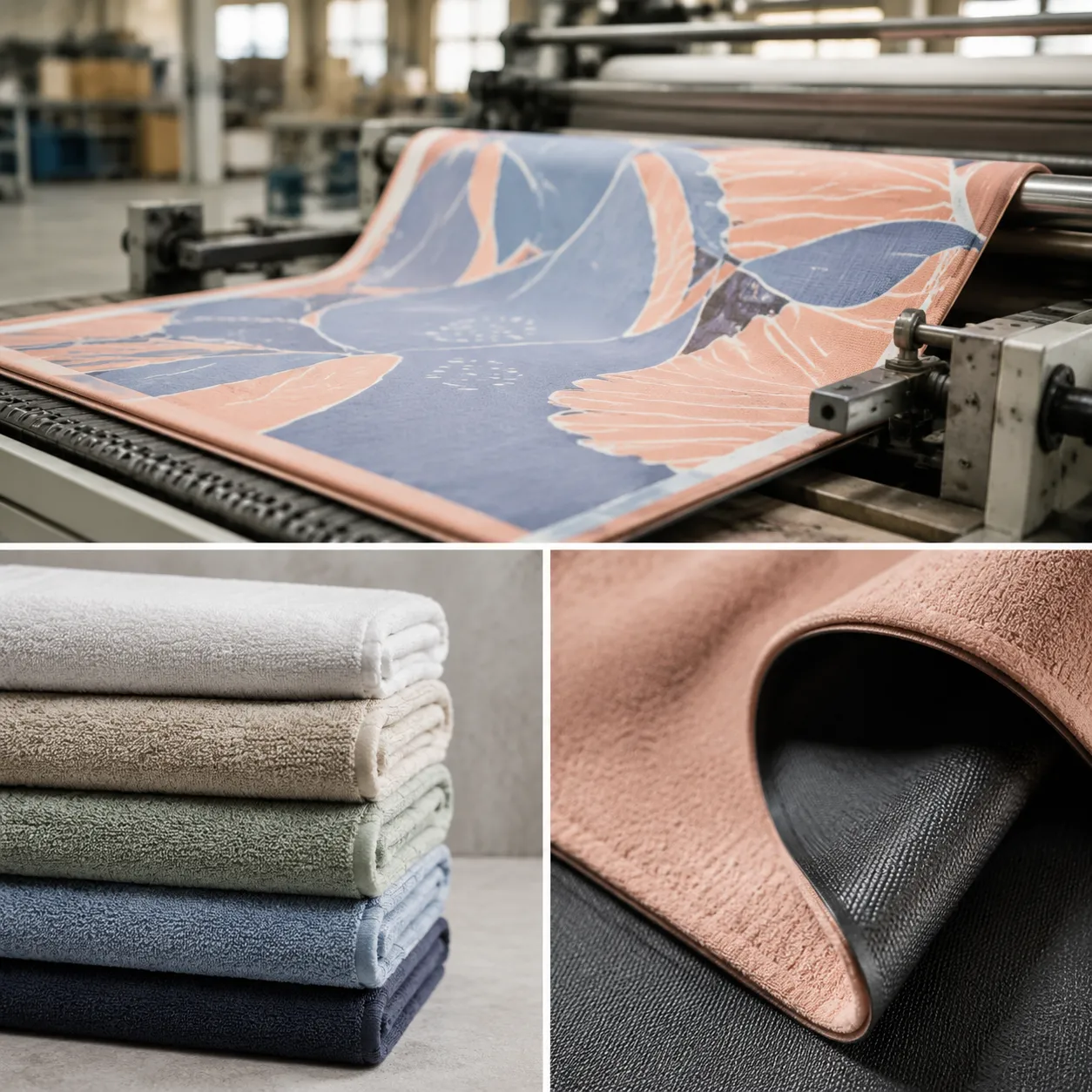
Many oversized towels look similar in a mood board but the factory route can be completely different. A yarn-dyed jacquard towel, a reactive printed velour towel and a pigment printed promo towel should never be compared on artwork sharpness, handfeel and wash life as if they are interchangeable. For beach retail and resort resale, the usual comparison is reactive print velour versus jacquard.
| Decoration route | Visual effect | Limit buyers should know | Typical FOB China at 3,000 pcs |
|---|---|---|---|
| Reactive print on cotton velour | Large artwork, strong color range, soft face | Registration can drift on very large repeats; white ground is cleaner than dark ground | USD 5.10-6.80 for 100×180 cm / 400-450 GSM |
| Yarn-dyed jacquard | Pattern built into fabric, stable wash appearance | Higher yarn planning complexity; limited for photo-style artwork | USD 5.70-7.40 for 100×180 cm / 420-500 GSM |
| Pigment print on low-GSM cotton | Low entry cost for events | Stiffer handfeel, lower rub fastness, shorter visual life | USD 3.20-4.30 for 90×170 cm / 320-360 GSM |
| Embroidery add-on | Good for small logos near border | Not suitable for large chest-center graphics on thick beach piles | Add USD 0.24-0.62 depending on stitch count |
For reactive printed velour, we watch two technical points that do not show up in simple quotes. First is face shearing consistency, because uneven shearing makes solid areas look cloudy. Second is print penetration control. If penetration is too deep, the terry back stiffens; too shallow, and the color looks weak after laundering.
GSM should match use case, not buyer instinct
Big towels invite a common mistake: buyers increase size and GSM at the same time, then discover the packed carton weight, drying time and FOB cost all jump together. For an oversized format, we usually see the best balance at 400-450 GSM for resort and beach club use. Below that, the towel can feel underbuilt for the footprint. Above 500 GSM, comfort improves, but drying slows and freight cost becomes noticeable.
A 100×200 cm towel at 520 GSM is a heavy article. It photographs well, but in commercial use it occupies more washer capacity and takes longer to condition after dyeing. If the order is meant for pool turnover rather than retail gifting, the extra GSM may not improve cost-per-use.
- Use 380-420 GSM for event, promo and lighter-carry formats
- Use 400-450 GSM for mainstream custom oversized beach towels
- Use 450-500 GSM when retail handfeel matters more than laundry throughput
- Check carton gross weight before locking any spec above 500 GSM
Inspect colorfastness with beach conditions in mind
Beach towels do not live only in home laundering. They face sun lotion, chlorinated water, sea salt, damp stacking and UV exposure on loungers. A supplier checklist for this category should include more than wash fastness. The base lab sequence we prefer on cotton printed beach towels includes ISO 105-C06 for domestic laundering color change, ISO 105-X12 for rubbing, and ISO 105-E02 when perspiration or salt-water migration is a concern for striped or dark-ground programs.
For resort orders, we also look at crocking on white trim areas and sunscreen staining risk on pale shades. One defect mode that repeats on oversized printed towels is border shadowing: the body print remains stable, but the hem area darkens after wash because sewing thread, edge density and print chemistry absorb differently. It is visible first on turquoise, coral and deep cobalt programs.
| Test item | Preferred target for beach programs | Why it matters |
|---|---|---|
| Wash color change | Grade 4 minimum | Protects artwork clarity after repeated laundering |
| Wash staining to adjacent fabric | Grade 3-4 minimum | Prevents bleed onto white bars or labels |
| Dry rubbing | Grade 4 minimum | Important for loungers, bags and apparel contact |
| Wet rubbing | Grade 3 minimum | Critical on dark reactive shades |
| Dimensional stability | Within 5% | Controls usable size after first wash |
| Skew / bow | Within 3% where striped design applies | Keeps border and stripe layout visually straight |
Set QC thresholds that fit large-format towels
An oversized towel needs its own inspection language. Generic "AQL pass" notes miss the defects that matter most on large panels. We normally classify print misregistration, bowing on border stripes, side-to-side shade variation, broken sheared face patches, pulled loops on back terry and hem roping as the key bulk risks. On wide artwork towels, a 6 mm visual shift can already be obvious at the center field.
For pre-shipment inspection, many buyers use ANSI/ASQ Z1.4 general level II. That is workable, but the product criteria need to be written in the tech pack. Example: stripe deviation over 8 mm across the towel width is major; exposed seam opening over 10 mm is major; pile void over 15×15 mm on face is major; loose thread under 30 mm can be minor if trimmed cleanly. Without thresholds, inspectors improvise.
- Measure three points across width on oversized pieces, not one center point only
- Check print registration at center and near both selvedges
- Open at least two master cartons per selected case pack to verify compression marks and moisture odor
- Count carton-to-carton shade drift separately from piece-level defects
Carton cube becomes a buying decision earlier than most teams expect
Large towels create freight surprises fast. The towel may be acceptable on FOB price but fail once carton height, pallet pattern or destination handling limit is added. A 24-piece carton on a heavy 100×200 cm spec can cross the gross weight limit that some 3PL operations prefer for manual handling. The answer is often to reduce pack quantity, not to weaken the towel specification.
Vacuum packing can improve cube, but it is not always suitable. On velour beach towels, aggressive compression can leave fold memory and flatten the pile presentation until goods recover. For private-label retail, we usually test one packed sample carton for 72 hours and then re-open to check face marking before approving the pack-out method.
| Spec example | Typical pack | Approx. carton size | Approx. gross weight |
|---|---|---|---|
| 90×170 cm / 400 GSM | 30 pcs | 58×38×46 cm | 19.5-21.0 kg |
| 100×180 cm / 430 GSM | 24 pcs | 60×40×46 cm | 20.5-22.5 kg |
| 100×200 cm / 450 GSM | 20 pcs | 62×42×48 cm | 20.0-22.0 kg |
| 120×180 cm / 420 GSM | 18 pcs | 64×44×46 cm | 19.0-21.5 kg |
Related reads: beach-towels-in-bulk-buyers-guide, beach-club-resort-towel-program, and container-vs-air-freight-towel-orders.
Sampling should include one abuse round, not only a beauty sample
A counter sample approved from a fresh loom lot is only a visual checkpoint. For oversized programs, we recommend three sample stages: lab dip or strike-off, pre-production towel, and one washed confirmation sample from the approved bulk route. That last stage catches the problems that often remain hidden in first approvals: torque on wide hems, edge curling on velour face, and shrinkage imbalance between printed face and terry back.
- Approve artwork scale on a strike-off or woven simulation before bulk yarn or screen booking
- Confirm handfeel, hem construction, hanger loop placement and label position on the pre-production towel
- Wash at least one sample using the stated care method and re-measure size, skew and color change
- Freeze the approved standard with photos of face, back, border and folded packing state
A realistic price map for bulk orders
Pricing on this category moves mostly with cotton level, towel weight, decoration route, and order quantity per design per color. Our MOQ remains 500 pcs per design per color, but oversized beach programs become materially more efficient above 1,500 pcs because screen cost, dye lot planning and packing setup are spread better. For buyers comparing offers, check whether the quote includes care label sewing, custom header card, polybag, carton marks and third-party inspection support.
| Order volume | 90×170 cm 400 GSM reactive print | 100×180 cm 430 GSM reactive print | 100×200 cm 450 GSM jacquard |
|---|---|---|---|
| 500-999 pcs | USD 4.95-5.85 | USD 5.85-6.95 | USD 7.10-8.35 |
| 1,000-2,999 pcs | USD 4.30-5.10 | USD 5.10-6.05 | USD 6.35-7.40 |
| 3,000-9,999 pcs | USD 3.85-4.60 | USD 4.65-5.55 | USD 5.80-6.95 |
| 10,000+ pcs | USD 3.55-4.20 | USD 4.30-5.10 | USD 5.40-6.45 |
These FOB China ranges are realistic for 2026 programs using OEKO-TEX Standard 100 Class I compliant inputs, standard export cartons and bulk packing. Certified social compliance such as BSCI, and process control under ISO 9001, should already be visible in the supplier profile rather than treated as a surcharge line item.
Lead time depends on print route and season slot
Oversized cotton beach towels are seasonal goods, so timing depends not only on capacity but also on when the dye house, shearing line and sewing floor are booked. For a new reactive print program, a practical schedule is 3-5 days for quoting, 7-10 days for sample development, 3-5 days for lab review and revisions, and 25-40 days for bulk production after approval and deposit. Jacquard programs can take longer up front because pattern graphing and yarn planning must be frozen earlier.
- Add 5-7 days if custom retail packaging needs drop testing or barcode approval
- Add 4-6 days if the order includes multiple dark shades requiring repeated lab dips
- Book vessel space early for spring resort launches; oversized cartons consume cube faster than buyers expect
- Do not merge sample approval and bulk booking on complex prints unless timing pressure is more costly than remake risk
Related reads: towel-gsm-decision-framework, build-towel-tech-pack-that-mills-can-quote, and pantone-color-matching-custom-towels.
What to put on the supplier checklist before deposit
If a buyer sends us a one-page inquiry for large resort towels, the fastest way to reduce quoting noise is to lock the technical points that cause rework later. This is where an oversized beach towels supplier checklist earns its keep. The useful version is not long, but every line must be measurable.
- Finished size after wash with tolerance, and whether fringe is included
- Construction: velour/terry or full terry, cotton type, GSM target and allowable variance
- Decoration route with artwork repeat size, Pantone references and placement tolerances
- Test requirements: ISO 5077, ISO 105-C06, ISO 105-X12 and any customer protocol additions
- QC limits for size, skew, print registration, hem defects, pile voids and shade variation
- Packing details: pcs per carton, carton max gross weight, barcode, polybag and shipping marks
- Commercial terms: MOQ 500 pcs per design per color, target ship window, inspection party and Incoterm
For buyers comparing suppliers in China, Turkey and South Asia, this same checklist also makes freight and quality discussions cleaner because every mill prices the same technical package. That matters more than chasing the lowest opening FOB number.
Need a factory review on your oversized beach towel spec?
Send the target size, GSM, artwork route and packing plan. We can review shrinkage risk, carton cube, MOQ split and realistic FOB ranges for your program. WhatsApp: +86 13205717266 | Email: [email protected]
Request a Quote →