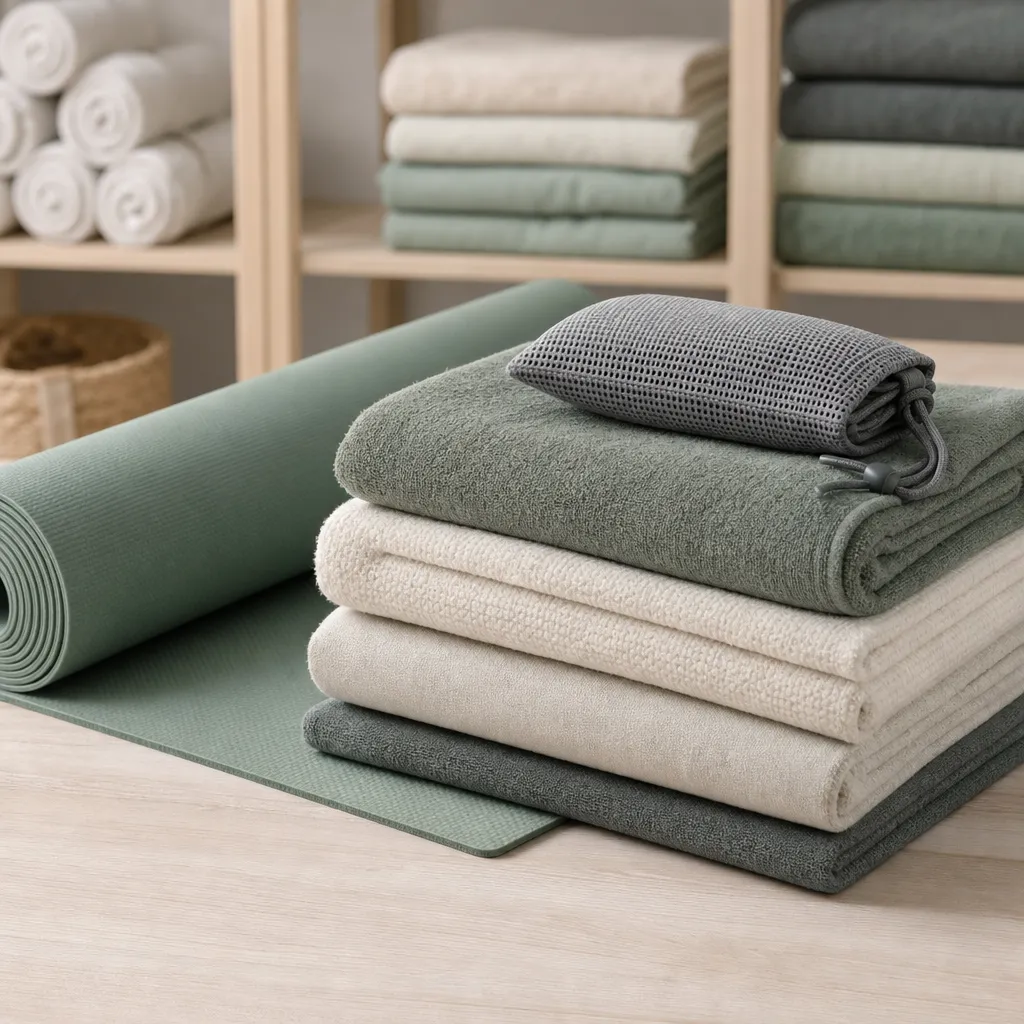
What a jade yoga mat buyer is usually trying to solve
In sourcing conversations, the phrase often means one of three things. Some buyers are building a towel to sit on top of a natural rubber yoga mat in a green shade. Some are building a private-label accessory kit where mat, towel, strap, and carry bag must look like one retail family. Others are replacing rental studio towels that slip once sweat builds under the palms.
We manufacture towels, not yoga mats, so our role is to make the towel side behave correctly against rubber, TPE, PU-coated, or cork surfaces. For a jade yoga mat setup, the towel should not bleed into light rubber, curl at the corners, or feel plasticky when the user moves from standing poses to floor work. Those are practical requirements, not brochure language.
The MOQ at our mill is 500 pcs per design per color. For yoga towels, the first decision is whether the order is for studio laundry use, retail resale, event gift packs, or DTC subscription kits. A towel that works for a 28-day hotel-style laundry loop is not always the best towel for a folded retail box with a mat and strap.
| Buyer use case | Recommended construction | Typical GSM | Why it fits |
|---|---|---|---|
| Hot yoga studio rental | Microfiber suede face with silicone dot backing | 280-340 GSM | Low lint, fast drying, stable grip after repeated sweat and wash cycles |
| Retail towel sold with mat | Printed microfiber face, light grip backing or corner pockets | 240-300 GSM | Neater folding, lower carton weight, better shelf presentation |
| Natural rubber mat protection | Reactive-dyed cotton terry or microfiber with tested backing | 360-480 GSM cotton or 260-320 GSM microfiber | Adds absorbency without aggressive rubber contact marks |
| Travel yoga kit | Thin microfiber waffle or suede | 200-260 GSM | Compact packing and quicker drying between classes |
The contact surface matters more than the top color
A yoga towel has two working faces. The visible face manages touch, sweat absorption, print clarity, and color. The underside decides whether the towel creeps forward during plank work or wrinkles during transitions. For natural rubber yoga mat programs, we test both faces because rubber can hold residue, oil, and loose dye more visibly than PVC flooring or a black gym mat.
For silicone dot backing, we normally use a 0.45-0.7 mm raised dot with 35-45% coverage on the underside. Lower coverage feels softer and folds cleanly, but may not hold enough on damp rubber. Higher coverage grips better, yet it adds cost and can leave a raised texture if the towel is rolled tightly inside a narrow carton for several weeks.
Corner pockets are another option. They reduce chemical contact between the towel and mat, which helps if the mat surface is sensitive. The drawback is sizing discipline. If the pocket depth is 90 mm but the mat width varies by 8 mm across production, one corner pulls while another corner floats. We ask buyers for the real mat sample, not only a catalog size.
- Silicone dot backing: best for hot yoga towel use where sweat creates movement.
- Corner pockets: useful for retail kits when buyers want a cleaner underside and less backing cost.
- No backing: acceptable for towel-only retail or floor stretching, but risky for active practice.
- Elastic corner bands: workable for thin travel mats, less clean for thicker natural rubber mats.
Size tolerance around rubber mats
Most yoga mats sold to studios fall near 61 x 173 cm, 66 x 183 cm, or 68 x 185 cm. The towel cannot simply copy the nominal mat size. Cotton terry shrinks differently from microfiber. Silicone backing can restrict shrinkage unevenly. Printed microfiber also behaves differently after heat fixation and edge stitching.
For a towel placed over a jade yoga mat in a retail kit, we usually make the finished towel 1-2 cm narrower and 1-3 cm shorter than the mat if no pockets are used. This prevents the towel edge from peeking out and collecting floor dirt. For corner-pocket designs, we build the cut size larger, then control final dimensions after wash testing.
Our internal sample check uses three measurements before approval: after cutting, after sewing, and after one ISO 6330 domestic wash cycle at 40 C with line dry or tumble dry depending on the buyer's care label. For studio laundry towels, we also run a five-cycle check because the first wash does not show enough about edge torque or corner curling.
| Mat size supplied by buyer | Finished towel without pockets | Finished towel with corner pockets | Sewing note |
|---|---|---|---|
| 61 x 173 cm | 60 x 171 cm | 62 x 175 cm before pocket tension | Use 8-10 mm overlock plus coverstitch if towel is microfiber |
| 66 x 183 cm | 65 x 181 cm | 67 x 185 cm before pocket tension | Keep pocket depth near 85-95 mm for 4-5 mm mats |
| 68 x 185 cm | 67 x 183 cm | 69 x 187 cm before pocket tension | Add corner reinforcement if kit is rolled tightly |
Color matching green without staining the mat
Green is a less forgiving towel color than navy, charcoal, or black. A muted sage towel can look gray under studio LED lighting. A yellow-green print can look cheap beside natural rubber. A deep jade shade can pass a dry handfeel check and still fail once the towel is washed with alkaline detergent.
For cotton, we prefer reactive dyeing when the shade must be stable through repeated washing. For microfiber, disperse print or solid disperse dye is normal, but the fixation and reduction cleaning step must be controlled. If the towel will touch pale green, cream, or marbled rubber, we add a wet crocking check based on ISO 105-X12 and a color fastness to washing check based on ISO 105-C06. Buyers who plan co-branded retail should budget for lab dips before bulk dyeing.
A common defect is edge haloing. The face fabric looks correct, but dye residue concentrates along the stitched border, then transfers to the mat after the towel is rolled damp. We reduce this by washing darker lots before sewing or by using color-matched polyester thread that has passed a separate rubbing check. Thread is small, but on a green kit it can become the most visible failure point.
- Approve the color under D65 daylight and one indoor light source close to the studio or retail environment.
- Confirm whether the mat is natural rubber, TPE, cork, PU-coated rubber, or PVC because transfer risk changes by surface.
- Run wet rubbing on both the towel face and stitched edge, not only the center panel.
- Roll one damp towel with the mat for 24 hours, then inspect the contact lines before bulk approval.
Grip patterns we actually sample
Grip is not a single specification. We can make a towel feel secure at the start of class and still have it skate once sweat pools under the hands. We can also make a backing so aggressive that users feel dots through the towel during kneeling poses. Sampling should check both movement and comfort.
For a non slip yoga towel, we usually prepare two or three backing layouts instead of arguing from a drawing. A 5 mm dot spaced 12 mm apart gives a softer hand. A 4 mm dot spaced 8 mm apart grips more evenly but adds roughly USD 0.18-0.32 per piece at 1,000 pcs, depending on towel size and silicone weight. Wave grip uses more screen area and looks cleaner in a retail display, but it can trap lint if the studio laundry uses cotton loads in the same machine.
| Grip option | Best use | Added cost at 1,000 pcs | Watch point |
|---|---|---|---|
| Small silicone dots | Hot yoga and studio rental | USD 0.22-0.38/pc | Must control dot height so folding stays flat |
| Wave silicone | Retail kits and DTC packaging | USD 0.30-0.48/pc | Screen alignment matters on long towels |
| Corner pockets only | Mat-specific kits | USD 0.16-0.29/pc | Needs real mat sample for tension testing |
| No grip backing | Travel towel or low-cost giveaway | USD 0.00 added | Not suitable for sweaty flow classes |
Cotton, microfiber, and blended faces
Cotton feels familiar and absorbs quickly, but it dries slowly in a studio back room. Microfiber packs lighter, prints with sharper artwork, and dries faster, yet some users dislike a slick handfeel before sweat begins. A cotton-poly blended face can sit between the two, though the buyer must accept slightly lower print sharpness than full microfiber sublimation.
For studio rental, we usually keep microfiber between 280 and 340 GSM. Below 240 GSM, the towel can feel like a travel sheet and may bunch under the heel. Above 380 GSM, drying time becomes the problem. For cotton yoga mat towel programs, 420-520 GSM is a realistic range if the buyer wants a terry feel, but carton volume and laundry cost rise quickly.
A practical comparison from one recent 1,200 pc studio order: a 305 GSM microfiber towel with dot backing landed at USD 4.35-4.90 per piece FOB Ningbo, while a 470 GSM combed cotton towel with reinforced corners was USD 5.65-6.40 per piece. The cotton version felt more like a bath textile, but the studio calculated that microfiber saved about 11 minutes of drying time per load in their equipment. That labor and energy difference mattered more than the first invoice.
- Choose microfiber when drying speed, print detail, and compact packing matter.
- Choose cotton terry when the brand wants a warmer handfeel and less synthetic touch.
- Choose waffle microfiber for travel kits, but test edge stability because thin waffle can distort.
- Avoid very heavy terry for hot yoga rental unless the studio has commercial drying capacity.
Decoration: logo placement without making practice awkward
Yoga towels are touched by hands, feet, elbows, and face. A thick embroidered logo placed at the forehead end can irritate users in child pose. A large plastisol print can reduce absorbency exactly where sweat falls. We treat decoration as a use-area decision before we treat it as branding.
For microfiber, sublimation gives the cleanest all-over artwork and is usually the right route for tonal green patterns, alignment marks, or marble effects. For cotton, jacquard can weave a logo into the structure, but the towel becomes heavier and the minimum setup is less friendly for small trial runs. Embroidery works for a corner mark or membership tier, provided the stitch count stays modest. A 55 x 25 mm logo at 4,000-5,800 stitches is usually enough on a towel corner.
Related reads: our decoration team compares embroidery, sublimation, and jacquard for towel buyers, and our color team explains how to manage Pantone color matching when a retail kit depends on a tight shade family.
| Decoration method | Suitable fabric | Good placement | Risk to test |
|---|---|---|---|
| Sublimation print | Polyester microfiber | Full panel or border pattern | Color shift after heat fixation and wash |
| Reactive solid dye plus woven label | Cotton terry | Side hem or corner | Label edge scratch on floor poses |
| Embroidery | Cotton or dense microfiber | Lower corner outside hand zones | Raised stitches against skin |
| Jacquard weave | Cotton or cotton blend | Large tonal logo or stripe | Longer sampling and higher yarn planning cost |
Compliance, labeling, and packing for retail kits
If the towel ships as a private label yoga accessories set, the compliance burden is higher than for a loose studio towel. We hold OEKO-TEX Standard 100 Class I, BSCI, and ISO 9001 certifications, and we still check the exact article because backing silicone, thread, label ink, and polybag printing may come from different material streams.
Care labels should be written for the weakest component in the towel, not the main fabric only. Silicone backing dislikes high-heat tumble drying. Some microfiber prints should avoid chlorine bleach. Cotton terry can tolerate more aggressive laundering, but a printed woven label may not. We also mark country of origin, fiber content, washing symbols, and buyer SKU where required.
Packing deserves early attention. If a towel is rolled directly around a mat, pressure lines can form where the silicone touches the towel face. We usually add tissue or a thin recyclable belly band between grip backing and visible surface for boxed sets. For ocean freight, cartons should not exceed a weight the buyer's warehouse team can move comfortably; for yoga towels, we prefer 14-18 kg gross weight per master carton.
- OEKO-TEX Standard 100 Class I: useful when the towel touches face and skin during practice.
- BSCI: often requested by European and North American retail buyers for social compliance files.
- ISO 9001: relevant for documented QC, lot traceability, and corrective action records.
- ISO 6330: used for domestic wash procedure checks during sample and bulk evaluation.
- ISO 105-X12 and ISO 105-C06: used for rubbing and washing color fastness review.
MOQ, pricing, and production timing
Our MOQ is 500 pcs per design per color. Small buyers sometimes ask for 100 pcs in four shades, but that usually creates the worst cost structure: more dye changes, more label sorting, more carton marks, and almost no material leverage. A cleaner first order is often 600-800 pcs in one color with two packaging versions, or 1,000 pcs split across two artwork placements if the base fabric remains the same.
For a jade yoga mat bundle, the main price drivers are fabric GSM, towel size, grip backing coverage, print route, label count, and packing format. A hangtag and belly band add less than a rigid retail box. Corner pockets add labor but can reduce silicone cost. Air freight can erase all savings from a lighter construction if the launch date is already too close.
| Order volume | Microfiber towel with grip | Cotton terry towel | Typical production time |
|---|---|---|---|
| 500-799 pcs | USD 4.85-6.20/pc | USD 6.10-7.45/pc | 18-25 days after sample approval |
| 800-1,499 pcs | USD 4.35-5.55/pc | USD 5.55-6.85/pc | 22-30 days after sample approval |
| 1,500-3,999 pcs | USD 3.95-5.05/pc | USD 5.10-6.30/pc | 28-36 days after sample approval |
| 4,000+ pcs | USD 3.55-4.70/pc | USD 4.75-5.95/pc | 34-45 days after sample approval |
Sample timing is normally 7-12 days for existing fabric with custom print or embroidery, and 14-20 days when we need new silicone screens, new yarn dyeing, or a special pocket construction. Bulk lead time starts after the approved sample, deposit, packaging file, and shipping marks are all confirmed. For freight planning, our logistics note on container versus air freight is useful when the launch calendar is tight.
QC checks before the towel ships
The most expensive failures show up after the product leaves the factory: a towel that stains a mat, a grip pattern that peels, or a size that no longer fits after laundering. We catch these by testing the actual construction, not only the fabric roll. For yoga towels, we inspect more than appearance because the product is stretched, sweated on, washed, rolled, and stored damp by real users.
For silicone backing, we run an adhesion check after washing and a simple flex check on the dot surface. Peeling often starts at the fold line if the backing was applied too thick or cured unevenly. For corner pockets, we check diagonal tension because a towel can measure correctly in length and width while twisting across the mat. For printed microfiber, we check shade consistency between panel center and hem because heat exposure at the edges can differ during fixation.
- Measure finished length and width from three pieces per size before wash.
- Wash samples under the approved care route and measure shrinkage after drying.
- Rub wet white cotton cloth across the face, hem, and logo area to screen transfer risk.
- Fit the towel on the buyer's mat sample and hold it through simulated downward-dog and lunge movement.
- Inspect packing pressure after 48 hours in the intended roll or box format.
Related reads: for base material decisions, compare microfiber versus cotton towels. For buyers building the first purchase file, our guide to building a towel tech pack shows which details prevent quote revisions. If the order is for studios, the sweat towel spec guide also overlaps with laundry planning.
What to send us for an accurate quote
A clear quote does not require a finished tech pack, but it does require more than a mood board. Send the mat size, target use, fabric preference, backing preference, logo file, packing idea, and annual forecast. If the towel must match a jade yoga mat color, send the mat sample or a physical color standard. Phone photos are useful for discussion, but they are not enough for bulk dye approval.
We also ask whether the towel will be sold alone or packed with the mat. That changes barcode placement, warning text, carton testing, and sometimes the tolerance for shade variation. A studio rental towel can live with a small tone difference between lots. A retail kit displayed in a row cannot.
- Mat material and exact measured size, including thickness.
- Target towel GSM, or a reference towel we can measure.
- Required certification files: OEKO-TEX 100 Class I, BSCI, ISO 9001, or buyer-specific forms.
- Artwork file in AI, PDF, or high-resolution PNG for print; DST or vector file for embroidery review.
- Packing method: folded, rolled, belly band, polybag, kraft box, or bundled with mat.
- Launch date, destination port, and preferred freight mode.
For retail buyers, the cleanest development path is one base towel, two backing trials, and one approved packing mockup before bulk. It costs a little more in sampling, but it prevents the familiar problem where a beautiful towel fails only when it meets the mat it was supposed to support.
Build a yoga towel kit that fits the mat
Send mat size, material, artwork, GSM target, and order quantity. We will quote a towel construction, sample timing, FOB price band, and QC route. WhatsApp: +86 13205717266. Email: [email protected].
Request a quote →