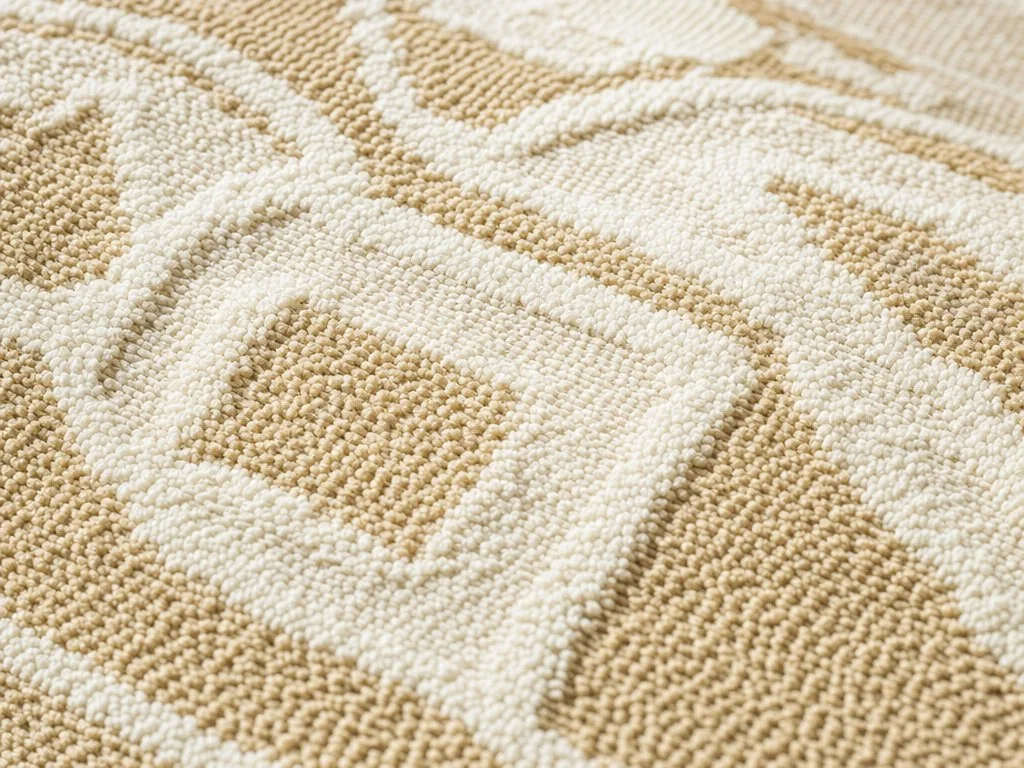
When a brand manager sees a jacquard-woven towel for the first time, two reactions are common. The first is delight: the way a woven pattern catches light, shifts under angle, and reads as fabric rather than as graphic is genuinely different from any printed or embroidered alternative. The second is frustration: their existing brand mark doesn't quite work on the loom. The lines are too thin, the contrast is wrong, or the design is too detailed for the weave to render cleanly. This article is the brief we send to clients before they start designing for jacquard.
How jacquard actually works
A jacquard loom has individually controlled warp threads, allowing the loom to raise or lower each warp thread independently for every pick (the weft pass). This means we can have one yarn (say, cream) on the top surface in some areas and a different yarn (say, sand) on top in other areas, with the pattern controlled by a digital file that drives the loom.
Critically: at any point in the towel, one color is on top and the other(s) are on the back. The pattern is a relief, not a print. The yarns themselves carry the color, so the design has the structural integrity of the textile itself. There is nothing to crack, fade, or peel.
Design rules that change for jacquard
Rule 1: Minimum line weight is bigger
In print or embroidery, you can render a 0.25mm line cleanly. On a jacquard loom, the minimum useful line weight is determined by the yarn diameter and weave density: typically 2mm at minimum for a sharp result, 3-4mm for a robust one. Thin script logos and fine outlines simply don't read on the loom.
Rule 2: Color count is limited
Most production jacquard towels use 2 colors (the base and an accent). Some advanced jacquards use 3 or even 4 colors, but each additional color requires another yarn-supply on the loom and significantly slows production. As a design rule: assume two tones unless you specifically negotiate three.
Rule 3: Contrast is yarn contrast, not print contrast
On a printed towel, contrast is whatever you put in your file. On a jacquard, contrast is the difference between the cream yarn and the sand yarn as dyed. Subtle two-tone designs (cream on ivory, charcoal on dark grey) can read as almost monochromatic because the yarn-to-yarn contrast is low. Bolder two-tone (cream on navy, white on terracotta) reads clearly.
Designers used to working in CMYK or RGB often want to dial in a precise hex code; on jacquard, you are selecting from physical yarn stock. We can match Pantone references within reason, but the practical Delta-E achievable is 2-3, not the 0.5 you might be used to in print.
Rule 4: Texture is part of the design
Because jacquard weaving uses raised loops on one side and flat on the other, the design has two surfaces with different absorbencies. The raised-loop side is the typical towel surface; the flat side is smoother. Most jacquard towels are designed with the brand mark on the flat side and the absorbent loops on the back. Some luxury programs reverse this for an even-more-tactile feel.
Pattern categories that work well
- Hem-stripe / border bands: Two-tone horizontal stripes near the hem. Simple, elegant, very widely used in luxury hotel programs.
- Geometric repeats: Small repeating motifs (dots, diamonds, chevrons, fleurs) over the whole body. Reads as quiet sophistication.
- Monogram blocks: A repeated single-letter monogram in a tonal pattern. Common in heritage hotel and resort branding.
- Damask scrolls: Curving floral patterns. Older, more traditional but still strong for spa and luxury bath programs.
- Single large logo + hem detail: One bold woven crest plus a tonal hem stripe. Modern interpretation of heritage style.
Pattern categories that don't work
- Photographic imagery (use sublimation instead)
- Gradients (yarn-based weave can't do continuous tone)
- Fine script lettering (lines too thin)
- Designs with more than 4 distinct colors (loom limitation)
- Very small details under 3mm (won't resolve)
The loom card (and why it costs upfront)
Before we can run your design on a jacquard loom, we have to create a loom card, the digital file that tells the loom which warp threads to raise on each pick. This is a one-time setup that takes 5-8 working days and costs USD 280-650 depending on pattern complexity.
The loom card cost is why jacquard MOQ is 1,000 pieces minimum. Below that quantity, the setup is uneconomical. Above 1,000 pieces, the per-unit setup amortization is acceptable; above 5,000 it is negligible.
We sometimes get briefs for 300-piece jacquard runs because the brand really wants a woven design. We always say: do the program properly. Run 1,500 pieces this year as a one-time run, build your repeat orders on that loom card for 3-5 years, and the loom-card cost amortizes to nothing per unit. Jacquard programs are designed to live, not to be a one-off.
What to send us when you're ready to design
- Vector logo file (AI or EPS preferred, SVG acceptable)
- Brand color palette with Pantone TCX references (not Pantone C)
- An indication of pattern density preference: dense all-over, sparse motif, hem-only
- Target towel size and GSM
- Approximate program quantity (so we can pick the right loom)
- Any reference imagery: hotel towels you have seen, competitor work you like, mood-board style references
We will then send back a digital pattern visualization (rendered as the towel would actually weave), a loom-feasibility check, and indicative pricing for setup and per-unit cost at your target quantity. Most clients iterate twice on the visualization before we cut a loom card and weave a physical sample.
Have a jacquard program in mind?
Send us your logo and a few reference photos of woven towels you like. We will send back a digital pattern simulation, feasibility check and indicative quote within three business days.
Start a jacquard brief →