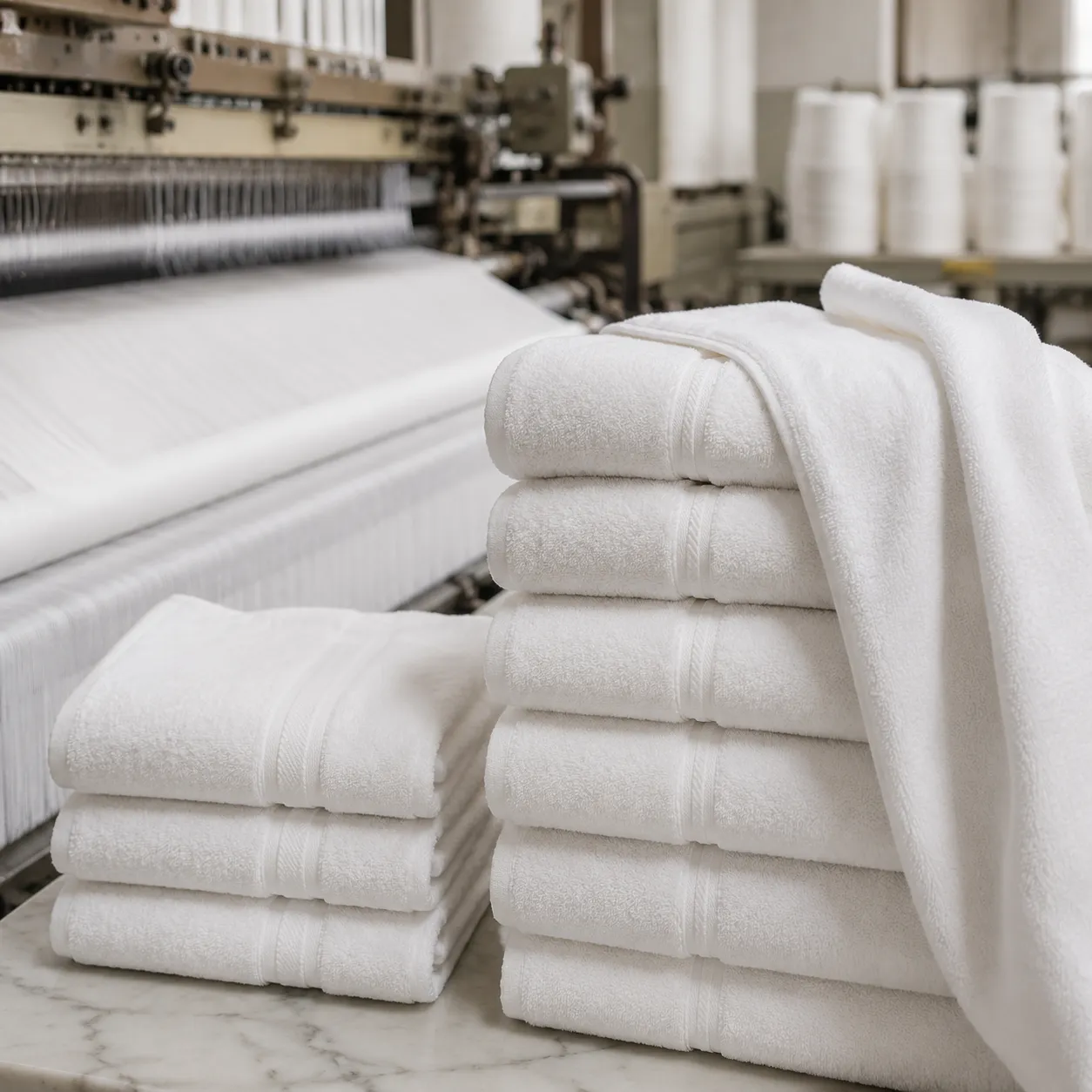
Start with the Cost Sheet, Not the Photo
Photos hide the expensive parts of a towel. A bath towel can look dense in a supplier image and still lose handfeel after 25 industrial washes if the loop length, yarn selection, and finishing route were chosen only to hit a target price. In our quoting room, we do not price hotel towels from a picture. We price from finished size, GSM, yarn type, color, border construction, decoration, packing, testing, and delivery term.
The figures in this article are FOB China reference bands from our 2026 costing practice for OEM hotel bath towels. They are not resale catalog prices. They exclude destination duty, ocean freight, local warehousing, and buyer-side inspection fees. Cotton, exchange rate, and carton material can move monthly, so any responsible price table should explain its basis before giving numbers.
- Mill basis: vertically integrated weaving, dyeing coordination, finishing, embroidery, QC, and export packing under one order file.
- Compliance basis: OEKO-TEX Standard 100 Class I material route available, ISO 9001 quality system, BSCI social audit documentation.
- Commercial basis: MOQ 500 pcs per design per color; lower trial quantities are possible only when they ride on existing yarn, color, and carton setups.
- Price basis: FOB Ningbo or Shanghai, standard export cartons, 30% deposit, 70% balance before shipment unless otherwise agreed.
- Tolerance basis: finished weight usually controlled within ±5%; size shrinkage depends on pre-wash and tumble process.
Hotel Bath Towel Bulk Pricing Model
A practical hotel bath towel bulk pricing model separates the towel into cost blocks. This prevents a common RFQ mistake: comparing one supplier’s full tested, packed, shipment-ready towel against another supplier’s loom-greige estimate with several missing lines. We prefer to show the blocks early because it makes negotiation cleaner.
| Cost block | Typical share of FOB price | What changes the number | Factory note |
|---|---|---|---|
| Cotton yarn | 38-48% | Yarn count, combed vs carded, long-staple content, monthly cotton market | A 21s/2 pile yarn costs more than coarse open-end yarn, but it usually survives hotel laundry better. |
| Weaving | 13-18% | GSM, loom speed, loop height, dobby border complexity | Dense borders slow output and can increase edge puckering if not balanced. |
| Dyeing and finishing | 12-20% | White vs reactive dyed color, softener level, pre-shrink, tumble drying | Dark navy, charcoal, and wine colors need stricter colorfastness control than white. |
| Cutting, sewing, inspection | 7-11% | Hem width, label position, needle control, AQL level | A narrow hem is cheaper but fails faster on tunnel washers. |
| Packing and carton | 4-8% | Polybag, belly band, carton ply, barcode labels, pallet request | Carton cube affects freight cost even when FOB unit price looks low. |
| Testing and documentation | 1-4% | OEKO-TEX route, wash test cycles, third-party lab report, buyer audit files | One lab test is cheap compared with replacing a poor laundry batch. |
| Margin and order handling | 8-13% | Order size, SKU count, payment terms, sample iterations | Too many sizes and colors spread setup labor across fewer pieces. |
This table is a model, not a promise that every towel fits the same percentages. A 430 GSM white bath towel has a different cost center than a 650 GSM yarn-dyed jacquard towel with embroidery. Still, the framework helps buyers ask better questions. If a quote is far below the band, one of the blocks has usually been reduced: lower actual GSM, shorter fiber, lighter carton, loose inspection, or no laundry trial.
The Four Specs That Move Price First
Hotel towel wholesale pricing is not mainly driven by logo size. For plain white bath towels, the first four price movers are finished weight, cotton route, finishing process, and expected laundry life. Decoration and private label packing matter, but they normally sit behind these physical inputs.
| Spec decision | Budget route | Durable hotel route | Price effect we normally see |
|---|---|---|---|
| GSM | 420-480 GSM | 520-650 GSM | Each 50 GSM increase can add about USD 0.18-0.42 per bath towel depending on size and cotton market. |
| Yarn | Carded ring-spun cotton | Combed ring-spun or selected long-staple blend | Combed yarn can add 6-14%, but reduces linting and improves face feel. |
| Finished size | 68 × 137 cm | 70 × 140 cm or 76 × 152 cm | A few centimeters matter because weight is area × GSM, not a styling detail. |
| Border | Simple dobby stripe | Wider dobby, branded woven border, or jacquard panel | Complex borders slow weaving and increase seconds if tension is not controlled. |
| Color | White | Reactive dyed beige, grey, navy, or brand color | Dyed colors often add USD 0.12-0.55 per piece plus shade-lot management. |
| Pre-shrink and tumble | Light finishing | Controlled pre-wash, tumble, and dimensional check | Adds processing cost, but avoids surprise shrinkage in the hotel laundry. |
For towel GSM pricing, we calculate from finished area and target finished weight, then add processing loss. Terry fabric loses weight through singeing, washing, dyeing, trimming, and lint extraction. If a buyer asks for a towel that must finish at 560 GSM, we cannot buy cotton as if no loss exists. A quote that ignores process loss can look attractive until the bulk shipment arrives 30-45 grams light per towel.
- White hotel towels: easiest to standardize; usually the best value for housekeeping-heavy properties.
- Light beige or warm grey: workable for resorts, but lab-dip approval and shade band control are important.
- Dark colors: higher dyeing risk; request ISO 105-C06 washing colorfastness and crocking checks.
- Jacquard or woven branding: good for theft control and brand visibility, but not the cheapest path.
- Embroidery: best for suites or spa programs, not every room towel, because stitch density affects drying and cost.
Reference FOB Bands with Clear Assumptions
Below is the type of pricing table we use for early budget planning. It assumes a plain bath towel, 100% cotton terry, standard dobby border, no embroidery, no retail belly band, export carton packing, and OEKO-TEX compatible material route. Size is 70 × 140 cm unless noted. The exchange-rate and cotton-market environment can change, so we treat these as planning bands, not a locked quotation.
| Order volume | 420-480 GSM FOB | 500-560 GSM FOB | 600-680 GSM FOB | Methodology note |
|---|---|---|---|---|
| 500-999 pcs | USD 2.85-3.55 | USD 3.45-4.35 | USD 4.40-5.65 | MOQ-level pricing carries sample, loom setup, dyeing coordination, and QC labor across fewer towels. |
| 1,000-2,999 pcs | USD 2.55-3.20 | USD 3.10-3.95 | USD 4.05-5.15 | This is usually the first efficient range for one hotel SKU in one color. |
| 3,000-7,999 pcs | USD 2.35-2.95 | USD 2.88-3.68 | USD 3.78-4.82 | Yarn purchasing and carton planning improve, but the towel still needs full inspection. |
| 8,000-19,999 pcs | USD 2.22-2.78 | USD 2.72-3.46 | USD 3.55-4.55 | Better loom allocation reduces unit overhead if the spec is stable. |
| 20,000+ pcs | USD 2.12-2.65 | USD 2.58-3.28 | USD 3.38-4.32 | Large orders can buy yarn and cartons more efficiently, but price drops are not unlimited because cotton remains the main cost. |
The bath towel cost per piece changes quickly if the size moves. For example, shifting from 70 × 140 cm to 76 × 152 cm increases fabric area by about 18%. At the same GSM and construction, that is not a small upcharge; it is more cotton, longer loom time, bigger carton volume, and often higher freight. For buyers building a full set, our towel sizes guide helps avoid size decisions that inflate cost without improving guest experience.
If a supplier cannot state whether the quoted price is based on finished GSM or greige fabric GSM, the comparison is not ready for approval.
Why the Cheapest Quote Often Moves Cost Later
Bulk hotel linen pricing should include the cost of keeping towels in circulation, not just the first purchase. A lower unit price can work for a short-stay budget property if the towel is honestly specified. It becomes expensive when the savings come from weak hems, loose loops, or poor dimensional control.
One buyer asked us to cost a 450 GSM bath towel for a 160-room property that launders in-house. The low-cost option was around USD 2.70 FOB at 3,500 pcs. A 530 GSM combed route with stronger hems was around USD 3.42 FOB. If the lighter towel averages 52 wash cycles before downgrading and the stronger one averages 88 cycles in the buyer’s laundry trial, the cost per usable wash is about USD 0.052 versus USD 0.039. That estimate excludes labor and freight, but it shows why procurement should model laundry life, not only invoice price.
- Loop pull defects: more common when pile yarn is weak or loop height is too open for tunnel washing.
- Hem cracking: appears after repeated drying when stitching thread and hem fold are underspecified.
- Shade striping: shows up in dyed towels if yarn lots are mixed without proper batch control.
- Weight drift: occurs when suppliers quote nominal GSM but ship below finished tolerance.
- Excess lint: often linked to cheaper carded yarn, aggressive brushing, or insufficient washing before packing.
We test hotel towel samples with procedures that match the buyer’s use case. Common checks include dimensional change after washing using ISO 6330 as a reference method, colorfastness to washing under ISO 105-C06, absorbency by drop or sink timing, and weight verification with a GSM cutter on conditioned fabric. For a hotel program, we prefer at least 10 home-style wash cycles for early screening and 30-50 commercial wash cycles for final comparison when the order value justifies it.
MOQ Logic: Why 500 Pieces Is Real
Our stated MOQ is 500 pcs per design per color. This is not a sales barrier; it is the point where yarn preparation, loom scheduling, finishing, inspection, and carton setup can be absorbed without turning the order into a sample-room project. Below that level, buyers often pay more per piece because the same production steps still happen.
| MOQ situation | What the mill can usually do | Cost risk | Best buyer action |
|---|---|---|---|
| 500 pcs, one white bath towel | Standard production if yarn and border are normal | Moderate unit cost because setup is spread thinly | Keep carton and label requirements simple. |
| 500 pcs split into 5 colors | Technically possible only if colors are standard and dye lots are accepted | High because each shade needs handling and approval | Reduce to 1-2 colors or increase volume. |
| 300 pcs trial for a hotel group | Sometimes possible from existing greige stock | Limited control over exact GSM and border | Use it for feel testing, not final brand standard. |
| 2,000 pcs plus future reorder plan | Better yarn buying and stable setup | Lower if the buyer locks the spec early | Approve a master sample and keep the same PO language. |
If your team is under a pilot budget, do not split the first order into too many SKUs. A better approach is one bath towel and one hand towel in white, both using the same cotton route, then add embroidered suite towels later. We discuss MOQ trade-offs in more detail in negotiate towel MOQ without killing margin.
Decoration, Labels, and Packing Lines
Decoration rarely dominates a standard room-towel program, but it can disturb the costing if it is introduced late. Embroidery requires thread color approval, stitch count, backing choice, and placement tolerance. Jacquard branding changes the weaving plan itself. Printed labels, woven labels, and RFID pockets are smaller lines, but they affect sewing time and inspection.
- Decide whether the towel is for room circulation, spa issue, pool inventory, or retail sale.
- Lock the finished size and GSM before discussing logos, because decoration is priced on the base towel.
- Send vector artwork for embroidery or jacquard, not a low-resolution screenshot.
- State label position, fold direction, carton quantity, and barcode requirement in the RFQ.
- Approve a physical pre-production sample before bulk cutting and sewing.
For embroidered hotel towels, we check stitch density against pile height. A dense satin logo on a soft 600 GSM towel can create a stiff patch that dries slowly and traps detergent. For woven branding, we check border tension because a heavy jacquard panel can bow after washing if the ground construction is not balanced. The decision guide embroidery vs sublimation vs jacquard is useful when a brand team wants visible identity but housekeeping wants durability.
Lead Time Adds Cost When It Is Compressed
A realistic OEM towel timeline protects the price. Rushed orders often need air sample shipments, smaller yarn lots, priority dyeing, or split packing. Those are real costs, even if they are not shown in the unit price. For normal hotel bath towel production, we plan around 7-10 days for sample development, 3-5 days for buyer review if shipping is fast, and 25-40 days for bulk production after deposit and sample approval.
- Plain white bath towel: usually 30-38 days after approval for standard volumes.
- Reactive dyed towel: usually 35-45 days because lab dip and shade approval add steps.
- Embroidery or woven label: add 3-7 days depending on artwork approval and thread availability.
- Jacquard border or custom weave: often 45-60 days because loom setup and strike-off approval are needed.
- Third-party inspection or lab testing: add 3-8 days depending on booking and report timing.
Shipping mode should be separated from production lead time. A compressed opening date can make air freight look necessary, but towels are bulky. A carton of 500-550 GSM bath towels may cube out before it weighs out, so freight per piece can erase any savings from a cheaper towel. For freight planning, see container vs air freight towel orders. For a new property launch, the 90-day planning logic in setting up a hotel linen program is safer than trying to solve everything in the final month.
What We Need to Quote Without Guessing
The cleanest RFQs include enough information for us to cost the towel once, not revise it through five rounds of assumptions. A short but complete tech pack also reduces the risk that two suppliers quote different products under the same description. If you are building one from scratch, our guide on building a towel tech pack gives the line items mills expect.
- Finished size: bath towel dimensions after washing and finishing, not only greige target.
- GSM and tolerance: target finished GSM with acceptable range, usually ±5% unless otherwise agreed.
- Cotton route: carded, combed, ring-spun, zero-twist, or blended construction if relevant.
- Color standard: white standard, Pantone reference, physical swatch, or approved lab dip.
- Testing scope: ISO 6330 wash reference, ISO 105-C06 colorfastness, linting, shrinkage, and absorbency checks.
- Packing: pieces per carton, polybag or no polybag, barcode label, pallet request, and shipping mark.
- Compliance documents: OEKO-TEX Standard 100 Class I, BSCI, ISO 9001, or buyer-specific audit files.
Related reads: For base specification choices, start with hotel towel sourcing guide 2026 and towel GSM decision framework. If your purchasing team is comparing suppliers rather than only prices, hotel towels wholesale supplier guide gives a useful audit angle.
How to Compare Two Supplier Quotes Fairly
Before presenting a hotel bath towel bulk pricing model to finance, normalize the quotes. Put every supplier on the same Incoterm, size, finished GSM, yarn route, carton specification, and testing scope. If one quote includes OEKO-TEX compliant material and another does not mention chemical safety, they are not equal.
- Convert all quotes to the same Incoterm, preferably FOB port or landed cost if freight is known.
- Calculate finished towel weight from size and GSM, then compare it with the supplier’s stated piece weight.
- Check whether price includes sample fee refund, lab dips, carton labels, and bulk inspection.
- Ask for wash-test results or agree on a shared test before purchase order release.
- Confirm reorder pricing rules, because a small first order may not hold the same unit cost later.
A fair comparison often shows that the middle quote is the real low-cost option over time. It may include stronger yarn, better hemming, clearer documentation, and fewer surprise charges. Our role as the mill is to make those trade-offs visible before deposit, not after the towels are already in housekeeping circulation.
Related reads: For cotton selection, see combed vs zero twist cotton explained. For certificate checking, use how to read an OEKO-TEX certificate. For brand color programs, Pantone color matching custom towels explains why lab dips affect both timing and price.
Build a Clear Hotel Towel Cost Sheet
Send your target size, GSM, quantity, color, packing, and testing requirements. We will return a structured FOB quote with assumptions stated, not hidden. MOQ is 500 pcs per design per color. WhatsApp: +86 13205717266. Email: [email protected].
Request a structured quote →