Start with the failure points, not the mood board
For this product, artwork and packaging are rarely the first commercial problem. Returns usually come from four repeat defects: the towel gets heavy and stays wet, the button-loop closure tears out, the pile snags after hook contact, or the towel sheds lint onto damp hair. A usable RFQ should ask the factory to answer those risks with measurable data, not broad statements.
The most useful supplier screen is simple: ask for the exact knit type, finished GSM tolerance, closure attachment method, and wash-test record. If a mill cannot give those items in one reply, it usually means the product is being traded through multiple layers or developed without a stable spec sheet.
- Request fabric construction by name: warp knit, weft knit, coral fleece, waffle microfiber, or suede finish
- Ask for fiber blend ratio such as 80/20 polyester-polyamide or 85/15 where applicable
- Confirm closure build: elastic loop length, button diameter, bartack count, or snap type
- Require wash and colorfastness evidence before order confirmation
- Match claims to documents: OEKO-TEX Standard 100 Class I, BSCI audit status, ISO 9001 process control
The fabric choice changes the product more than the shape
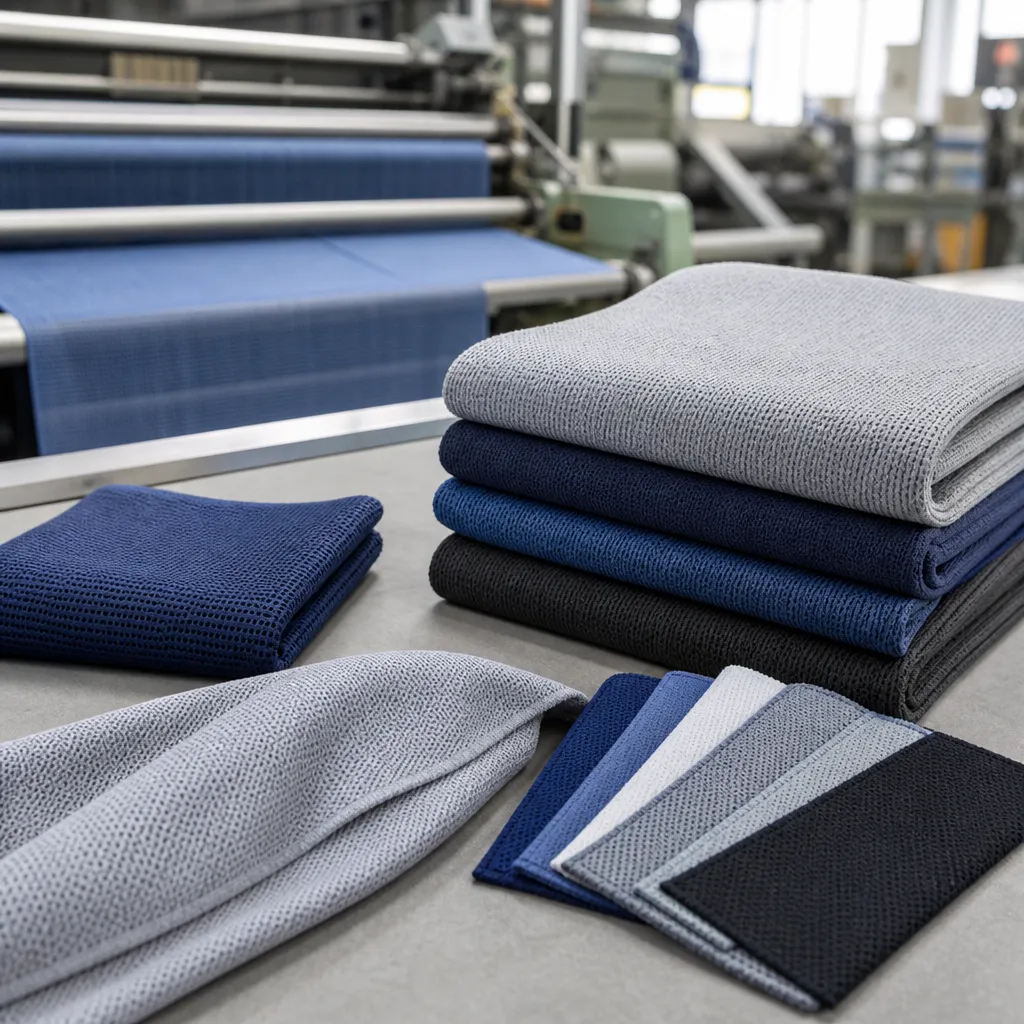
Most buyers compare only GSM and color, but a hair wrap behaves very differently depending on the knit and pile height. For fast-drying salon or gym use, low-pile warp knit microfiber around 220-280 GSM is easier to rinse and dries faster after laundering. For DTC beauty brands that sell softness first, coral fleece at 290-360 GSM feels fuller in hand but holds more water and takes longer to dry on the rail.
| Construction | Typical GSM | Use Case | Common Risk |
|---|---|---|---|
| Warp knit microfiber | 220-280 | Gym, travel, fast-turn salon | Can feel too thin if pattern cutting is narrow |
| Coral fleece microfiber | 290-360 | Beauty retail, gift sets | Loop crushing after repeated compression packing |
| Waffle microfiber | 240-300 | Spa retail, quick-dry positioning | Lower perceived softness versus fleece |
| Suede microfiber | 180-230 | Promotional or low-cost wrap | Absorbency perception can disappoint end users |
A specific construction detail that matters here is whether the face pile is sheared evenly after dyeing. Uneven shearing on coral fleece creates shiny tracking lines that show badly on dark shades like charcoal or deep plum. Another point is selvage stability on warp knit fabric. If the cutting plan runs too close to the knit edge, the finished twist cap can torque after home washing even when the seam does not break.
A usable spec sheet for a microfiber hair towels supplier checklist
A good supplier should be able to quote from a one-page technical sheet. For this item, the sheet needs more than dimensions. Buyers should define the finished shape length, widest panel width, head-pocket depth if used, target finished weight per piece, closure position, and packaging fold method because compression can deform pile direction in transit.
| Spec Line | Recommended Detail | Why It Matters |
|---|---|---|
| Size | 24×65 cm, 25×68 cm, or custom graded size | Fit changes between straight hair and thick curly hair users |
| Weight | 75-125 g per piece depending on fabric | More reliable than GSM alone once shape is cut |
| Blend | 80/20 or 85/15 polyester/polyamide | Affects absorbency handfeel and cost |
| Closure | Elastic loop + resin button or covered button | Most common consumer failure point |
| Edge finish | Overlock + turn-in or bound edge | Controls seam distortion and fray appearance |
| Label zone | Inside seam or back hem | Important for skin comfort and brand presentation |
- State GSM tolerance clearly, for example ±5% on bulk average
- Ask for finished piece weight tolerance as well as fabric GSM
- Define whether the button is resin, fabric-covered, or coconut-style because each has different pull strength
- Call out needle policy and metal detection if the order goes to infant or family-care retail channels
Check the closure like a trim, because it is
Hair wraps are sold as fabric products but many complaints come from trim failure. The elastic loop stretches out, the button shank snaps, or the bartack bites through the fleece base cloth. On approval samples, ask for close photos of the reverse side where the closure is attached. That is where weak reinforcement usually shows first.
Two process details are especially relevant to this category. First, the loop insertion point should sit on a reinforcement patch or folded seam allowance, not on single-layer pile fabric. Second, if the factory uses a fabric-covered button, the cap edge must be smooth; sharp internal ring edges can cut elastic after repeated twisting.
| Closure Option | Typical Bulk Result | Suggested Test |
|---|---|---|
| Elastic loop + resin button | Stable and economical | 50-cycle stretch and button pull check |
| Fabric loop + button | Better visual match, lower recovery | Repeated wet twist simulation |
| Snap closure | Fast use, cleaner look | Snap fatigue and rust review after wash |
| Velcro tab | Adjustable fit | Lint contamination and rough-edge complaint check |
- Pull the closure area by hand before wash and after wash
- Check bartack density and whether stitches cut into pile base
- Measure loop recovery after 10, 25, and 50 stretches
- Approve button color after wash because white resin can dull in reactive shade transfer environments
What proof to ask for before you trust absorbency claims
Absorbency language is often the softest part of a quotation. For microfiber hair wraps, ask the supplier which method they use to benchmark liquid uptake and drying time. Some mills use internal gravimetric tests: dry weight, wet pickup after timed immersion, then drain and reweigh. That is acceptable if the method is written consistently and compared across fabric options. For colorfastness and dimensional change, recognized textile methods matter more.
- Colorfastness to washing: ISO 105-C06
- Colorfastness to rubbing: ISO 105-X12
- Water absorbency benchmark: internal timed pickup method or buyer-nominated protocol
- Dimensional change after laundering: ISO 5077 or equivalent controlled method
- pH and restricted substances for skin-contact claims under OEKO-TEX Standard 100 Class I
If the supplier says a fabric is 'super absorbent', ask for the actual pickup ratio from a repeatable test lot. A plausible example for a mid-pile 80/20 coral fleece wrap is liquid uptake around 4.8 to 6.2 times dry weight, depending on shearing and finishing. If a very light suede microfiber sample claims the same range, that deserves verification.
MOQ, FOB, and why suppliers quote them differently
For cut-and-sew microfiber hair wraps, the mill-side minimum is usually driven by fabric dyeing and trim setup rather than sewing time. A common commercial floor is 500 pieces per design per color, which matches our own MOQ and is also typical when the fabric shade is dyed to order instead of pulled from stock. Smaller quantities are possible only when the supplier has greige stock in a matching construction and accepts mixed sewing runs.
FOB pricing changes sharply with construction and packaging. The bands below assume China FOB, one-color bulk dye, one sewn-in label, one closure, and standard polybag or bellyband. Freight, duties, and branded gift box programs are outside these figures.
| Order Volume | Warp Knit 230-260 GSM | Coral Fleece 300-330 GSM | Notes |
|---|---|---|---|
| 500-999 pcs | USD 1.12-1.46 | USD 1.38-1.79 | Sampling and trim amortization still high |
| 1,000-2,999 pcs | USD 0.94-1.25 | USD 1.17-1.54 | Most common opening MOQ band |
| 3,000-9,999 pcs | USD 0.82-1.09 | USD 1.01-1.34 | Better dye lot efficiency |
| 10,000+ pcs | USD 0.74-0.98 | USD 0.92-1.22 | Requires stable forecast and color planning |
Those ranges should be attributed to a few checkable cost drivers: fabric weight, polyamide ratio, closure trim type, edge finishing method, and packaging labor. If a supplier quotes far below the lower end, inspect whether the blend has shifted to 90/10, the size has been narrowed, or the closure reinforcement has been removed.
Audit the sample path before you audit the factory
A clean sample approval process reveals more than a one-hour site visit. For this item, the fastest way to expose weak control is to compare pre-production sample records against bulk output detail. If the button placement moves by 2 cm between sample and bulk, or the fold direction in packaging reverses and crushes the nap, the supplier has a process discipline problem even if the workshop looks orderly.
- Approve fabric handfeel and shade on uncut swatch
- Approve sewn prototype with final closure method
- Confirm carton count, fold direction, and barcode position
- Sign pre-production sample against final PO line items
- Hold one sealed golden sample for inline and final QC comparison
For related process control, build-towel-tech-pack-that-mills-can-quote helps tighten the RFQ format, and pantone-color-matching-custom-towels is useful when the wrap has to align with an existing haircare or spa range.
Lead time is short only if the fabric is real, not assumed
Buyers often hear 20-day promises for simple microfiber items. That can happen, but only under narrow conditions: available greige in the right knit, no custom trim mold, and straightforward packaging. For dyed-to-order coral fleece or matched retail sets, realistic production timing is longer.
| Stage | Typical Days | What Delays It |
|---|---|---|
| Lab dip or color approval | 3-5 | Dark shade correction or retail match standard |
| Prototype sample | 5-8 | Closure sourcing and pattern revision |
| Pre-production sample | 4-6 | Artwork, label, packaging confirmation |
| Bulk fabric knitting/dyeing | 12-18 | Queue time and shade remake |
| Cutting, sewing, inspection, packing | 8-12 | Manual closure attachment and gift-box packing |
| Total after deposit | 26-41 | Excludes sea transit |
If launch timing is tight, the practical question is whether the supplier owns or controls the knitting and dyeing schedule. Traders can still be useful, but they rarely control re-dye decisions or loom allocation. For freight planning after production, see container-vs-air-freight-towel-orders.
Documents that make a supplier easier to trust
Compliance language should be attached to current documents, not just quotation headers. For skin-contact microfiber wraps, request the valid OEKO-TEX certificate number and scope page, then confirm whether the certified article group actually covers the offered fabric and accessories. For process and social compliance, ISO 9001 and BSCI are useful indicators, but they do not replace product-level testing.
- Ask for the latest OEKO-TEX Standard 100 Class I certificate scope and expiry
- Request current BSCI audit result or platform reference
- Check ISO 9001 certificate validity and issuing body
- Match the PO spec to the tested article because changing trim or dyehouse can void assumptions
- Keep test reports tied to lot, date, and sample description
If you need help reading certificate scope language, how-to-read-oeko-tex-certificate breaks down what buyers should verify. Brands combining wraps with broader spa or beauty programs may also want to review microfiber-vs-cotton-towel-comparison and the sector page for spa applications when building mixed-material assortments.
A short supplier scorecard before deposit
Before sending money, score the supplier on the points that actually predict repeatability. Fancy sample photography does not deserve the same weight as closure testing, absorbency data, or stable dye-lot control. A five-line scorecard is enough if the lines are specific.
- Fabric clarity: construction, blend, GSM, and finished weight all stated consistently
- Trim security: closure photos, attachment method, and pull-test result available
- Testing record: wash, rubbing, shrinkage, and restricted-substance proof current
- Commercial fit: MOQ, FOB basis, and lead time written against exact packaging scope
- Process control: pre-production sample discipline and golden sample retention confirmed
Related reads: custom-microfiber-towels-wholesale-guide, why-gym-towels-fail-after-50-washes, and negotiate-towel-moq-without-killing-margin.
Need a quoteable hair wrap spec
Send the target size, fabric construction, closure type, packaging brief, and annual volume. MOQ starts at 500 pcs per design per color. Contact us at [email protected] or WhatsApp +86 13205717266.
Request OEM Pricing →