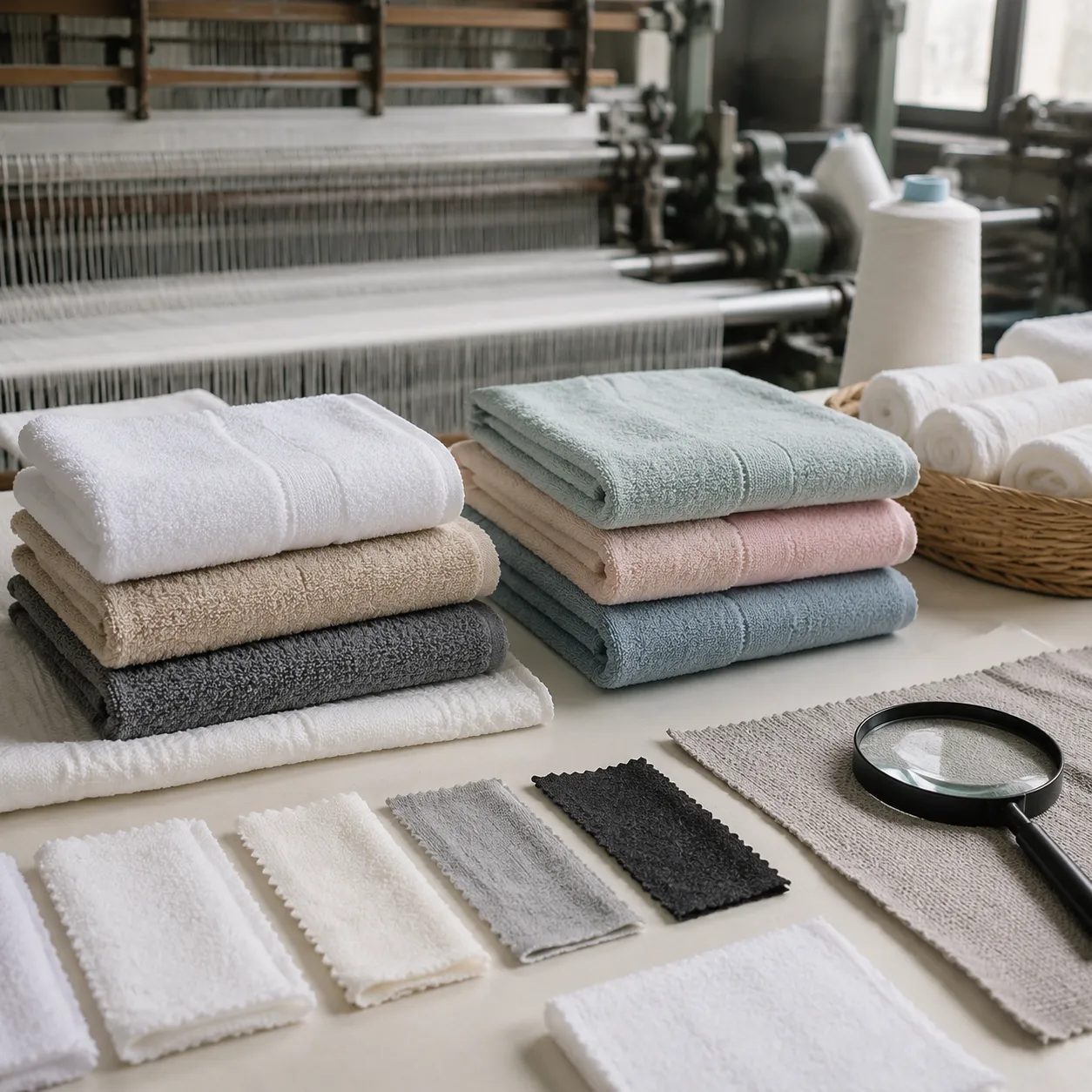
Why low MOQ audits fail differently
Auditing a 30,000-piece hotel towel order is mostly about capacity, lab control, and repeatability. Auditing a 500- to 1,200-piece program is different. The risk is not that the factory cannot weave towels. The risk is that the order gets pushed between production lines, decoration desks, and packing tables because each department sees it as too small to prioritize.
At LUMA & CO. TEXTILE, our MOQ is 500 pcs per design / per color. We can do that because we run dyeing, weaving, cutting, sewing, decoration coordination, inspection, and export packing under one operations system. A trading company can also accept 500 pcs, but the buyer must check whether that number is backed by actual loom planning or only by outsourcing to whichever workshop has idle time.
For low minimum order towels, the audit should ask practical questions: Who controls the yarn lot? Is the dye vat size compatible with the order weight? Are labels applied in the towel sewing line or by a packing subcontractor? These details decide whether a small batch looks like a brand program or like a leftover production slot.
| Audit area | Large-volume risk | Low MOQ risk | What to verify |
|---|---|---|---|
| Yarn control | Raw material shortage | Mixed yarn lots across colors | Yarn purchase record and lot tagging |
| Dyeing | Batch-to-batch shade drift | Minimum dye vat surcharge or over-dyeing | Vat capacity, lab dip approval, Delta E tolerance |
| Decoration | Slow production rate | Setup cost spread over too few units | Embroidery or jacquard setup sheet |
| Packing | Carton damage in transit | SKU mix-up in small cartons | Barcode, carton mark, and inner pack audit |
| Commercial terms | Long payment exposure | Hidden small-order add-ons | Written quote with tooling, labels, and inspection costs |
Low MOQ Towels Supplier Audit Checklist
Use this low MOQ towels supplier audit checklist before paying a deposit, especially if the supplier offers a price that looks close to a 5,000-piece quote. Small-batch production has real fixed costs. If a supplier hides them, they usually reappear later as weaker yarn, narrower hems, loose packing, or missed inspection.
- Business license and export identity: confirm the company name on the invoice matches the certification holder or authorized exporter.
- Production ownership: ask which steps are in-house: weaving, dyeing coordination, cutting, sewing, embroidery, jacquard, packing, and final inspection.
- MOQ rule: verify whether MOQ is per design, per color, per size, or per SKU. A 500-piece MOQ is not useful if each color needs 500 pcs and each label version needs another 500 pcs.
- Small-order workflow: request a sample production schedule showing fabric preparation, decoration setup, bulk sewing, QC, and packing dates.
- Reference orders: ask for recent low MOQ export cases in the same towel type, not only big hotel or retail programs.
- Defect accountability: confirm whether replacements, credit notes, or rework are offered if inspection finds size, shade, or logo defects above AQL limits.
A serious OEM towel supplier will not treat these questions as difficult. We answer them daily because they decide whether a project can be quoted correctly. For example, a 520-piece embroidered hand towel order can fit normal sewing capacity, but if the logo has 8 thread colors and 18,000 stitches, the embroidery station becomes the bottleneck, not the towel line.
Check capacity at the exact order size
A supplier may show 100 looms or a 40-foot container loading photo, but that does not prove they are good at small batch towel production. Low MOQ work needs changeover discipline. Loom width, yarn count, terry height, dye lot, sewing thread, label stock, and carton artwork all need to align for a short run.
For cotton terry towels, we usually see viable small-order GSM bands like 360-420 GSM for gym and promo towels, 450-520 GSM for beach and pool towels, and 550-680 GSM for hotel bath towels. Going below those ranges may reduce unit price, but often creates poor hand feel and faster edge distortion after 30-40 commercial washes. Going above them on a tiny order can force yarn procurement and drying costs that make the quote unstable.
| Towel program | Common low MOQ size | Practical GSM range | Audit capacity question |
|---|---|---|---|
| Gym sweat towel | 30 x 80 cm or 35 x 80 cm | 360-450 GSM | Can the factory hold absorbency after logo printing or embroidery? |
| Hotel hand towel | 40 x 70 cm or 50 x 80 cm | 480-600 GSM | Can the supplier match bath and hand towel shade in one dye plan? |
| Beach towel | 80 x 160 cm or 90 x 170 cm | 420-560 GSM | Is the loom width efficient or will there be cutting waste? |
| Golf towel | 40 x 60 cm with grommet | 380-520 GSM | Who installs grommets and checks pull strength? |
| Spa face towel | 30 x 30 cm or 32 x 32 cm | 420-560 GSM | Can hems stay flat after warmer cycles? |
During a towel factory audit, ask for the daily output at your actual size and decoration method. “We make 20,000 towels per day” tells little if your order needs dobby border weaving, corner embroidery, and a retail belly band. A realistic small order may occupy only one cutting table for half a day, but decoration and packing may take 3-5 working days because setup and inspection cannot be skipped.
Verify certifications without accepting screenshots
Low MOQ buyers sometimes assume certifications matter less because the order is small. We see the opposite. Small brands, hotel pilots, and club programs often have no internal compliance department, so the factory documentation becomes the buyer’s main protection.
For skin-contact towels, request OEKO-TEX Standard 100 Class I or Class II depending on end use. Class I is the stricter category used for baby and infant contact; we hold OEKO-TEX 100 Class I because several clients sell family and children’s towel lines. Also check BSCI for social compliance and ISO 9001 for quality management. These do not guarantee every towel is good, but they show whether the factory has audited systems instead of only verbal promises.
- Ask for the full certificate PDF, not a cropped image.
- Check the holder name, address, product scope, and expiry date.
- Verify the certificate number on the issuing body’s website where possible.
- Confirm whether decoration materials are included: embroidery thread, printed ink, labels, and packaging adhesives.
- Save the PDF in your supplier file before deposit, not after shipment.
If the supplier refuses to share certificate numbers until after payment, pause the order. For a 700-piece corporate gift towel, the cost of one failed restricted substance issue can exceed the full purchase value once recall freight and replacement units are included.
Inspect samples for defects specific to small runs
A pre-production sample for a low MOQ order should not be treated like a showroom towel. It should prove the same construction the bulk line will use. If the sample is hand-cut, hand-steamed, or embroidered on a different backing than bulk, it is only a visual reference.
Two defect modes show up often in small orders. The first is side-to-side shade banding when towel panels from different dye micro-batches are mixed before cutting. The second is border draw-in, where a dense dobby or jacquard border shrinks more than the terry field, making the towel look hourglass-shaped after washing. These are not generic QC issues; they come from planning small yardage through equipment meant for larger lots.
| Sample check | Method or standard | Acceptable target | Why it matters |
|---|---|---|---|
| Dimensional change | ISO 6330 domestic washing reference | Usually within -5% to +3% after agreed wash cycles | Prevents size complaints after laundry |
| Color fastness to washing | ISO 105-C06 | Grade 4 minimum for most brand programs | Reduces shade bleeding and dulling |
| Color fastness to rubbing | ISO 105-X12 | Dry 4, wet 3-4 depending on shade | Important for dark towels and gym use |
| Absorbency | Drop test or internal sink rate record | Water should penetrate quickly after finishing wash | Over-softening can reduce performance |
| Needle detection | Factory metal control log | Required for baby, hotel, and retail packs | Catches broken needle contamination |
- Measure the sample before and after one wash, then keep both numbers in the tech pack.
- Rub dark colors on white cotton fabric while dry and damp; do not rely only on visual shade approval.
- Check hem corners for bulky folding, skipped stitches, and loose terry loops trapped in the seam.
- For embroidered logos, inspect reverse backing after washing. Stiff backing can scratch skin on face towels and gym towels.
- For jacquard towels, look at the back face. Long floats can snag in hotel or club laundry.
Related reads: for building a quote-ready spec, use build a towel tech pack that mills can quote. For material decisions before sampling, compare microfiber vs cotton towel performance and the towel GSM decision framework.
Price the audit around real fixed costs
A low MOQ audit should include commercial math. Not because procurement needs to squeeze every cent, but because unrealistic pricing is one of the easiest signs of a weak supplier. A factory that quotes below cost usually recovers margin through downgraded yarn, skipped inspection, cheaper thread, or carton compression.
For reference, our 2026 factory-direct FOB China pricing for compliant custom towel programs normally sits in the bands below. These are not universal quotes; size, GSM, decoration area, yarn, color count, packaging, and exchange rate all move the final number. They are useful as a sanity check during supplier qualification.
| Order volume | Cotton gym/hand towel FOB | Beach/pool towel FOB | Typical included controls |
|---|---|---|---|
| 500-799 pcs | USD 1.45-2.75 | USD 4.20-7.80 | Lab dip, PP sample, inline QC, export carton |
| 800-1,499 pcs | USD 1.22-2.35 | USD 3.85-7.10 | Better decoration setup absorption |
| 1,500-2,999 pcs | USD 1.05-2.05 | USD 3.45-6.55 | More efficient dye lot and cutting yield |
| 3,000-5,999 pcs | USD 0.92-1.82 | USD 3.10-5.95 | Stronger carton and SKU consolidation options |
| 6,000+ pcs | Project quote | Project quote | Optimized yarn booking and container planning |
Here is a cost-per-use example from a recent style review. A 42 x 72 cm 500 GSM hand towel at USD 2.18 that survives 85 hotel laundry cycles costs about 2.6 cents per use before freight. A lighter 390 GSM version at USD 1.54 that becomes thin and distorted after 38 cycles costs about 4.1 cents per use. The cheaper towel wins the purchase order line but loses the operating cost calculation.
For low MOQ towels, also ask how the supplier charges for setup. Embroidery digitizing may be USD 25-65 per logo. Jacquard development can run USD 90-240 depending on artwork and loom card work. Retail packaging plate or label setup may add USD 40-120. A transparent quote lists these separately so the buyer can decide whether to spread them over more units or simplify the design.
Audit decoration readiness before approving artwork
Decoration is where small towel orders often break schedule. A supplier may accept your logo file, but the audit should confirm whether the chosen decoration is technically suitable for the fabric.
Embroidery works well on 420-650 GSM cotton towels when the logo area is controlled and terry pile is stabilized with topping film. On thin towels, dense stitching can pucker the fabric. On very plush towels, small letters sink into the pile unless we add underlay stitches or enlarge the text. Jacquard is more durable for woven-in branding, but it needs artwork simplified into yarn colors and may not be economical for 500 pcs unless the towel will reorder.
Sublimation belongs mainly on polyester microfiber, not standard cotton terry. If a supplier promises full-color sublimation on cotton bath towels at a low price, ask exactly what fabric is being used. Often it is a polyester face with microfiber back, which has a different absorbency and hand feel than cotton.
- Request a stitch-count estimate before confirming embroidered pricing.
- Ask for logo placement tolerance, usually plus or minus 5-8 mm depending on towel size and pile.
- Confirm thread color standard: Pantone approximation, Madeira, or local embroidery thread card.
- For woven labels, check wash temperature resistance and edge softness.
- For printed microfiber, confirm artwork resolution at final size, not only at screen preview size.
Related reads: compare decoration choices in embroidery vs sublimation vs jacquard, then use Pantone color matching for custom towels before locking lab dips. If your order is a golf or club program, country club golf towel program covers grommets, clips, and tournament packing.
Confirm QC timing, not just final inspection
Final inspection catches defects after money has already been spent. For small orders, we prefer three control points: incoming material check, inline inspection after sewing or decoration starts, and final AQL inspection before packing release.
Our standard production timing for a low MOQ custom order is usually 7-10 days for lab dip and material confirmation, 5-8 days for pre-production sample, and 18-28 days for bulk production after approval and deposit. Embroidery can add 2-5 days when the stitch count is high. Jacquard or custom yarn-dyed programs can push bulk timing to 30-40 days because loom setup and yarn planning take longer.
- Approve lab dip or strike-off under D65 light, then photograph it with the Pantone or physical target card.
- Approve the pre-production sample with measured GSM, dimensions, hem width, decoration size, and packaging format.
- Run inline QC after the first 5-10% of bulk output, not after all towels are sewn.
- Perform final inspection to agreed AQL, commonly 2.5 for major defects and 4.0 for minor defects unless the buyer sets stricter limits.
- Hold shipment until carton marks, polybag warnings, barcode labels, and packing list quantities match.
A supplier qualification checklist should name who signs off each step. “QC team” is too vague. We record merchandiser approval, workshop inspection, packing supervisor check, and export document review separately. That creates accountability if a shipment has 12 cartons with mixed colors or if one SKU is short-packed.
Logistics questions for small shipments
Low MOQ does not always mean cheap freight. Towels are bulky, and compressed packing can damage pile recovery or create hard creases on retail-ready units. During audit, ask the supplier to estimate carton size, gross weight, and chargeable weight before confirming the order.
A 900-piece hand towel order may move well by LCL sea freight if timing is flexible. A 600-piece beach towel order with individual retail boxes may have high airfreight cost because carton volume, not towel value, drives the charge. For many buyers, the right answer is to approve samples early, use sea freight, and keep 2-3 weeks of launch buffer instead of paying express charges at the end.
We normally plan 3-5 days for export packing and document preparation after final QC. LCL sea booking can add 4-7 days before vessel departure, while air freight booking is often 2-4 days depending on destination and space. These dates should be in the purchase order calendar, not discussed only after production ends.
For more freight planning, see container vs air freight towel orders. If you are still negotiating volume, negotiate towel MOQ without killing margin explains where a mill can flex and where small orders become uneconomic.
What we would reject during an audit
A good audit should produce yes/no decisions, not only a pleasant factory visit report. We would reject or delay a supplier if they cannot prove control over the details that affect low MOQ consistency.
- They quote 500 pcs but require no lab dip, no PP sample, and no written inspection standard.
- Their OEKO-TEX, BSCI, or ISO 9001 documents show a different company name with no clear relationship.
- They cannot explain whether MOQ is per color, per size, or per artwork version.
- They push very low GSM as a “same quality” substitute without wash-cycle testing.
- They accept fine embroidery text under 4 mm high on high-pile terry without warning about legibility.
- They refuse to list decoration setup, packaging, and inspection charges separately.
We also push back when buyers ask for luxury hotel towels at promotional towel pricing. For example, a 650 GSM combed cotton bath towel with dobby border, OEKO-TEX-compliant dyeing, carton compression control, and brand label cannot be built at the same cost as a 360 GSM giveaway towel. If the use case is guest-room laundry, the stronger towel may cost USD 1.10-1.80 more per piece but can last twice as many wash cycles. That difference matters more than the first invoice total.
How LUMA runs a low MOQ audit call
Before we quote, we ask for size, GSM target, fiber, color count, logo method, packaging, destination country, and expected reorder plan. If a buyer does not have a full tech pack, we help convert the idea into a quoteable structure. We do not pretend every concept works at 500 pcs. Some designs need simplification, and we say that before sampling.
Our factory has operated since 2007 with about 220 employees, annual output around 2.4 million towels, and exports to 80+ brand clients across 47 countries. We hold OEKO-TEX Standard 100 Class I, BSCI, and ISO 9001 certification. Those numbers matter only if they translate into controlled execution: clear MOQ, realistic day counts, documented QC, and honest pricing.
If you are auditing us or another mill, send the same checklist to every supplier and compare answers line by line. The best supplier is usually not the one with the shortest answer. It is the one that tells you where the small order is easy, where it is risky, and what the cost will be before deposit.
Send us your audit checklist
Share your towel size, GSM, logo method, packaging target, and volume. We will respond with MOQ feasibility, FOB price band, production timing, and certification documents. WhatsApp: +86 13384590853. Email: [email protected].
Request audit support →