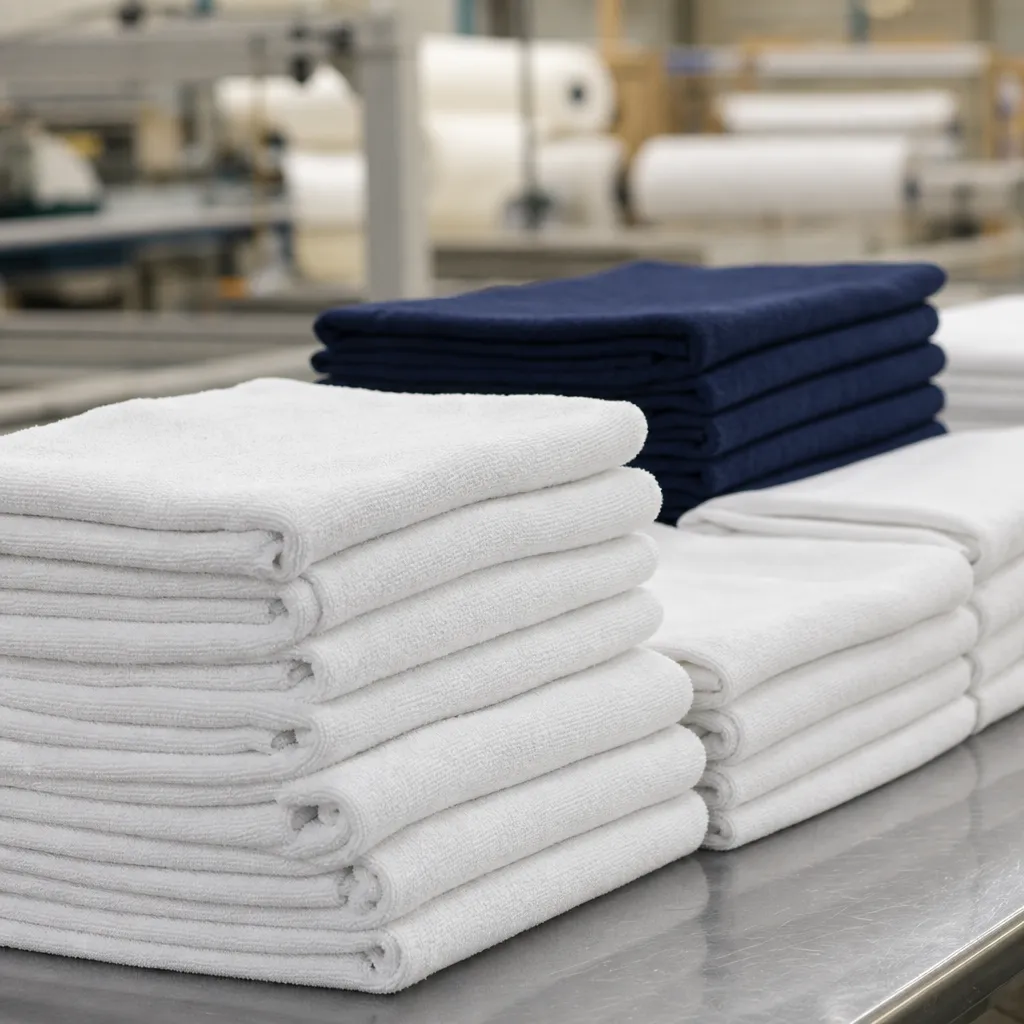
Start with the failure points, not the logo file
Buyers usually review the crest, thread colors, and packaging first. We look earlier in the sequence. On monogrammed bath towels, the most expensive mistakes come from a mismatch between pile construction and embroidery plan: ground yarn too open for the stitch density, decorative border too narrow for hoop stability, or pile height too lofty so the monogram sinks and loses edge definition after wash.
For that reason, our internal monogram bath towel supplier checklist starts with four linked points: base towel construction, embroidery zone, wash regime, and reordering method. If one is missing, approvals drift. A supplier can send a clean salesman sample and still struggle in bulk if they do not control shrinkage before hooping or if they change bobbin tension between lines.
- Ask for the unembroidered base towel specification first: size tolerance, finished GSM, pile type, border width, and yarn composition.
- Confirm whether the monogram sits on the hem border, dobby border, or body pile. Each behaves differently in wash and in hooping.
- Define the laundry exposure in writing: home wash, commercial hotel laundry, or spa bleach contact.
- Require the supplier to keep a sealed strike-off and sealed embroidery panel together with the bulk standard.
The base towel spec decides whether embroidery will stay flat
A crest that looks sharp on a hand towel may fail on a bath towel because the fabric weight and span are different. For hotel programs, we most often see monogrammed bath towels in 520-680 GSM cotton terry, usually 16s single or 21s/2 ground with a denser border area reserved for decoration. Below roughly 500 GSM, the face can feel too lean for a refined embroidered presentation unless the design is small and the border is tightly woven. Above 700 GSM, the towel may present well at first inspection but can become heavy in laundry and pull around the stitched area if the monogram is large.
| Base towel choice | Typical use | Embroidery behavior | Factory note |
|---|---|---|---|
| 520-560 GSM ring spun terry | Upscale midscale hotel | Stable for initials on border | Best if border width is at least 6 cm |
| 580-620 GSM combed cotton terry | Upper-upscale bath program | Clean logo definition with moderate stitch density | Usually the safest balance for chain hotels |
| 640-680 GSM dense terry | Luxury suite or retail set | Good handfeel but higher risk of panel draw if logo is oversized | Needs tighter control on shrinkage and backing |
| Zero-twist style over 650 GSM | Soft-touch retail focus | Logo edges can sink into lofty pile | We do not recommend it for complex crests on body pile |
Two construction details matter here and they are specific to embroidery, not generic towel sourcing. First, the dobby border pick count needs to be firm enough that needle penetration does not create waviness along the border edge. Second, the towel should be measured after pre-shrinking and finishing, not from loom-state weight, because the embroidery window changes once the towel relaxes after dyeing and tumbling.
Border geometry is where approvals are won or lost
Most monogram bath towel claims are really border claims. A crest placed 25 mm too close to the pile transition can tunnel the border and produce a slight smile shape after wash. A logo placed too low can interfere with the hem fold and create needle strikes across multiple thicknesses. We normally advise buyers to treat the embroidery zone as an engineered area, not empty space waiting for artwork.
- For bath towels, a usable embroidery zone of about 8 × 8 cm works for initials; larger hotel crests often need 10 × 12 cm or more.
- If the towel uses a dobby border, keep at least 12-15 mm clearance from the pile transition to the first stitch line.
- For end hems, specify whether the logo is measured from the finished hem edge or from the border seam; confusion here causes repeat bulk errors.
- If artwork has fine serif details or enclosed counters, request a digitized sew-out on the actual towel, not only on twill or paper simulation.
This is also where we push back on very cheap vendor offers. A supplier quoting on a generic bath towel body and adding embroidery later often has no dedicated border layout. The monogram may be technically applied, but it will not look centered once the towel is folded for room presentation.
What to ask about the embroidery process itself
Buyers do not need to manage machine settings line by line, but they should know which process controls separate a reliable towel supplier from a trader outsourcing decoration to whichever workshop is free that week. Towels are difficult embroidery substrates because the pile moves, lint loads the needle path, and the towel panel can torque if hoop pressure is inconsistent.
We would ask any supplier to explain three items plainly: what backing they use, how they control registration on thick terry, and whether they trim jump threads manually before packing. On bath towels, a cutaway backing that is too stiff can leave the logo boardy; too light, and the crest ripples after laundering. Water-soluble topping is often used on higher pile areas so stitches sit above the loops during sewing and do not disappear into the face.
| Embroidery control point | What buyer should request | Why it matters |
|---|---|---|
| Digitizing | Stitch count range and sew-out approval | Over-digitized files add stiffness and puckering |
| Backing | Type and weight confirmation | Controls distortion around the monogram |
| Needle and thread | Thread brand/spec and needle size | Affects linting, breaks, and edge clarity |
| Placement method | Template, laser, or hoop guide reference | Reduces left-right drift in bulk |
| Trim standard | Photo of front and back after trimming | Loose jump threads are common on rushed towel runs |
A practical monogram bath towel supplier checklist should also ask whether embroidery happens before or after final garment-wash style softening. For towels, bulk embroidery is normally done after the base towel is fully finished and inspected. If a supplier proposes an unusual sequence, ask why. There may be a reason, but it needs technical justification.
Use wash evidence that matches the real end use
We see many approvals based on one home-laundry cycle. That is not enough for hospitality buying. For hotel programs, ask for laundering evidence under a repeatable method and separate what you are measuring: colorfastness, logo edge retention, towel skew, border waviness, and handfeel loss are not the same issue.
The test methods we rely on most often are ISO 6330 for domestic washing procedure reference, ISO 5077 for dimensional change after washing and drying, and ISO 105-C06 for colorfastness to domestic and commercial laundering. If the monogram uses dark thread on pale cotton, ask for specific comment on staining or halo risk after wash, not just a pass statement.
- Set a dimensional change tolerance for the finished towel after washing, commonly within ±5% on length and width for hospitality terry.
- Ask the supplier to compare the embroidered panel against a blank control towel after laundering; this isolates embroidery-caused distortion.
- Request front and back photos after wash, because backing abrasion and bobbin tension issues often show more clearly on the reverse.
- If the hotel laundry uses peroxide, alkali, or higher extraction, mention that in the tech pack. A sample washed gently at home proves very little.
Sampling should have three approvals, not one
One sample approval is too blunt for this category. We prefer three gates because they isolate different risks. First comes the base towel approval: shade, handfeel, size, GSM, and border layout. Second comes the embroidery panel approval on the approved base. Third comes the full presentation sample with packaging, fold, barcode, and carton mark. If these are merged into one rushed signoff, buyers end up debating embroidery issues inside a presentation sample where root cause is harder to trace.
- Approve the blank towel first, with measured finished weight and dimensions recorded.
- Approve an embroidery strike-off on the same production towel color and construction.
- Approve one final assembled sample with ticketing, polybag choice if any, and master carton details.
This sequence sounds slower, but it normally shortens the whole program. On a fresh hotel monogram order, we usually budget 3-5 days for blank towel lab dips or shade review if color is custom, 4-6 days for digitizing and sew-out panels, and 22-34 days for bulk production after final approval, depending on volume and whether the embroidery line is booked. Air shipment can move in 6-10 days door-to-airport; ocean planning is usually 28-40 days depending on destination and consolidation.
| Order stage | Typical timing | What should be signed off |
|---|---|---|
| RFQ and spec review | 2-4 days | Towel spec, logo size, placement, MOQ split |
| Sample development | 7-12 days | Blank towel and embroidery panel |
| Pre-production confirmation | 3-5 days | Bulk standard, carton plan, care label |
| Bulk production | 22-34 days | In-line and final QC against sealed sample |
| Freight dispatch | 6-10 days by air / 28-40 days by ocean | Shipping marks and document set |
Supplier audit questions that actually reveal control
A buyer visit or video audit should not spend twenty minutes on showroom shelves. Look for evidence that the supplier controls towel making and embroidery as one program. If weaving, dyeing, cutting, sewing, and decoration are split across several subcontractors, that is not automatically disqualifying, but the handoff points need to be visible.
- Check whether the factory records needle breakage and replacement logs on embroidery lines; this is basic control on thick terry goods.
- Ask to see an in-line hoop placement template or laser positioning system for the exact towel size range.
- Review how they separate shade lots before embroidery. Mixed lots can make a monogram program look inconsistent on shelf even if the logo is identical.
- Confirm QC uses an AQL final inspection and measures placement from the same datum every time.
- Request copies of current OEKO-TEX STANDARD 100 Class I, BSCI, and ISO 9001 certificates, and verify the legal entity matches the exporter.
One useful tell: ask the team to show the back of an approved embroidered towel from a previous run. Front-side beauty can hide poor trimming, excessive backing, or loose bobbin tension. The reverse side shows whether the program was built for bulk or just for sample approval.
Price bands make sense only after you freeze the embroidery variables
Pricing for monogrammed bath towels moves more with stitch count, towel weight, and packaging than with the word "luxury" in the brief. If a buyer asks three suppliers for a monogram towel quote but leaves artwork size, border placement, and polybag requirement open, the prices will not be comparable.
| Program scenario | Volume | Indicative unit price | Notes |
|---|---|---|---|
| 550 GSM bath towel, 70×140 cm, simple initials on border | 1,000-2,999 pcs | USD 4.10-5.20 | Cotton terry with standard export carton |
| 600 GSM bath towel, 75×150 cm, medium crest | 3,000-7,999 pcs | USD 4.85-6.35 | Price depends on stitch count and thread colors |
| 650 GSM bath towel, 80×160 cm, dense monogram plus retail band | 8,000+ pcs | USD 5.90-7.80 | Heavier towel, larger embroidery area, tighter packing control |
Our MOQ is 500 pcs per design per color, but embroidery programs become materially easier to control from about 1,000 pcs upward because we can stabilize thread planning, hoop setup, and inspection references. If you need multiple size splits or matching hotel bath and hand towel programs, state that at RFQ stage so the embroidery files and border geometry are aligned across the set.
The shortest useful buyer checklist
If you need a working shortlist for vendor approval, use this. It is compact enough for procurement, but each line ties back to a real production control point.
- Approved blank towel spec with finished GSM, size, yarn composition, border width, and color standard.
- Embroidery artwork with measured placement from finished edges and target stitch coverage.
- Sew-out approval on the actual towel, front and back reviewed.
- Wash test evidence to ISO 5077 and colorfastness reference to ISO 105-C06.
- Certificate pack: OEKO-TEX STANDARD 100 Class I, BSCI, ISO 9001.
- QC method stating placement tolerance, loose thread standard, and carton sampling plan.
- Commercial terms covering MOQ 500 pcs per design per color, payment, and re-order shade control.
Related reads: if you are still defining the towel before decoration, start with towel GSM decision framework and combed vs zero-twist cotton explained. If you need to compare decoration routes before locking a crest program, see embroidery vs sublimation vs jacquard.
Where buyers usually overspend or under-spec
The common overspend is ordering a very heavy towel to signal luxury, then adding a dense crest that makes the piece slower to dry and harder to process in laundry. The common under-spec is approving a nice-looking monogram on a generic towel without locking border construction and wash criteria. In both cases, the buyer pays later: either in avoidable freight and laundry cost, or in replacements and inconsistent guestrooms.
A better route is to choose a bath towel that supports the logo cleanly at the intended laundering intensity. For many hotel programs, that lands in a mid-to-high terry weight with a stable decorative border, moderate embroidery density, and disciplined sample sequencing. That is less dramatic in the showroom than an oversized fluffy sample, but it performs better over repeated use.
Related reads: for supplier communication, build towel tech pack that mills can quote is the right next step. For launch planning across rooms and back-of-house stock, setting up hotel linen program 90 day roadmap helps procurement teams line up approvals with inventory timing.
Need a monogram towel quote with real spec feedback?
Send the towel size, target GSM, logo file, placement, and order quantity. We will flag embroidery risks before sampling. MOQ 500 pcs per design per color. WhatsApp +86 13205717266 or email [email protected].
Request Quote →