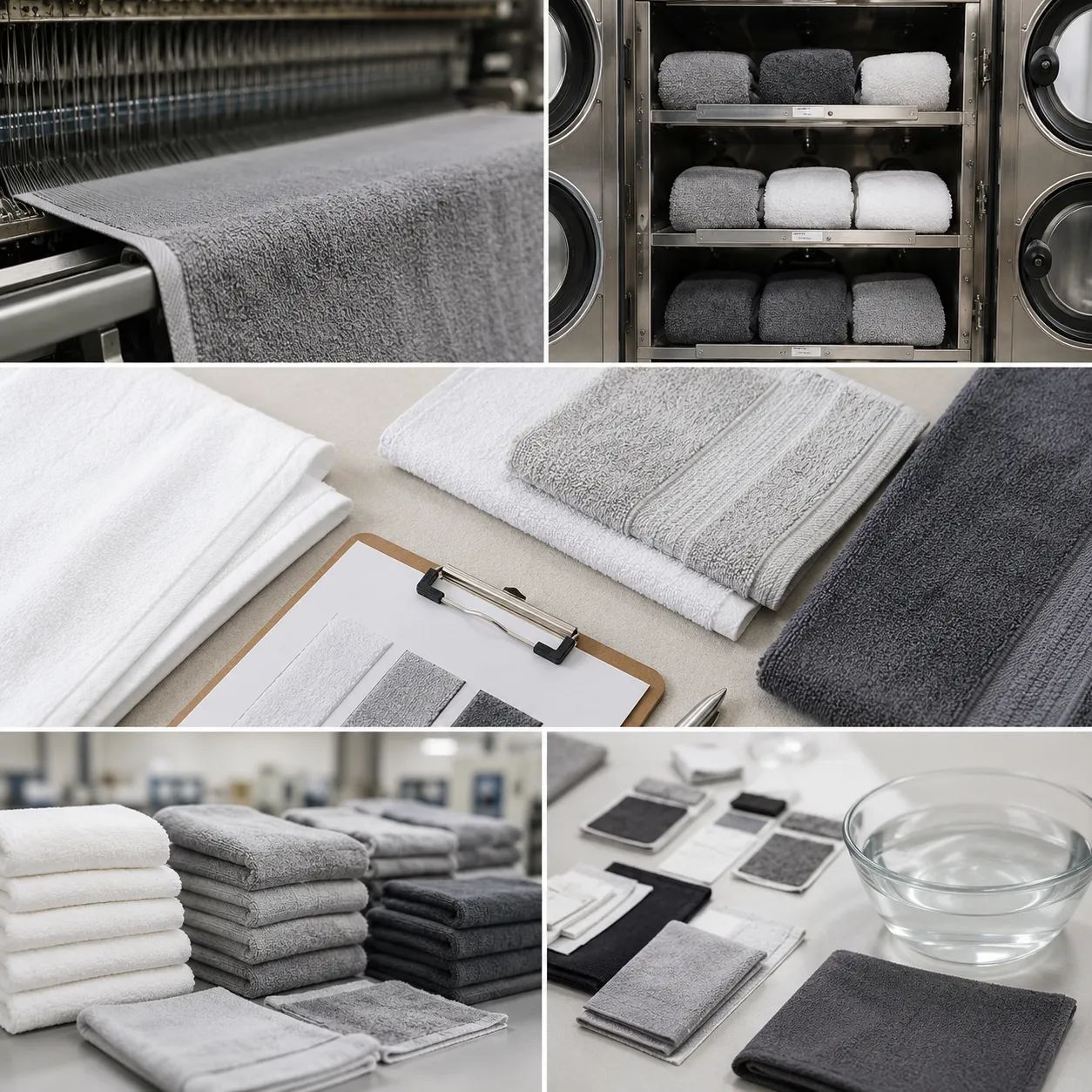
Why sample approval fails when the towel still looks fine on day one
A clean hand feel at first touch does not tell us much. In gym programs, the failures that hurt repurchase usually show up after repeated laundering: loop distortion, hem torque, weak overlock at the edge, and shade change under alkaline detergent. That is why the gym towel durability sample approval process has to test behavior, not just appearance.
We often see buyers approve a soft sample from a showroom, then discover that the first 10 wash cycles already change the towel enough to upset a gym member's experience. For a sweat towel, the brief should include wash life, snag resistance, dimensional stability, and colorfastness under real club laundry conditions, not only size and logo placement.
| Failure mode | What it looks like | What usually caused it |
|---|---|---|
| Loop pull or snag | Raised yarns, visible runs | Low twist yarn, loose shearing, rough handling during finishing |
| Edge curl | Corners flip up after washing | Uneven shrinkage between body and hem |
| Shade shift | Logo or body looks duller after laundering | Poor reactive dye fixation or weak pigment cure |
| Hard hand after washing | Towel feels board-like | Excessive resin, over-drying, or cheap finishing chemistry |
| Seam burst | Stitch line opens at stress points | Weak thread count, bad backtack, or wrong needle choice |
Set the durability spec before you ask for samples
A sample cannot be approved against a vague idea. We ask buyers to lock the technical brief first: fiber, yarn count, pile height, GSM, hem construction, and decoration method. For gym programs, we usually quote 280 to 420 GSM for hand-size towels and 360 to 500 GSM for larger training towels, depending on absorbency target and drying time.
If the towel is meant for high-throughput studios or chain gyms, we lean toward tighter constructions and durable edge finishing. If it is for boutique yoga or premium club packs, we can allow a softer hand, but the wash target still has to survive normal laundering. The approval sample should mirror the intended bulk spec exactly, not a prettier pre-production version.
| Spec item | Typical gym range | Why it matters |
|---|---|---|
| GSM | 280-420 for sweat towels; 360-500 for larger formats | Balances absorbency, dry time, and wash retention |
| Yarn | Combed cotton or ring-spun cotton | Improves surface stability and reduces lint |
| Hem | Double-needle or lockstitched with clean corners | Controls edge curling and seam failure |
| Decoration | Woven label, embroidery, or heat-transfer patch | Must survive laundering without stiffening the towel |
| Shrinkage target | Within 4% length and width after wash cycles | Keeps packs and fold dimensions consistent |
Gym towel durability sample approval process: the test sequence we use
Here is the sequence we follow when a buyer asks us to approve a gym towel before bulk release. It is simple enough for a merchandising team to manage, but strict enough to catch the common failure modes early.
- Confirm the tech pack: size, GSM, yarn, color, logo method, and pack style.
- Produce 2-3 lab dips or shade references if the towel is dyed, then cut a full-size production-intent sample.
- Inspect the first sample for construction accuracy: hem width, stitch density, label alignment, and cut edge symmetry.
- Run wash cycles using the intended detergent profile and loading method, then measure shrinkage and evaluate surface changes.
- Repeat handling checks for snagging, edge roll, pilling, and loop loss after drying and folding.
- Approve only when the sample matches the target appearance after wash, not before it.
For some buyers we also include a simple abrasion check using a Martindale-style rub or a controlled towel rub against a Velcro-like surface, because locker-room handling can be rough. If a logo is embroidered too close to the edge, we will reject it when the backing begins to distort the towel body. These are small issues on paper and big problems in use.
If the sample passes only because it is handled carefully in the factory, it is not approved for a gym program yet.
The wash tests that matter for fitness towels
In our factory we separate appearance checks from performance checks. The most useful wash tests for a gym towel are repeated home-laundry style cycles, not a one-time soak. We normally run 5, 10, and 20 cycle checkpoints for sampling, because many defects become visible only after the finish has been stripped or the yarn relaxes.
| Test checkpoint | What we measure | Pass signal |
|---|---|---|
| After 1 wash | Initial shrinkage, color bleed, hand feel | No twisted seams, no obvious bleeding |
| After 5 washes | Loop stability, corner flatness, label security | No snag growth, no hem distortion |
| After 10 washes | Shade retention, towel body softness, lint | Stable appearance and even drying behavior |
| After 20 washes | Durability trend and pack consistency | No structural failure or severe hardening |
We also inspect the towel under light from different angles. Some yarns look fine front-on but reveal sheen streaks or crushed pile when turned. For dark colors, we check crocking and wet rub behavior because gym bags and shared laundry carts can transfer dye faster than buyers expect. If a towel is printed, we evaluate edge cracking at the fold line after washing and drying.
- Check dimensional change on a flat board, not by eye alone.
- Record towel weight before and after tests to spot finish loss.
- Inspect hem corners for torque or tuck-in after tumble drying.
- Measure the logo area for distortion if the towel uses embroidery or a woven patch.
What usually gets rejected at sample stage
The fastest way to miss the right approval decision is to focus only on absorbency and softness. Gym towels fail for more practical reasons. A small size mistake can affect pack presentation; a weak hem can shorten the working life; a poorly chosen decoration can make the towel feel stiff where members grip it.
- Corners not square enough to fold cleanly into retail or amenity packs.
- Loose pile that sheds lint and leaves fuzz on black workout clothing.
- Embroidery stitch density too high, creating a hard patch that traps sweat instead of absorbing it.
- Dye migration in dark shades after repeated warm washes.
- Bad seam start-stop points that open when the towel is pulled from a laundry cart.
If you want a deeper buyer-side framing on lifecycle problems, we recommend comparing this article with why gym towels fail after 50 washes and sweat towels for gym spec guide. Both help define the durability target before sampling starts.
How we price sampling versus bulk so buyers can judge risk
Sampling is not free in a proper OEM program because we are using production yarn, dying or bleaching, cutting, sewing, finishing, and sometimes decoration on a small run. The sample cost becomes clearer when you compare it with the cost of approving the wrong towel and replacing it after complaints.
| Order stage | Typical unit price range | Notes |
|---|---|---|
| Sample run, 2-3 pcs per color | USD 4.80-8.90 per piece | Includes setup waste and manual QC |
| Bulk 500-1,000 pcs | USD 1.70-3.10 per piece | Depends on GSM, color, and decoration |
| Bulk 3,000+ pcs | USD 1.28-2.45 per piece | Better efficiency, lower setup burden |
| Decorated program with embroidery | Add USD 0.18-0.65 per piece | Depends on stitch count and logo size |
The cheapest sample is not the cheapest program. A towel that looks acceptable at sample stage but pills early or curls after laundering creates a much larger cost-per-use problem. A gym chain using 1,500 towels may save a few hundred dollars on the order but spend more on replacements, re-folding, member complaints, and laundry sorting. That is the wrong place to cut.
What documents we ask for before approval
A good sample approval file is small but complete. We do not need a long presentation deck. We need enough technical information to reproduce the towel after approval without interpretation errors at the mill.
- Final size with tolerance, usually in millimeters or centimeters.
- Target GSM and acceptable variance.
- Fiber content and yarn construction.
- Decoration method and exact placement from edge to logo center.
- Color standard reference, ideally Pantone or a sealed lab dip.
- Packing method, fold style, and carton count.
If the buyer already has a tech pack, we can quote faster and reduce sample churn. If not, we point them to build towel tech pack that mills can quote before they send us another round of revisions.
| Approval file item | Why we need it | Common mistake |
|---|---|---|
| Color reference | Prevents shade disputes | Sending only a screen image |
| Size tolerance | Controls fold and pack consistency | Giving only a nominal size |
| Decoration placement | Stops logo drift between samples | Measuring from the wrong edge |
| Laundry method | Sets the durability test properly | Ignoring actual washing temperature |
| Carton spec | Avoids pack-out surprises | Leaving out inner polybag or bundle count |
Common gym towel constructions and their durability tradeoffs
Not every towel construction handles gym use the same way. The right choice depends on whether the buyer cares more about fast drying, strong absorbency, or a sharper branded appearance. We usually narrow the options to a few constructions and then sample the one that best fits the laundering profile.
| Construction | Durability behavior | Typical use |
|---|---|---|
| Combed terry cotton | Stable after washing, moderate lint when new | Club hand towels and sweat towels |
| Ring-spun cotton terry | Good balance of softness and durability | Fitness retail and amenity packs |
| Zero-twist cotton | Soft feel but can snag more easily if underbuilt | Spa-style gym programs |
| Microfiber blend | Fast dry, but feel and edge behavior differ from cotton | Travel and wipe-focused fitness kits |
For buyers comparing materials, microfiber vs cotton towel comparison is useful, but a gym towel is not an auto-detailing cloth. In a workout setting, skin contact, sweat uptake, and laundry behavior matter more than glass-like wiping performance.
Our minimum factory controls before we release a sample
We are a vertically integrated mill, so we can check the towel at each stage instead of waiting until the carton is packed. For sample approval, that matters. A defect found after sewing is easier to correct than a defect found after finishing or after a customer wash trial.
- Greige inspection for yarn breaks, thick-thin streaks, and weave alignment.
- Post-dye or post-bleach check for shade uniformity and staining.
- Cutting inspection for square corners and consistent length.
- Sewing inspection for stitch density and thread tension.
- Final QC for hand feel, folded dimensions, and label security.
We work under ISO 9001 process control, and for social compliance and chemical safety we maintain BSCI and OEKO-TEX 100 Class I coverage on suitable programs. If a buyer asks, we can provide certificate references and explain what each one does and does not cover. For more on reading the certificate, see how to read oeko tex certificate.
How long the approval cycle takes in practice
A realistic sampling schedule depends on whether the towel is solid dyed, jacquard-woven, or decorated. For a straightforward solid-color gym towel, we usually need 7 to 12 days to prepare a production-intent sample and run the first wash checkpoints. If the program includes custom color matching, embroidered logo approval, or a special fold pack, the cycle can stretch to 12 to 18 days.
| Stage | Typical timing | What can delay it |
|---|---|---|
| Tech pack review | 1-2 days | Missing size or color data |
| Sample making | 3-5 days | Custom yarn or dye work |
| Initial inspection | 1 day | Construction corrections |
| Wash testing | 3-6 days | Extra cycle requests or shade issues |
| Buyer approval and revision | 2-4 days | Late spec changes |
For larger programs, keeping the approval loop tight protects the order calendar. If the buyer is also planning delivery by sea, sample timing needs to fit with consolidation and carton preparation. Our minimum order quantity is 500 pcs per design per color, and sample decisions should be made early enough to avoid rebooking the line.
Related reads
If you are building a broader fitness towel program, these guides connect well with the approval process: sweat towels for gym spec guide, why gym towels fail after 50 washes, gym towel size fit laundry guide, workout towels fitness brand wash specs, and small gym towels bulk oem spec guide.
For buyers comparing material routes, microfiber vs cotton towel comparison and towel gsm decision framework help align the sample spec with the intended user experience.
Request a sample review before bulk approval
Send us the tech pack, target wash life, logo details, and carton plan. We will review the sample path, flag durability risks, and quote the right spec for your gym program. WhatsApp +86 13205717266 or email [email protected].
Get Quote →