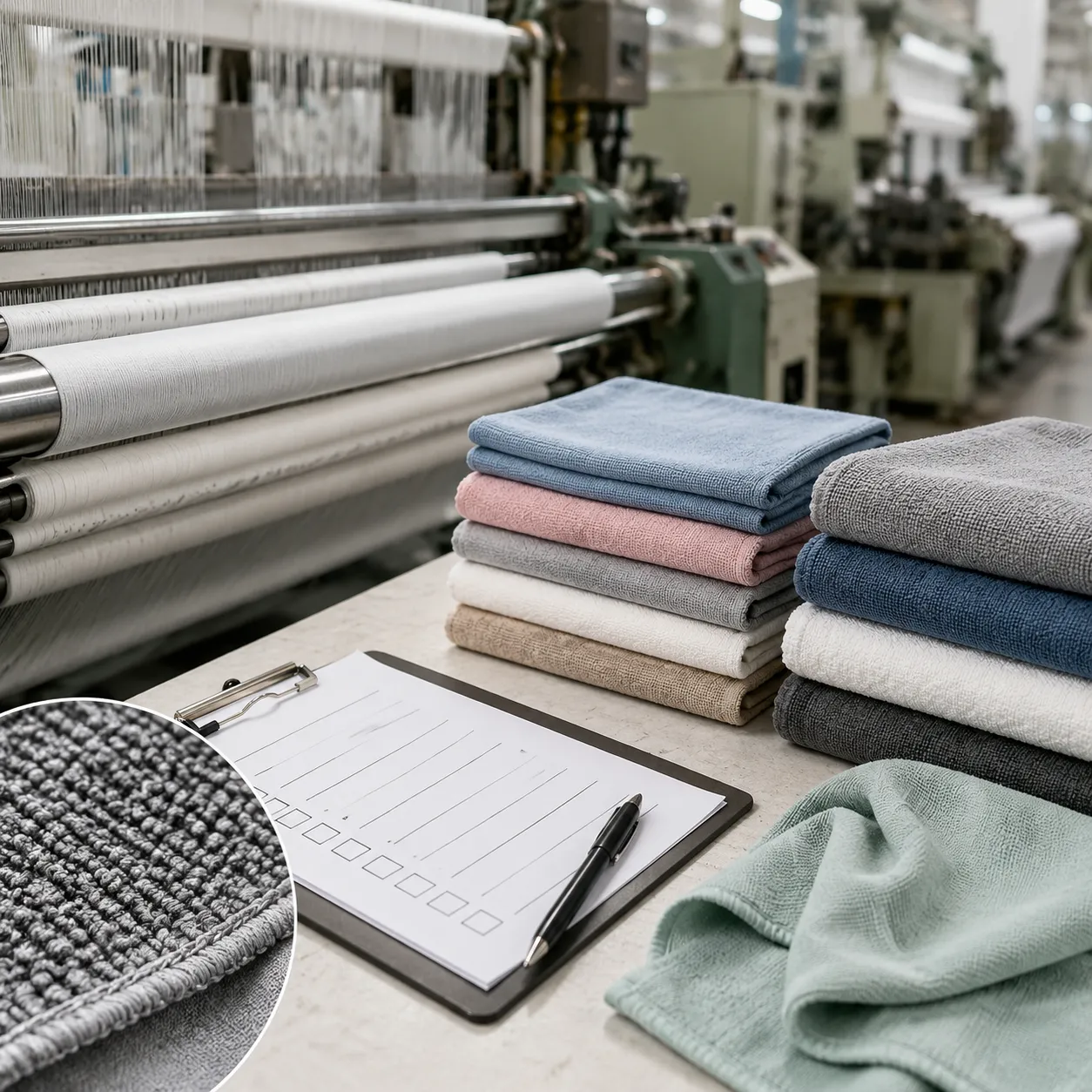
Why this audit matters before deposit
A cleaning towel that wipes glass streak-free in a sample room can still lint, shed, or distort once it moves into bulk production. For buyers, the risk is not only cosmetic; a bad microfiber cleaning towel batch can raise labor time per room, increase rewash rates, and trigger chargebacks from retail or detailing customers.
We audit for the failure modes that actually show up at scale: incomplete fiber splitting, unstable pile height, weak sonic cutting at the hem, and color drift between lot numbers. If the supplier cannot explain those points clearly, they usually cannot control them.
| Issue we look for | What it does in use | What a buyer sees |
|---|---|---|
| Poor split ratio | Reduces grab on dust and oil | Streaks, drag, low absorbency |
| Loose edge finishing | Creates thread release after laundering | Fraying, customer complaints |
| Dye lot drift | Breaks set consistency | Different shades in the same carton |
| Wrong package moisture | Encourages odor in transit | Musty unpacking, returns |
Microfiber cleaning towel factory audit checklist: production line
Start with the opening fiber path, not the sample table. The first question is whether the mill actually controls the yarn and fabric route for microfiber cleaning towel production or just outsources the critical steps. We want to see documented control from yarn creel to final pack-out.
- Confirm whether the yarn is polyester/polyamide blend or recycled PET blend, and ask for the exact ratio by spec sheet.
- Check if the factory uses warp knitting, circular knitting, or woven construction for the target end use.
- Inspect whether splitting, if required, happens before or after dyeing, and who owns that process step.
- Look for separate storage for raw yarn, in-process fabric, and finished goods to avoid cross-contamination.
- Ask for machine records showing needle bar maintenance, tension calibration, and defect logs.
For wipe cloths used in detailing or janitorial programs, the construction must match the job. A 170 GSM suede-style cloth behaves very differently from a 320 GSM plush terry cloth. If the supplier only says “microfiber towel” without showing pile direction, edge type, and cleaning target, the audit should stop there.
| Construction point | What to verify | Why it matters |
|---|---|---|
| Yarn spec | Denier and filament count are documented | Controls softness and lint release |
| Fabric structure | Woven, knitted, or split-loop is declared | Affects dust pickup and drying speed |
| Edge finishing | Sonic cut, hem, or overlock is specified | Determines fray risk |
| Color control | Pantone or lab dip approval is on file | Prevents set mismatch |
Fiber, GSM, and performance controls
We do not accept GSM as a standalone buying decision. A 280 GSM cloth made with thin yarn and poor splitting may underperform a 240 GSM cloth built with tighter control. The microfiber cleaning towel factory audit checklist should therefore test build logic, not just weight.
For general cleaning programs, we usually see sensible buying ranges between 220 and 360 GSM depending on whether the cloth is meant for dusting, glass, polishing, or heavy-duty wipe-down work. Lower weights can be fine for one-job disposables; higher weights make sense when the towel must survive repeated laundering and hold more liquid.
| Use case | Typical GSM range | Audit focus |
|---|---|---|
| Glass and mirror cloth | 220-260 GSM | Low lint, tight edge finish |
| General surface wipe | 240-300 GSM | Absorbency and hand feel |
| Detailing and polish cloth | 280-360 GSM | Pile consistency and streak control |
| Heavy janitorial wipe | 300-380 GSM | Durability after repeated wash |
Ask the factory for its internal test method, not only the marketing sheet. A serious mill can discuss water absorbency, lint release, and dimensional change after wash. If they have a lab, they should be able to reference ASTM D3776 for fabric weight, ISO 6330 for laundering, and an in-house lint check that records towel residue on black glass or dark acrylic panels.
- Request a lab report showing absorbency time in seconds for a standard specimen size.
- Check shrinkage after three and five wash cycles, not just a single wash.
- Inspect whether pile pull and seam slippage are tracked during wash testing.
- Confirm that the supplier can separate performance data by construction style, not one generic towel family.
Color, dye lot, and hand-feel control
Many audit failures start in the dyehouse. Microfiber shades can look stable under warehouse light and drift under daylight or shop lighting. A buyer who wants black, gray, or branded accent colors should inspect lot control, re-dye policy, and shade tolerance before PO release.
We ask for dye lot records, lab dip approval, and a physical retention card for the approved shade. If the supplier works with dark colors, they should explain how they handle bleeding risk, especially when the towel will be washed with hot water or alkaline detergent.
- Ask how the factory separates light, medium, and dark dye lots on the floor.
- Check if rework fabric is kept out of current production orders.
- Review the batch card used to track yarn lot, dye lot, and finishing date.
- Require a simple shade comparison under D65 light and store light.
| Color control item | Pass condition | Red flag |
|---|---|---|
| Lab dip approval | Signed by buyer before bulk | Color chosen from memory only |
| Lot traceability | Each carton ties back to one dye lot | Mixed shade cartons |
| Bleed check | Wash test shows no visible transfer | Rinse water runs dark after first wash |
| Re-dye rule | Factory documents decision path | No written policy |
Packaging, carton marks, and moisture control
A lot of microfiber complaints arrive after the ocean leg, not on the sewing line. That is why the microfiber cleaning towel factory audit checklist must include packaging verification. Microfiber holds odor if packed wet, and it can pick up warehouse dust if cartons are not sealed correctly.
We inspect carton strength, polybag seal quality, inner count accuracy, and whether desiccant or ventilation is needed for the route. For export orders, the carton mark should match the PO line item, and the barcode or SKU should not be hand-corrected at the last minute.
- Open one master carton and confirm the pack count against the packing list.
- Check whether inner polybags are clear, printed, or recyclable as requested.
- Verify carton compression resistance for stacking in a container or distribution center.
- Inspect whether finished goods are protected from dust, floor moisture, and oil marks in the packing area.
If the order is for retail, add a visual carton audit. We have seen otherwise acceptable towels rejected because the folded stack was inconsistent, the insert card curled, or the barcode label was applied off-center. These are avoidable defects if the factory has a packing SOP.
MOQ, pricing tiers, and what changes the cost
For bulk orders, the real cost driver is not only material weight. Yarn blend, fabric width, edge finish, color count, packaging, and whether the towel needs special cleaning performance all affect price. MOQ also matters because small dye lots and color changeovers raise line downtime.
At our level, a practical MOQ often starts around 500 pcs per design or per color, but the unit cost drops more cleanly at 3,000 pcs and again at 10,000 pcs. That pattern is normal because setup spread becomes smaller and cutting efficiency improves.
| Order tier | Indicative FOB China range | What usually drives it |
|---|---|---|
| 500-1,000 pcs | USD 0.82-1.25/pc | Small dye lot, manual pack, higher setup spread |
| 3,000-5,000 pcs | USD 0.64-0.98/pc | Better fabric yield, steadier machine run |
| 10,000+ pcs | USD 0.52-0.84/pc | Efficient production, more stable sourcing |
If a quote looks unusually low, check the hidden assumptions. Sometimes the factory is quoting a lighter fabric, a simpler edge finish, or an untested blend that will lint after repeated laundering. That is cheaper only until the first claim lands.
Lead time, sample path, and production timing
The timeline should be specific enough to audit. A supplier who says “about a month” usually has not locked the real path. For a standard microfiber cleaning towel program, we expect sample development, bulk yarn booking, weaving or knitting, finishing, inspection, and carton closure to be mapped in days.
| Stage | Typical timing | Audit question |
|---|---|---|
| Lab dip and sample cloth | 5-8 days | Who signs the approval and keeps the retained sample? |
| Bulk material booking | 3-6 days | Is yarn available locally or imported? |
| Main production | 12-18 days | How many lines can run the order at once? |
| Final QC and pack-out | 3-5 days | Is there AQL sampling before carton close? |
| Ocean export buffer | 7-14 days | Is the ship date protected against factory congestion? |
For first orders, we like to see a realistic total of 25 to 35 days after approval, depending on complexity and season. If the factory promises much faster than that for a colored, branded, export-packed cloth, we ask how they are avoiding the normal drying, inspection, and packing controls.
QC gates that actually catch bad lots
The inspection must happen before cartons are sealed. A useful factory has three gates: inline self-check, final random inspection, and a rework hold area. Each one should have a documented pass/fail rule tied to the same acceptance standard.
- Check whether the factory uses AQL 2.5 or a tighter buyer-specific standard for major defects.
- Review lint, edge, and stain defect categories separately instead of one generic “appearance” label.
- Ask for photo records of rejected pieces and rework logs.
- Confirm that quarantine cartons are physically separated from approved stock.
We also look for process-specific failure modes. In microfiber, the common ones are edge fray, pile distortion after heat, oil stain marking from the packing table, and mixed lengths in the same bundle. Those are not rare defects; they are signs of weak discipline.
| Defect mode | Where it starts | How to prevent it |
|---|---|---|
| Edge fray | Cutting and sealing | Use controlled sonic cutting or clean hem control |
| Lint release | Fiber opening and finishing | Verify splitting and brush-cleaning step |
| Mixed count | Packing line | Use verified bundle count by operator |
| Shade mismatch | Dyehouse and sorting | Seal each lot and label cartons clearly |
Questions we ask the supplier on site
On a real audit, we do not ask broad marketing questions. We ask the questions that force the mill to show records, not promises. A factory that answers clearly usually has the process under control.
- Show us the approved retained sample and the current bulk standard side by side.
- Which machine model makes this towel, and what is the maintenance interval?
- How do you prevent leftover yarn from one color entering the next run?
- What is the documented rework rule for lint, stain, or edge defects?
- Can you show three recent orders with traceable lots, packing lists, and inspection results?
If the supplier also serves auto-detailing or janitorial buyers, ask whether they separate cloth families by end use. A good microfiber cleaning towel factory audit checklist should reveal whether the mill truly distinguishes glass cloth, polishing cloth, and all-purpose wipe cloths, or whether it relabels one fabric for every customer.
Related reads: custom microfiber towels wholesale guide, microfiber vs cotton towel comparison, auto detailing microfiber towel program, build towel tech pack that mills can quote, how to read OEKO-TEX certificate.
Related reads: microfiber cloth sourcing specs, best microfiber cleaning cloths specs, container vs air freight towel orders, negotiate towel MOQ without killing margin.
What a passable factory file should include
By the end of the audit, we want a file that can support the order from sample to repeat bulk. If the factory cannot hand over documents in one package, they usually cannot repeat the result without constant buyer intervention.
- Company license, BSCI, and ISO 9001 certificates in current validity.
- OEKO-TEX 100 Class I certificate if the buyer needs skin-contact confidence.
- Yarn and fabric specifications with blend ratio, GSM, and construction type.
- Retained sample reference, lab dip card, and approved packaging artwork.
- Inspection report with defect photos, lot numbers, and carton count.
For buyers building a repeat program, the best outcome is not the cheapest first quote. It is the supplier who can run the same microfiber cleaning towel twice a year with stable hand feel, stable shade, and stable pack-out. That is what keeps reorder risk low and service complaints under control.
Request a factory audit review
Send us your target GSM, size, blend, and pack spec. We will review the checklist against a real microfiber line and quote the next step.
Get a Quote →