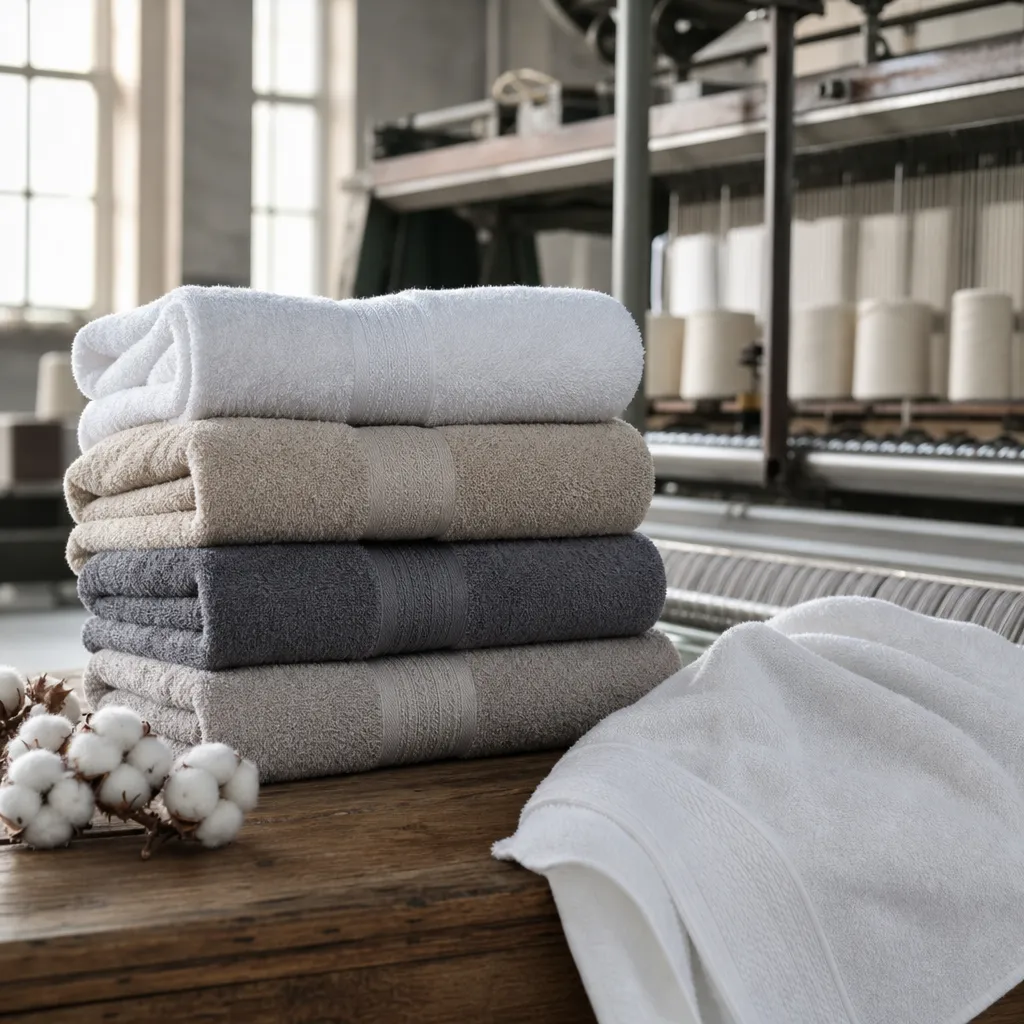
What Buyers Usually Mean by Turkish Cotton Bath Towels
In sourcing conversations, turkish cotton bath towels usually means a bath towel made with longer-staple cotton, a smoother hand feel, and better absorbency after several washes. It does not automatically mean the towel was woven in Turkiye, and it does not guarantee a specific GSM, yarn count, or durability level. We see three buyer intentions behind the phrase: hotel-grade softness, retail shelf appeal, and a Mediterranean-style cotton story.
As a mill, we translate that wording into measurable specifications. For bath towels, the practical range is 480-720 GSM. Below 480 GSM, the towel may dry quickly but often lacks the dense hand feel buyers expect from Turkish cotton. Above 720 GSM, the towel feels impressive in a sample room but becomes slower to dry, heavier to ship, and more expensive to launder in hospitality use.
| Buyer intention | Factory specification we confirm | Risk if left vague |
|---|---|---|
| Soft hotel bath towel | 550-650 GSM, 16s/1 or 21s/2 ring spun pile, combed cotton option | Nice first touch but weak pile recovery after repeated washing |
| Retail bath towel set | 500-620 GSM, controlled border, low lint finishing | Color shade variation between bath, hand, and wash sizes |
| Spa or wellness towel | 480-580 GSM, faster dry structure, softener controlled below 3.5% add-on | Over-softened towel with poor absorbency on first use |
| Luxury villa towel | 650-720 GSM, longer pile, reinforced hems | High freight weight and slow housekeeping turnaround |
Cotton Origin Matters Less Than Staple Control
Turkish cotton has a strong reputation because it is associated with long staple fiber and smooth yarn. In production, we still need the buyer to define what performance they need. A towel woven from average cotton but tightly controlled in yarn spinning, pile height, bleaching, and washing can outperform a towel sold with a nice origin claim but loose production discipline.
For long staple cotton towels, we normally look for fiber length around 28-32 mm, with lower short-fiber content because short fibers create linting and a rougher hand after laundering. If the buyer asks for a Turkish cotton positioning but wants a lower price band, we may suggest a blended long-staple cotton program rather than cutting GSM too aggressively.
- Combed cotton removes more short fibers before spinning, giving a cleaner pile and lower lint release in the first 5 washes.
- Ring spun cotton towels have a smoother, stronger yarn than open-end yarn and are usually the right baseline for this category.
- Zero-twist yarn gives strong softness but needs careful drying tests because loose pile can snag more easily in commercial laundry.
- Two-ply yarn improves body and durability, but the towel may feel less fluffy than a single-ply construction at the same GSM.
We do not recommend using the cotton name as the only approval point. In our sample room, we approve by weight tolerance, absorbency time, dimensional change, lint behavior, colorfastness, and hand feel after washing. The fiber story can support the product, but the test results protect the reorder.
The Spec Range for Turkish Cotton Bath Towels
For turkish cotton bath towels, the buyer's first real decision is use environment. A DTC brand can accept a heavier towel if its customer values plushness. A hotel group needs a towel that looks good after 60-80 industrial wash cycles and does not slow down room turnover. A spa may prefer lower GSM because warm, damp towels need faster drying between treatments.
| Use case | Common size | Recommended GSM | Construction note | Target landed product feel |
|---|---|---|---|---|
| Boutique hotel bath towel | 70 x 140 cm or 76 x 152 cm | 560-650 GSM | 16s/1 ring spun pile, 20s/2 ground | Dense, absorbent, stable after repeated washing |
| Retail bath towel | 70 x 140 cm | 520-620 GSM | Combed cotton pile, decorative dobby border | Soft shelf touch with controlled shrinkage |
| Spa treatment towel | 70 x 140 cm | 480-560 GSM | Lower pile height, less softener | Soft but not heavy when damp |
| Villa or resort towel | 76 x 152 cm or 80 x 160 cm | 620-720 GSM | Longer pile, reinforced side hems | Plush hand and visible volume on shelf |
| Rental property towel | 68 x 137 cm or 70 x 140 cm | 500-580 GSM | Stronger hem sewing, reactive dyed white or neutral | Durable, faster replacement economics |
A simple weight check helps buyers catch unrealistic offers. A 76 x 152 cm towel at 620 GSM has a theoretical fabric weight of about 716 g before normal cutting and sewing variation. If a quote claims that size and GSM but the packed towel is close to 610 g, something in the spec is not matching: size, GSM, moisture regain, or measurement method.
For this category, we prefer to lock GSM after pre-production washing, not only from grey fabric weight. Terry fabric changes after bleaching, dyeing, tumble drying, and compacting.
Absorbency, Lint, and Shrinkage Tests We Use
The first sample of an absorbent bath towel can be misleading because finishing agents affect touch and water uptake. Too much softener gives a smooth hand but slows absorbency. Too little finishing can make the towel feel dry and harsh in a retail pack. We usually run a wash-and-test loop before approving a new bath towel construction.
- Measure incoming yarn count and twist against the approved construction sheet.
- Weigh greige fabric before dyeing to check whether pile density is on target.
- Run bleaching or reactive dyeing, then tumble dry under the same route planned for bulk.
- Test absorbency using a drop test adapted from AATCC 79, recording seconds to full wet-out.
- Wash 3 cycles and 10 cycles, then measure dimensional change based on ISO 6330 washing conditions.
- Inspect lint release, border waviness, pile pulls, and hem twisting under production light.
For bath towels in this program, we normally target absorbency below 5 seconds after 3 home laundry cycles. For hotel towels, we are stricter on lint and dimensional change because industrial laundry exposes weak yarn and unstable borders quickly. Typical shrinkage tolerance is within -5% length and -4% width after controlled washing, though some buyers request tighter limits for retail sets where folded sizes must align.
One construction quirk matters here: a high dobby border can shrink differently from the terry field. If the border yarn is too tight, the towel develops a smile-shaped curve after washing. For Turkish-style bath programs with wide borders, we adjust border density and pre-shrink finishing so the towel folds flat after laundering.
Decoration Choices Without Damaging the Hand Feel
Most buyers want the cotton story to remain the main feature, so decoration should not make the towel stiff. For hotel bath towels, embroidery is common but should be limited in stitch count and placed away from the main drying surface. For retail, a woven dobby border or jacquard logo can look cleaner than a large embroidered mark.
| Decoration method | Best placement | Typical cost add-on | Factory caution |
|---|---|---|---|
| Embroidery | Lower border, 8-14 cm above hem | USD 0.18-0.55 per towel depending on stitch count | Dense fills can pucker after tumble drying |
| Jacquard logo | Border or full terry field | USD 0.22-0.70 per towel at 1,000 pcs+ | Fine lettering below 6 mm loses clarity in pile |
| Dobby border pattern | Woven end border | USD 0.10-0.28 per towel | Border shrinkage must be tested separately |
| Printed care label or woven label | Hem or side seam | USD 0.04-0.12 per towel | Rough label edges irritate skin on bath towels |
For monogram programs, we ask buyers to approve embroidery after washing, not only on the fresh sample. Cotton pile compresses around embroidery, and the thread tension can create a shadow mark if the stabilizer is wrong. For a deeper comparison of decoration choices, our team has written about embroidery, sublimation, and jacquard and monogrammed bath towels.
Pricing Bands by Volume and Spec Level
Pricing changes quickly with cotton cost, dye color, size, GSM, and packaging. The bands below are realistic FOB China reference ranges for OEM production, not retail pricing. They assume 100% cotton terry bath towels, normal export carton packing, and MOQ of 500 pcs per design / per color.
| Volume | 500-999 pcs | 1,000-2,999 pcs | 3,000-7,999 pcs | 8,000+ pcs |
|---|---|---|---|---|
| 500-560 GSM basic ring spun | USD 3.85-4.75 | USD 3.45-4.25 | USD 3.18-3.90 | USD 2.95-3.62 |
| 570-650 GSM combed cotton | USD 4.70-6.10 | USD 4.25-5.55 | USD 3.92-5.15 | USD 3.68-4.82 |
| 660-720 GSM plush program | USD 6.20-8.30 | USD 5.70-7.65 | USD 5.28-7.10 | USD 4.95-6.70 |
| Embroidery add-on | USD 0.24-0.62 | USD 0.20-0.54 | USD 0.17-0.48 | USD 0.15-0.42 |
A cheaper towel can be expensive in use. For example, a 500 GSM towel quoted at USD 3.35 may survive 38 commercial wash cycles before the hems twist and the pile looks tired, giving a towel cost of about USD 0.088 per use. A 610 GSM combed construction at USD 4.65 may reach 76 cycles in the same laundry route, lowering towel cost to about USD 0.061 per use. This does not include laundry energy or replacement handling, but it shows why purchase price alone is a weak decision tool.
- White and light neutrals are usually more stable and lower risk than saturated reactive colors.
- Dark navy, forest green, and black need stronger colorfastness control and may carry a dye surcharge.
- Individual belly bands, retail cartons, or barcode labels add time and cost even when towel construction is unchanged.
- For mixed-size towel sets, color approval must be checked across bath, hand, washcloth, and bath sheet because pile depth changes shade perception.
Certifications and Compliance Buyers Should Request
For skin-contact towels, we recommend requiring OEKO-TEX Standard 100 Class I when the towel may be used by babies or sensitive-skin guests. Class II can be acceptable for normal adult bath use, but many hotel and retail buyers prefer Class I because it gives a cleaner compliance position. Our mill also maintains BSCI social compliance and ISO 9001 quality management certification.
For buyers new to certification review, the certificate scope matters. The supplier name, product category, expiry date, appendix pages, and testing institute should all match the claim. A certificate for fabric dyeing does not automatically cover embroidery thread, labels, or printed packaging. We explain the document checks in how to read an OEKO-TEX certificate.
- Request the current OEKO-TEX certificate number and confirm it on the issuing institute database.
- Ask whether embroidery thread, sewing thread, and labels are included or separately certified.
- Use ISO 105-C06 or equivalent washing colorfastness testing for darker shades.
- Use ISO 105-X12 for rubbing colorfastness when towels are dark or highly saturated.
- Keep a sealed golden sample and one washed approval sample before bulk cutting.
Sampling and Production Timing
A realistic timeline prevents rushed approvals. For existing yarn and standard colors, we can usually prepare a development sample in 7-10 days. Custom dyed yarn, special border weaving, or embroidered logo sampling often needs 12-18 days because lab dips, strike-offs, and washing checks must happen in sequence.
| Stage | Typical timing | Buyer action needed |
|---|---|---|
| Tech pack review and quote | 1-3 days | Confirm size, GSM, color, decoration, packing, and target price |
| Lab dip or yarn shade approval | 5-8 days | Approve under D65 and store lighting if retail display matters |
| Sample weaving and finishing | 7-14 days | Review weight, hand feel, border, shrinkage, and absorbency |
| Pre-production sample | 5-9 days after deposit and artwork lock | Approve final construction, label, packing, and carton marks |
| Bulk production | 25-38 days | Depends on volume, dye route, decoration, and factory loading |
| Inspection and export packing | 2-5 days | AQL inspection, carton weight check, shipping documents |
For repeat programs, we keep yarn construction, dye recipe, and finishing route on file. That shortens reorders, but cotton lots still need shade and hand-feel control. A reorder placed six months later should not be approved only by Pantone number; it should be compared to the retained production sample. For broader sourcing setup, see our hotel towel sourcing guide and 90-day hotel linen roadmap.
Common Defects in This Category
The most common defects are not dramatic. They are small problems that become visible only after washing: side hem twisting, uneven pile height, linting, border waviness, shade drift between sizes, and hard hand feel after over-bleaching. Turkish cotton bath towels are often sold on softness, so any defect that changes touch becomes a customer complaint.
- Pile pull lines: often caused by tension variation during weaving or snagging during finishing.
- Flat hand after wash: can come from low pile density, excessive compacting pressure, or short-fiber yarn.
- Yellow cast on white towels: usually linked to bleaching control, optical brightener level, or high-temperature drying.
- Border wave: caused by mismatch between terry field shrinkage and dobby border shrinkage.
- High lint in first washes: often points to short fiber content, weak yarn twist, or insufficient washing before packing.
For retail brands, we also check folded presentation. A towel can pass size tolerance but still look uneven on shelf if the border width varies by 5-8 mm across panels. For hotel groups, we focus more on post-wash appearance because housekeeping teams see the towel after real laundry stress, not after showroom steaming.
How We Build a Quote That Can Survive Bulk Production
A quote for cotton towel manufacturing should include more than unit price. We need size, GSM, yarn type, cotton grade, color, decoration, label, packing, test requirements, order quantity, and destination. Missing details force suppliers to guess, and those guesses usually appear later as extra cost or quality arguments.
- Send target towel size and whether measurement is before or after washing.
- Define GSM range and acceptable tolerance, usually +/-5% for bath towels.
- State yarn preference: carded, combed, ring spun, two-ply, or zero-twist.
- Attach logo artwork in vector format if embroidery or jacquard is needed.
- Confirm certification needs: OEKO-TEX 100 Class I, BSCI, ISO 9001, or buyer-specific protocol.
- List packing requirements, carton limits, barcode rules, and delivery address or port.
Our MOQ is 500 pcs per design / per color. Below that level, the loom setup, dyeing minimum, and QC work do not spread cleanly across the order. For brands still testing a towel concept, we usually suggest one core color and one size first, then expand into hand towels and bath sheets after feedback. The same principle applies to negotiating towel MOQ and building a quote-ready towel tech pack.
Related reads: compare cotton options in combed vs zero-twist cotton, check size planning in towel dimensions guide, and review freight tradeoffs in container vs air freight towel orders. Buyers sourcing for hospitality can also review our hotel towel wholesale supplier guide and product options under /products.html#hotel.
Build a Turkish Cotton Bath Towel Spec
Send us your target size, GSM, cotton story, decoration method, and expected order volume. We will return a factory quote with MOQ, timing, test options, and realistic price bands. WhatsApp: +86 13205717266. Email: [email protected].
Request OEM Quote →