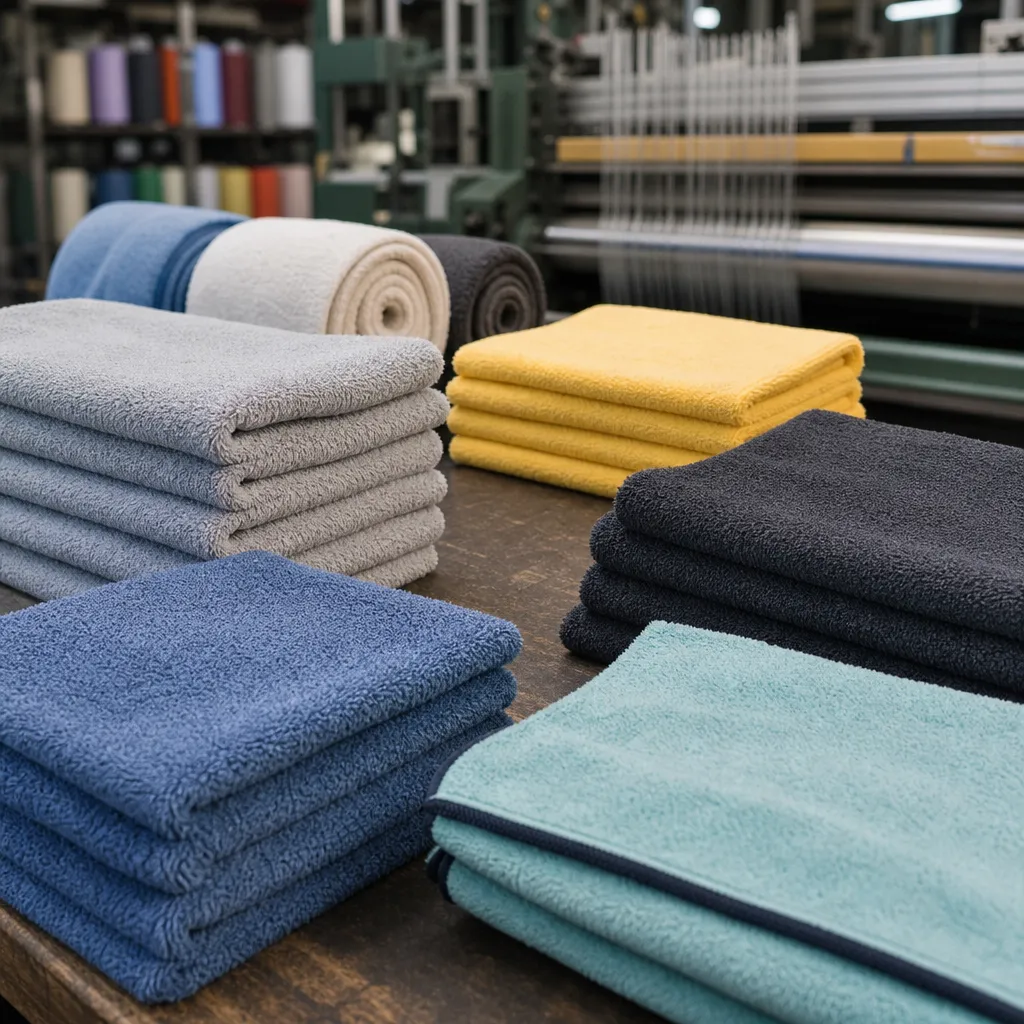
The towel spec has to match the job
Automotive microfiber is not one product. A towel used for first-pass drying has a different construction from a towel used to level ceramic spray, remove wax haze, wipe glass, or clean interior trim. If a buyer asks us for one SKU to cover every station in a car wash tunnel, we usually push back because the towel will either be too light for drying or too plush for residue removal.
For microfiber towels for cars, we normally start with end use, chemical exposure, laundry method, and whether the towel will touch painted panels. Paint-contact towels need lower lint, softer edges, and tighter control of hard contamination. Utility towels for wheels can tolerate a simpler edge and darker dye, but they should not be mixed with paint towels after washing.
| Use case | Common size | Recommended GSM | Construction note |
|---|---|---|---|
| Exterior drying | 50 × 80 cm or 60 × 90 cm | 500-900 GSM | Twist-loop or high-pile terry for water pickup |
| Wax and polish removal | 40 × 40 cm | 320-420 GSM | Dual pile: short side breaks residue, plush side buffs |
| Interior and trim | 30 × 30 cm or 40 × 40 cm | 250-350 GSM | Short pile reduces snagging on textured plastics |
| Glass cleaning | 40 × 40 cm | 220-300 GSM | Waffle or suede-like knit to reduce streaking |
| Wheel and lower panel work | 40 × 40 cm | 280-360 GSM | Dark color, utility edge, separated laundry route |
Microfiber Towels for Cars: GSM is only one control point
GSM tells us fabric weight per square meter, but it does not tell us whether the towel will glide safely on clear coat. Two 400 GSM towels can feel different if one uses a dense short pile and the other uses a looser plush pile. For auto detailing towels, we check GSM together with pile height, yarn fineness, split quality, and finishing temperature.
Most car wash towels we produce sit between 250 and 900 GSM. Below 250 GSM, the towel may work for disposable-style interior use but often lacks absorbency. Above 900 GSM, drying performance can be strong, yet wash cost and drying time rise sharply. A 60 × 90 cm towel at 780 GSM weighs about 421 g before packaging, so one carton fills quickly and freight cost becomes visible.
- 250-300 GSM: glass, interior, dashboard, and value utility cleaning.
- 320-420 GSM: polish removal, spray wax leveling, general detailing, and retail multipacks.
- 450-600 GSM: paint-safe plush microfiber cloths for exterior wipe-downs and drying small panels.
- 650-900 GSM: dedicated drying towels for cars where absorbency matters more than fast line laundering.
- Above 900 GSM: niche detailing use; we quote carefully because carton volume and laundry time increase.
For buyers comparing cotton and microfiber programs, our broader microfiber vs cotton towel comparison explains where each material wins. Cotton is still sensible for some service workflows, but in car care the split filament structure gives microfiber a clear advantage on fine dust and water pickup.
Split ratio, denier, and why cheap cloths smear
Automotive microfiber is usually a polyester-polyamide blend. The polyester provides structure and cleaning bite; the polyamide helps absorb water and gives a softer hand feel. Common ratios are 80/20 and 70/30. For large car wash orders, 80/20 often gives the best cost and durability balance. For higher-end paint-contact towels, 70/30 feels softer and absorbs better, but the yarn cost is higher.
The split process is one of the hidden differences between a towel that wipes cleanly and one that pushes water around. During finishing, the bicomponent filament is opened so one yarn becomes many tiny wedges. If splitting is incomplete, the towel can look normal but leaves moisture trails on glass or drags polish residue instead of lifting it.
| Material spec | Where we use it | Buyer impact | Cost effect |
|---|---|---|---|
| 80/20 polyester-polyamide | Car wash, wheels, interiors, value retail sets | Good strength and controlled price | Base cost |
| 70/30 polyester-polyamide | Paint-contact detailing and plush drying | Softer touch and higher water pickup | Typically +8-15% |
| Ultra-short pile suede knit | Glass, screens, chrome, instrument panels | Lower lint and smoother wipe path | Similar to 80/20 terry at same GSM |
| Twist-loop microfiber | Large drying towel programs | Fast absorption, lower drag when wet | Higher knitting and finishing cost |
A practical issue we see in low-cost car wash towels is aggressive heat setting. The towel comes out flat and stable, but the pile can become harsh. If the towel is for wheels, that may be acceptable. If it touches black paint, it is a problem. We test new lots on a black acrylic panel under bright light because fine marring is easier to see there than on pale paint.
Edges cause more complaints than buyers expect
The edge is a small cost line with a large complaint risk. A soft center fabric can still scratch if the overlock thread is hard, the label is placed on a wipe surface, or the corner seam builds a stiff knot. For edgeless microfiber towels, we use ultrasonic cutting or laser cutting depending on fabric and order volume. Ultrasonic edges reduce bulk, but the cut parameter must be controlled so the border seals without becoming sharp.
For private label programs, we recommend woven labels only on utility towels or on a non-contact corner with a tear-away option. For paint towels, printed care labels or removable stickers are safer. Hang loops are useful in a detailing bay, but they should not be on the main wiping face.
- Overlock edge: durable and economical, best for wheel, interior, and general cleaning towels.
- Silk-style border: cleaner retail appearance, but thread quality must be soft enough for paint use.
- Ultrasonic edgeless cut: lower scratch risk for polishing and wax removal towels.
- Rounded corners: reduce curling and corner hardening after repeated tunnel laundry.
- No sewn label on contact face: important for black paint, glass, and ceramic coating work.
If the program includes logo work, decoration should follow the towel's job. Embroidery is possible on some auto towels, but it creates a raised back side and is rarely suitable for paint-contact cloths. Our embroidery vs sublimation vs jacquard guide gives a wider view of decoration choices.
Color coding prevents workflow damage
Color is not only branding. In car wash operations, color coding keeps dirty work away from paint. We have seen buyers use one gray towel across every station to simplify purchasing, then spend more money replacing towels because staff cannot tell glass towels from wheel towels. Four colors usually work better than one: blue for glass, yellow for interior, green for paint, and black or charcoal for wheels.
For dyed microfiber, we test colorfastness using ISO 105-C06 for washing and ISO 105-X12 for rubbing. Dark colors need extra attention because loose dye can transfer during the first wash, especially if the customer launders at high pH. For brand colors, Pantone matching is possible, but microfiber does not take color like cotton terry. Neon orange on a screen and dyed polyamide-polyester yarn are not the same target.
- Assign colors by station before sampling, not after bulk goods arrive.
- Keep wheel and lower-panel towels darker than paint towels to discourage cross-use.
- Approve color under D65 light, then recheck after one wash cycle.
- Use carton labels and polybag stickers that match the towel color system.
- Document laundry temperature and detergent pH in the tech pack.
For buyers managing brand color across several towel types, our Pantone color matching guide is a useful companion. The tolerance should be written into the purchase file rather than handled by phone after production.
QC tests we run before bulk release
Car care towels need a different QC mindset from hotel bath towels. A towel can pass size and weight checks and still fail in use because it sheds lint on glass or has hard debris trapped in the pile. We run incoming yarn checks, in-line fabric checks, and final inspection before packing. For export orders, AQL is normally set to ISO 2859-1, with critical defects at 0, major defects commonly at 2.5, and minor defects at 4.0 unless the buyer specifies otherwise.
| QC item | Method or reference | Typical acceptance target | Why it matters |
|---|---|---|---|
| GSM | Cut-and-weigh lab check | Within +/-5% of approved sample | Controls absorbency and carton weight |
| Size after wash | Internal wash test, 40 °C, tumble dry medium | Shrinkage within 3-6% by towel type | Prevents small retail towels after first use |
| Colorfastness to washing | ISO 105-C06 | Grade 4 or better for most colors | Reduces dye bleed in mixed laundry |
| Rubbing fastness | ISO 105-X12 | Dry grade 4, wet grade 3-4 | Controls transfer on interior trim |
| Absorbency speed | AATCC 79 adapted drop test | Water drop absorbed within 3 seconds after prewash | Screens out over-finished fabric |
| Lint and debris | Black glass wipe and tape lift check | No visible lint streaks under inspection light | Protects glass and dark paint results |
We also perform needle detection for sewn-edge styles when requested, especially for retail packs. For edgeless towels, the risk shifts to cut quality: a burned edge, uneven seal, or loose corner fiber can create complaints even when the center fabric is correct.
Pricing, MOQ, and what changes the quote
Our MOQ is 500 pcs per design / per color. That MOQ is workable for a detailing brand testing a new towel, but for a car wash chain we usually recommend 2,000-5,000 pcs per color so dyeing, cutting, and packing costs do not dominate the unit price. LUMA & CO. TEXTILE has operated since 2007 with 220 employees, about 2.4M towels annual output, and supply history with 80+ brand clients across 47 countries, so we quote these programs from actual factory routing rather than catalog assumptions.
| Spec example | 500 pcs | 2,000 pcs | 10,000 pcs | Notes |
|---|---|---|---|---|
| 40 × 40 cm, 320 GSM, overlock edge | USD 0.46-0.62 | USD 0.34-0.48 | USD 0.29-0.40 | Interior, wheel, or general car wash towels |
| 40 × 40 cm, 420 GSM, edgeless 70/30 | USD 0.72-0.96 | USD 0.58-0.78 | USD 0.49-0.66 | Paint-contact polishing towel |
| 50 × 80 cm, 550 GSM, plush drying towel | USD 1.95-2.65 | USD 1.58-2.12 | USD 1.36-1.82 | Retail or detailing bay drying towel |
| 60 × 90 cm, 780 GSM, twist-loop | USD 3.25-4.40 | USD 2.74-3.58 | USD 2.38-3.12 | High-absorbency drying program |
The biggest price drivers are GSM, blend ratio, dye shade, edge finish, packing format, and inspection level. A five-pack retail sleeve costs more than bulk cartons even when the towel is identical because folding, insert card placement, barcode checking, and carton assortment add labor.
A cheap towel can look attractive on the first invoice and become expensive in use. For example, a 40 × 40 cm 280 GSM utility towel at USD 0.31 may survive 45 commercial washes before the edge curls and lint increases. A 360 GSM towel at USD 0.52 with better overlock thread may reach 105 washes. The first towel costs about 0.69 cents per use; the second costs about 0.50 cents per use, while also reducing rewash complaints.
Sampling and production timeline
Standard sampling takes 5-8 days if we use available microfiber fabric and standard dye colors. Custom dyed yarn or special GSM development usually takes 10-14 days. Bulk production for microfiber towels for cars normally runs 18-28 days after sample approval and deposit, with another 4-7 days for final inspection, packing, and export document preparation.
- Day 1-2: confirm size, GSM, blend, edge, color, logo or label, and packing.
- Day 3-8: make sample using closest available fabric or approved custom route.
- Day 9-12: buyer wash test, wipe test, color approval, and comments.
- Day 13-35: bulk knitting or fabric allocation, dyeing, finishing, cutting, sewing, inspection, and packing.
- After packing: ship by courier, air freight, LCL, or full container depending on volume and deadline.
For freight planning, microfiber is compact by weight but bulky at high GSM. A 10,000 pc order of 60 × 90 cm drying towels can fill far more carton volume than a similar count of 300 GSM utility cloths. Our container vs air freight towel orders explains the trade-off between speed and freight cost.
What to put in the tech pack
A clear tech pack saves more time than a long email thread. For car care programs, we want to see the surface use, towel size, GSM, blend ratio, pile type, edge finish, color standard, label position, packing method, and wash expectations. If the towel will be sold at retail, add barcode, warning text, insert card dimensions, folded size, and master carton limit.
- Product name and use case, such as glass cloth, wax removal towel, or drying towel.
- Size tolerance, GSM tolerance, blend ratio, pile type, and edge construction.
- Pantone or lab dip reference, plus acceptable shade tolerance after one wash.
- Logo method, label artwork, care label language, and label placement drawing.
- Packing: bulk, single polybag, multipack, paper band, insert card, or retail sleeve.
- Compliance requirements: OEKO-TEX Standard 100 Class I, BSCI, ISO 9001, or buyer-specific audit needs.
We are OEKO-TEX Standard 100 Class I, BSCI, and ISO 9001 certified. For automotive programs, OEKO-TEX is most useful when towels are handled daily by staff or sold to consumers, while ISO 9001 matters for repeatable process control. Buyers can also read how to read an OEKO-TEX certificate before adding certificate language to a vendor file.
Related reads: for a complete detailing program, see our auto detailing microfiber towel program, custom microfiber towels wholesale guide, and microfiber cloth sourcing specs.
Related reads: if your order includes mixed towel categories, the build a towel tech pack guide and negotiate towel MOQ without killing margin articles will help your sourcing team prepare a cleaner RFQ.
Build a car wash towel spec sheet
Send us the towel use case, target GSM, size, color system, edge finish, packing format, and estimated order volume. We will quote factory-direct options from 500 pcs per design / per color. WhatsApp: +86 13205717266. Email: [email protected].
Request a quote →