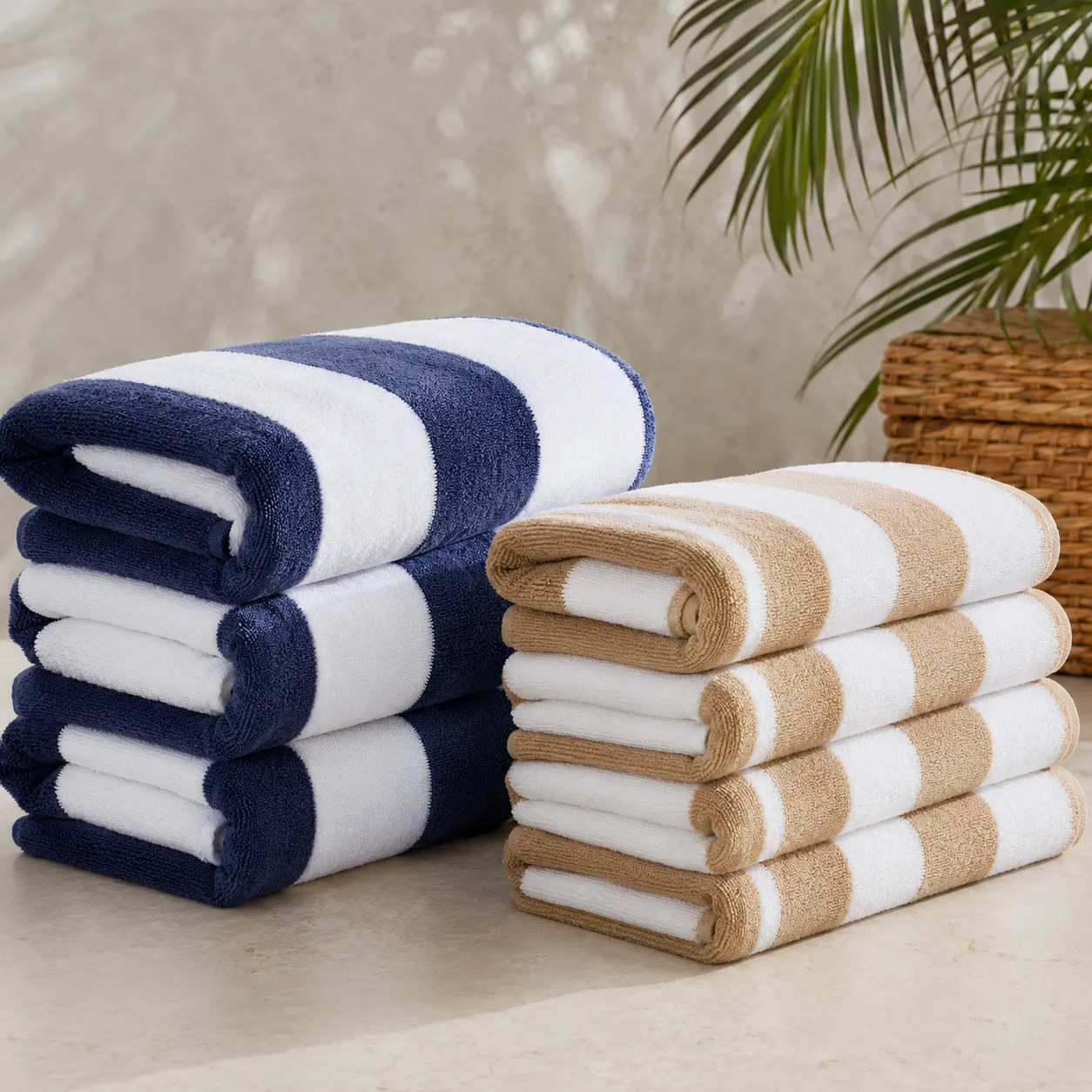
The Deck Problem Before the GSM Number
Beach club towels live harder lives than retail beach towels. They sit on hot loungers, collect sunscreen, drag across sand, move through commercial washers, and get folded again before they are fully cool from tumble drying. A towel that feels impressive in a showroom can become a slow-drying storage problem when a club needs 1,200 clean pieces before 10 a.m.
In our mill, we normally separate beach club programs into three uses: pool-deck issue towels, paid cabana or VIP towels, and retail take-home towels. The GSM decision changes for each use. For shared service towels, a 430-500 GSM construction often gives better cost-per-use than a 620 GSM towel, even if the heavier towel feels better on first touch.
- Pool-deck service: repeated guest issue, high laundering frequency, low tolerance for slow drying.
- Cabana or suite service: higher perceived value, more visible branding, moderate replacement budget.
- Retail towel: stronger artwork priority, less commercial washing, more packaging attention.
- Event or day-pass towel: lower unit cost, shorter planned service life, simplified decoration.
Beach Club Towel GSM Comparison by Use
For a practical beach club towel gsm comparison, we quote by finished size and finished weight, not only by fabric GSM. Two towels can both be 500 GSM, but a 90×170 cm towel weighs about 765 g before allowance for border and trimming, while a 100×180 cm towel sits near 900 g. That difference affects carton weight, laundry load capacity, and freight cost.
| Use case | Typical size | Recommended GSM | Approx. finished weight | Factory note |
|---|---|---|---|---|
| High-turnover pool deck | 86×160 cm or 90×170 cm | 400-460 GSM | 550-705 g | Fast drying and lower washer load weight |
| Standard beach club towel | 90×170 cm or 95×175 cm | 460-520 GSM | 705-865 g | Best balance for comfort and wash cost |
| Cabana or VIP lounger | 100×180 cm | 520-580 GSM | 935-1,045 g | Better drape and visual stack height |
| Retail souvenir towel | 90×170 cm or 100×180 cm | 380-480 GSM | 580-865 g | Artwork and handfeel matter more than laundry cycle |
We rarely suggest 650 GSM for shared beach club inventory unless the property has a slow guest turnover and enough drying capacity. A 650 GSM, 100×180 cm towel can pass 1,150 g after finishing. In a 60 kg commercial washer, that means fewer pieces per load and longer extraction time. The towel may be beautiful, but the laundry room pays for that beauty every day.
What GSM Changes in Laundry Economics
The cost of a towel is not only the FOB price. For commercial laundry towels, the main hidden cost is water retention. Higher pile height traps more moisture after spin extraction, and terry with dense yarn twist can release water more slowly than a flatter velour or low-loop construction. This is why clubs with limited back-of-house space often ask us to test drying time before locking the purchase order.
A sample calculation from a recent Mediterranean beach account: a 92×172 cm towel at 470 GSM finished around 745 g and dried in 31 minutes in their tunnel dryer setting. The same artwork on a 560 GSM base finished around 887 g and needed 39 minutes to reach the same residual moisture target. If the club washes 700 towels per day during peak season, that 8-minute difference can force an extra dryer shift.
| GSM band | Guest perception | Laundry impact | Expected wash life | Best fit |
|---|---|---|---|---|
| 360-400 GSM | Light, easy to carry | Fastest drying | 45-70 commercial washes | Events, day-pass programs |
| 420-480 GSM | Good deck towel feel | Efficient washer loading | 70-105 commercial washes | Pool deck and beach club issue |
| 500-560 GSM | Fuller handfeel | Moderate drying penalty | 90-130 commercial washes | Resort pool towels and cabanas |
| 580-650 GSM | Heavy, high stack value | High drying and storage load | 100-145 commercial washes | VIP suites, low-turnover luxury service |
Wash-life numbers depend on detergent alkalinity, chlorine exposure, and whether the towel is vat dyed, yarn dyed, or reactive dyed. We test production samples through internal 20-wash and 50-wash checks before bulk approval for programs where the buyer wants a defined replacement forecast.
Sand, Sunscreen, and Chlorine Are Material Decisions
Beach towel weight is only one part of the specification. Sand retention is a construction issue. Tall, open loops feel plush, but they also hold fine sand in the pile and release it inside the washer. For beach clubs with direct sand access, we often reduce loop height slightly and use a tighter ground weave so the towel shakes out better before laundering.
Sunscreen is another real defect source. Avobenzone and mineral sunscreen can create yellow-orange staining on light colors when combined with iron in wash water. Strong blue or charcoal shades hide some staining but need better colorfastness control. We run ISO 105-X12 rubbing checks for dark yarns and recommend ISO 105-E03 chlorinated water testing when towels will sit around treated pools all day.
- Sand-heavy beach access: avoid very tall loops; choose 420-500 GSM terry or a jacquard with controlled pile height.
- Chlorinated pool decks: specify reactive dye and test colorfastness to chlorinated water, especially for navy, red, and black.
- White towel programs: confirm optical brightener policy because some laundries over-bleach to keep a clean look.
- Sunscreen-heavy guests: use mid-tone stripes or borders to hide stains without making the towel look old too early.
Construction Choices That Change the Same GSM
A 500 GSM towel is not a single product. The same GSM can be woven as loop terry, velour front with terry back, yarn-dyed cabana stripe, or jacquard logo. Each construction changes absorbency, printing surface, shrinkage, and how the towel folds on a lounger.
| Construction | Good point | Risk point | Recommended GSM |
|---|---|---|---|
| Loop terry, solid dyed | Best absorbency per dollar | Logo needs embroidery or label | 420-540 GSM |
| Yarn-dyed cabana stripe | Classic beach club look | Stripe shrinkage must be balanced across colors | 450-560 GSM |
| Jacquard logo terry | Brand built into weave | Artwork loses detail below 2-3 mm line width | 480-600 GSM |
| Velour face, terry back | Smooth print or luxury feel | Lower absorbency on the sheared side | 400-520 GSM |
| Flat hammam style | Compact storage and fast drying | Different guest expectation than terry | 260-380 GSM |
For yarn-dyed cabana stripes, we pay close attention to border behavior. If the border yarn count and body yarn count are not balanced, the towel can cup at the short edge after repeated high-temperature drying. On bulk beach towels, this defect shows up as uneven stacking and guest complaints about curled ends. We check finished shrinkage after washing at 60°C and tumble drying before approving bulk weaving.
Size, Theft Risk, and Stack Height
Beach clubs sometimes ask for oversized towels because competitors use large loungers. That can be correct, but oversizing affects theft risk and shelf space. A 100×190 cm towel at 540 GSM occupies much more trolley volume than a 90×170 cm towel at 470 GSM. If the towel is free issue and not tracked by room or cabana number, heavier oversized pieces often disappear faster because guests treat them as merchandise.
- Measure the longest lounger cushion and decide whether the towel must cover the full length or only the guest contact area.
- Confirm laundry washer and dryer load limits in kilograms, not only piece count.
- Check storage shelves and trolley dimensions before approving an oversized format.
- Set a guest return process if the towel is above 850 g finished weight.
- Run a 10-piece sample wash so the operations team can judge folding speed and stack height.
For most beach clubs, our starting spec is 90×170 cm at 460-500 GSM. For clubs charging for cabanas or offering reserved loungers, 95×175 cm at 500-540 GSM gives a better visual upgrade without crossing into the laundry penalty of very heavy resort pool towels.
Decoration Limits at Different GSM Levels
Decoration should be chosen after GSM, not before it. On a low-GSM towel, heavy embroidery can pucker the corner because the ground fabric does not have enough mass to stabilize the stitches. On a high-pile towel, a small woven label can sink into the terry and become hard to see from a distance. We usually ask buyers for the guest touchpoint first: visible from lounger stacks, visible in photos, or subtle for a private club.
- Embroidery: works well from 450 GSM upward; keep chest-style logos under 8,000 stitches for towel corners.
- Jacquard: best for repeat stripes, large initials, or simple club marks; avoid tiny serif text.
- Woven label: cost-efficient for 400-520 GSM service towels, especially when color rotation changes seasonally.
- Reactive print on velour: useful for retail artwork but less absorbent on the printed face.
If the design depends on Pantone accuracy, we recommend reading our Pantone color matching guide before choosing yarn-dyed stripes or reactive-dyed solids. For buyers comparing decoration methods, embroidery vs sublimation vs jacquard explains which method survives repeated laundering best.
Pricing Bands and MOQ We Can Actually Hold
Our MOQ is 500 pcs per design per color. For beach club towel gsm comparison work, we can make lab dips and pre-production samples before bulk weaving, but the production line still needs enough yarn and dye volume to hold consistent shade. Lower quantities are possible only when using stock yarn colors or simplified labels, and the unit price usually rises sharply.
| Quantity | 420-460 GSM service towel | 480-540 GSM beach club towel | 560-620 GSM VIP towel | Typical terms |
|---|---|---|---|---|
| 500-799 pcs | USD 4.10-5.35 | USD 5.20-6.85 | USD 6.90-8.75 | Custom color, label or simple embroidery |
| 800-1,499 pcs | USD 3.55-4.70 | USD 4.65-6.10 | USD 6.20-7.95 | Better yarn allocation and carton efficiency |
| 1,500-2,999 pcs | USD 3.15-4.20 | USD 4.15-5.55 | USD 5.70-7.25 | Recommended for seasonal opening stock |
| 3,000+ pcs | USD 2.85-3.85 | USD 3.85-5.10 | USD 5.25-6.80 | Best for multi-property or annual programs |
These are realistic FOB China bands for cotton terry, yarn-dyed stripe, or simple jacquard programs. Heavy embroidery, individual polybags, RFID chips, and gift cartons add cost. We do not recommend cutting GSM below the functional point just to reduce the first invoice. If a 390 GSM towel costs USD 3.05 but lasts 52 washes, the towel cost is about USD 0.059 per use. If a 475 GSM towel costs USD 4.05 and lasts 92 washes, the towel cost drops to about USD 0.044 per use before laundry energy is counted.
Sampling, Testing, and Production Timeline
A reliable towel program needs time for material approval. We are OEKO-TEX Standard 100 Class I certified, BSCI audited, and ISO 9001 certified. For beach clubs with family guests, OEKO-TEX Class I is useful because it applies the strictest residue limits, originally designed for baby and toddler contact.
- Tech pack review and GSM recommendation: 1-2 working days after we receive size, artwork, and use case.
- Yarn or lab dip approval: 5-8 days for custom dyed colors, faster for stock shades.
- Counter sample weaving or decoration: 7-12 days depending on jacquard, stripe, or embroidery.
- Bulk weaving, dyeing, finishing, and QC: 24-35 days after sample and deposit approval.
- Export packing and booking: 4-7 days before vessel cut-off or air cargo handover.
Our QC checks include GSM by cut-and-weigh method, dimensional stability after washing, color shade under D65 light, seam strength on hems, and visual inspection for pulled loops. For dark cabana stripes, we also check dry and wet rubbing because color transfer onto white pool furniture is a real complaint mode.
Related reads: for overall program planning, see our beach club resort towel program and beach towels in bulk buyer guide. If your team is still deciding dimensions, our towel sizes and dimensions guide is a useful starting point.
Our Practical Recommendation
For most beach clubs replacing towels every season, we would start with a 90×170 cm towel at 470-500 GSM, reactive dyed or yarn dyed, with a woven label or medium-size embroidery. For clubs that want a more elevated cabana program, we would add a second 95×175 cm or 100×180 cm towel at 520-560 GSM and keep it controlled by reservation or deposit.
We would avoid making the entire inventory 600 GSM unless the laundry room confirms drying capacity and storage volume. The best pool deck towel specs are the ones staff can wash, fold, move, and replace without fighting the product every day.
- Lowest safe deck spec: 86×160 cm, 420-440 GSM, woven label, stock color.
- Balanced club spec: 90×170 cm, 470-500 GSM, stripe or solid, 70-105 wash target.
- Cabana upgrade: 95×175 cm, 520-560 GSM, jacquard logo or embroidery.
- Retail add-on: 90×170 cm, 400-460 GSM velour face if artwork detail matters.
Related reads: for material comparisons beyond cotton, see microfiber vs cotton towel comparison. For buyers building a quotation file, build a towel tech pack that mills can quote will help your team send the right GSM, size, color, and decoration details.
Build a Beach Club Towel Spec
Send us your lounger size, daily towel circulation, laundry setup, and logo artwork. We will recommend GSM, construction, MOQ plan, and FOB pricing. WhatsApp: +86 13205717266. Email: [email protected].
Request GSM Recommendation →