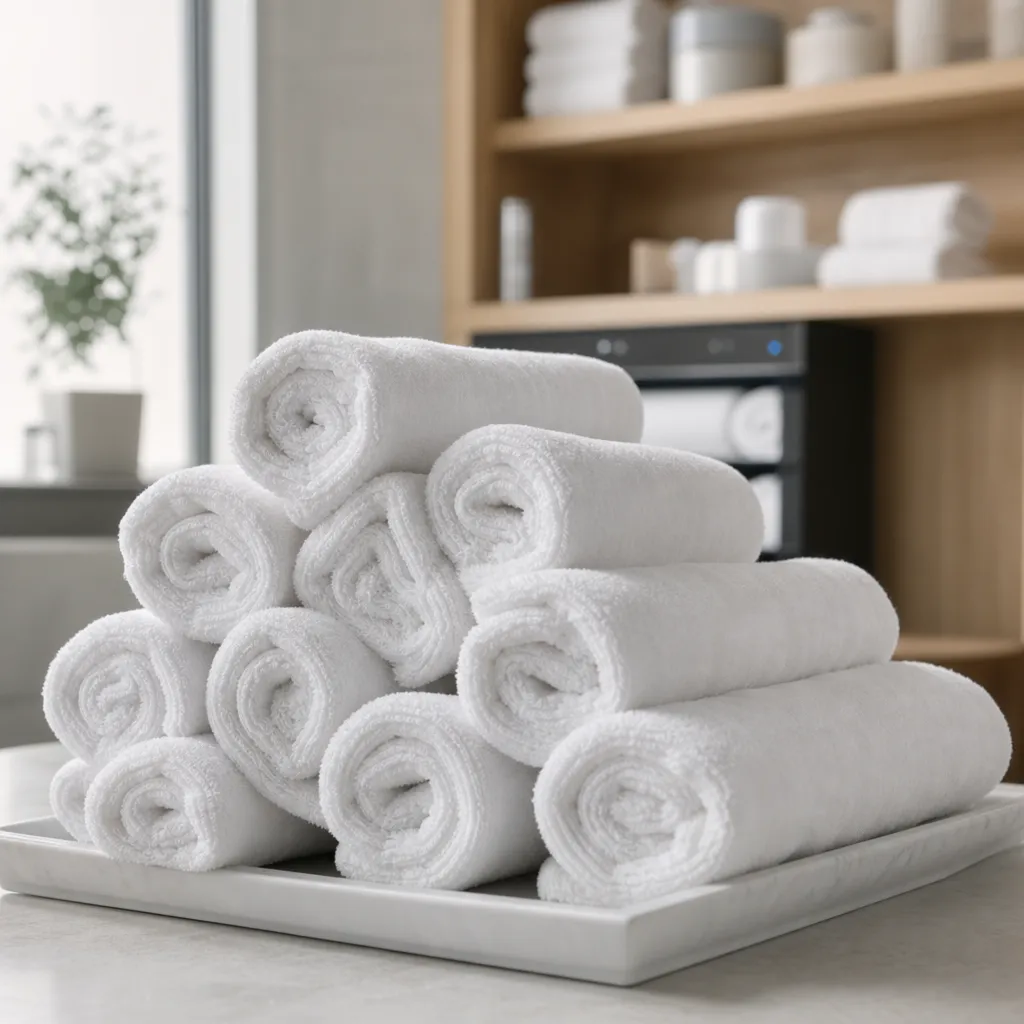
What the Spa Towel Warmer Can and Cannot Fix
We manufacture the towels, not the electrical cabinet, so we look at a spa towel warmer from the textile side. A warmer can hold heat and moisture, but it cannot correct an over-heavy towel, unstable dye, loose lint, or a size that rolls into a cylinder too thick for the shelf spacing. Those problems start in the purchase spec.
For facial service, hot shave, massage prep, and compress work, most spas do better with compact cotton towels in the 360-500 GSM range. Heavier 600-700 GSM hand towels feel soft when dry, but inside a warmer they absorb more water, heat more slowly, and reduce cabinet capacity. If the cabinet is opened 40-80 times per day, slow recovery becomes visible to therapists by mid-afternoon.
Our usual MOQ is 500 pcs per design per color. For spa replenishment programs, we often recommend one standardized heated-towel SKU first, then add embroidered guest towels or retail pieces later. That keeps training, folding, laundering, and warmer loading consistent across rooms.
| Use case | Common towel size | Recommended GSM | Why it works in a warmer |
|---|---|---|---|
| Facial compress | 30 x 30 cm or 32 x 32 cm | 360-420 GSM | Small roll diameter, fast heat transfer, easy one-hand handling |
| Hot shave or barber service | 30 x 50 cm | 380-460 GSM | Enough length for face wrap without crowding cabinet shelves |
| Massage hand towel | 35 x 75 cm | 420-500 GSM | More coverage, still manageable when damp |
| Spa treatment room backup | 40 x 80 cm | 450-520 GSM | Useful for hands, neck, and product removal, but lower cabinet count |
| Bath or wrap towel | 70 x 140 cm and above | 500-650 GSM | Usually stored warm in larger cabinets, not small counter units |
Start With Cabinet Capacity, Not Dry Towel Feel
A towel that feels excellent in a showroom can be wrong inside a towel warmer cabinet. Buyers often test one dry sample by hand, then discover the production towel rolls too wide after washing. We ask for cabinet inner dimensions, shelf count, target towel count per room, and how the staff folds or rolls the towel.
A 32 x 32 cm towel at 400 GSM weighs about 41 g before washing. After wetting and wringing by hand, it may carry 45-60 g of extra water, depending on cotton absorbency and operator habit. That turns a 100-piece load into 8.6-10.1 kg of wet mass. Small 16-23 liter cabinets are not designed to heat that quickly from cold.
- Ask the warmer supplier for usable internal shelf dimensions, not only outside cabinet dimensions.
- Test the towel after 3-5 commercial wash cycles because shrinkage changes roll diameter.
- Measure wet weight after the staff's normal wringing method, not after laboratory extraction only.
- Leave air space between rolls; a fully packed shelf heats unevenly and traps odor.
- Avoid mixing sizes in one cabinet during service because staff will overload the smaller spaces.
For a new spa opening, we normally calculate three counts: towels in use, towels in laundry, and towels waiting clean. A treatment room using 24 heated facial towels per day may need 72-96 pieces allocated to that room if laundry runs daily. If laundry runs every second day, the number rises quickly.
| Cabinet type | Typical internal volume | Practical facial towel load | Suggested towel spec |
|---|---|---|---|
| Countertop mini warmer | 8-12 L | 18-32 pcs of 30 x 30 cm | 360-400 GSM, tight hem, low lint |
| Standard treatment room warmer | 16-23 L | 40-70 pcs of 30 x 30 cm | 380-430 GSM, cotton terry or velour face |
| Large spa cabinet | 32-45 L | 90-140 pcs of 30 x 30 cm | 400-460 GSM, stable shrinkage control |
| Floor cabinet for bath towels | 60 L and above | Varies by towel size | 450-600 GSM, larger fold format |
The GSM Range We Use for Heated Towels
For wet towel heating, GSM is a capacity issue as much as a hand-feel issue. Lower GSM heats faster and dries faster after laundering, but if it drops too low the towel feels thin and loses service life. Higher GSM gives more cushion, but the warmer may not recover fast enough between guest appointments.
For most spa towel warmer programs, our starting point is 390-430 GSM for 30 x 30 cm facial towels and 420-480 GSM for 30 x 50 cm hot towels. A 30 x 30 cm towel at 410 GSM is roughly 37 g before hemming variation and wash shrinkage adjustment. That is light enough for cabinet rotation but substantial enough for a guest-facing treatment.
We do make lighter 320-350 GSM towels for promotional or one-time wellness events, but we do not recommend them for daily hot cabinet use. After 35-50 washes, the edge distortion and reduced pile recovery cost more in replacement labor than the initial saving. For a spa using 6,000 towel turns per month, replacing a weak batch two months early is not a saving.
| GSM band | Best application | Risk if misused | Our comment |
|---|---|---|---|
| 320-350 GSM | Sampling kits, short events | Thin hand feel, faster edge curl | Use only when budget is the main constraint |
| 360-420 GSM | Facial towels, compress towels | Can feel modest if yarn is too coarse | Best balance for small warmers |
| 430-500 GSM | Hot shave, massage hand towels | Lower load count per cabinet | Good for higher-touch service |
| 520-600 GSM | Spa hand towels outside warmer | Slow heat-up in compact cabinets | Better for dry presentation shelves |
| 600 GSM plus | Bath sheets and wraps | Too bulky for most counter warmers | Use in large warming drawers only |
Cotton, Twist, and Lint Around Heating Vents
Lint is not only a laundry complaint. In a hot towel cabinet, loose fiber can collect near vents, water trays, and silicone door seals. That lint holds moisture and product residue, then contributes to a sour smell even when the cabinet is wiped daily.
For heated towels, we usually choose ring-spun cotton with controlled twist rather than very low-twist cotton. Zero-twist constructions feel lofty, but they release more surface fiber under repeated wet rolling and hot storage. Combed cotton is useful when the spa needs a smoother hand and lower lint, especially for facial towels used around oil, cleanser, or exfoliant residue. For a deeper explanation of cotton behavior, we often point buyers to combed vs zero-twist cotton.
- Use ring-spun or combed cotton when facial contact and lint control matter.
- Keep pile height moderate; very tall loops flatten inside tightly rolled hot towels.
- Specify double-stitched hems for 30 x 50 cm towels that are pulled open repeatedly.
- Avoid unstable softener finishes that wash out after 5-8 cycles and change cabinet behavior.
- For white towels, confirm optical brightener policy if the spa uses peroxide-based laundry chemicals.
One construction quirk matters: the hem should not be too thick relative to the towel body. A bulky border creates a hard ridge in a rolled towel. Therapists notice this when applying warm towels to the jawline, eyes, or neck. We normally keep the border compact on facial towels and reserve heavier dobby borders for display hand towels.
White, Dyed, or Dark Towels in Hot Cabinets
White is still the easiest color for hot cabinet control because staff can see residue, oil, and makeup transfer quickly. Dyed towels can work, but they need better colorfastness testing because heat, moisture, and disinfectant exposure are a rough combination. Dark charcoal and espresso shades hide stains but may show lint and can transfer dye if the original reactive dyeing is under-washed.
For spa towels, we test wash shrinkage using ISO 6330-style domestic washing conditions when the buyer does not provide a commercial laundry protocol. For colorfastness, we use ISO 105-C06 washing checks and rub checks similar to ISO 105-X12. OEKO-TEX Standard 100 Class I is available for skin-contact programs, and our factory also holds BSCI and ISO 9001 certifications. Certificates do not replace batch testing, but they reduce risk when the towels touch the face repeatedly.
A common defect mode in warmer programs is yellowing near fold lines. This can come from chlorine residue, facial oil, essential oil, or over-long heated storage. If towels sit wet and warm overnight, even a good towel will develop odor. We tell spa operators to heat for service windows, then empty and dry the cabinet at closing.
| Color choice | Advantages | Control points |
|---|---|---|
| White | Easy stain inspection, clean spa presentation | Laundry must manage yellowing and makeup residue |
| Ivory or warm white | Softer look in treatment rooms | Shade matching requires lab dip approval |
| Light grey | Hides mild discoloration better than white | Check dye stability in hot moisture |
| Dark grey or black | Useful for hair color, mud, or product-heavy rooms | Lint visibility and dye wash-off need testing |
| Brand color | Strong retail or membership identity | MOQ 500 pcs per color; Pantone matching adds lab-dip time |
Laundry Rules That Protect the Warmer Program
The towel and the warmer are only two parts of the system. Laundry decides whether the towel stays soft, absorbent, and neutral-smelling. Too much softener blocks absorbency. Too little rinsing leaves alkaline residue. Over-drying weakens fibers and shrinks hems harder than the towel body.
- Wash incoming production samples before the final approval meeting; judge the towel after laundering, not only from carton condition.
- Set a clear chemical rule: oxygen bleach for white cotton is safer than routine chlorine use, unless the laundry has controlled dosing.
- Rinse thoroughly after oil-heavy treatments because warmed residual oil creates odor quickly.
- Dry to normal moisture, then store fully dry before wetting for the cabinet.
- Remove towels with rough hems, visible fray, or persistent odor instead of cycling them back into guest service.
For spas using external laundries, put the towel spec and wash expectations in writing. A towel designed for 60 C commercial wash and medium tumble drying can fail early if the laundry uses high alkalinity, aggressive chlorine, and overdrying. We cover related failure patterns in why gym towels fail after 50 washes, and several points apply to spa operations as well.
Decoration Choices for Heated Spa Towels
Decoration should be limited on towels that go inside hot cabinets. Embroidery is possible, but a dense logo patch can feel stiff against the face and adds a raised area in the roll. For facial towels, we usually place a small woven label or a low-stitch embroidery near one corner. For display hand towels outside the warmer, embroidery or jacquard branding can be larger.
If a spa wants a monogrammed guest towel and a heated treatment towel, we often split them into two SKUs. The heated SKU stays plain, compact, and easy to launder. The guest-facing towel carries the decoration. This avoids paying for decoration where it reduces comfort and slows production handling.
- Keep embroidery under 3,000-5,000 stitches for small facial towel corners.
- Avoid metallic thread in hot, wet storage because it can feel scratchy and age unevenly.
- Use woven labels only if the edge is soft and positioned away from the treatment contact zone.
- For jacquard logos, move to a larger hand towel format where the pattern has room to read.
- Approve decoration after wash testing because puckering around embroidery can appear after shrinkage.
For buyers comparing decoration routes, embroidery vs sublimation vs jacquard gives the broader trade-off. For monogram-heavy spa or hotel programs, monogrammed bath towels is also useful, though we would not copy those exact specs into a hot cabinet towel.
Pricing, MOQ, and Production Timing
Our MOQ is 500 pcs per design per color. For a new spa towel warmer towel, sampling is usually 7-10 days for available yarn and 12-18 days when custom dyeing or special labels are involved. Bulk production normally takes 25-35 days after sample approval and deposit. Add 5-9 days if embroidery, woven labels, or custom carton marking requires separate approval.
Prices below are realistic FOB China working bands for cotton spa towels, assuming standard white or basic dyed cotton, OEKO-TEX available materials, and normal packing. They change with cotton market, exchange rate, decoration, and carton requirements, but they give a useful starting point for budget approval.
| Item spec | 500-999 pcs | 1,000-2,999 pcs | 3,000-9,999 pcs | 10,000 pcs plus |
|---|---|---|---|---|
| 30 x 30 cm, 390-420 GSM white cotton | USD 0.42-0.58 | USD 0.36-0.50 | USD 0.31-0.44 | USD 0.28-0.39 |
| 32 x 32 cm, 400-440 GSM combed cotton | USD 0.56-0.76 | USD 0.49-0.66 | USD 0.43-0.58 | USD 0.39-0.52 |
| 30 x 50 cm, 420-470 GSM hot towel | USD 0.78-1.08 | USD 0.68-0.94 | USD 0.59-0.82 | USD 0.54-0.74 |
| 35 x 75 cm, 450-500 GSM massage hand towel | USD 1.55-2.25 | USD 1.36-1.98 | USD 1.18-1.72 | USD 1.06-1.55 |
A cheaper towel can still be expensive in use. In one 18-room spa calculation, a 30 x 30 cm towel at USD 0.34 lasted about 58 service washes before edge curling made it unsuitable for facial service. A USD 0.49 towel with better yarn and hem control reached about 118 service washes. At 9,000 heated towel uses per month, the lower-priced option saved roughly USD 675 on the first 4,500-piece purchase but required replacement about two months earlier. Labor disruption and freight made the saving disappear.
QC Checks Before We Ship
For hot cabinet towels, we focus QC on consistency rather than showroom drama. The towel needs to roll the same way, heat the same way, and survive repeated wet handling. During inline inspection, we check size tolerance, GSM, hem security, shade, loose loops, stains, metal contamination, and carton moisture condition.
We also recommend a buyer-side pilot before scaling to every treatment room. Put 100-200 towels through the exact warmer, laundry, wetting, and storage routine for two weeks. That trial catches the small operational problems: shelves too tight, staff over-soaking towels, oil residue left overnight, or cabinet doors opened too often during back-to-back appointments.
- Size tolerance target: usually within +/-3% after agreed washing method.
- Shrinkage target: often 3-6% for cotton terry, depending on construction and wash temperature.
- Needle and metal control: standard production scan before packing for guest-contact goods.
- Carton moisture check: avoid sealing towels with elevated humidity after finishing.
- AQL inspection: commonly AQL 2.5 for major defects and 4.0 for minor defects unless the buyer sets stricter rules.
Related reads: for towel weight decisions, see our GSM decision framework. For dimensions beyond facial and hand towels, use the complete towel size guide. For certificate checks, how to read an OEKO-TEX certificate explains what buyers should verify before placing bulk orders.
Spec Sheet We Ask Buyers to Send
A clear tech pack prevents most spa towel warmer problems before sampling. We do not need a long document, but we do need the operating details that affect towel behavior. A towel for a quiet facial room and a towel for a high-turnover massage chain may look similar in photos, yet the correct GSM and construction can be different.
- Cabinet brand, model, internal dimensions, and shelf count.
- Target towel size before wash and acceptable size after wash.
- Daily towel turns per treatment room and laundry frequency.
- Preferred color, cotton type, GSM band, and whether OEKO-TEX Standard 100 is required.
- Decoration placement, stitch limit, woven label position, or request for plain towels.
- Packing method: bulk carton, room packs, polybag count, barcode, or carton mark.
- Destination port, delivery deadline, and whether air freight or sea freight is planned.
Related reads: spas building a wider linen program can compare this with our spa towel program guide and waffle weave towels for spa buyers. If freight timing is part of the launch calendar, container vs air freight for towel orders will help procurement set a realistic delivery plan.
Build a Warmer-Ready Spa Towel Spec
Send cabinet dimensions, target towel count, GSM preference, and color plan. We can quote from 500 pcs per design per color with sampling and bulk timing.
Request a quote →