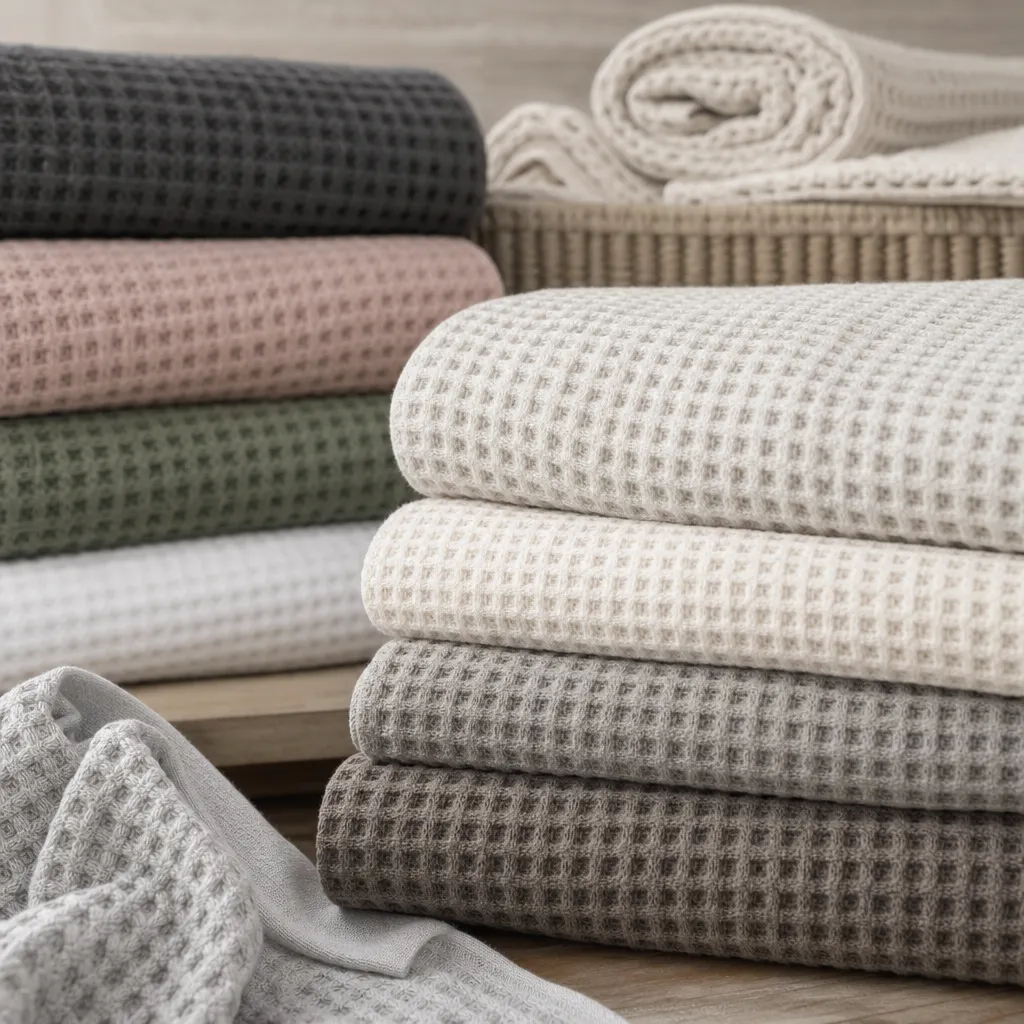
Why Waffle Weave Towels Behave Differently
Waffle weave towels are built with a raised honeycomb structure instead of a flat terry loop pile. That structure gives the towel more surface area, faster air flow, and a lighter handfeel at the same finished size. It also means the fabric can move more in washing if the weaving tension and finishing recipe are not controlled.
In our mill, the biggest mistake we see in buyer briefs is treating waffle as a visual texture only. For hotel spas, hammams, salons, yoga studios, and wellness retail, the construction decides whether the towel feels crisp and dry after 30 minutes or limp after the third laundry cycle. A 320 GSM honeycomb weave can outperform a heavier flat weave in drying speed, but it will not absorb like a 520 GSM terry bath towel.
We usually position waffle as a specialist towel: spa wrap, treatment towel, sauna towel, robe fabric, guest amenity towel, or quick-dry travel towel. For high-friction bath programs, we still compare it against terry using wash testing, not just sample-room handfeel.
| Use case | Common size | Recommended GSM | Main risk to control |
|---|---|---|---|
| Spa treatment towel | 50 x 90 cm or 70 x 140 cm | 300-380 GSM | Shrinkage after hot wash |
| Sauna or hammam towel | 80 x 160 cm or 90 x 180 cm | 260-340 GSM | Edge twisting on long panels |
| Hotel spa bath towel | 70 x 140 cm or 76 x 152 cm | 360-450 GSM | Low absorbency if yarn is too compact |
| Retail waffle bath towels | 70 x 135 cm to 80 x 160 cm | 380-500 GSM | Uneven cell depth between production lots |
The Construction Choices Buyers Should Specify
A proper waffle spec needs more than cotton percentage, color, and size. We need the buyer to confirm yarn type, cell scale, border style, laundering expectation, and whether the towel will be folded for retail display or used in back-of-house rotation. These decisions change weaving efficiency and finishing loss.
For cotton waffle towels, we normally start with 21s/2 or 16s/1 cotton yarn depending on target weight. Finer yarns can make a cleaner grid, but if the fabric is pushed too light the cells collapse after drying. Coarser yarns give a fuller handfeel but may feel rough on facial or spa use unless combed cotton is selected.
- Cell size: small waffle cells suit face towels and spa wraps; larger cells look stronger on bath sheets but show distortion more easily.
- Yarn choice: combed cotton improves softness and lint control; carded cotton lowers cost but can feel dry and shed more in the first washes.
- Border construction: a plain woven border looks clean, but on long sauna towels we often recommend a narrower hem to reduce edge curling.
- Finishing: pre-shrink and softening must be balanced; too much softener can reduce initial water uptake.
- Packaging: tight compression saves carton space but can flatten the honeycomb texture before retail photography.
One detail that belongs specifically to waffle fabric is cell recovery. During finishing, the fabric is opened, washed, dried, and relaxed. If the dryer temperature is too high or the stenter width is forced, the honeycomb can look sharp at inspection but lose depth after the buyer's first commercial wash. We check this by comparing cell height before and after laundering, not only by measuring width and length.
GSM, Weight, and Carton Reality
Waffle fabric reads lighter than terry because there is no raised pile loop. That is useful for freight and drying time, but buyers should not under-spec the GSM for institutional use. For spa towel programs that wash daily, our usual starting point is 340-400 GSM for bath size and 280-330 GSM for wrap or sauna size.
As a quick factory calculation, a 75 x 150 cm towel at 360 GSM has a theoretical fabric weight of about 405 g before hem, shrinkage, and finishing variation. After hemming and normal production tolerance, the finished towel may land around 420-455 g. A 75 x 150 cm terry towel at 520 GSM would often be 590-650 g. That difference matters when a buyer is shipping 12,000 pieces by air for a resort opening.
| Target feel | Suggested GSM | Typical fiber | Where it works |
|---|---|---|---|
| Light and crisp | 240-300 GSM | Cotton or cotton-linen blend | Hammam, sauna, travel, amenity kits |
| Spa service weight | 300-380 GSM | Combed cotton | Treatment rooms, wraps, quick-dry pool towels |
| Bath towel weight | 380-460 GSM | Combed cotton or zero-twist blend | Hotel spa bathrooms, retail waffle bath towels |
| Heavy retail texture | 460-520 GSM | Thicker cotton yarn | Gift sets, lifestyle stores, low-frequency use |
The heavier options look attractive on a showroom table, but they can create two issues: slower drying inside the waffle pockets and more lint during early wash cycles. We do make 480 GSM waffle bath towels, but we usually ask for the buyer's laundry setup before approving that spec for hotels.
Shrinkage Is the Main QC Point
Shrinkage is the complaint that reaches our merchandising desk most often on waffle spa towels. The fabric has a three-dimensional weave, so it relaxes more than a flat woven towel. If a buyer approves a fresh sample without a wash report, the bulk shipment can look smaller, thicker, and more puckered after laundering.
Our internal approval uses ISO 6330 domestic washing and drying as a baseline when the towel is for retail or light hospitality. For commercial spa programs, we add a harsher in-house cycle at 60 degrees Celsius with tumble drying, then compare size, skew, edge twist, and handfeel. The pass range depends on use, but for most cotton waffle towels we try to hold shrinkage within 5-7 percent after the first full wash cycle.
- Measure the pre-wash sample after 24 hours of conditioning.
- Wash according to the buyer's care label target, normally 40 or 60 degrees Celsius.
- Tumble dry or line dry based on real laundry practice, not the showroom preference.
- Condition again, then measure length, width, diagonal skew, and hem twist.
- Compare absorbency and cell recovery before approving bulk production.
For darker colors, we also monitor shade change after washing using a grey scale assessment under D65 light. Deep charcoal, forest green, and navy can look uneven if the waffle pockets hold residual dye or if the fabric is overloaded in the dyeing machine. This is one reason we do not rush lab dips on textured fabric.
Absorbency and Drying Speed Need Separate Tests
A towel can dry quickly and still have weak first-touch absorbency. With waffle weave, this happens when the yarn is too tightly twisted, when softener blocks the fiber surface, or when the buyer chooses a cotton-poly blend for cost reasons. Quick dry cotton towels still need enough open fiber to take water from skin.
For absorbency, we use a practical drop test during development and can align with AATCC 79 when a buyer needs a formal method. We place water on the towel surface and measure wetting time. For spa face towels and treatment towels, we want rapid wet-out rather than water beading on the cell peaks.
Drying speed is tested differently. We weigh the towel wet, dry it under controlled conditions, and track weight loss over time. A 350 GSM waffle towel may reach usable dryness 25-35 percent faster than a 500 GSM terry towel in the same room conditions. That does not mean it replaces terry everywhere; it means it can reduce damp storage odor in spa back rooms when the laundry flow is tight.
- For massage rooms: choose absorbency first, because oil and water residue must lift cleanly from skin.
- For sauna service: choose drying speed first, because the towel is often reused within a short guest cycle.
- For hotel bathrooms: balance absorbency and loft; some guests expect a fuller bath towel feel.
- For retail: test after packaging, because compressed waffle can feel flatter until washed.
Decoration Limits on Honeycomb Weave
Decoration on waffle fabric needs a calmer approach than terry or microfiber. The textured cells interrupt fine lines, and the surface can stretch during embroidery. Large filled logos can also stiffen the towel, especially on lighter 280-320 GSM fabric.
For spa and hotel groups, we normally recommend woven labels, narrow border embroidery, or tone-on-tone monograms. If the brand wants a large logo, we place it on a flat dobby border or add a separate patch. Direct screen printing is possible on some waffle constructions, but the ink sits unevenly on the peaks and valleys, so we avoid it for refined spa programs.
| Decoration method | Best placement | Minimum order impact | Factory note |
|---|---|---|---|
| Embroidery | Flat border or corner | 500 pcs per design/color | Keep stitch count below about 8,000 for light waffle |
| Woven label | Hem edge | 500 pcs per design/color | Good for spa and retail programs with many colors |
| Jacquard logo | Full towel body | Usually 1,000 pcs+ | Texture competes with logo unless artwork is simple |
| Patch applique | One short end | 500 pcs per design/color | Adds cost but protects logo clarity |
A common defect mode is embroidery tunneling, where the waffle fabric pulls inward around the logo and creates a raised ridge. We prevent it with backing selection, lower thread density, and a test sew-out after washing. For buyers comparing decoration routes, our guide to embroidery vs sublimation vs jacquard gives a broader method comparison.
Pricing Bands and MOQ
Our standard MOQ is 500 pieces per design per color. For custom dyed waffle weave towels, that MOQ is realistic because dyeing, shrink testing, and cutting loss must be spread across enough fabric. For yarn-dyed stripes or custom jacquard, the MOQ can move to 1,000-1,500 pieces because loom setup and yarn preparation take longer.
Pricing changes quickly with cotton grade, towel size, GSM, dye color, and packaging. The ranges below are FOB China working bands for typical OEM spa orders, not a quote. They assume cotton waffle fabric, standard hem, one woven label or simple embroidery, and export carton packing.
| Order volume | 50 x 90 cm, 320 GSM | 70 x 140 cm, 380 GSM | 90 x 180 cm, 300 GSM |
|---|---|---|---|
| 500-999 pcs | USD 1.85-2.45 | USD 4.10-5.20 | USD 4.95-6.30 |
| 1,000-2,999 pcs | USD 1.55-2.05 | USD 3.55-4.55 | USD 4.35-5.60 |
| 3,000-7,999 pcs | USD 1.32-1.78 | USD 3.10-4.05 | USD 3.85-5.05 |
| 8,000 pcs+ | USD 1.18-1.58 | USD 2.82-3.72 | USD 3.55-4.68 |
Cheap waffle can be expensive in use. One spa chain once compared a 300 GSM carded cotton sauna towel at USD 3.25 with a 350 GSM combed cotton version at USD 4.05. In their laundry trial, the cheaper towel was retired after about 55 washes because the edges twisted and the cells flattened. The better towel was still acceptable after 92 washes. The purchase price looked 25 percent higher, but the towel cost per service cycle fell from about 5.9 cents to 4.4 cents before laundry cost.
Certification, Compliance, and Color Control
For spa, hotel, and wellness retail programs, buyers usually ask for OEKO-TEX Standard 100. Our production can support OEKO-TEX 100 Class I when the yarn, dyestuff, embroidery thread, and trims are all controlled under the approved input list. That matters for face towels, baby-adjacent retail, and guest skin contact.
LUMA & CO. TEXTILE is also BSCI audited and ISO 9001 certified. ISO 9001 does not mean every towel is identical; it means the quality process is documented, inspected, and traceable. For waffle programs, we record greige fabric weight, finished GSM, shade lot, shrinkage result, needle inspection, and carton weight.
- OEKO-TEX Standard 100 Class I: useful when the towel touches face, skin, or children.
- BSCI: requested by European retailers and hotel groups that audit social compliance.
- ISO 9001: supports repeatable inspection records and corrective action tracking.
- AATCC 61 or ISO 105-C06: used when buyers need colorfastness-to-washing evidence.
- ISO 105-X12: relevant for crocking risk on dark navy, black, and saturated spa colors.
Color matching on honeycomb weave is slightly different from flat fabric. The peaks catch more light, while the recessed cells look darker. We measure with a spectrophotometer, but we still ask buyers to approve a physical lab dip under D65 and warm indoor lighting. For more on shade approval, see our article on Pantone color matching custom towels.
Production Timeline We Can Actually Hold
A rushed waffle order is where defects hide. The fabric needs time to relax after weaving and finishing, and shrinkage testing cannot be completed honestly in one afternoon. For a repeat color and existing construction, we can move faster. For a new spa towel program with custom dye and decoration, we plan around 35-50 days after sample approval and deposit.
- Tech pack and quotation: 2-4 days if size, GSM, color, and packaging are clear.
- Lab dip or strike-off: 5-8 days for solid dyed cotton waffle.
- Pre-production sample: 7-12 days including decoration and wash check.
- Bulk weaving, dyeing, finishing, and sewing: 22-32 days depending on volume.
- Final inspection and packing: 2-4 days, with carton marks and export documents checked before shipment.
For air freight, waffle has an advantage because lower weight reduces cost. For ocean freight, carton cube becomes the issue, especially if the towel is packed in belly bands or retail boxes that protect texture. Our logistics team normally calculates both chargeable air weight and ocean CBM before recommending a route. The broader freight comparison is covered in container vs air freight towel orders.
Related reads: buyers building a full spa or hotel linen program may also find spa towels need different cotton than hotel, hotel towel sourcing guide, and towel GSM guide useful before locking the final specification.
For buyers still drafting the brief, start with build a towel tech pack that mills can quote. If the program includes robes, bath sheets, and guest amenities, compare dimensions against bath towel dimensions and review the spa product range at /products.html#spa.
Our Practical Spec Recommendation
For a first OEM order of waffle weave towels, we usually recommend staying close to a proven construction: 100 percent combed cotton, 340-390 GSM for bath size, pre-shrunk finishing, narrow hem, and either woven label or small border embroidery. That spec gives enough absorbency for guest use while keeping drying time and freight weight under control.
For a luxury retail set, we may move to 420-480 GSM with a deeper cell and softer finish, but we warn buyers to test drying time and packaging recovery. For sauna or hammam use, we go lighter, often 260-320 GSM, because the towel must dry quickly between guest turns. The right construction is tied to laundering frequency, not only shelf appearance.
Our factory team in Gaoyang, Zhejiang has produced towels since 2007, with about 220 employees and annual output around 2.4 million towels. We supply more than 80 brand clients across 47 countries. For waffle programs, the useful conversation starts with the wash cycle, target handfeel, decoration plan, and expected life in washes; after that, the quote becomes much more accurate.
Build a Waffle Towel Spec That Survives Laundry
Send size, GSM target, color, decoration, packaging, and expected wash conditions. Our team will check construction risk, MOQ, pricing band, and production timing. WhatsApp: +86 13205717266. Email: [email protected].
Request a Quote →