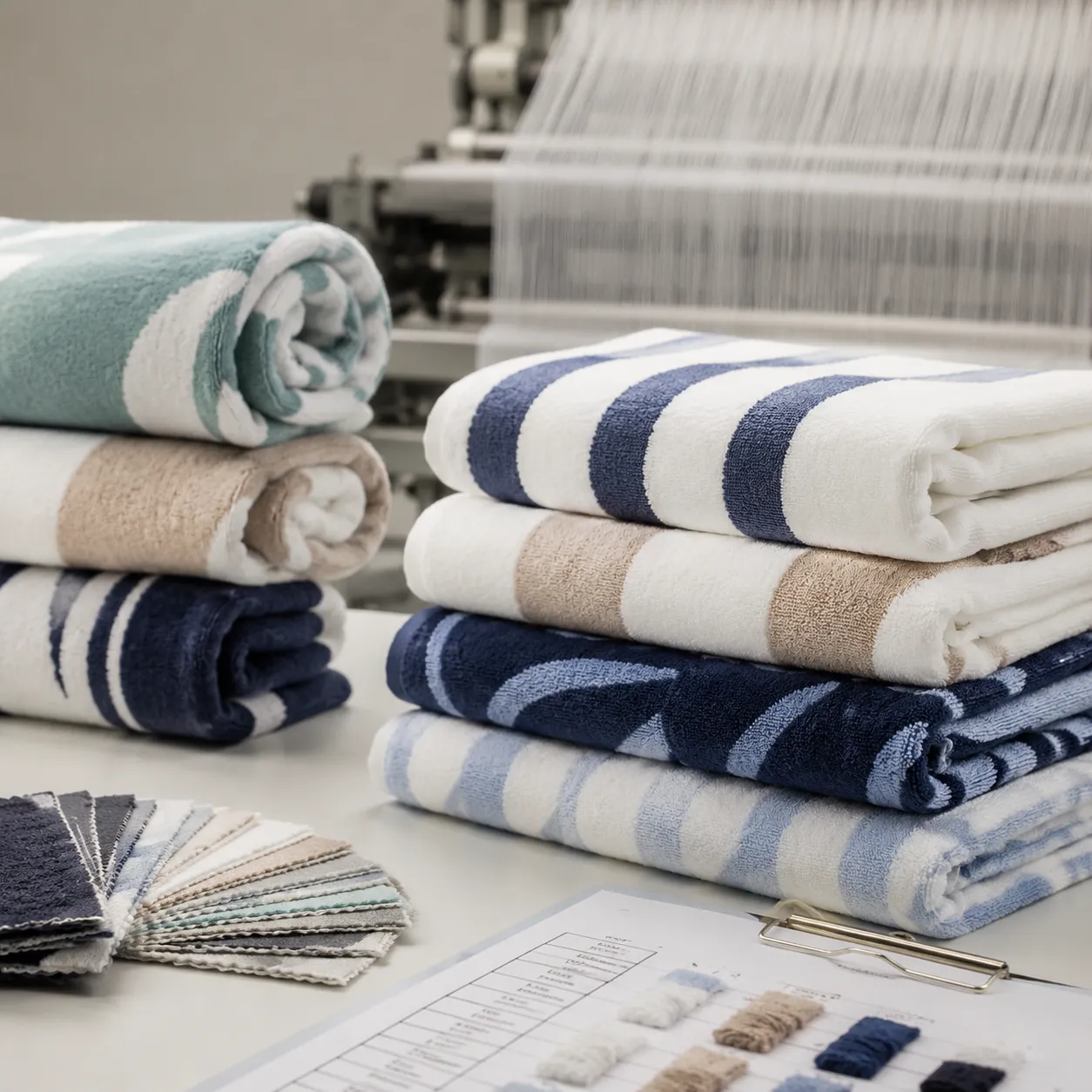
Read the towel backwards from the laundry room
If you start with catalog photos, you will usually overpay for appearance or underbuy for wash performance. We tell hotel buyers to read the line item from the laundry room backwards: wash cycles, bleach exposure, cart handling, room count, replacement rate, then guest touch. A 16s ring-spun terry bath towel at 580-620 GSM behaves very differently from a soft open-end construction at the same nominal weight once it has gone through tunnel finishing, alkaline wash chemistry, and repeated tumble drying.
That is why an american hotel register cost breakdown cannot stop at piece price. The useful version separates visible cost from operating cost. Visible cost is the invoice. Operating cost sits in shrinkage, seam burst, shade drift lot to lot, lint in the first ten washes, and whether your team has to pull stock early because the pile goes flat. Hotels with on-premise laundry usually notice these failures sooner than properties using outsourced laundries, because they see the reclaim pile every day.
| Cost layer | What actually moves it | Typical impact on a bath towel |
|---|---|---|
| Base fabric | Cotton grade, yarn count, twist level, GSM | USD 0.42-0.88 |
| Construction | Dobby border height, pile density, side hems, lockstitch quality | USD 0.08-0.19 |
| Dyeing and finishing | Reactive dye depth, optical brightener, softener system, preshrink control | USD 0.07-0.22 |
| Compliance and QA | OEKO-TEX screening, in-line checks, final AQL, carton traceability | USD 0.03-0.09 |
| Packaging and freight readiness | Bagging, barcode labels, export cartons, pallet discipline | USD 0.05-0.17 |
Where the catalog gap usually comes from
On hospitality programs, the biggest pricing gaps usually come from four places: actual finished weight, yarn quality, finishing discipline, and replacement expectation. A towel listed as 600 GSM may be quoted on loom state weight while another is controlled on post-wash finished weight. That single difference can move delivered handfeel and cost more than most buyers expect. We see this often when a brand compares one vendor’s tech pack against another vendor’s marketing sheet.
- Finished GSM tolerance: a workable hotel spec is often plus or minus 4 percent after preconditioning, not a broad nominal target with no test condition attached.
- Ground warp and pile ratio: two towels can share the same GSM but differ in absorbency and visual fullness because of pile yarn allocation.
- Hem build: 10 mm lock hem with 20/2 sewing thread lasts longer in commercial laundry than a narrow decorative hem built for retail shelves.
- Softener choice: silicone-heavy finishing can make a development sample feel rich, then mute absorbency after early washes.
One concrete check we use in development is measuring mass after ISO 139 conditioning before confirming GSM, then validating dimensional change after a controlled wash and dry sequence. Another is seam stress at the side hem where cart loading and extractor handling create concentrated pull. Those are not glamorous tests, but they explain a lot of invoice differences.
A practical american hotel register cost breakdown by spec tier
Below is the cost shape we would expect for three common hotel bath towel levels sourced FOB China in 2026. These are not retail tags or distributor margins. They are factory-side ranges for custom OEM orders with MOQ 500 pcs per design per color, using white or light solid shades, standard export cartons, and no embroidery.
| Program level | Representative spec | FOB China at 3,000 pcs | FOB China at 12,000 pcs |
|---|---|---|---|
| Utility full-service | 70 x 140 cm, 520-560 GSM, carded cotton, standard dobby | USD 3.18-3.72 | USD 2.86-3.31 |
| Upper midscale | 70 x 140 cm, 580-620 GSM, ring-spun cotton, tighter pile density | USD 3.84-4.46 | USD 3.49-4.02 |
| Luxury city/resort | 76 x 142 cm, 650-720 GSM, combed ring-spun or low-twist blend, reinforced hems | USD 4.88-5.96 | USD 4.43-5.37 |
If a buyer sends us a target around USD 2.60 FOB for a bath towel that also asks for 600 GSM, combed cotton, low lint, bleach tolerance, and low shade variation, we usually push back. That number can be reached only by trimming something material: actual size, finished weight, yarn quality, pile density, or QA discipline. The cheaper line may still work for a budget property, but it is a different program.
The piece price is only half the math
Hotels often evaluate replacement by room and by quarter, but they should also look at cost per successful wash. Here is a realistic comparison we ran for a regional operator choosing between a lighter carded bath towel and a denser ring-spun option. The lower-cost towel was cheaper to buy, but its edge fray rate and body shrinkage pushed it out of service earlier.
| Item | Option A | Option B |
|---|---|---|
| FOB unit cost | USD 3.04 | USD 3.87 |
| Average usable washes before downgrade | 72 | 128 |
| Estimated cost per wash | USD 0.042 | USD 0.030 |
| Common retirement reason | Pile harshness and skew | Late-stage shade dulling |
| Buyer fit | Short-stay budget hotel | Business hotel or resort |
The key is not to overspec every room tier. It is to match the towel to the property’s laundry reality. A resort with heavy sunscreen, pool crossover, and longer guest stays may need the denser build. A select-service chain turning rooms fast may prefer a simpler construction if the replacement discipline is already built into budget.
Spec lines buyers miss in RFQs
The expensive misunderstandings usually start in the request for quote. We receive hotel briefs that specify size, color, and GSM, then leave out the details that determine whether the bulk lot matches the approved sample. If you want a clean quotation comparison, the technical data sheet has to pin down the lines below.
- State whether GSM is required on finished, conditioned fabric or loom state fabric.
- Set dimensional tolerance after wash, for example within 5 percent on length and width after agreed test method.
- Name the cotton build: carded, combed, zero-twist blend, or conventional ring-spun.
- Define whiteness target or approved shade standard if ordering white towels; optical brightener level changes visual match between batches.
- Specify border construction and hem width so vendors are not pricing different sewing workloads.
- List carton count, inner poly requirement, barcode placement, and shipping mark format.
A missing line on packout can distort comparison more than buyers think. A bath towel packed 24 pcs per carton with stronger five-layer export board and barcode-by-size discipline may cost a few cents more than loose mixed carton packing, but it arrives cleaner and counts faster at the property warehouse. We covered the broader quoting logic in build-towel-tech-pack-that-mills-can-quote.html, but the short version is simple: if one RFQ field is vague, suppliers fill it with different assumptions and the price sheet stops being comparable.
Compliance and QA are small cost lines until they are not
This was the section missing in the rejected draft, so here is the complete version. On a standard hospitality order, compliance and QA rarely add more than a few cents per piece. That makes them easy to dismiss. It is a mistake. Those cents are where you pay for traceability, chemical screening, lot consistency, and shipment release discipline.
For our hotel programs, we usually align documentation around OEKO-TEX Standard 100 Class I, BSCI, and ISO 9001 process control. On the factory floor, the more decisive work is operational: shade banding checks under D65 light box, absorbency spot checks, measurement after conditioning, metal detection where required by customer protocol, and final inspection to an agreed AQL, often 2.5 major / 4.0 minor for export home textiles.
- Shade continuity: white towels can still vary visibly because of optical brightener dosage and finishing temperature drift between dye lots.
- Bow and skew control: if the terry loops lean after finishing, the towel hangs twisted on rack display and feels inconsistent after laundering.
- Needle and oil discipline: dark machine oil near hems is rare but costly because it usually appears only when cartons are opened at destination.
- Carton traceability: buyer complaints are easier to isolate when carton marks map back to production date, machine group, and packing team.
Two test details matter here. First, absorbency should be checked after finishing with residual softener in place, not on greige expectation. Second, dimensional stability needs a fixed wash method; otherwise one party uses mild domestic conditions and the other uses a harsher hospitality simulation. Buyers reviewing certificates should also read what they actually cover, which is why how-to-read-oeko-tex-certificate.html is worth keeping in your sourcing folder.
| QA gate | What we check | Typical timing |
|---|---|---|
| Pre-production | Approved lab dip, handfeel reference, seam construction, carton artwork | 2-4 days |
| In-line | GSM spot check, size, loop pull, sewing consistency, shade grouping | During weaving and sewing |
| Wash validation | Shrinkage, absorbency, appearance after agreed cycles | 3-5 days |
| Final inspection | AQL sampling, assortment, barcode, carton drop condition | 1-2 days |
Lead time changes with complexity more than volume
Hotel buyers often expect a direct line between order size and lead time. In towel production, the bigger delay is usually not volume but coordination. White stock shades move faster than custom dyed fashion colors. Plain dobby moves faster than elaborate border programs. A repeat order with frozen specs can ship before a smaller first order that is still changing carton marks or label language.
| Order type | Sampling and approval | Bulk production | Total working lead time |
|---|---|---|---|
| Repeat white hotel towel | No new sample or only seal sample | 18-24 days | 22-28 days |
| New private-label white set | Lab standard confirmation, packout signoff | 26-34 days | 32-42 days |
| Custom dyed multi-size program | Lab dips, pilot wash review, barcode and carton approval | 34-46 days | 42-58 days |
Freight choice then matters at the margin. For most bath towel programs, container freight remains the rational default because towels cube out quickly. Air can rescue a launch gap, but it usually makes sense only for partial emergency quantities or approval sets. The broader tradeoff is covered in container-vs-air-freight-towel-orders.html.
How we would quote against a distributor benchmark
If a buyer asks us to quote against a known hospitality distributor benchmark, we do not try to imitate every line blindly. We first separate the non-negotiables from the easy substitutions. Example: if the reference towel is 610 GSM, 70 x 140 cm, bright white, ring-spun, with a 4 cm dobby border and institutional hem, we can usually hold guest-facing feel while changing one or two back-end items to manage cost.
- Keep finished size and wash stability intact because housekeeping notices those immediately.
- Protect hem sewing strength and border balance because those drive early failure.
- Adjust cotton grade or twist profile carefully if the handfeel target allows it.
- Simplify packaging if the buyer warehouse can handle it without scan errors.
- Consolidate colors and embroidery exclusions on opening orders to stay above MOQ efficiency.
That last point matters. Our MOQ is 500 pcs per design per color, but efficiency improves materially once a hotel group commits by size family instead of fragmenting too many room-level variants. If you need help structuring that split, negotiate-towel-moq-without-killing-margin.html and setting-up-hotel-linen-program-90-day-roadmap.html are the two internal reads we usually send first.
What a clean buying decision looks like
A strong sourcing decision on hospitality towels is usually boring in the best sense. The spec is complete. The approved sample is tied to measured values, not memory. The cost sheet shows which features are structural and which are optional. The QA plan is written before bulk starts. When that is done, an american hotel register cost breakdown becomes a useful reference point rather than a pricing trap.
For most hotel groups we advise choosing one of three paths. First, match the benchmark closely when guest expectation is already defined and internal stakeholders do not want to retest. Second, build a value-engineered equivalent where laundry life is maintained but packout or yarn selection is simplified. Third, split the program by property tier so the luxury wing and the standard wing are not forced into the same towel economics. Related reads: hotel-towel-sourcing-guide-2026.html, hotel-towels-wholesale-supplier-guide.html, and towel-gsm-decision-framework.html.
Need a hotel towel cost review against your current benchmark?
Send the current spec sheet or distributor reference. We can mark the lines affecting price, wash life, MOQ efficiency, and lead time, then quote a workable OEM alternative. WhatsApp: +86 13205717266 | Email: [email protected]
Request Quote →