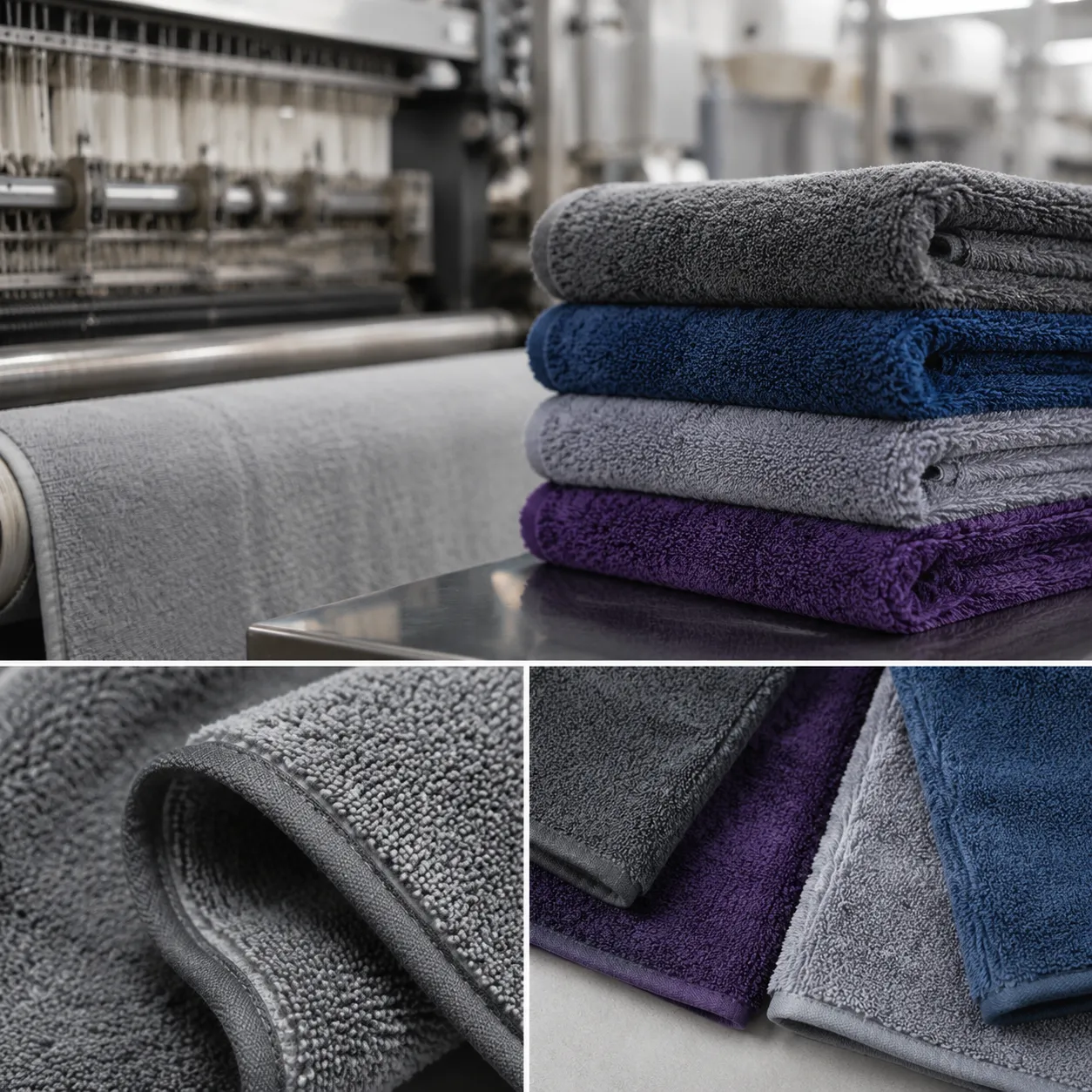
Why Drying Marks Usually Start at the Edge
In our QC room, the first check on an auto towel is not the face pile. We fold the towel and run the border across a coated acrylic test panel under oblique light. A towel can have a good microfiber face and still fail because the binding, corner seam, label, or heat-cut edge becomes the contact point during wiping.
For car drying, we normally avoid raised polyester border tape unless the buyer has a very controlled user base. Tape is stable and cheap, but after 25-40 industrial washes at 60-70 C it can feel sharper than the pile. For a retail detailing towel, that becomes a complaint on dark paint. For a tunnel wash towel, it becomes a rewash cost because operators press harder when water remains on panels.
The safer builds are ultrasonic cut edge, overlocked microfiber edge, or truly edgeless cut with lint control. Each has trade-offs. Ultrasonic edges reduce seam bulk, but if the blade temperature is too high, the cut line can glaze. Edgeless towels feel safest, but poor cutting creates loose filaments that shed in the first wash. We inspect both by dry rubbing on black glass and by checking loose fiber count after a 10-minute tumble.
| Edge construction | Scratch risk on clear coat | Best use | Factory note |
|---|---|---|---|
| Ultrasonic cut | Low if the cut line is not glazed | Retail drying towels and premium car wash programs | Requires blade temperature control and edge stretch checks |
| Microfiber overlock | Low to medium | High-laundry commercial users | Thread must stay softer than face pile after washing |
| Satin or polyester tape | Medium | Budget wash bay towels, not black-paint retail positioning | Can harden in heat drying and become the first contact point |
| Raw edgeless cut | Low if lint is controlled | Detailing brands selling a scratch free car drying towel | Needs clean slitting and pre-wash or air blow-off before packing |
Best Towel to Dry Car Without Scratching: Spec Range
The best towel to dry car without scratching is usually a high-pile microfiber drying towel in the 450-720 GSM range, not the thickest towel the factory can make. Above about 800 GSM, the towel may feel impressive in packaging but can become heavy when wet, harder to wring, slower to dry, and more expensive to ship. Below 360 GSM, the user often needs extra wiping passes, which raises the chance of dragging dust or remaining grit.
For most detailing brands, we quote two reliable constructions. The first is a 70/30 polyester-polyamide twisted loop microfiber at 500-650 GSM for fast water pickup and lower drag. The second is a plush split microfiber at 420-550 GSM for a softer hand and easier folding. Twisted loop is efficient on large panels; plush pile feels more forgiving around mirrors, trim, and ceramic-coated curves.
- Fiber split: 70/30 is softer and more absorbent than 80/20, but costs more because polyamide is the higher-cost component.
- Pile type: twisted loop microfiber pulls water quickly with less surface drag; plush pile has a softer retail feel but may need a larger towel size.
- Size: 50 x 80 cm and 60 x 90 cm are practical for consumer drying; 40 x 60 cm is better as a secondary wipe towel.
- Color: medium grey, navy, teal, or charcoal hide staining better than white, but very dark shades need stronger colorfastness control.
- Packaging: avoid stiff hang tags or plastic barb attachments through the towel body; they create snag points before the customer even opens the pack.
| Program type | Recommended construction | GSM range | Common size | Why it works |
|---|---|---|---|---|
| DTC detailing towel | 70/30 twisted loop microfiber | 520-680 GSM | 60 x 90 cm | High water pickup with fewer passes on hood and roof panels |
| Car wash drying station | 80/20 split microfiber overlocked edge | 360-480 GSM | 40 x 60 cm | Lower unit cost and faster laundry turnaround |
| Premium ceramic coating kit | 70/30 plush split microfiber edgeless | 430-560 GSM | 50 x 80 cm | Soft feel and low drag for final drying |
| Giveaway with useful performance | 80/20 low-twist microfiber | 300-380 GSM | 40 x 60 cm | Acceptable cost, but not positioned as the main drying towel |
Absorbency Is a Test Result, Not a Hand Feel
A thick towel on a showroom table can still move water poorly. We use AATCC TM79-style absorbency timing as a reference, then adjust for towel structure because automotive towels are used by wiping, not just drop absorption. For development samples, we also do a panel-dry test: 80 ml of water is sprayed across a 60 x 60 cm coated glass panel, then we count complete passes needed to remove visible water film.
A good 600 GSM twisted loop towel should clear that panel in 1-2 passes without squeaking or bunching. If the towel needs 4 passes, the user will press harder. Pressing harder is where minor contamination, edge stiffness, or label corners begin to matter. That is why we treat absorbency as a scratch-control issue, not only a convenience issue.
Buyers sometimes ask whether one towel can handle drying, wax removal, interior glass, and wheels. We usually push back. A drying towel needs pile height and water capacity. A glass towel needs a flatter weave with low lint. Wheel towels need chemical resistance and should never return to paint contact. Combining those into one SKU saves a little in purchasing but creates avoidable complaint risk.
The Construction Details That Matter in OEM Sampling
In sampling, we ask buyers to approve more than color and size. We need confirmation on pile direction, border, label placement, and carton compression. Microfiber pile can lay in one direction after finishing. If the towel is folded with the pile compressed hard for 45 days, the first unpacking may show pressure lines. They usually recover after washing, but retail customers may judge the product before laundry.
- Confirm face construction: twisted loop, plush split microfiber, waffle microfiber, or dual pile.
- Approve exact GSM tolerance, normally plus or minus 5 percent after conditioning.
- Specify border construction and whether labels are woven, printed satin, heat-transfer, or removed entirely.
- Run one home-laundry simulation before approving bulk, especially if the towel is marketed to enthusiasts.
- Check final packed towel height because large 60 x 90 cm towels can inflate carton volume quickly.
For dark towel colors, we run ISO 105-C06 washing colorfastness and ISO 105-X12 rubbing colorfastness as baseline checks. For absorbency retention, we compare the first sample against the same towel after 10 wash cycles without fabric softener. Fabric softener is a major field problem because it coats microfiber and reduces water pickup. We add a care label warning, but the fabric still needs enough initial performance to survive imperfect users.
| QC checkpoint | Target we use | Why auto buyers should care |
|---|---|---|
| GSM tolerance | Plus or minus 5 percent after conditioning | Keeps hand feel and absorbency consistent between lots |
| Colorfastness to washing | ISO 105-C06, grade 4 or better for most shades | Reduces dye bleed during customer laundry |
| Rubbing colorfastness | ISO 105-X12, dry grade 4, wet grade 3-4 target | Important for dark towels on wet hands and trim |
| Lint check | Black glass rub plus tumble observation | Prevents visible fibers on paint and windows |
| Needle or metal control | Broken needle log and final metal detection where applicable | Useful for retail programs and brand compliance files |
Price Bands by Volume and Spec
For OEM microfiber drying towels, the unit price changes more from construction and size than from logo printing. A 60 x 90 cm 620 GSM 70/30 twisted loop towel contains much more yarn than a 40 x 60 cm 380 GSM 80/20 utility towel. Polyamide content also matters. Moving from 80/20 to 70/30 often adds USD 0.18-0.42 per piece depending on size and yarn market.
Below are realistic FOB China bands we would use for first quoting. They assume standard dyed microfiber, one woven label or printed care label, bulk polybag packing, and normal carton export packing. Custom belly bands, gift boxes, barcodes, Amazon carton rules, or individual zip bags add cost and handling time.
| Specification | 500 pcs | 2,000 pcs | 10,000 pcs | Typical buyer |
|---|---|---|---|---|
| 40 x 60 cm, 380 GSM, 80/20 overlocked | USD 1.35-1.75 | USD 1.05-1.38 | USD 0.82-1.08 | Car wash stations and kit add-ons |
| 50 x 80 cm, 500 GSM, 70/30 plush edgeless | USD 3.10-3.85 | USD 2.55-3.20 | USD 2.18-2.72 | Detailing brands and ceramic coating kits |
| 60 x 90 cm, 620 GSM, 70/30 twisted loop | USD 5.20-6.45 | USD 4.45-5.35 | USD 3.86-4.65 | Premium retail drying towel programs |
| 70 x 100 cm, 650 GSM, 70/30 dual pile | USD 7.40-8.90 | USD 6.35-7.55 | USD 5.60-6.70 | High-ticket DTC bundles |
A simple cost-per-use example helps keep the discussion honest. If a 50 x 80 cm towel at USD 2.85 survives 95 careful washes, the towel cost is USD 0.030 per wash. A cheaper USD 1.55 towel that loses absorbency after 28 washes costs USD 0.055 per wash and creates more customer service risk. The lower invoice price is not always the lower program cost.
Decoration Choices That Do Not Create Scratch Points
Auto towels need quiet branding. Heavy embroidery looks good on apparel, but on a drying towel it creates dense thread, backing, and a raised edge. If embroidery is required, we keep it small, place it away from the main wiping zone, and use soft backing that is fully trimmed. For most car drying towels, a woven loop label, jacquard border, printed paper band, or heat-transfer care mark is safer.
Sublimation works on polyester-rich microfiber and can create full-surface artwork, but it changes the hand feel if the face is pressed too hard during heat transfer. On high-pile drying towels, full sublimation is usually not our first choice unless the towel is designed more as a promo item than a serious drying tool. For a performance towel, we prefer dyed yarn or piece dye with restrained external packaging.
- Use a soft woven label on one corner instead of a large central embroidery.
- Keep hang tags attached to packaging, not through the towel pile.
- Avoid PVC patches, metal eyelets, or stiff rubber badges on paint-contact towels.
- For club or retail branding, use a belly band or insert card so the towel face remains clean.
- If a logo must be on the towel, test the decorated area against a coated panel after washing.
For a broader comparison of decoration methods, our article on embroidery vs sublimation vs jacquard explains where each process fits. Automotive buyers also benefit from reading custom microfiber towels wholesale guide, especially if they are building a multi-SKU kit rather than a single towel.
Certifications and Compliance Files Buyers Ask For
Most auto detailing towels are not baby products or hotel linens, but compliance still matters for brand owners. We manufacture under ISO 9001 process controls and maintain BSCI audit documentation for social compliance review. For chemical safety, OEKO-TEX Standard 100 Class I can be provided on qualifying materials and dye routes. Class I is stricter than many adult-use requirements, which helps brands selling through larger retailers.
For microfiber, buyers should also ask for composition testing if the claimed blend is part of the product value. A towel labeled 70/30 should not arrive as an 85/15 blend because the hand feel and absorbency will change. We can arrange third-party testing through SGS, Intertek, or BV when the purchase order requires it, but buyers should budget both fee and time. A standard composition and colorfastness test package commonly adds 5-8 working days.
- OEKO-TEX Standard 100 Class I certificate for approved fabric and dye combinations.
- ISO 9001 manufacturing record control for sampling, inspection, and corrective action.
- BSCI audit file for buyers with social compliance requirements.
- ISO 105-C06 and ISO 105-X12 colorfastness reports when dark colors or retail channels are involved.
- A retained golden sample with signed GSM, size, edge, color, and packing details.
Production Timeline and MOQ Reality
Our MOQ is 500 pcs per design per color. That works for a test run, but the most stable pricing begins around 2,000 pcs because dyeing, cutting, inspection, and packing losses spread over more units. For a custom color, 500 pcs is possible, but yarn or dye minimums may push the cost higher than buyers expect. Stock color microfiber is faster and easier for pilot programs.
A normal OEM car wash drying towel timeline is 5-7 days for spec confirmation and lab dip, 7-10 days for sample making if the construction is not already in our archive, 18-28 days for bulk production after approval, and 6-12 days for final inspection, packing, and export documents. Sea freight timing depends on destination. Air freight is possible for launch shortages, but bulky 600 GSM towels are expensive by volumetric weight.
- Send towel size, GSM target, fiber blend, edge type, color, logo method, packing, and target price.
- We return a quote with practical alternatives if the requested cost does not match the spec.
- Lab dip or stock color approval is completed before bulk dyeing.
- Pre-production sample is checked for absorbency, lint, edge hand feel, and decoration placement.
- Bulk production starts after written approval and deposit; final inspection follows AQL agreed in the PO.
For freight planning, compare container vs air freight towel orders before locking your launch calendar. If your internal team is still building the specification, build towel tech pack that mills can quote will help you send details we can price without three rounds of clarification.
Common Spec Mistakes We Correct Before Bulk
The most common mistake is asking for the highest GSM at the lowest possible price. A 900 GSM towel can become slow-drying, bulky, and difficult to launder. It may also trap grit deeper in the pile if users drop it on the ground. For many retail programs, a 620 GSM twisted loop towel performs better than an oversized ultra-heavy towel because it dries the panel with less dragging.
The second mistake is treating all microfiber as the same. A cheap 250 GSM cleaning cloth and a 600 GSM microfiber drying towel can both be called microfiber, but they are not interchangeable. Split quality, filament fineness, pile height, finishing temperature, and edge construction all affect paint safety. This is why our sampling comments are sometimes more direct than buyers expect. We would rather adjust the spec early than ship a towel that earns complaints on black cars.
- Do not approve a sample only by touching it dry; test it wet on a glossy panel.
- Do not put a stiff logo patch where the towel contacts paint.
- Do not choose white for a commercial drying towel unless the laundry process is controlled.
- Do not mix wheel, interior, glass, and paint towels in the same color family.
- Do not use fabric softener in care instructions or sample testing.
Related reads: compare microfiber structures in microfiber vs cotton towel comparison, review an auto-detailing range in auto detailing microfiber towel program, and check sizing logic in towel sizes dimensions complete guide. For buyers evaluating factory claims, how to read OEKO-TEX certificate is useful before asking any mill for compliance files.
Our Practical Recommendation
If a buyer asks us for the best towel to dry car without scratching for a serious retail or detailing program, our starting recommendation is a 60 x 90 cm, 580-650 GSM, 70/30 twisted loop microfiber towel with ultrasonic or clean edgeless construction, no central decoration, and a soft corner label. For a more cost-sensitive car wash drying towel, we usually move to 40 x 60 cm or 50 x 80 cm at 380-480 GSM, still with a soft border and clear towel-color separation by work area.
We are a 220-employee mill operating since 2007, with about 2.4M towels produced annually for 80+ brand clients across 47 countries. For auto towel programs, we can quote MOQ 500 pcs per design per color, with stronger pricing at 2,000 pcs and above. Send your target GSM, towel size, edge preference, color, logo method, packing, destination port, and launch date to [email protected] or WhatsApp +86 13384590853, and we will tell you where the spec is solid and where it is likely to cause trouble.
Build a Scratch-Safe Car Towel Spec
Share your size, GSM, fiber blend, edge finish, color, decoration, quantity, and delivery market. We will quote the workable version and flag risks before sampling.
Request OEM Quote →