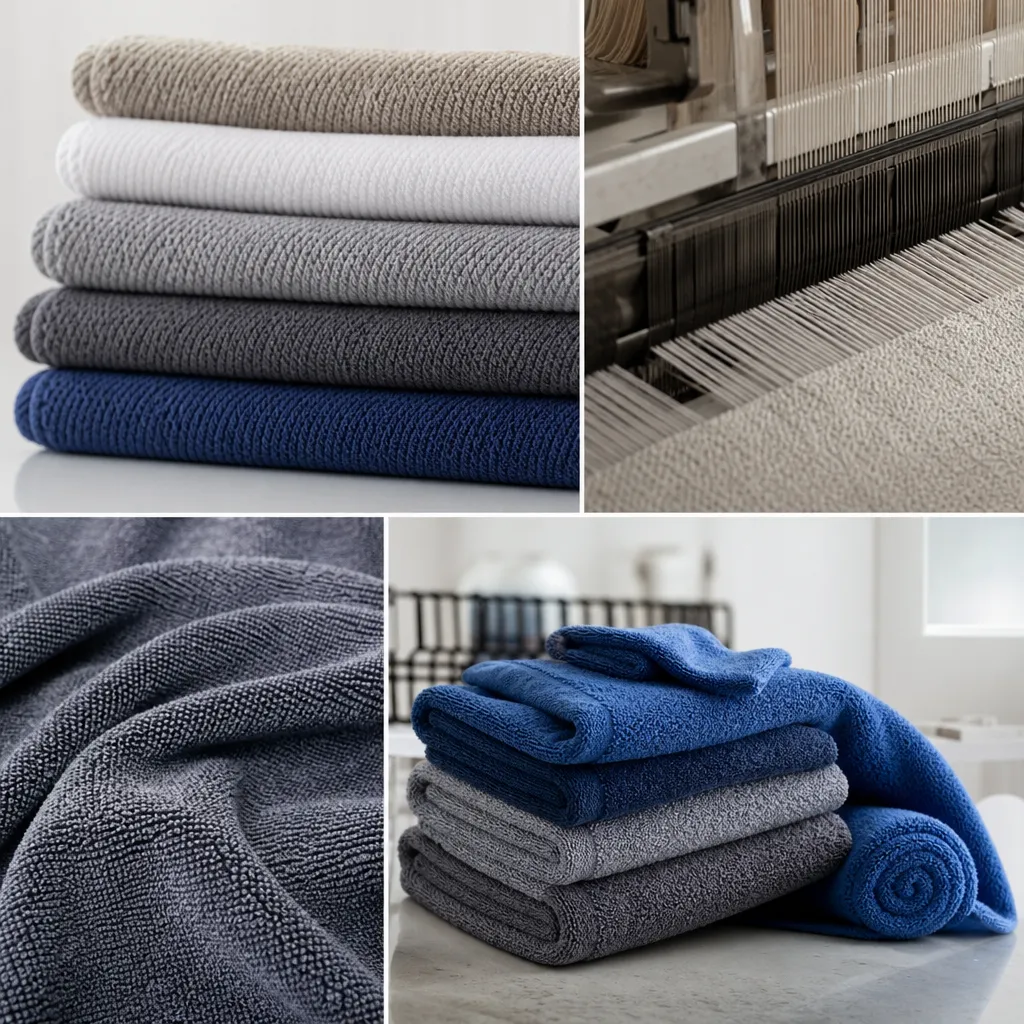
What Makes the Best Car Drying Towel Different
For paintwork, the towel must remove water quickly without leaving lint, streaks, or pressure marks. In our factory, we treat this as a performance textile, not a general cleaning cloth. A normal 300-350 GSM multipurpose microfiber can wipe a dashboard, but it will usually saturate too fast on a full hood or roof panel.
The best car drying towel specification normally starts at 500 GSM and can run to 1,200 GSM depending on size and pile. Most serious detailing brands we supply sit in the 600-900 GSM range for retail drying towels and 450-650 GSM for car wash operator programs where towels are laundered daily and cost per wash matters more than gift-box handfeel.
- Absorption speed: water should pull into the pile within 2-4 seconds in a drop test, not bead on the surface.
- Glide: the towel should move over clear coat without the heavy grab that causes installers to press harder.
- Low lint: cut-pile towels must be brushed and vacuumed after cutting, while twisted loop towels need stable yarn loops that do not shed at the tip.
- Edge safety: stitched borders, ultrasonic cuts, or hidden-edge construction must not create a hard ridge.
- Wash recovery: after ISO 6330 laundering, the towel should regain loft without matting into flat patches.
For OEM programs, we ask buyers to define the use case before we quote: enthusiast retail, tunnel car wash, ceramic coating studio, dealership prep bay, or promotional kit. The same towel cannot be the lowest-cost giveaway and the highest-performing drying tool at the same time.
Pile Construction Comes First
Most failed drying towel projects fail at the pile decision. A towel can feel thick in hand yet still push water because the yarn loop is too dense, the microfiber split is poor, or the finishing process leaves softener residue. For car paint, we usually recommend either twisted loop microfiber or a dense dual-pile terry construction.
| Construction | Typical GSM | Best use | Factory caution |
|---|---|---|---|
| Twisted loop microfiber | 550-750 GSM | Fast drying of large panels, pro detailing, car wash retail packs | Loop height must be controlled; loose loops can snag on badges or trim |
| Dual-pile terry microfiber | 600-900 GSM | Retail detailing towels and safe final wipe after rinse | Very plush handfeel, but slower drying if pile is too compact |
| Waffle microfiber | 350-500 GSM | Glass, quick maintenance drying, motorcycle panels | Good capillary action, less impressive on a large wet SUV |
| Suede microfiber | 200-260 GSM | Coating leveling, interior screens, not primary drying | Too thin for full-body drying tasks |
Twisted loop construction is popular because the yarn has more channel structure. Water moves along the loop instead of sitting on the face. The production risk is loop stability. If the loop yarn is under-twisted, it can fuzz after cutting and washing. If it is over-twisted, the handfeel becomes rope-like and buyers complain that the towel feels rough even when the fiber is technically soft.
For a microfiber drying towel, we commonly use 80/20 polyester-polyamide for commercial cost control and 70/30 when the buyer wants a softer bite and higher absorbency. The 70/30 option usually adds USD 0.18-0.42 per piece depending on size and GSM, because polyamide is the more expensive part of the blend.
GSM, Size, and Finished Weight
GSM is useful only when tied to the finished size and construction. A 1,000 GSM towel sounds strong, but if it is 40 x 40 cm it may not dry a vehicle efficiently. A 600 GSM towel at 60 x 90 cm can hold more total water and cover panels faster.
For OEM quoting, we calculate the finished textile weight before decoration, hang tags, cartons, and polybags. For example, a 60 x 90 cm towel at 650 GSM has a fabric area of 0.54 square meters, so the fabric weight is about 351 g before allowance for edge binding and cutting loss. The packed piece may land closer to 370-385 g depending on edging and label.
| Finished size | Recommended GSM | Approx. towel weight | Buyer fit |
|---|---|---|---|
| 40 x 40 cm | 500-700 GSM | 80-112 g | Coating studios, mirrors, motorcycles, kit add-on |
| 50 x 80 cm | 600-800 GSM | 240-320 g | Retail drying towel, compact cars, dealership prep |
| 60 x 90 cm | 550-750 GSM | 297-405 g | Mainstream auto detailing towel for full vehicles |
| 70 x 100 cm | 500-700 GSM | 350-490 g | Large SUV towel, premium retail box, low-piece-count drying |
We push back when a buyer asks for a very large towel at very high GSM for the lowest retail price point. A 70 x 100 cm towel at 900 GSM looks impressive, but it weighs about 630 g before packing. Freight cost rises, drying time after laundering increases, and some users find it heavy once saturated. For many car wash towel programs, a 60 x 90 cm at 620-680 GSM is a more balanced spec.
Edges Decide Whether Paint Stays Safe
The border is small on the tech pack, but it is one of the easiest places to create a scratch risk. We have rejected batches where the microfiber face was correct but the polyester binding tape had a hard melted bead at the corner. On dark paint, that kind of edge can leave faint arcs if the user drags the towel under pressure.
- Hidden-edge stitching: best for retail detailing towels where paint safety is part of the brand promise.
- Microfiber suede binding: soft and stable, usually adds USD 0.05-0.11 per piece versus a basic overlock edge.
- Ultrasonic cut edge: clean look and low bulk, but the cutting temperature must be controlled so the rim does not become sharp.
- Overlock edge: acceptable for lower-cost utility towels, but less suitable for a best car drying towel claim unless the yarn and stitch density are carefully selected.
We normally test edges by rubbing them against a black acrylic inspection panel before washing and again after five wash cycles. It is not a substitute for a full laboratory abrasion test, but it catches the obvious production issue: a border that feels fine to fingers but marks glossy surfaces when wet.
Absorbency and Lint Tests We Actually Use
A sample towel can be made fluffy with finishing chemicals. That sample may absorb slowly because softener blocks the microfiber capillaries. Our QC team checks incoming yarn, greige fabric, and finished towels so the final sample does not behave differently from the production lot.
- Run a vertical wicking check on cut strips to see whether water climbs consistently through the pile.
- Use a 1 ml drop test on the towel face and record whether the drop disappears within the agreed window, usually 2-4 seconds for drying towels.
- Wash samples under ISO 6330 conditions, then tumble dry on a controlled setting to check shrinkage, pile recovery, and edge distortion.
- Rub the face and edge on a black inspection panel, then check lint and streaking under angled light.
- Check colorfastness to washing using ISO 105-C06 when the towel is dyed black, navy, red, or other high-risk shades.
For dark towels, crocking matters. A black towel that bleeds slightly in the first home wash can ruin a buyer's review score even if the towel dries well. We test dark shades more tightly because car care buyers often wash microfiber separately and notice dye transfer on pale utility towels.
Lint-free performance also depends on cutting and cleaning. After slitting, we use air blowing and vacuum removal before final folding. For cut-pile plush towels, this step is especially important. Twisted loop towels shed less when the yarn is stable, but loose fibers from cutting can still remain if the line runs too fast.
Decoration Without Hurting Performance
Decoration on a car drying towel should be restrained. A large embroidery patch on the drying face reduces usable area and can create drag. A heavy woven label at the corner can also become a scratch point if it flips under the towel.
| Branding method | Where we place it | MOQ impact | Performance note |
|---|---|---|---|
| Satin wash label | Corner seam | No change above 500 pcs per design/color | Lowest risk and simplest for compliance text |
| Woven brand tab | Short edge or hanging loop | Usually 500 pcs | Keep small, soft, and away from the main wiping path |
| Embroidery | Storage pouch or separate band, rarely towel face | Adds setup charge of USD 35-70 per logo | Thread can stiffen the contact area |
| Heat transfer logo | Pouch, header card, or non-contact corner | Works from 500 pcs if artwork is ready | Must be tested for wash cracking |
For buyers comparing decoration methods, our article on embroidery vs sublimation vs jacquard explains why some beautiful branding methods are wrong for a towel that touches clear coat. If the product is part of a larger auto care range, the safer route is often a clean towel plus a printed pouch or header card.
Price Bands by Volume
Pricing moves with fiber blend, GSM, size, dye color, edge finish, packing, and inspection level. The ranges below are realistic FOB China bands for custom OEM orders from our line, not retail prices. They assume microfiber drying towels with private label packaging and standard export cartons.
| Spec example | 500 pcs | 2,000 pcs | 8,000 pcs | 20,000 pcs |
|---|---|---|---|---|
| 50 x 80 cm, 600 GSM, 80/20, suede edge | USD 2.35-2.85 | USD 1.92-2.38 | USD 1.58-1.95 | USD 1.42-1.76 |
| 60 x 90 cm, 650 GSM, 80/20, hidden edge | USD 3.25-3.95 | USD 2.74-3.32 | USD 2.28-2.82 | USD 2.05-2.48 |
| 60 x 90 cm, 720 GSM, 70/30, premium pouch | USD 4.10-4.95 | USD 3.46-4.15 | USD 2.96-3.52 | USD 2.68-3.18 |
| 70 x 100 cm, 600 GSM, twisted loop, belly band | USD 4.35-5.25 | USD 3.70-4.48 | USD 3.15-3.82 | USD 2.86-3.40 |
The MOQ at LUMA & CO. TEXTILE is 500 pcs per design per color. For a single SKU launch, 500-1,000 pcs is enough to validate reviews and packaging. For a car wash chain or marketplace seller, 5,000-20,000 pcs gives better dye lot efficiency, carton utilization, and packaging unit cost.
A cheap 60 x 90 cm towel at USD 1.65 may look attractive on a spreadsheet, but if it loses absorbency after 12 washes, the cost per useful wash is about USD 0.14. A USD 2.55 towel that holds performance for 45 washes costs about USD 0.06 per useful wash. For professional wash bays using dozens of towels per day, the lower purchase price can be the more expensive operating choice.
Compliance, Certificates, and Factory Controls
For car care products, buyers sometimes assume certification is less important than for bath or baby textiles. We still recommend keeping the same discipline. Our mill is OEKO-TEX Standard 100 Class I certified, BSCI audited, and ISO 9001 certified. These do not automatically prove a towel will dry a vehicle well, but they give a controlled framework for chemicals, social compliance, and production records.
- OEKO-TEX Standard 100 Class I: useful when the towel may be handled frequently by consumers or packed in retail kits.
- BSCI: requested by European and North American importers that need social compliance records from the manufacturing site.
- ISO 9001: supports traceable inspection plans, corrective actions, batch records, and documented QC checkpoints.
- AQL inspection: common setting is AQL 2.5 for major defects and 4.0 for minor defects, adjusted for strict retail programs.
Common defects for this category include uneven pile height, shade variation between panels and edge binding, skipped stitches at rounded corners, lint after cutting, and carton compression that crushes loft. We include towel recovery checks after unpacking because very dense microfiber can look flat if cartons are overfilled.
For more background on microfiber behavior, see our microfiber vs cotton towel comparison and custom microfiber towels wholesale guide. Buyers building a wider detailing line may also find the auto-detailing microfiber towel program useful.
Sampling and Production Timing
A buyer can move quickly if the tech pack is complete. The slow part is usually not weaving or sewing; it is unclear approval of GSM, edge type, packaging, and color. For dyed microfiber, we also need enough time to confirm shade under D65 and store lighting because black, charcoal, and navy can shift visually under different lamps.
- Spec confirmation and quotation: 1-2 working days when size, GSM, blend, edge, and packing are clear.
- Lab dip or stock color approval: 3-6 days for custom dye; 1-2 days for stock black, grey, blue, or red options.
- Pre-production sample: 5-9 days for standard microfiber drying towel construction, longer if custom pouch printing is included.
- Bulk weaving, dyeing, cutting, sewing, and packing: 18-28 days after deposit and sample approval.
- Final inspection and export documents: 2-4 days depending on order size and buyer inspection requirements.
For ocean freight, add the shipping window separately. A small first order can move by air if the launch date is fixed, but towels are bulky. Air freight can easily add USD 0.65-1.40 per piece for larger drying towels. Our container vs air freight towel orders guide explains when the math becomes painful.
Tech Pack Details Buyers Should Lock
The cleanest quote comes from a complete tech pack. If we receive only a photo and the words "make the best car drying towel," we can estimate, but we cannot protect the buyer from later cost movement. A drying towel has too many variables hidden inside the handfeel.
- Finished size tolerance, usually +/-2 cm after washing for larger microfiber towels.
- Target GSM and acceptable range, for example 650 GSM +/-5%.
- Fiber blend, such as 80/20 or 70/30 polyester-polyamide, plus whether recycled polyester is required.
- Pile construction, loop height, single-sided or double-sided structure, and edge finish.
- Color standard using Pantone TPX, fabric swatch, or approved physical sample.
- Packaging: polybag, belly band, printed pouch, carton count, barcode, suffocation warning, and country-of-origin label.
- Testing expectations: ISO 6330 wash method, ISO 105-C06 colorfastness, lint check, and AQL level.
We covered the broader format in build a towel tech pack that mills can quote. For margin planning, pair it with negotiate towel MOQ without killing margin, because reducing MOQ by changing size or packaging is usually smarter than stripping performance out of the towel.
Our Practical Recommendation
For most DTC detailing brands launching one hero SKU, we would start with a 60 x 90 cm twisted loop microfiber towel at 620-700 GSM, 80/20 blend, hidden or suede edge, dark grey or teal dye, and a small woven tab placed away from the wiping face. That spec gives strong drying performance without creating a towel so heavy that freight and drying time become a complaint.
For a professional car wash group buying bulk car drying towels, we would lower the target to 500-600 GSM, keep the size around 50 x 80 cm or 60 x 80 cm, use durable 80/20 microfiber, and avoid expensive retail packaging. The towel will be washed harder and replaced on a schedule, so edge durability and lint control matter more than a luxury unboxing.
LUMA & CO. TEXTILE has 220 employees and has operated since 2007, producing about 2.4M towels annually for 80+ brand clients across 47 countries. For this category, our role is to help buyers choose a spec that survives real use: water, clear coat, detergents, tumble drying, storage bins, and impatient end users.
Related reads: towel GSM decision framework, microfiber cloth sourcing specs, and pantone color matching custom towels. For industry-specific programs, see auto detailing towels and our product range under promotional and custom towels.
Quote a Car Drying Towel Spec
Send size, GSM, edge type, color, packing, and target volume. MOQ is 500 pcs per design per color. WhatsApp: +86 13205717266. Email: [email protected].
Request OEM Quote →