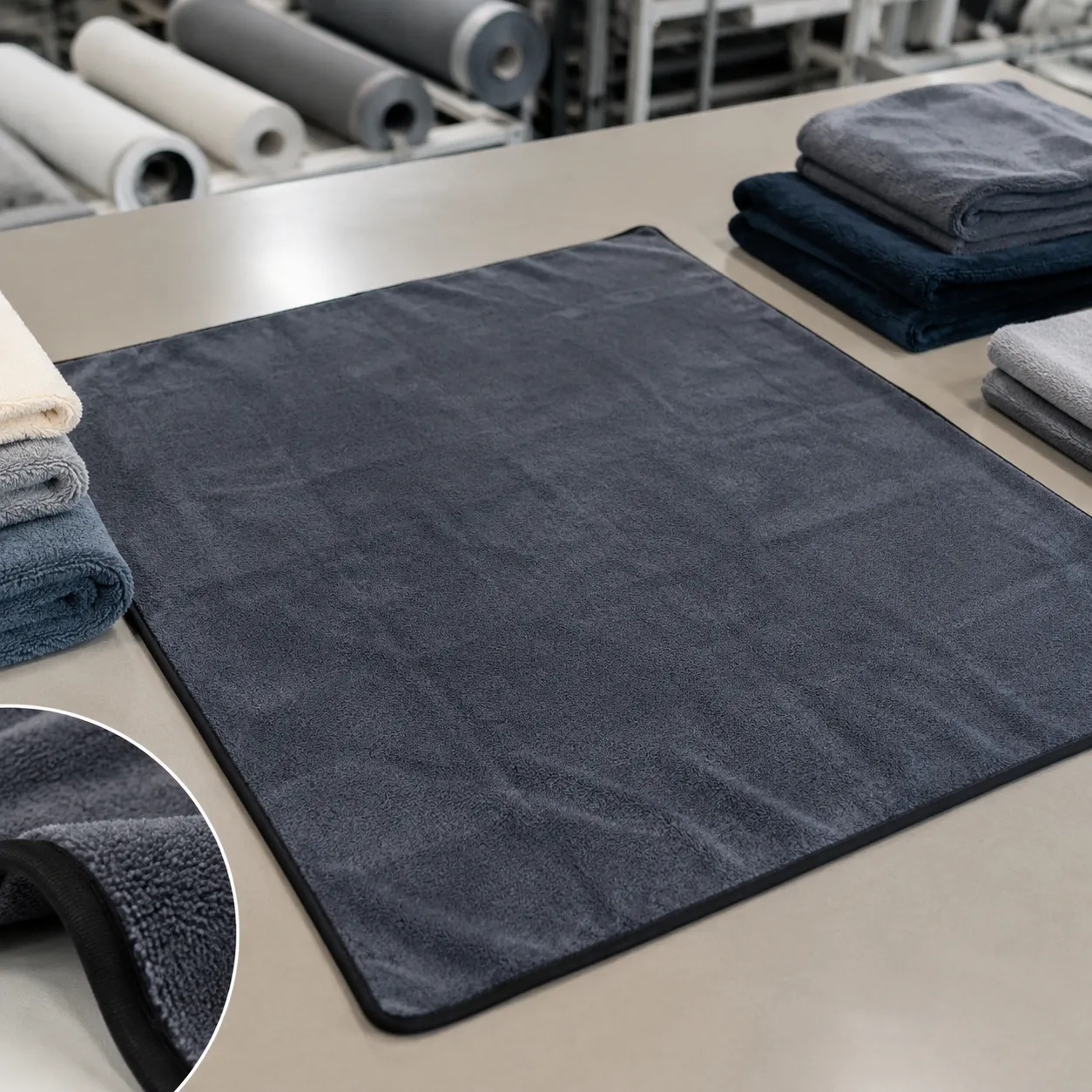
The size decision comes before the logo
For car drying, size changes the way the towel is used. A 30×30 cm cloth works for glass, mirrors, and interior trim, but it forces the user to rub the same wet area repeatedly on a hood or roof panel. That raises friction and increases the chance of dragging dust across clear coat. In our sampling room, the drying towels that perform best for retail kits and professional wash bays usually sit between 50×80 cm and 70×90 cm.
The buyer often asks for the largest possible towel because it looks generous on the shelf. We push back when the towel becomes heavy once saturated. A 90×120 cm twisted-loop towel at 1,000 GSM can hold impressive water, but a consumer may drop it on the ground after two panels because it becomes bulky. For most OEM programs, we prefer a towel that dries one mid-size sedan with one wring, not one that wins a catalog weight comparison.
| Use case | Common size | Recommended GSM | Construction note |
|---|---|---|---|
| Retail car drying towel | 60×80 cm | 650-850 GSM | Good shelf size, manageable wet weight |
| Professional wash bay towel | 70×90 cm | 750-950 GSM | Higher capacity, needs strong overlock or ultrasonic edge |
| Quick-detail trunk towel | 50×70 cm | 500-650 GSM | Folds easily, lower drying capacity |
| Motorcycle or glass drying towel | 40×60 cm | 420-600 GSM | Better control around curves and mirrors |
What makes a large microfiber towel for car drying work
A large microfiber towel for car drying needs split fiber, usable pile height, and a soft edge system. We normally use polyester/polyamide blends in 80/20 or 70/30 ratios. The 70/30 blend is more expensive because polyamide costs more, but it improves absorbency and hand feel. For drying towels, the difference is visible during the first pull across a wet panel: water should disappear into the towel instead of being pushed to the side.
For twisted loop microfiber, the pile is built from looped yarns that stand higher and create channels for water. This is different from short-pile all-purpose microfiber, which is good for polish removal but slower on rinse water. We also inspect the loop angle after dyeing and tumble finishing. If the loops collapse too much, the towel may still weigh 800 GSM but act like a flatter cloth.
- Blend: 80/20 polyester-polyamide for cost control; 70/30 for higher absorbency programs.
- Pile: twisted loop for drying, dual-pile for mixed drying and buffing, low pile only for glass or coating wipe-off.
- Edge: ultrasonic cut, microfiber binding, or true edgeless cut; avoid stiff polyester satin binding for paint contact.
- Label: woven side labels can scratch if placed on the wiping face; we recommend a tear-away label or corner hang tag.
- Color: charcoal, navy, and grey hide stains, but very dark shades require stricter crocking tests before bulk approval.
GSM is useful, but only after fabric geometry is fixed
GSM for microfiber towels is not the same as GSM for cotton towels. In cotton, more grams usually means more yarn in the towel. In microfiber, the same GSM can be built with different pile heights, base density, and finishing tension. Two towels at 800 GSM can behave differently if one has open twisted loops and the other has a compact plush face.
For an OEM car drying towel, we normally build first samples in two GSM options instead of one. A 60×80 cm towel at 700 GSM weighs about 336 g before packaging. At 850 GSM, the same size reaches about 408 g. That 72 g difference affects carton weight, freight cost, retail hangability, and wet handling. If the towel is sold in a kit with wash mitts and glass cloths, the lighter version may give better total margin.
| GSM range | Best fit | Main advantage | Main risk |
|---|---|---|---|
| 450-550 GSM | Compact drying or motorcycle kits | Lower unit cost and faster drying after wash | Not enough capacity for large cars |
| 600-750 GSM | Mainstream retail drying towel | Balanced absorbency, packing weight, and price | Needs good split fiber to avoid water streaking |
| 800-950 GSM | Professional detailing towel | High water pickup on first pass | Bulkier carton and higher wet weight |
| 1,000-1,200 GSM | Specialty oversized towel | Strong demonstration value | Can feel heavy and slow to dry after laundering |
Edges, labels, and seams cause more complaints than buyers expect
Paint-safe construction is not only about the center fabric. We see many towel failures at the edge. A thick bound edge can collect grit during washing. A narrow polyester tape can become harder after repeated tumble drying. If the user drags that edge across a soft clear coat, the center fabric is irrelevant.
For auto detailing towels wholesale programs, we usually present three edge options during sampling. Ultrasonic cut gives a clean, low-profile edge and is cost-effective for higher volume. Microfiber binding is more durable but must be soft and colorfast. Edgeless microfiber towel construction feels safest to many detailers, but it needs controlled cutting and lint removal, otherwise loose fibers appear after the first wash.
- Ultrasonic edge: low bulk, clean retail appearance, good for 600-850 GSM fabrics.
- Microfiber bound edge: stronger for heavy towels, but the binding material must be softer than the car paint contact area.
- Edgeless cut: softest feel, but requires vacuum lint removal and a higher sewing-room cleanliness standard.
- Round corner: reduces snagging at the corner and improves folding consistency for retail packs.
One defect we watch for is a raised weld bead on ultrasonic edges. It happens when blade temperature or line speed is wrong. The bead may be only 0.3-0.5 mm high, but it can feel sharp against the fingertip. Our QC team checks this by running the towel edge across a black acrylic test panel before shipment.
QC tests we run before bulk approval
A car drying towel must be checked differently from a gym towel or hotel bath towel. The buyer is not only worried about shrinkage and color; they also worry about lint, streaking, and paint contact. We include lab tests and practical handling checks because a towel can pass one and fail the other.
| Test or inspection | Method or setup | Our usual target | Why it matters |
|---|---|---|---|
| Absorbency speed | AATCC TM79 drop test, deionized water | Drop absorbed in 2-4 seconds after prewash | Shows whether split fiber is opening correctly |
| Colorfastness to washing | AATCC 61, 40°C accelerated wash | Grade 4 or above | Reduces dye bleed in mixed detailing kits |
| Crocking on dark colors | ISO 105-X12 dry and wet rub | Dry grade 4, wet grade 3-4 | Prevents transfer onto hands, trim, or other cloths |
| Lint screen check | Black glass panel, 20 straight wipes after tumble | No visible lint cluster larger than 1 mm | Catches cut-edge lint and weak pile release |
| Edge feel check | Finger drag plus acrylic panel pass | No hard bead or scratch trace | Verifies edge safety beyond lab numbers |
We are certified to ISO 9001, so every bulk order has incoming yarn checks, in-line inspection, and final AQL inspection. OEKO-TEX Standard 100 Class I is available for towels where buyers need skin-contact chemical assurance, even though car towels are not baby products. Our BSCI audit is useful for brand-side compliance files, especially for DTC retailers selling through larger marketplaces.
Logo placement: useful branding without ruining performance
For a car drying towel, we avoid heavy decoration on the wiping field. Embroidery looks strong on golf towels and spa towels, but dense stitches can create a hard patch on microfiber. If the towel is meant to touch paint, the safest logo methods are a printed belly band, woven hang tag, heat-transfer label on a non-wiping corner, or jacquard border if the construction allows it.
Sublimation is possible on polyester-rich microfiber, but it works better on flat or short-pile surfaces than on high twisted-loop drying fabric. A full-surface printed drying towel can look attractive in photos, but the print may slightly reduce absorbency if the finish is not controlled. We normally recommend printed packaging for branding and keep the towel body performance-focused.
- Place the main brand mark on a kraft belly band or recyclable sleeve.
- Use a small corner heat-transfer label only if it remains outside the primary wiping zone.
- Keep woven labels soft, narrow, and positioned at the corner seam.
- Avoid dense embroidery on the drying face unless the towel is for display rather than paint contact.
Related reads: for a broader decoration comparison, see embroidery vs sublimation vs jacquard. If you are building a retail auto kit rather than a single towel, our auto detailing microfiber towel program covers assortments, packing, and cloth roles.
Pricing bands, MOQ, and what changes the quote
Our MOQ is 500 pcs per design and per color. For microfiber drying towels, the quote changes with GSM, size, blend ratio, edge method, packaging, and carton requirements. The price difference between 80/20 and 70/30 blend is not cosmetic; polyamide content affects both absorbency and raw material cost.
| Specification example | 500-999 pcs | 1,000-2,999 pcs | 5,000+ pcs |
|---|---|---|---|
| 50×70 cm, 600 GSM, 80/20, ultrasonic edge | USD 2.05-2.45 | USD 1.72-2.08 | USD 1.46-1.78 |
| 60×80 cm, 750 GSM, 80/20, microfiber bound edge | USD 3.35-3.95 | USD 2.86-3.42 | USD 2.48-2.95 |
| 70×90 cm, 850 GSM, 70/30, edgeless finish | USD 5.10-5.90 | USD 4.38-5.05 | USD 3.82-4.45 |
| 60×90 cm, 900 GSM, 70/30, belly band packed | USD 4.95-5.65 | USD 4.22-4.88 | USD 3.68-4.26 |
A cheap towel can look attractive at purchase order stage but fail in cost-per-use. For example, a 60×80 cm drying towel at USD 2.58 that lasts 90 wash cycles costs about USD 0.029 per use. A lighter towel at USD 1.76 that loses pile and starts streaking after 32 washes costs about USD 0.055 per use. The cheaper invoice creates a higher working cost for a wash bay, and for retail it creates returns and poor reviews.
- Lowest cost lever: reduce size slightly before reducing split quality.
- Best durability lever: specify edge type and washing test instead of only GSM.
- Best retail lever: improve packaging and folding consistency rather than adding embroidery.
- Hidden freight lever: check carton CBM; oversized towels can create volume cost before they create weight cost.
Sampling and production timing from our mill
For a new microfiber drying towel, we need a tech pack or reference sample, target size, GSM, color, edge style, logo plan, packaging plan, and expected order volume. If the buyer only sends a marketplace link, we can still start, but the first sample round takes longer because we must reverse-engineer the practical specification.
- Spec confirmation and fabric selection: 1-2 working days.
- Lab dip for custom color: 4-6 days, longer for deep navy, black, or saturated red.
- Prototype sample: 6-9 days after fabric and edge decision.
- Buyer review and adjustment: usually 3-7 days depending on wash testing.
- Bulk production: 18-28 days after deposit and sample approval for standard microfiber colors.
- Final inspection, packing, and export documents: 3-5 days.
For repeat programs, we hold approved construction records in our ISO 9001 system: fabric code, blend, GSM tolerance, edge setting, packing method, carton count, and approved color standard. That is how we keep the second and third reorder from drifting away from the first approved lot.
Related reads: if you are comparing cloth types across a full line, read microfiber vs cotton towel comparison and custom microfiber towels wholesale guide. For freight planning, container vs air freight towel orders explains why bulky towel cartons change landed cost.
Packing choices for retail, wash bays, and kits
Packing is not just presentation. A high-pile drying towel compressed too tightly in a vacuum bag may recover, but the first touch can feel flat. For retail, we prefer a folded towel with belly band, paper sleeve, or recyclable polybag with warning text. For professional wash bays, bulk cartons with 25 or 50 pcs per inner pack are easier to count and issue.
- Retail single: folded to show pile face, belly band, barcode sticker, optional care card.
- Detailing kit: towel grouped with wash mitt, glass cloth, and applicator; each item separated to avoid dye transfer.
- Professional bulk: 25 pcs per inner polybag, carton label by color and GSM, no retail sleeve.
- Marketplace FBA: individual barcode, suffocation warning when required, drop-test carton strength reviewed before shipment.
Care instructions should be printed clearly. We recommend wash before first use, no fabric softener, no bleach, low tumble dry, and separate washing from cotton lint products. Fabric softener blocks microfiber channels. Cotton lint contaminates the pile and makes the towel appear defective even when the base fabric is correct.
What we need to quote accurately
A clear request saves several days. For a large microfiber towel for car programs, we need more than a target price. We need the surface the towel will touch, the user type, the expected wash life, and the sales channel. A towel for a professional ceramic coating studio should not be built the same way as a promotional trunk towel sold with car shampoo.
Send us the intended size, GSM range, blend preference, edge type, color, logo method, packaging format, destination country, and first order quantity. If you already have a towel you like, ship one sample to us or provide measured weight and close photos of the edge, pile, and label. We will mark what can be improved and what should not be changed just to cut cost.
LUMA & CO. TEXTILE has produced towels since 2007, with 220 employees and annual output around 2.4 million pieces. We supply more than 80 brand clients in 47 countries. For OEM microfiber towel programs, our minimum order is 500 pcs per design and per color, with OEKO-TEX Standard 100 Class I, BSCI, and ISO 9001 documentation available for compliant programs.
Build a scratch-safe microfiber drying towel
Send your target size, GSM, edge type, color, packing plan, and order volume. We will return a practical OEM specification and price band. WhatsApp: +86 13384590853. Email: [email protected].
Request a quote →