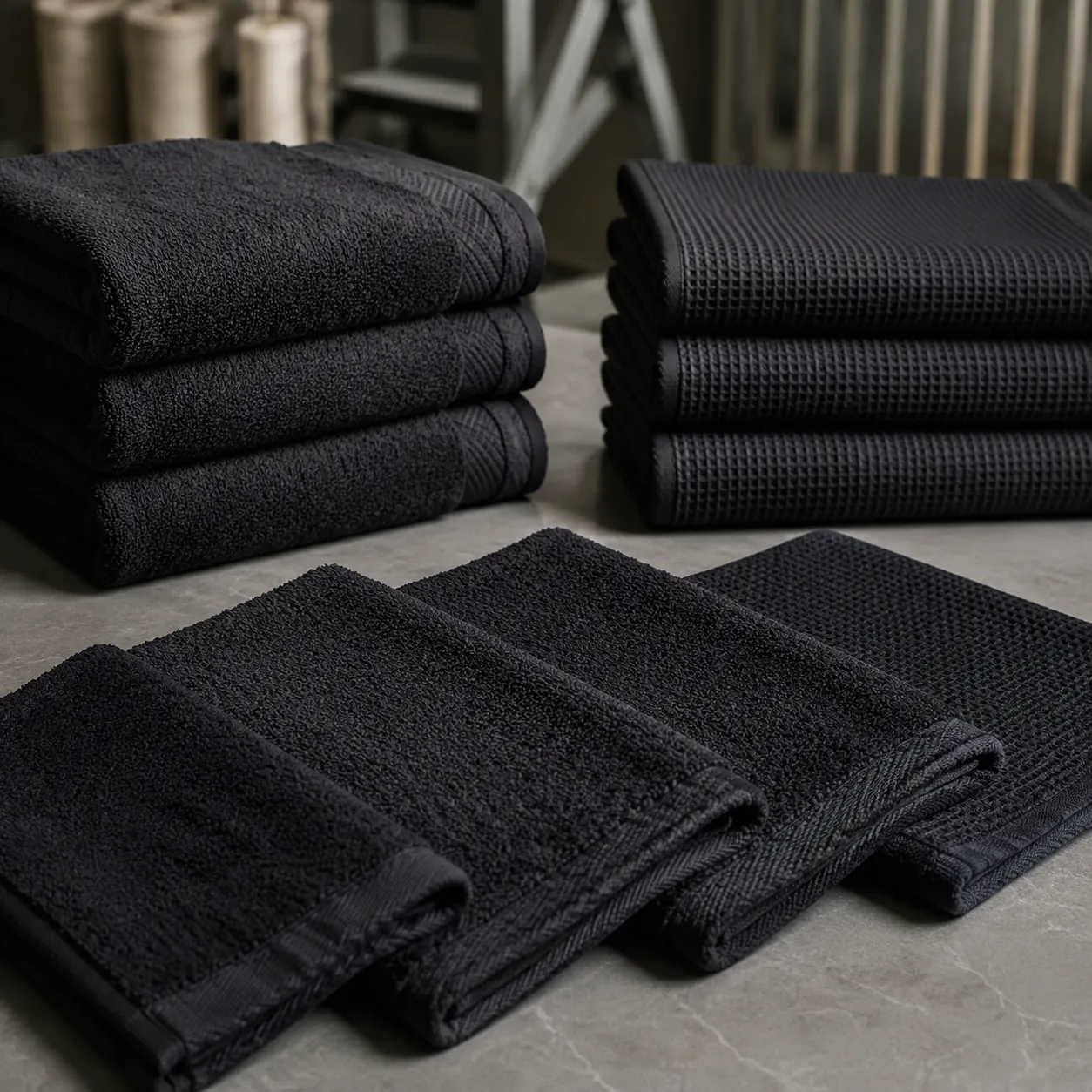
Start With the Chemical Exposure, Not the Color Card
Most salon towel RFQs arrive with a short line: black, bleach proof, 40×70 cm, 400 GSM. That is enough for a rough estimate, but not enough for a towel that survives developer, toner, and salon laundry. A hair salon towel does not fail like a hotel towel. We see edge fading near the hem where wet towels are stacked, orange-brown spotting from oxidizer droplets, and stiff hand feel when alkaline color cream is not rinsed before washing.
In our Gaoyang production flow, we treat salon towels as a chemical-resistance program. The cost is shaped by dyestuff selection, after-treatment, bath ratio, drying loss, and extra inspection. For black and charcoal salon towels, a standard reactive dye route can look correct at shipment but show coppery marks after a few weeks beside a color station. For higher-risk accounts, we quote vat dye or sulfur-vat combination methods, then validate them before bulk cutting.
- Oxidizer contact: 6%, 9%, or 12% hydrogen peroxide developer gives different fading behavior.
- Alkaline residue: ammonia-based color cream raises pH and can accelerate shade change during hot washing.
- Laundry chemistry: chlorine bleach, oxygen bleach, and quaternary disinfectants do not attack dye in the same way.
- Towel storage: damp black towels stacked for 8-12 hours show more localized marks than towels rinsed quickly.
- Decoration choice: embroidery thread may hold color while the ground fabric shifts, making fading more visible.
How Our Salon Bleach Resistant Towel Bulk Pricing Model Is Built
The exact primary cost drivers are not mysterious, but they are often mixed together in supplier quotes. We separate base fabric, dye route, test handling, decoration, packing, and freight assumptions. That is the only way a buyer can compare a USD 0.94 towel against a USD 1.38 towel without discovering later that one was only colorfast to normal washing.
| Cost driver | Typical range | Factory note |
|---|---|---|
| Base cotton terry | 320-500 GSM | Salon hand towels usually sit at 350-430 GSM; heavier bath sizes add drying cost in laundry. |
| Dye process | Reactive, sulfur, vat, or blend route | Vat dye adds cost but gives better oxidizer resistance on dark shades. |
| Peroxide resistance screening | 1-3 lab rounds | Each failed shade adjustment adds 2-4 working days before lab dip approval. |
| Cutting and sewing | Plain hem or dobby border | Dense borders trap chemical residue; we prefer simpler hems for color rooms. |
| Decoration | None, woven label, embroidery | Embroidery is quoted by stitch count, usually 3,000-8,000 stitches for a salon logo. |
| Packing | Bulk polybag or retail band | Most salon distributors use 12 pcs/polybag and 120-180 pcs/carton depending on size. |
For black salon towels, the dye route can contribute more to the finished cost than a 40 GSM weight change. A 40×70 cm towel at 380 GSM uses roughly 106 g of fabric before process loss. After dyeing, drying, cutting loss, and sewing allowance, the practical cost difference between a normal black and an oxidizer-resistant black can exceed the cotton weight difference between 360 and 400 GSM.
Realistic Bulk Price Bands by Quantity
The bands below are FOB China estimates for cotton salon hand towels in common dark shades. They assume our MOQ of 500 pcs per design per color, OEKO-TEX Standard 100 Class I compliant inputs, BSCI-audited production, and ISO 9001 process control. Prices move with cotton, dye market, carton specification, and exchange rate, so we use them for sourcing decisions rather than fixed public quotations.
| Specification | 500 pcs | 1,500 pcs | 5,000 pcs | 10,000 pcs |
|---|---|---|---|---|
| 40×70 cm, 340 GSM, reactive dark shade | USD 0.82-1.02 | USD 0.68-0.86 | USD 0.59-0.74 | USD 0.55-0.69 |
| 40×70 cm, 380 GSM, vat-dyed black | USD 1.18-1.48 | USD 0.98-1.24 | USD 0.86-1.08 | USD 0.80-1.00 |
| 45×90 cm, 400 GSM, vat-dyed charcoal | USD 1.72-2.18 | USD 1.46-1.82 | USD 1.28-1.58 | USD 1.19-1.46 |
| 50×100 cm, 430 GSM, salon backwash towel | USD 2.38-3.05 | USD 2.05-2.58 | USD 1.82-2.25 | USD 1.68-2.08 |
A salon chain recently asked us to match a low-cost 40×70 cm black towel used in a promotional opening kit. The cheaper towel was 310 GSM with normal reactive dye. It looked acceptable in the carton, but the trial salon discarded 31 towels from 240 pcs after six weeks because the orange spotting looked dirty in guest areas. The replacement spec was 380 GSM vat-dyed black at about USD 0.37 more per piece at 3,000 pcs. Over an estimated 95 usable wash cycles, the towel cost rose by less than half a cent per use while visible discard dropped sharply during the pilot.
Testing Detail We Require Before Confirming Price
We do not label a towel bleach resistant because the fabric survived one quick dip. For salon use, we run two screening paths: peroxide exposure for hair developer and wash colorfastness for laundry. These are not a substitute for a buyer's in-salon trial, but they stop weak dye lots before bulk production.
| Test area | Method we reference | Practical setup for salon towels | Pass target |
|---|---|---|---|
| Washing colorfastness | ISO 105-C06, A2S or B2S depending on wash temperature | Multifiber adjacent fabric, 4 g/L ECE reference detergent, steel balls where required, 40-50°C wash bath | Color change grade 4 minimum; staining grade 4 minimum for dark shades |
| Rubbing fastness | ISO 105-X12 | Dry and wet crocking on dyed towel face and hem border | Dry grade 4; wet grade 3-4 or better |
| Peroxide spot exposure | Internal method based on controlled H2O2 contact | Drops of 6%, 9%, and 12% hydrogen peroxide developer placed on conditioned fabric for 30 minutes, then rinsed and dried flat | No obvious orange ring at 9%; limited shade change accepted only if buyer signs range board |
| Accelerated salon wash trial | Internal 20-cycle protocol | Domestic or industrial washer at 60°C, oxygen bleach detergent at supplier-stated dose, tumble dry medium, visual check every 5 cycles | No patchy fading, seam distortion under 3%, and towel remains usable by agreed appearance standard |
For peroxide exposure, we condition samples for at least 4 hours at standard room conditions before testing, then compare against an unexposed control under D65 light. We photograph the control, 6%, 9%, and 12% zones on the same card. This matters because a black towel can pass a casual warehouse view yet show reddish halos under salon LED lighting.
For wash cycles, we avoid vague claims such as "50 washes guaranteed" unless the wash chemistry is defined. A 40°C mild detergent cycle is not the same as a 60°C oxygen bleach cycle with high alkalinity. If your laundry uses chlorine bleach, we say that directly: cotton dark shades will not remain black under repeated sodium hypochlorite exposure. In that case, we discuss white towels, lighter heather shades, or a replacement calendar rather than pretending chemistry can be negotiated.
GSM and Size Choices That Change the Invoice
Salon operators often over-spec GSM because they associate weight with durability. Weight helps absorbency, but it also increases drying time and freight. For chemical service, dye stability and rinse behavior usually matter more than moving from 400 to 500 GSM.
| Use point | Common size | Recommended GSM | Why we quote it this way |
|---|---|---|---|
| Color station hand towel | 35×75 cm or 40×70 cm | 340-400 GSM | Fast turnover, easy hand handling, lower laundry load |
| Backwash neck towel | 40×90 cm or 45×90 cm | 380-430 GSM | More coverage without becoming slow to dry |
| Shoulder protection towel | 50×100 cm | 400-460 GSM | Needs drape and absorption, but not hotel bath-towel bulk |
| Retail take-home salon towel | 50×100 cm or 70×140 cm | 450-550 GSM | Hand feel and perceived value matter more than laundry speed |
If a distributor asks for one towel to cover shampoo bowls, color stations, and retail gifting, we usually push back. A 50×100 cm 460 GSM towel may feel substantial, but it is inefficient for a stylist wiping tools every few minutes. A mixed program can cost less overall: 70% of units in 40×70 cm, 20% in 45×90 cm, and 10% in a larger guest-facing size. The landed carton count becomes cleaner, and the salon is not laundering oversized pieces for small spills.
Dye Route Trade-Offs for Dark Salon Towels
For black salon towels in bulk, color chemistry is the line item most buyers under-read. Reactive dyes are common for cotton terry because they give a clean shade and good wash fastness. They are not automatically strong against oxidizer spotting. Vat dyes cost more and require tighter process control, but they are the route we prefer when a buyer expects contact with developer and lightener.
- Reactive black: economical and acceptable for barbers, spas, or salons that separate color-service towels.
- Sulfur black: cost-effective for deep shades, but odor control and after-washing must be managed carefully.
- Vat black: stronger for oxidizer exposure, with higher dyeing cost and longer lab approval.
- Charcoal or graphite: often hides minor shade movement better than blue-black.
- White cotton: safest under chlorine bleach, but stains from toner and color cream remain visible.
The construction also matters. A dense dobby stripe can hold chemical residue along the border. A bulky zero-twist yarn feels soft but can snag more easily around clips and brush handles. For salon service towels, combed ring-spun cotton in a moderate twist is a safer balance. If you are comparing yarn options, our note on combed versus zero-twist cotton explains why hotel softness does not always fit chemical work.
Where MOQ Helps and Where It Does Not
Our standard MOQ is 500 pcs per design per color. That is workable for one salon, a distributor test, or a first private-label run. MOQ helps spread sample dyeing, lab dips, carton printing, and setup. It does not remove the need for a stable dye bath. Very small dark-color lots are harder to control because shade correction has less room for adjustment.
- Confirm the towel role: color station, backwash, shoulder cover, retail, or mixed program.
- Select a chemical-risk level: normal dark towel, peroxide-resistant dark towel, or chlorine-tolerant white towel.
- Approve lab dip under D65 and salon-style lighting, not only office lighting.
- Run peroxide spots and 10-20 wash cycles before bulk if the towel will touch developer.
- Lock carton packout after size and GSM are fixed, because freight math changes quickly.
For 500-1,000 pcs, private label extras can distort the unit price. A woven label, belly band, or printed insert may add USD 0.05-0.18 per towel when spread over a small run. At 5,000 pcs, the same items become easier to absorb. Buyers working near MOQ should spend budget first on dye route and testing, then decide whether retail packaging is necessary.
Related reads: if you are building a broader salon linen program, start with our bleach and colorfastness notes in salon towels wholesale bleach proof. For size decisions across hand, face, and bath formats, use towel sizes and dimensions before you issue the RFQ. Buyers comparing cotton with quick-dry synthetics can also review microfiber versus cotton towels.
Production Timing From Lab Dip to Carton Close
A salon bleach resistant towel bulk pricing model should include time, because rushed approvals create expensive rework. A normal dark towel may move faster than a peroxide-resistant black, but we still prefer to test before deposit balance is due. For repeat orders using an approved shade and construction, the schedule shortens because lab dip and trial data already exist.
- Tech pack review: 1-2 working days for size, GSM, color, label, and packout check.
- Lab dip and dye-route proposal: 4-7 working days for reactive shades; 7-12 working days for vat-dyed black or charcoal.
- Sample towel production: 6-10 working days after lab dip approval, depending on yarn and loom availability.
- Testing window: 5-12 working days for peroxide spot review and 10-20 wash-cycle screening.
- Bulk production: 22-35 working days after sample approval and deposit for 500-10,000 pcs.
- Export documentation and loading: 3-6 working days for carton marking, packing list, invoice, and booking coordination.
Air freight can rescue an opening date, but towels are dense cargo. For a 5,000 pc order of 40×70 cm 380 GSM towels packed 150 pcs per carton, the shipment may use around 34 cartons before outer carton variation. Air freight can cost more than the dye upgrade itself. If timing is tight, we suggest approving a smaller air batch for launch and sending the balance by sea. Our freight article on container versus air freight towel orders gives the broader math.
Quote Lines We Ask Buyers to Lock
Clean RFQ lines prevent price drift. If the request only says "bleach resistant black towel," three factories may quote three different products: a normal black cotton towel, a vat-dyed towel tested against peroxide, or a white towel that tolerates chlorine bleach. Those are not comparable.
- Fiber and yarn: 100% cotton, combed ring-spun, or agreed blend if quick drying is required.
- Finished size tolerance: usually ±3% after washing for salon towels.
- GSM target and tolerance: for example 380 GSM ±5%, measured after finishing.
- Color standard: Pantone reference plus approved lab dip and tolerance range.
- Chemical test: specify peroxide percentage, contact time, wash temperature, and detergent type.
- Compliance: OEKO-TEX Standard 100 Class I, BSCI audit availability, and ISO 9001 production controls.
- Packout: pieces per polybag, pieces per carton, carton marks, barcode need, and pallet requirement.
If your brand team needs exact shade control, link the color standard to a physical approval, not only a screen value. Our guide to Pantone color matching for custom towels explains where terry pile, lighting, and dye chemistry change the visual result. For certification checks, procurement teams can use how to read an OEKO-TEX certificate so the certificate scope matches the towel category and supplier.
A Practical Buying Position for Salon Chains
For multi-location salons, we usually recommend one controlled core towel instead of chasing the lowest unit quote each season. A 40×70 cm 370-400 GSM vat-dyed black or graphite towel, bulk packed, with a 20-cycle wash screen gives a stable baseline. Add a 45×90 cm backwash size only if the operation truly needs it. Keep embroidery away from high-chemical wipe towels unless the logo must be visible to guests.
For distributors, the better commercial setup is often two SKUs: an economical dark towel for general salon use and a tested peroxide-resistant towel for color-heavy accounts. That lets sales teams explain the price gap honestly. At LUMA & CO. TEXTILE, we manufacture from MOQ 500 pcs per design per color and scale to container programs; our annual towel output is about 2.4M pieces across hospitality, salon, spa, gym, beach, and promotional accounts in 47 countries.
A strong quote should tell you what the towel is designed to resist, what it is not designed to resist, and how that claim was checked. Once those points are clear, salon towel wholesale pricing becomes much easier to compare because the unit price is tied to a defined service life rather than a color name.
Price a Tested Salon Towel Program
Send your size, GSM, color-risk level, expected peroxide exposure, and order quantity. We can quote FOB pricing, sample timing, and test options. Contact us by WhatsApp at +86 13205717266 or email [email protected].
Request a Quote →