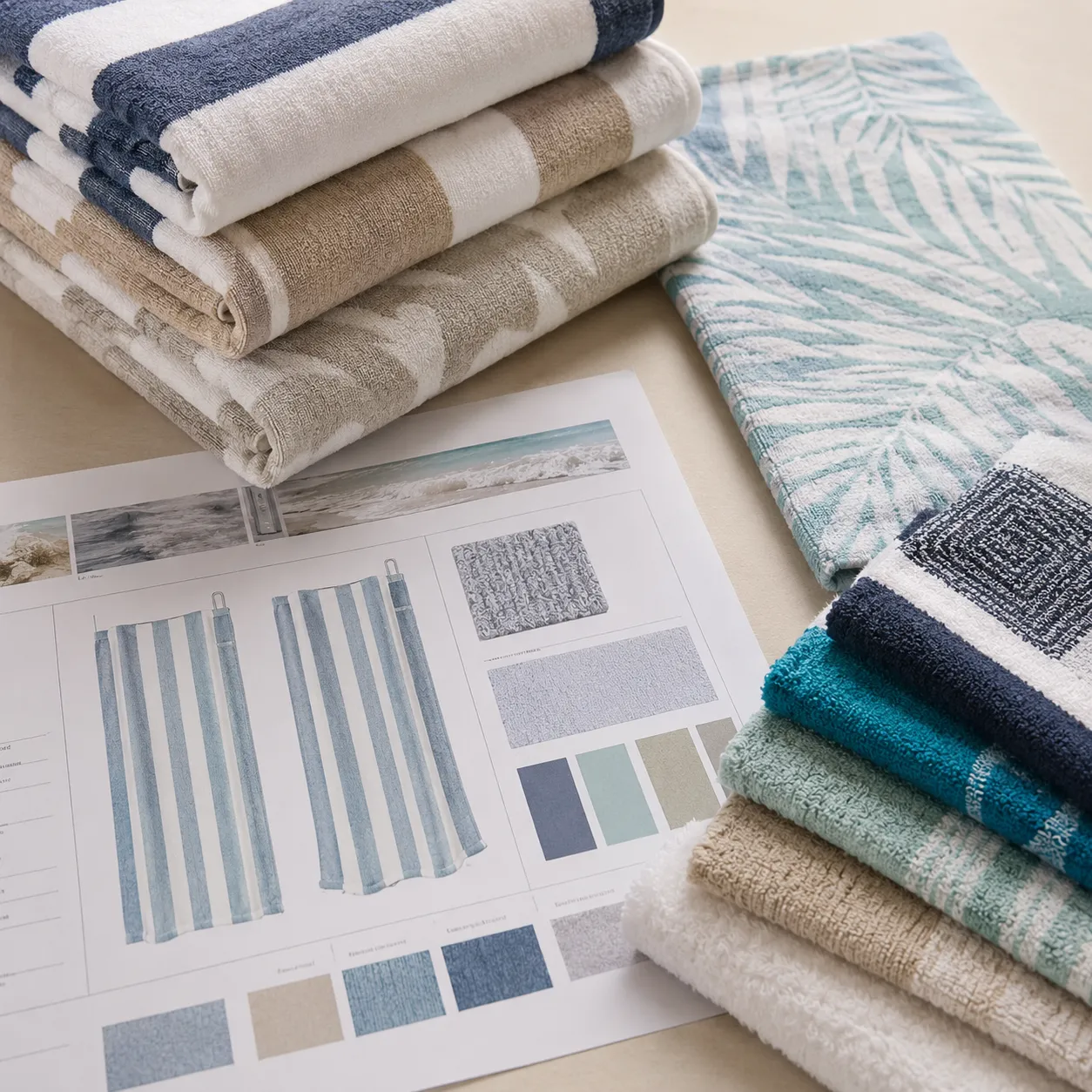
Why the TDS Comes Before Price
We can quote a rough beach towel from a photo, but we cannot lock a production price from it. At our mill in Gaoyang, we treat the technical data sheet as the working document between merchandising, weaving, dyeing, decoration, QC, and packing. If one line is missing, the risk usually appears later as color drift, weight shortage, logo distortion, carton overweight, or a bulk towel that feels thinner than the approved sample.
For beach programs, the gap between a loose request and a controlled spec is larger than many buyers expect. A 90 × 170 cm towel at 420 GSM uses about 643 g of fabric before allowance for hems and processing loss. Move the same towel to 520 GSM and the fabric mass becomes about 796 g. On 3,000 pcs, that GSM change adds roughly 459 kg of cotton terry fabric before waste. The price difference is not a rounding issue; it changes yarn purchase, dyeing load, drying time, carton count, and ocean freight.
A custom beach towel buyer technical data sheet should not read like a brochure. It should read like a production instruction. We want exact dimensions, tolerance, GSM after wash, yarn count, pile construction, color standard, decoration method, testing requirement, packing method, and inspection level. If the buyer cannot define one field yet, we mark it as a decision item before sampling.
| TDS field | What we need to see | Why it matters in production |
|---|---|---|
| Product size | Finished size in cm plus tolerance | Controls loom planning, cutting loss, carton volume, and pool chair fit |
| GSM basis | Target GSM after pre-production wash | Prevents approving a fluffy greige sample that drops weight after finishing |
| Yarn and pile | Cotton type, yarn count, pile height, single or double pile face | Changes absorbency, lint level, drying speed, and price |
| Decoration | Jacquard, reactive print, pigment print, embroidery, or woven label | Each method has different artwork, MOQ, setup cost, and wash risk |
| Testing | Colorfastness, dimensional change, absorbency, lint, and seam strength | Defines pass or fail before the bulk inspection argument starts |
| Packing | Fold, band, polybag, barcode, carton mark, and carton weight limit | Affects receiving speed, warehouse labor, and freight audit |
What a Custom Beach Towel Buyer Technical Data Sheet Must Control
The first page should control the towel itself, not the branding story. We recommend one SKU per line if size, color, GSM, or decoration changes. Buyers sometimes combine three colorways under one item code to keep the PO tidy, but that creates confusion when the blue towel is yarn-dyed jacquard and the ivory towel uses embroidery. If the production route changes, the TDS line should change too.
- Finished size: common resort sizes are 80 × 160 cm, 86 × 170 cm, 90 × 170 cm, and 100 × 180 cm. We usually set ±2 cm tolerance after washing for large beach towels.
- GSM target: promotional beach towels may sit at 320-380 GSM, resort pool programs at 420-500 GSM, and heavier retail styles at 520-650 GSM.
- Construction: define terry loop, velour sheared face, flat-woven hammam, or one-side velour with one-side terry. These are not interchangeable.
- Border and hem: specify dobby border width, side hem width, corner reinforcement, and whether the label is sewn into the short or long side.
- Shrinkage allowance: state whether size is measured before wash, after one wash, or after five wash cycles.
For a terry beach towel, the construction line is especially important. A one-side velour towel prints cleaner because the sheared face gives a flatter surface, but it absorbs less quickly on that side than open terry. A double terry towel is more absorbent and more stable for hotel laundry, but fine photo printing will not look as sharp. A flat hammam towel packs smaller and dries fast, but it does not deliver the thick poolside feel some guests expect. These trade-offs belong in the data sheet, not in late-stage email threads.
Related reads: if your team is still choosing the base fabric, compare turkish hammam beach towels, beach towels in bulk, and our towel GSM decision framework.
Size, GSM, and Weight Lines Buyers Often Miss
Beach towels create more weight surprises than bath towels because the surface area is large. Buyers may approve 500 GSM in a meeting without calculating the actual unit weight. We do that calculation before quoting because it tells us whether the towel can fit the requested carton limit, whether a retail shelf pack will be too bulky, and whether air freight is still realistic.
| Finished size | GSM | Approx. fabric weight per pc | Typical use case |
|---|---|---|---|
| 75 × 150 cm | 360 GSM | 405 g | Event giveaway, short-stay rental, low freight target |
| 80 × 160 cm | 430 GSM | 550 g | Beach club chair towel, mid-level resort pool |
| 86 × 170 cm | 480 GSM | 702 g | Hotel pool towel with stronger hand feel |
| 90 × 180 cm | 560 GSM | 907 g | Retail oversized beach towel or luxury cabana program |
| 100 × 180 cm | 620 GSM | 1116 g | Heavy retail towel where freight cost is accepted |
The table shows fabric weight only. Labels, hangtags, polybags, and moisture after finishing add small but real weight. For export cartons, we prefer to keep gross carton weight below 18-22 kg for manual warehouse handling. A 560 GSM oversized towel may need 12 pcs per carton, while a 360 GSM towel can often pack 24 pcs per carton. The TDS should therefore show unit weight and carton quantity together, not in separate documents.
For woven terry, we quote GSM as the finished target after normal finishing, not as theoretical loom weight. Dyeing, tumbling, shearing, and washing all affect the final hand feel and measured mass. Our internal tolerance is usually ±5% on GSM unless the buyer sets a tighter control, but tighter control can increase sorting cost and rejection risk. If a buyer asks for 500 GSM at the price of a 420 GSM towel, we show the cotton mass difference instead of pretending the mill can remove the cost.
Yarn, Pile, and Border Details
A beach towel spec sheet should name the yarn route. For cotton terry, common choices include 21s/2, 16s/1, 10s/1, or ring-spun combinations depending on thickness and target hand feel. Combed cotton reduces short fibers and lint, but it costs more than carded cotton. For a resort program that washes towels 80-120 times per season, the lint reduction and stronger hand often justify the difference.
Pile height also needs a number. If pile is too tall on a velour towel, shearing loss increases and the surface can show cloudy bands after printing. If pile is too short, the towel may pass weight but feel flat. For most printed cotton beach towels, we keep velour pile around 3.5-4.5 mm before shearing trials. For terry pool towels, loop height may sit closer to 4.5-6.0 mm depending on GSM and yarn count.
- Carded cotton: lower price, acceptable for basic promotional programs, more lint in early washes.
- Combed cotton: cleaner yarn, better for hotel and retail beach towels where wash life matters.
- Ring-spun yarn: stronger, smoother hand, useful when embroidery or dense jacquard stresses the ground fabric.
- Zero-twist cotton: soft hand but not our first choice for heavy beach club laundering because loops can snag more easily.
- Flat-woven cotton: lighter packout and fast drying, but a different product category from terry.
The border line is not decorative only. A wide dobby border can curl if the tension balance between ground and border is poor. Jacquard lettering near the border may distort if the design sits too close to the hem fold. For private label beach towels, we ask for at least 25 mm from the final hem edge to any critical logo or stripe alignment.
Decoration Data: Artwork Is Not Enough
Beach towel decoration has to survive sunlight, chlorine exposure, salt, sand abrasion, and repeated laundry. The TDS should define not only the logo file but also the decoration method, maximum color count, placement, size, thread or dyestuff standard, and wash test. We reject vague lines such as “logo as attached” because a 12 cm embroidered crest, a 60 cm jacquard wordmark, and full-surface reactive print all require different production routes.
| Decoration method | Best fit | Technical note to include in TDS |
|---|---|---|
| Yarn-dyed jacquard | Stripes, repeat logos, resort names woven into towel | Limit very small lettering; confirm reverse-side appearance and float length |
| Reactive print on velour | Full-color artwork with softer hand | Require fabric face, print size, colorfastness to washing ISO 105-C06 |
| Pigment print | Lower-cost graphics and event towels | Define hand-feel acceptance and crocking test ISO 105-X12 |
| Embroidery | Small club logos, monograms, retail personalization | State stitch count limit, backing type, placement tolerance ±5 mm |
| Woven label | Private label branding without changing towel face | Specify label size, fold type, seam location, and OEKO-TEX scope |
One topic-specific defect we watch closely is jacquard float snagging. If a logo uses thin diagonal strokes, the back side may create longer floats that catch on pool furniture or laundry equipment. We review the weave simulation before sample weaving and may thicken strokes by 1-2 warp ends to improve durability. For printed velour, a different issue appears: the sheared nap can make dark solid areas look directionally shaded if cutting and brushing are not controlled.
For artwork control, Pantone TCX or TPX references are better than RGB screenshots. We still build lab dips because cotton, microfiber, and yarn-dyed grounds do not reflect color the same way. If color accuracy is critical, connect the TDS to a signed physical standard and state the viewing condition, usually D65 light box assessment. For more on color standards, see Pantone color matching custom towels and embroidery vs sublimation vs jacquard.
Testing Standards and Pass-Fail Limits
A technical data sheet should convert expectations into testable limits. “Good colorfastness” is not a QC standard. For bulk orders, we prefer named methods and minimum ratings. LUMA & CO. TEXTILE holds OEKO-TEX Standard 100 Class I, BSCI, and ISO 9001 certification, but product testing still has to be defined per order because a white hotel pool towel and a navy printed retail beach towel fail in different ways.
| Test item | Common method | Practical beach towel target |
|---|---|---|
| Dimensional change | ISO 6330 wash, line or tumble dry as agreed | Within -5% length and width after 3 cycles unless special construction |
| Colorfastness to washing | ISO 105-C06 | Grade 4 color change, grade 3-4 staining for medium/dark shades |
| Colorfastness to rubbing | ISO 105-X12 | Dry grade 4, wet grade 3-4 for printed or dark dyed towels |
| Absorbency | AATCC 79 or internal drop test with agreed seconds | Water drop absorbed within 5 seconds for terry face after prewash |
| Seam strength | ISO 13935-2 adapted for hem seam check | No seam opening under agreed pull force; no skipped stitch chains |
| pH value | ISO 3071 | pH 6.0-8.0 for skin-contact towel programs |
Two beach-specific checks are worth adding. First, we run a chlorine spotting review for towels that will sit beside pools. It is not a full guarantee against bleach, but it shows whether a dark shade has obvious immediate discharge risk. Second, we check sand release after drying for dense velour styles. Some velour faces trap fine sand more than open terry, which matters for beach clubs where housekeeping shakes and launders hundreds of towels daily.
Inspection level should also be written. For export towel orders, many buyers use ANSI/ASQ Z1.4 or ISO 2859-1 sampling, general inspection level II, with AQL 2.5 for major defects and 4.0 for minor defects. Critical defects should be zero tolerance. Typical major defects include wrong size beyond tolerance, wrong logo placement, oil stain, broken hem, severe color shade difference, and barcode mismatch.
Sampling Workflow and Approval Records
We do not recommend jumping from artwork to bulk on beach towels, even at 500 pcs MOQ. The approved sample is the physical version of the custom beach towel buyer technical data sheet. If the sample and document disagree, bulk production will follow the latest signed record, not the memory of a video call.
- Buyer sends TDS draft, artwork file, Pantone references, target quantity, destination, and required delivery window.
- Our merchandising team checks missing fields and returns a quote assumption sheet within 1-2 working days.
- Lab dips or strike-offs are prepared in 5-9 days for dyed or printed color approval.
- Prototype sample is woven, dyed, decorated, washed, measured, and photographed in 10-16 days depending on construction.
- Buyer signs sample approval with tolerance notes, or requests one correction round before bulk PO release.
- Pre-production sample is pulled from bulk materials and kept as the inspection standard.
For jacquard beach towels, the first sample takes longer because the CAD weave file, yarn dye schedule, and loom setup must align. For printed velour, the critical approval is often the strike-off panel, not the sewn towel, because color behavior must be checked before committing full fabric width. Embroidery samples need stitch density review after washing; too many stitches can pucker the towel face or make the logo patch feel stiff against skin.
Our standard MOQ is 500 pcs per design per color. We can sometimes discuss a split, such as 300 pcs navy and 300 pcs sand under one design, but only if yarn, dyeing, label, and packing remain efficient. A TDS with five colors at 100 pcs each is usually more expensive per piece than buyers expect because setup work repeats while fabric efficiency drops.
Pricing Bands by Specification Level
A buyer technical data sheet does not only protect quality; it makes pricing honest. The same 86 × 170 cm beach towel can sit in very different price bands depending on GSM, yarn, decoration, label, and packing. The ranges below are realistic FOB China estimates for 2026, assuming standard export packing and no unusual licensing, testing lab surcharge, or rush air freight.
| Spec level | 500 pcs | 1,500 pcs | 5,000 pcs | What drives the price |
|---|---|---|---|---|
| Basic pigment print, 360-400 GSM | USD 4.10-5.35 | USD 3.45-4.60 | USD 2.95-3.80 | Lower cotton mass, simpler print setup, compact carton pack |
| Reactive printed velour, 420-480 GSM | USD 5.70-7.40 | USD 4.85-6.35 | USD 4.25-5.55 | Velour shearing, color control, higher finishing loss |
| Yarn-dyed jacquard, 450-520 GSM | USD 6.30-8.90 | USD 5.35-7.45 | USD 4.70-6.40 | Dyed yarn MOQ, loom setup, pattern efficiency |
| Combed cotton resort terry, 500-600 GSM with label | USD 7.20-10.60 | USD 6.10-8.85 | USD 5.35-7.60 | Cotton grade, unit weight, stronger hem and branded packing |
A practical cost-per-use example: a 430 GSM club towel at USD 4.75 that lasts 65 laundry cycles costs about USD 0.073 per use before laundry. A cheaper 330 GSM event towel at USD 3.35 that becomes too thin or distorted after 24 cycles costs about USD 0.140 per use. The low unit price saves USD 1.40 at purchase but can nearly double the textile cost per service cycle. That is why we push back when a buyer wants a long-life resort towel built to a one-week promotional spec.
Related reads: for commercial planning, use beach club resort towel program, chair towels lounger pool deck guide, and container vs air freight towel orders.
Lead Time, Packing, and Export Fields
Beach towel lead time depends on whether the towel is solid dyed, yarn dyed, printed, jacquard, or embroidered. A complete TDS shortens the calendar because we do not lose a week asking for barcode size, carton mark language, or whether the towel should be folded face-in. For seasonal resort launches, those small gaps are often the difference between vessel booking and air freight.
- TDS and quotation review: 1-3 working days if size, GSM, artwork, and destination are clear.
- Lab dip or print strike-off: 5-9 days for most cotton shades; neon and very dark colors may need an extra correction round.
- Prototype sample: 10-16 days for printed or embroidered towels, 14-22 days for jacquard or yarn-dyed stripe towels.
- Bulk production: 25-38 days after deposit and signed sample for 500-5,000 pcs; larger programs may run 40-55 days.
- Final inspection and packing: 2-5 days depending on SKU count, barcode scan requirement, and carton sorting.
Packing fields should be exact. For resort operations, bulk fold by color may be enough. For retail, the TDS needs belly band material, hangtag size, warning label language, UPC/EAN barcode position, polybag thickness, carton quantity, and gross weight limit. If towels go directly to a hotel group or beach club warehouse, carton marks should match their receiving format to avoid relabeling.
Our common export carton for mid-weight beach towels is 5-ply corrugated with inner poly liner. We use carton drop and compression checks internally when buyers request retail-grade packaging, especially for long ocean routes. For private-label beach towels, we also ask whether the outer carton can show factory information or must use neutral shipper marks. This affects compliance review and packing artwork timing.
Final Buyer Checklist Before PO
Before a PO is issued, the TDS should be locked by the buyer, sourcing office, and mill merchandiser. The custom beach towel buyer technical data sheet then becomes the document we attach to the order folder, sample tag, QC plan, and packing instruction. If a later change is needed, we revise the version number and confirm whether price or lead time moves.
- Confirm finished size, GSM after wash, yarn type, construction, border width, and hem tolerance.
- Attach vector artwork, Pantone references, logo placement diagram, and decoration method.
- Define test methods such as ISO 105-C06, ISO 105-X12, ISO 6330, ISO 3071, and inspection AQL.
- Approve physical sample, lab dip, strike-off, or pre-production sample with date and signer name.
- Lock MOQ at 500 pcs per design per color, or document any approved color split before deposit.
- List packing, barcode, carton mark, carton quantity, gross weight limit, destination port, and required ship date.
We are a 220-person towel mill operating since 2007, with about 2.4M towels produced annually for 80+ brand clients across 47 countries. Our certifications include OEKO-TEX Standard 100 Class I, BSCI, and ISO 9001. Those systems help, but the buyer document still has to be specific. Certifications do not tell the loom operator whether your stripe is 18 mm or 22 mm wide.
If you already have a tech pack, compare it with build towel tech pack that mills can quote. If you are still negotiating quantity, read negotiate towel MOQ without killing margin before reducing GSM or removing testing lines.
Send Us Your Beach Towel TDS
Share your draft spec, artwork, quantity, and target ship window. We will mark missing production fields and return a quote-ready version. WhatsApp: +86 13205717266. Email: [email protected].
Request TDS Review →