Start with the failure you are trying to prevent
For printed microfiber beach programs, the most expensive defects are usually not obvious in carton photos. Buyers notice obvious shade difference and sewing faults quickly, but claims often come later: towels that push water instead of absorbing it, sandy handfeel after the first wash, edges that torque after hotel laundry, or back-side whiteness showing through a dark face print. A useful inspection routine should therefore be built around failure modes, not a generic checklist.
The four defects we see trigger the highest rework and claim rates are: weak absorbency after heat transfer, print strike-through inconsistency on single-sided constructions, seam grin on low-density knitted bases, and carton count errors on mixed SKU shipments. Those are measurable. They should be tied to AQL 2.5 or 4.0 depending on the order class, documented against approved sample, and checked before final packing release.
| Failure mode | What the buyer sees | How to test it | Typical disposition |
|---|---|---|---|
| Poor absorbency | Water beads or smears across face | Timed drop or sink test after 1 wash | Hold shipment and review finishing bath |
| Print bleed or fuzzy edges | Logo edge not crisp at 1 m viewing | Visual against signed strike-off under D65 light | Sort and rework if localized |
| Edge waviness or torque | Towel will not lay flat on lounger | Flat measurement after conditioning | Re-press or reject lot if systematic |
| Carton mix-up | Wrong design or count at DC | Outer/inner barcode and count audit | 100% recount of affected lot |
Construction tells you where to inspect first
Most microfiber beach towels are not woven like cotton velour towels. They are typically warp knitted or circular knitted polyester/polyamide microfiber, then printed and cut-sewn. Common market constructions are 80/20 polyester-polyamide or 85/15 for tighter cost targets. Weight usually sits between 220 and 320 GSM for travel and promo use, and 300 to 380 GSM for fuller resort programs. At 160 × 80 cm, that means a realistic finished piece weight around 282 g to 486 g depending on construction, moisture regain, and hem allowance.
Inspection points change with the build. A suede-printed face with terry back needs back-pile uniformity and print penetration checks. A double-sided brushed towel needs stronger lint and shade controls because both faces are visible. If the buyer only says "microfiber printed beach towel" without face/back structure, the factory and inspector can easily check the wrong thing very thoroughly.
- Suede face + terry back: prioritize absorbency on back, print clarity on face, and face/back orientation in packing
- Double brushed knit: prioritize handfeel consistency, skew, and face shade because either side may be used
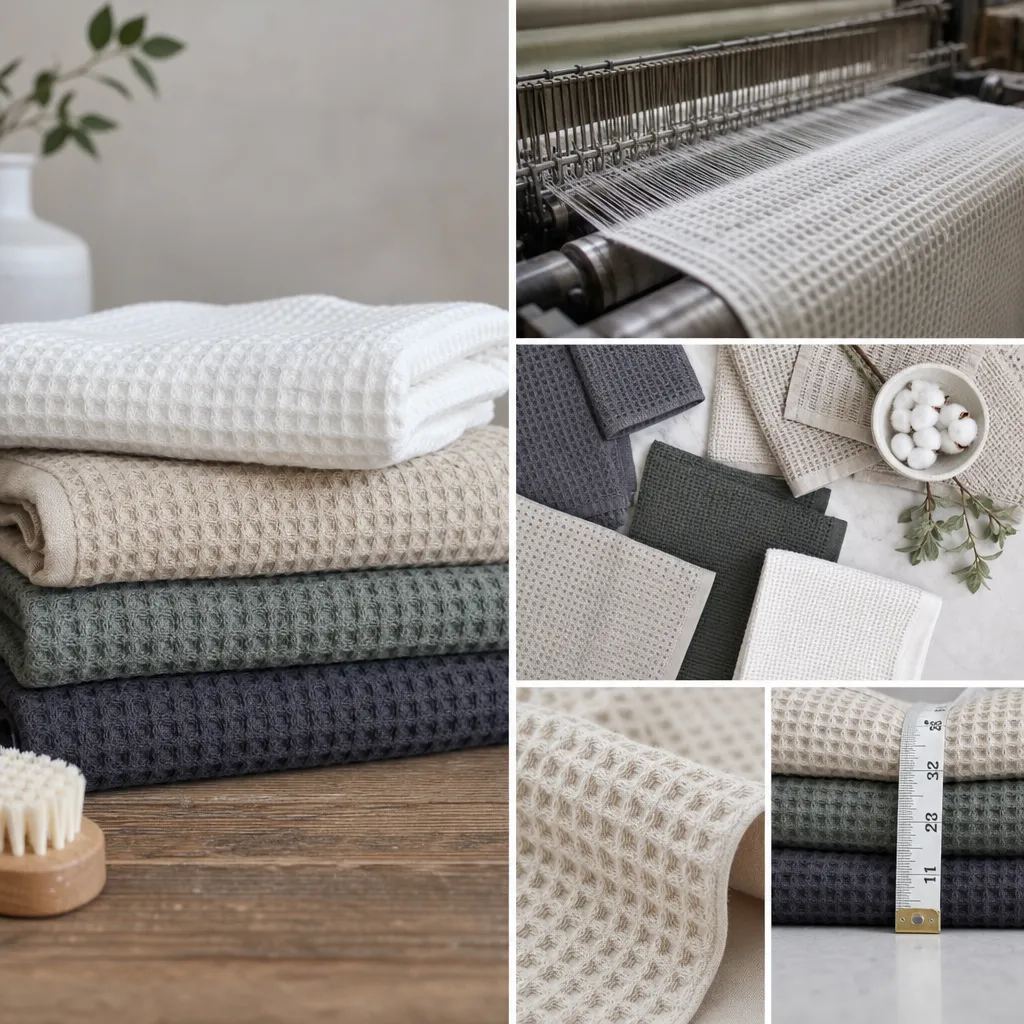
- Waffle microfiber beach towel: prioritize panel distortion and logo placement because cells stretch during cutting
- Recycled polyester blend: prioritize lot-to-lot shade and pilling because yarn source variation is higher
The inspection file should name standards, not preferences
Editors are right to reject articles that lean on vague in-house habits. Buyers need standards they can write into a PO or third-party inspection brief. For bulk towel programs, we typically align the inspection file with ISO 139 for conditioning before physical tests, ISO 105-C06 for domestic laundering colorfastness, ISO 105-X12 for rubbing fastness, and ISO 5077 for dimensional change after washing. For restricted substances, buyers usually request OEKO-TEX STANDARD 100 Class I or Class II depending on the end market, while social compliance audits often reference BSCI and management systems ISO 9001.
That does not mean every shipment needs a full laboratory package. It means the acceptance language should be anchored to recognized methods. If a shipment fails and the only note says "absorbency should be good," that argument goes nowhere. If the spec says "dimensional change max 5% after one wash per ISO 5077 sample method" you have a usable claim document.
| Control point | Standard or benchmark | Typical acceptance target |
|---|---|---|
| Conditioning before measurement | ISO 139 | Condition samples before dimension and weight checks |
| Colorfastness to washing | ISO 105-C06 | Grade 4 min on color change for standard shades |
| Colorfastness to rubbing | ISO 105-X12 | Dry 4 min, wet 3-4 depending on dark print |
| Dimensional stability | ISO 5077 | Within 3% to 5% depending on construction |
| Harmful substances | OEKO-TEX STANDARD 100 | Valid certificate scope matches product class |
Microfiber beach towels QC inspection guide: the absorbency section buyers should not skip
This is where many inspections fail because the towel looks excellent. Printed microfiber can show brilliant color and still underperform in use. The reason is technical: heavy face printing and some softener systems can lower capillary uptake on the contact surface. On suede-face towels, buyers also forget that the printed face is often not the best side for first-contact drying. If the end user expects a lounger towel only, that may be acceptable. If the towel is sold as swim-and-dry merchandise, it is not.
For incoming or pre-shipment checks, we recommend a simple absorbency sequence that can be repeated by the factory, the third-party inspector, and the buyer's receiving team. Condition the sample, wash one specimen once according to the agreed care instruction, then run the same timed drop test on both faces. Place a measured water droplet on the surface and record the time to disappear without smearing. On a well-finished terry-back microfiber towel, the absorbent face should usually wet out within about 4 to 9 seconds. A suede printed face may be slower, but if it sits as a bead beyond roughly 12 to 15 seconds after one wash, we would flag the lot for finishing review.
The second part is pickup, not just wetting. Weigh a dry specimen, immerse it briefly, hang for a fixed drain time, then reweigh. For resort-grade microfiber beach towels around 300 to 340 GSM, practical water pickup should be meaningfully above piece weight, often around 2.0 to 3.2 times specimen mass depending on structure. A towel can pass the droplet check and still feel weak in use if bulk pickup is low. That usually points to insufficient pile development on the back or too-flat brushing on both faces.
- Condition test specimens under standard atmosphere per ISO 139 before checking weight or dimensions
- Wash one specimen according to approved care label before final absorbency signoff
- Run timed wet-out on both faces because printed suede and terry back behave differently
- Record pickup by weight gain after fixed immersion and drain time
- Compare results with sealed approval sample, not only with a verbal expectation
Print inspection is more than matching Pantone
Most microfiber beach towels use sublimation for all-over designs because it handles gradients, photography, and low setup cost better than jacquard or embroidery. The quality risks are specific. The print can look saturated but still show ghosting around logos if transfer paper shifted. Fine black outlines can feather when knit stability is weak. Large dark panels can produce smile-shaped shade change near selvage areas because heat and pressure are not fully even across the blanket.
Inspectors should compare bulk against the signed strike-off or approval towel under controlled light, ideally D65. Random daylight at the warehouse door is not enough. Check face sharpness from normal viewing distance, then inspect 30 to 40 cm from the surface for saw-tooth edges, pin dots in solid areas, transfer creases, and white grin at folds. On single-sided constructions, turn the towel over and verify whether strike-through level matches the approved sample. A buyer may accept a pale reverse if the product page shows that clearly. If not, complaints follow.
- Ghosting: duplicate shadow image caused by transfer paper movement
- Blowout at edges: fine lines spread on unstable or over-heated knit
- Mottle in dark fields: uneven pressure or moisture during transfer cycle
- Reverse show-through mismatch: back appearance differs from signed approval sample
| Print defect | Likely cause | Best checkpoint |
|---|---|---|
| Ghosting | Paper shift during heat transfer | First-off production and random inline checks |
| Feathered outlines | Excess heat or fabric instability | Bulk print panel inspection before cutting |
| Banding across width | Uneven blanket pressure | Visual audit under D65 on full-open towel |
| Back too white | Insufficient penetration for approved standard | Approval sample comparison at final QC |
Sewing defects on microfiber are different from cotton towel defects
Microfiber knits shift more during cutting and hemming than dense cotton terry. That is why we pay close attention to edge tension, corner shape, and needle condition. A seam that looks acceptable on the table may wave after the first wash because the hem thread tension was too high relative to the knit recovery. Another recurring issue is needle heat glazing on dark shades, where the edge catches light differently and appears shiny.
A sharp sewing audit should measure lay-flat performance, not only stitch count. Open the towel fully on a flat table after conditioning. If opposite sides lift noticeably or corners twist, the towel will look poor on a lounger and fold badly at retail. Check hem width consistency too. For a 1 cm target hem, we usually accept a narrow tolerance, because visible variation around a print border makes the design look off-center even when the cut panel was correct.
- Missed stitches at corners where knit bulk changes
- Tunneling or puckering from over-tensioned lockstitch
- Corner radius mismatch on rounded-corner programs
- Shiny needle marks on deep navy or black microfiber
Dimension, GSM, and piece weight should be checked together
We see buyers request GSM only, then dispute towel weight after delivery. For cut-and-sew microfiber, GSM alone does not protect you because finishing and hemming affect finished-piece mass. A better control point is to verify fabric GSM on bulk panel, then verify finished dimensions and net piece weight on completed towels. If your resort spec is 90 × 180 cm at 280 GSM, and the finished towel arrives at 86 × 176 cm with narrow hems, the towel may still hit fabric GSM while missing end-use coverage.
For commercial orders, we suggest declaring three linked tolerances in the tech pack: cut size tolerance, finished size tolerance after wash, and piece weight tolerance per towel. This gives the inspector a clear path. Otherwise, a factory can defend a short towel by pointing to fabric weight, while the buyer is focused on lounger fit.
| Spec item | Common bulk range | Inspection note |
|---|---|---|
| Fabric GSM | 240-360 GSM | Check on conditioned fabric, not immediately off heat transfer |
| Finished size | 80 × 160 cm to 100 × 180 cm | Measure lay-flat on completed towel |
| Piece weight | 300 g to 620 g | Verify against approved construction and hem style |
| Shrinkage after wash | Up to 5% | Use agreed method and care cycle |
Carton audit matters because SKU errors are common on printed programs
Printed beach towel orders often run many artworks with the same base fabric. That raises the risk of carton mix-ups, especially when several designs are cut and sewn in parallel. A final QC that inspects product only, without carton reconciliation, misses one of the costliest failure modes for distributors and resort groups.
For mixed-SKU orders, the outer carton should show PO number, style, color or artwork code, size, quantity, gross and net weight, carton number, and country of origin. If cartons contain inner polybags or bundles, those markings should match the master label. Barcode scans help, but inspectors should still open selected cartons from each SKU. We have seen barcode labels printed correctly and applied to the wrong stacked bundle.
- Pull cartons from top, middle, and bottom pallet positions
- Verify artwork code against PO and packing list
- Count inners and loose pieces, not just closed bundle labels
- Check carton compression if sea freight stacking will exceed five layers
- Confirm moisture protection when shipping in humid season
Use AQL correctly for beach towel shipments
AQL is not a replacement for a good spec, but it keeps decisions consistent. For most custom towel programs, major defects are judged at AQL 2.5 and minor defects at AQL 4.0, with critical defects at zero tolerance. Wrong artwork, severe odor, mold, metal contamination, or major labeling non-compliance should sit in the critical bucket. Absorbency failure can be major or critical depending on the promised end use and claim risk.
If the order is 8,000 pieces packed across eight designs, do not let the inspection collapse into a single blended sample with one pass/fail result. Allocate sample pulls by SKU and by production lot where possible. One design printed on Monday and another printed on Thursday may have different transfer settings and different risk. AQL works best when the lot definition reflects how the goods were actually made.
The strongest pre-shipment reports are the ones that tie each defect to a sample photo, a measurable criterion, and a lot reference. That is what turns a disagreement into a decision.
What this inspection level costs and how long it adds
For sourcing teams building budgets, a practical quality plan is not expensive compared with a claim. Current FOB pricing for custom microfiber beach towels from China usually sits around USD 2.10 to 3.05 per piece for 80 × 160 cm at 250-280 GSM in 3,000 to 5,000 pcs quantities, rising to about USD 3.30 to 4.85 for 90 × 180 cm at 300-340 GSM with fuller print coverage and branded packing. Smaller 500-pc MOQ runs can carry a noticeable setup premium, especially if there are many artworks.
A third-party final random inspection often costs a small fraction of shipment value, while in-house pre-final checks add labor but reduce rework. Production lead time for a repeat microfiber print order is commonly 18 to 28 days after artwork and sample signoff. New programs with lab dips, strike-offs, and packaging mockups usually run 28 to 40 days. If absorbency and wash testing are included before bulk release, add about 3 to 5 days for sample preparation and evaluation.
| Order scenario | Typical FOB band | Lead time after approval |
|---|---|---|
| 500 pcs, one design, basic polybag | USD 3.75-5.10 | 24-34 days |
| 3,000 pcs, 80 × 160 cm, 260 GSM | USD 2.10-3.05 | 18-28 days |
| 5,000 pcs, 90 × 180 cm, 320 GSM | USD 3.30-4.85 | 22-32 days |
| 10,000 pcs, mixed artworks, retail insert | USD 2.45-4.20 | 26-40 days |
Related reads: if you are still building the specification before QC, start with build-towel-tech-pack-that-mills-can-quote, then compare decoration routes in embroidery-vs-sublimation-vs-jacquard, and review sea versus air timing in container-vs-air-freight-towel-orders.
A short buyer checklist for the PO and inspection brief
If you want fewer disputes, the PO should state exactly what the inspector is asked to judge. We suggest naming construction, face/back function, approved sample reference, test methods, packaging hierarchy, and lot definition. That sounds basic, but many claims happen because one of those six items was left implied.
- State fiber blend, structure, and whether the printed face is expected to dry effectively or mainly provide aesthetics
- Attach approval sample photos for face, back, hem, and packout
- Reference ISO 105-C06, ISO 105-X12, ISO 5077, and ISO 139 where relevant
- Set AQL levels for critical, major, and minor defects
- List carton markings and inner pack counts by SKU
- Require OEKO-TEX STANDARD 100 scope confirmation and note any BSCI or ISO 9001 document review
Related reads: for broader material trade-offs, see microfiber-vs-cotton-towel-comparison and towel-gsm-decision-framework. If the order is for a resort launch rather than one shipment, beach-club-resort-towel-program helps align replenishment and SKU planning.
Need a QC-ready microfiber towel quote
Send your artwork, target size, GSM, packout, and inspection standard. We will quote with MOQ, testing points, and a realistic production calendar.
Request quote →For OEM microfiber beach towel development and bulk inspection planning, contact us at [email protected] or WhatsApp +86 13205717266. Our MOQ is 500 pcs per design per color, and we can build the inspection brief around your approved sample and target market compliance.